Tron traders on alert! THIS make-or-break level will decide TRX’s next move

ambcryptoPublished on 2026-06-26Last updated on 2026-06-26

Abstract

Tron (TRX) traders are watching a key support level as the cryptocurrency, which has gained 13.44% year-to-date, approaches a potential turning point. The asset is testing a crucial support zone between $0.318 and $0.320, a level that has previously initiated two rallies. A bounce from this support, followed by a close above $0.334, could propel TRX toward $0.353 and $0.377. Conversely, a break below $0.310 would signal a bearish shift, indicating a steeper decline. While the chart shows fading momentum into support, technical indicators offer a more bullish perspective. Bollinger Band analysis suggests the middle band has held as support on recent touches, and the Money Flow Index reading of 65 indicates continued capital inflow. The immediate price action at this make-or-break support level will determine TRX's next significant move.

While most major cryptocurrencies have suffered significant outflows this year, Tron [TRX] has held a largely bullish posture—the asset has booked a 13.44% gain year-to-date, and that resilience is now about to be tested.

TRX is approaching a decisive level on its price chart, and how it reacts there will determine whether it holds its place among the year’s bullish performers or breaks down into a far steeper decline.

TRX nears the support level that defines its trend

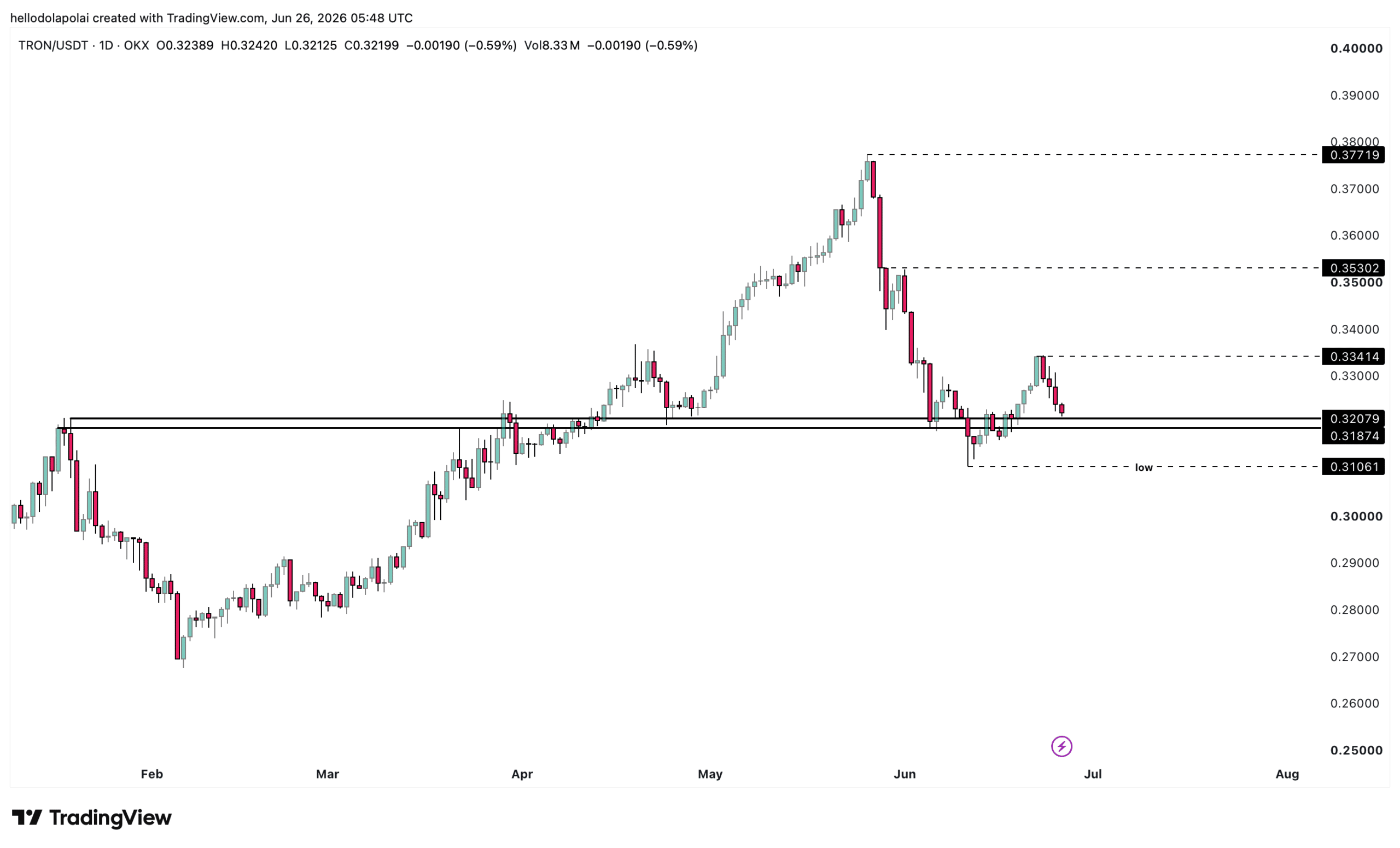
Chart analysis shows TRX bearing down on a key support level that will decide whether the asset can sustain its run. The token has shed 2% over the past day as it edges closer to that line.

This level has anchored two separate rallies, though the gains thinned noticeably as price ground back into support on the second attempt. Fading momentum into a level of this kind often signals that buying pressure there is weakening.
Source: TradingView

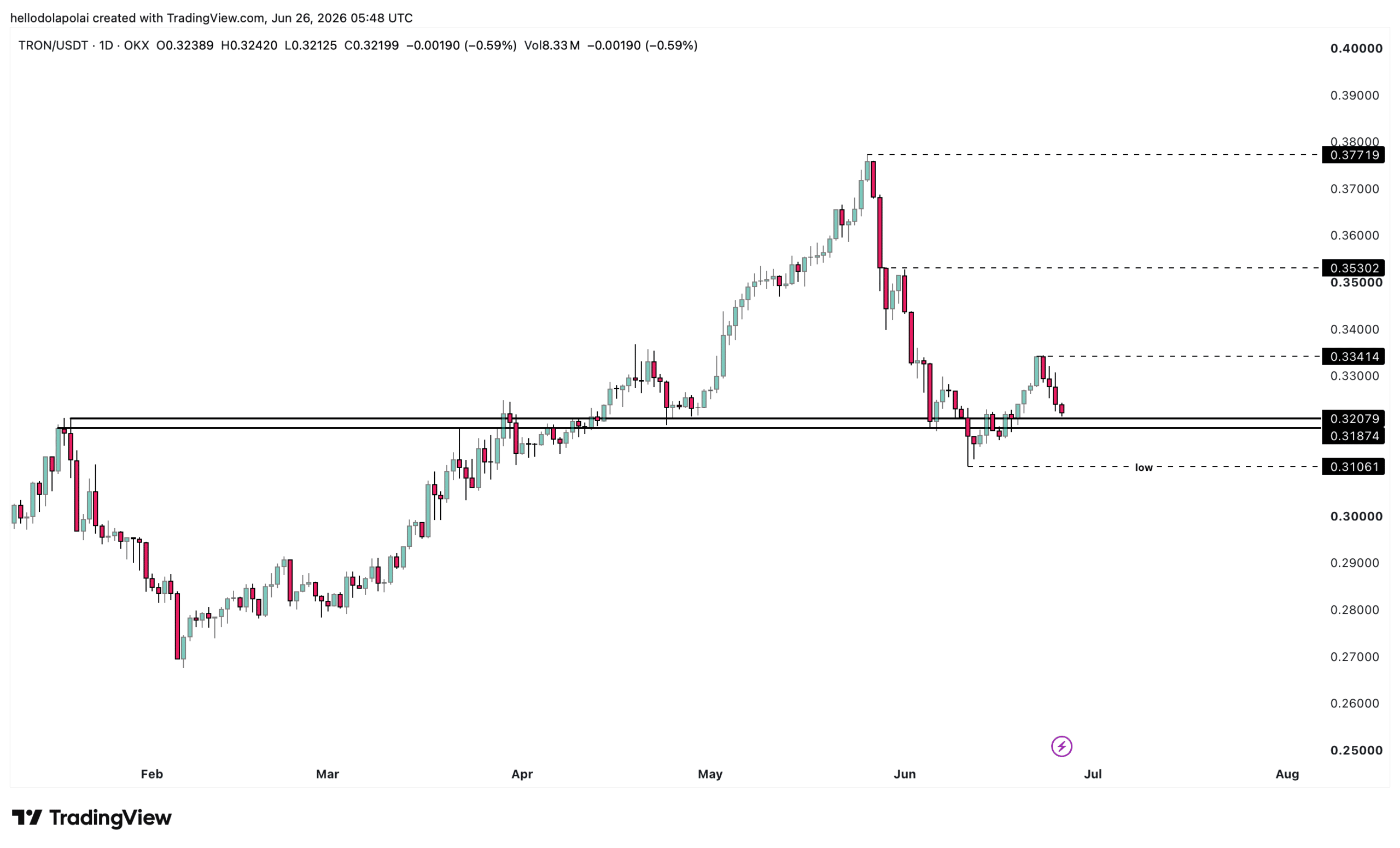
At the time of writing, the support sits between $0.318 and $0.320. Two scenarios flow from this chart pattern and frame the near-term bull and bear cases.

A bounce off support, a candle close above $0.334, and follow-through trade above it would confirm that bulls hold the upper hand, opening the path toward $0.353 and $0.377. A drop beneath $0.310—the marked low—would carve out a lower low and point to TRX extending its losses further.

TRX indicators lean bullish against the chart’s caution

The indicators paint a slightly different picture from the one the chart suggests.

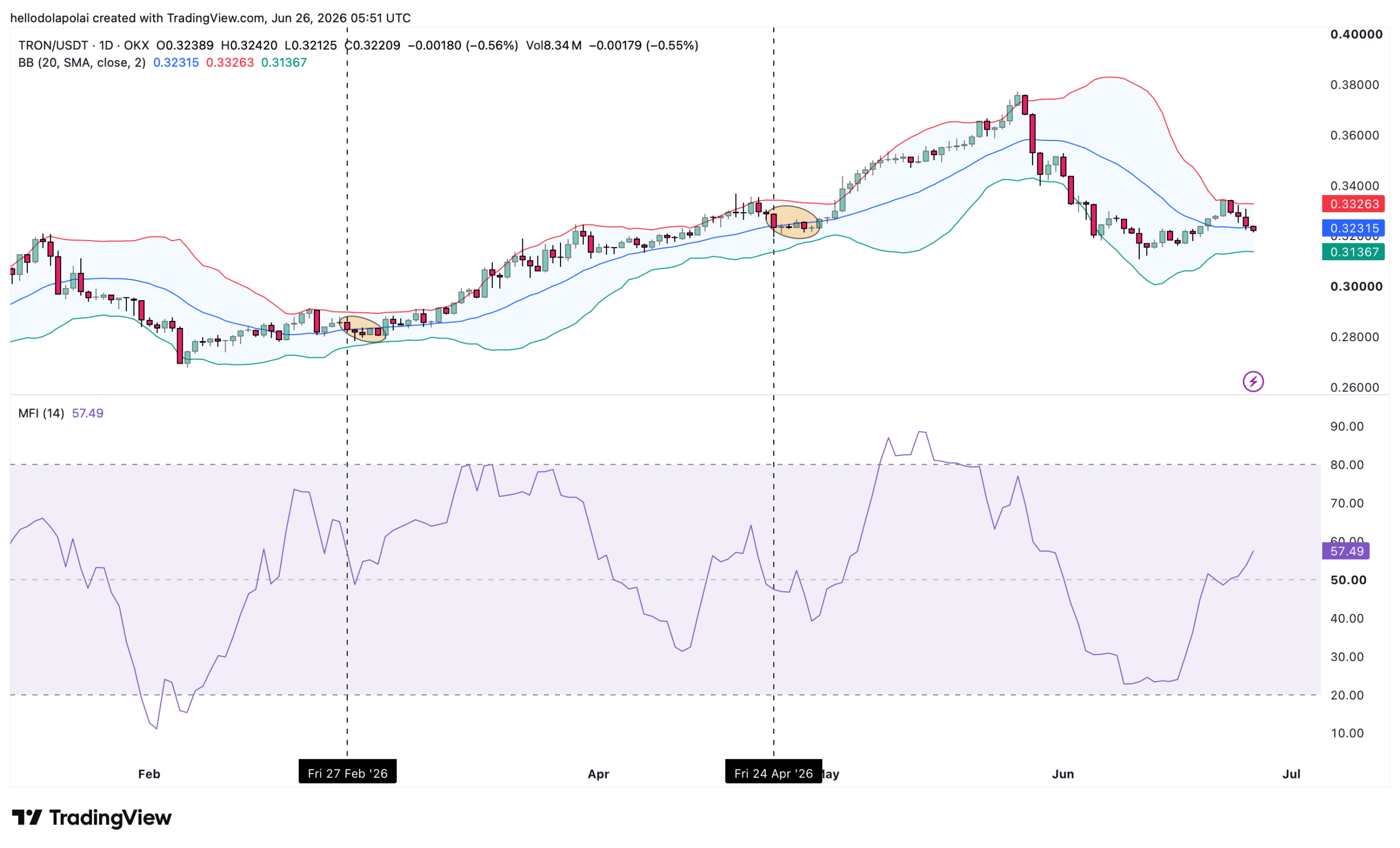
Bollinger Band analysis points to price settling at its present level and attempting a move higher, provided the middle band (marked in blue) holds as support.
Source: TradingView

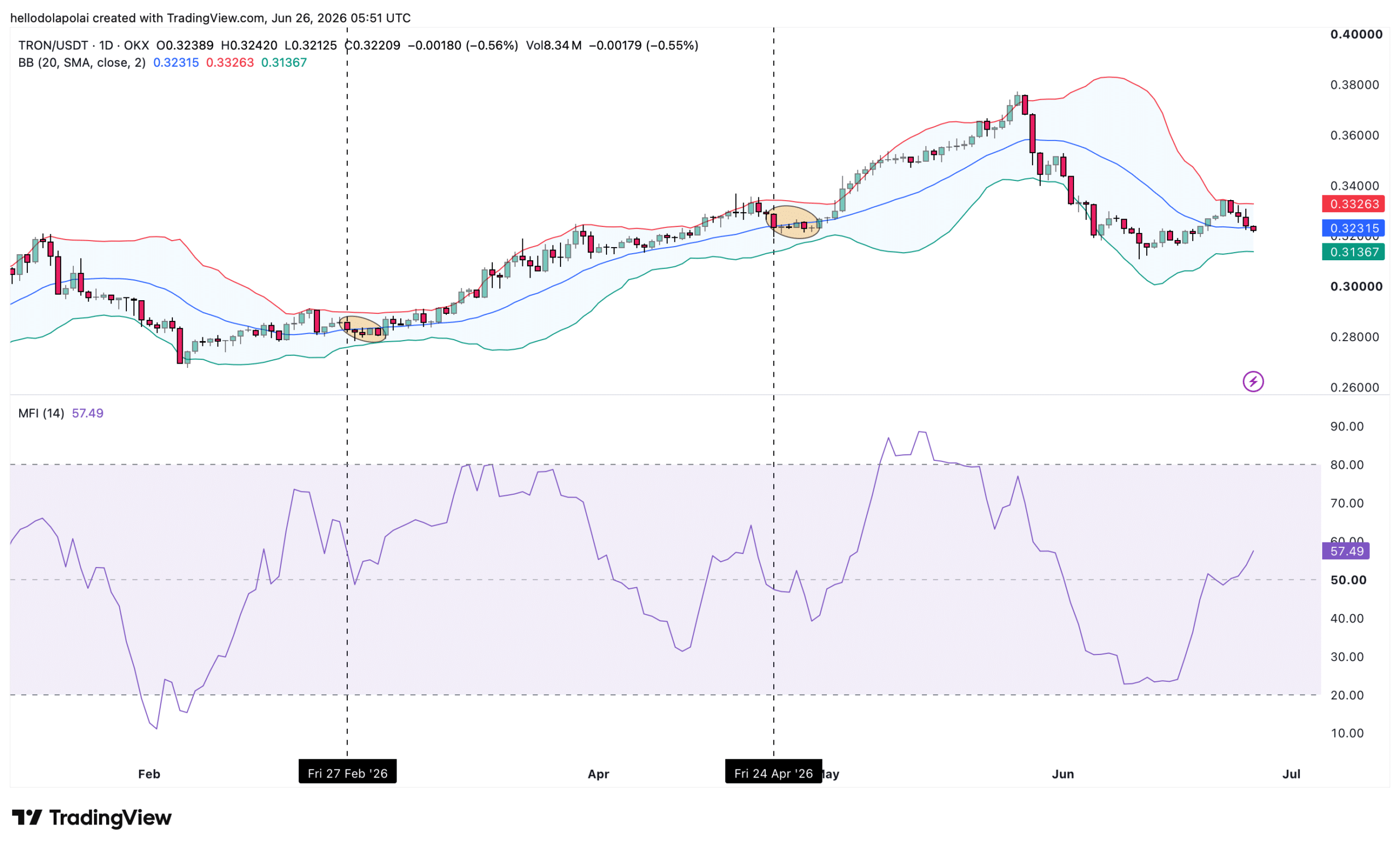
The middle band has done exactly that on the last two occasions the price dropped to it—and, notably, both touches landed on Fridays roughly two months apart, on the 27th of February and the 24th of April.

Now, at the time of writing, it is the 26th of June, another Friday.

There is no guarantee the fractal holds, but the Bollinger Band frames the worst case as a slide to $0.313. The Money Flow Index, which tracks capital moving into and out of an asset, reinforces the bullish read.

The MFI has kept climbing, with a current reading of 65 that sits firmly in the bullish zone (50–80), a sign that capital is flowing in and supporting the bullish case already in motion, and that the asset is likely to stay on that path.


Final Summary

  • TRX is holding just above a $0.318–$0.320 support zone that has sparked two rallies this year, and the reaction there decides whether its gains survive.
  • Momentum still leans bullish as capital flows in, but a break below $0.310 would flip the outlook bearish.


Trending Cryptos

Related Questions

QWhat is the critical support level that TRX is approaching, according to the article?

ATRX is approaching the critical support level between $0.318 and $0.320.

QWhat are the two possible price scenarios outlined for TRX based on its reaction to the support level?

AThe two scenarios are: 1) A bounce off support, a close above $0.334, and a move higher targeting $0.353 and $0.377. 2) A drop below $0.310, which would signal a lower low and extend losses.

QWhat bullish signal does the Money Flow Index (MFI) provide for TRX in the article?

AThe Money Flow Index has a reading of 65, which is in the bullish zone (50–80), indicating that capital is flowing into TRX and supporting the bullish case.

QAccording to the Bollinger Band analysis, what is the worst-case price target mentioned if TRX breaks down?

AAccording to the Bollinger Band analysis, the worst-case scenario is a slide down to $0.313.

QHow has Tron (TRX) performed year-to-date compared to other major cryptocurrencies, as stated in the article?

ATron (TRX) has gained 13.44% year-to-date, showing resilience while most other major cryptocurrencies have suffered significant outflows.

Related Reads

You Use Claude and Codex Every Day, but Meta Has Restricted Internal Use

In May, Meta imposed internal restrictions on its engineers regarding the use of Claude Code and Codex, two widely used AI programming tools. Despite being a major client, Meta's guidelines, still in effect, prohibit these external models from being used for specific tasks to prevent potential "escalations with partners." The core concern is "distillation"—the risk that outputs from Claude or Codex could inadvertently contaminate the training data and evaluation processes for Meta's in-house AI coding assistant, MetaCode. If MetaCode is trained or evaluated using data generated by these external models, it risks learning their capabilities rather than developing its own, blurring the line of intellectual origin. The restrictions are precise: engineers cannot use the external models to generate test questions, debug source code, or suggest test cases. AI-generated content is also barred from environments accessible to MetaCode. However, AI can still assist with peripheral tasks like workflow setup and code organization, provided all outputs are manually reviewed. This caution reflects a broader industry dilemma. While distillation is a common technique, using a competitor's model output for training raises legal and ethical questions about the ownership of derived capabilities. Contractual terms from companies like OpenAI and Anthropic explicitly forbid using their outputs to build competing products, putting enforcement power in the hands of rivals. The move is also financially motivated, as Meta seeks to reduce its hefty internal AI spending, estimated in the billions this year. Meta's policy illustrates the delicate balance companies must strike: leveraging powerful external AI tools while safeguarding the integrity and independence of their own AI development. As AI systems increasingly help build other AIs, distinguishing the origin of capabilities becomes a fundamental challenge for the entire industry.

marsbit2h ago

You Use Claude and Codex Every Day, but Meta Has Restricted Internal Use

marsbit2h ago

Why Do We Need an AI Content Perspective Today?

The article "Why Do We Need an AI Content Perspective Today?" explores the complex and often contentious integration of AI into the cultural and creative industries, particularly film and television. It begins with the cancellation of Amazon's AI-generated animation "Punky Duck," highlighting the ethical debates surrounding AI content. AI's rapid advancement is transforming video production, enabling cost-effective, full-length AI films (e.g., "RAPHAEL," "Dreams of Violets") while sparking industry resistance over issues like "synthetic actors." The core debate has shifted from whether to use AI to how to use it responsibly. The article analyzes why AI's entry into film is uniquely unsettling. It distinguishes between "cultural fast food" (short-form, fast-paced content like micro-dramas) and "cultural main courses" (traditional, long-form film/TV). AI currently excels at the former, matching its fragmented narratives, shallow emotional needs, and free-to-consumer models. However, venturing into the latter challenges the human-centric essence of storytelling—creativity, emotional depth, and the unique value of human labor and experience. While AI can generate massive volumes of content and lower costs, it risks devaluing human creativity, leading to homogenized output, and creating unfair competition through potential intellectual property infringement. Its efficiency also amplifies content safety risks, making preemptive governance crucial. To counter these risks, the article proposes establishing clear boundaries guided by a human-centered AI content perspective. It outlines four principles: 1) Amplify, rather than displace, human creative space; 2) Respect and protect human creative output; 3) Ensure human creative control and responsibility remain paramount; and 4) Guarantee transparency and traceability in AI creation. The conclusion emphasizes that humans must act as the "helmsmen" of technology, steering AI development to enhance, not replace, the core human values at the heart of cultural expression.

marsbit3h ago

Why Do We Need an AI Content Perspective Today?

marsbit3h ago

Trading

Spot

Hot Articles

Discussions

Welcome to the HTX Community. Here, you can stay informed about the latest platform developments and gain access to professional market insights. Users' opinions on the price of S (S) are presented below.

活动图片