World Unveils AgentKit for Human-Verified AI Agents with Coinbase Integration

TheNewsCryptoPublished on 2026-03-18Last updated on 2026-03-18

Abstract

World has launched the beta of AgentKit, a developer toolkit that integrates with the x402 protocol (founded by Coinbase and Cloudflare) to enable AI agents to cryptographically prove they are backed by a unique human via World ID, without revealing the user’s identity. This addresses the growing challenge of trust and accountability in agentic commerce, which is projected to reach $3–5 trillion by 2030. By combining World ID’s privacy-preserving proof-of-humanity with x402’s micropayment system, AgentKit allows platforms to distinguish legitimate human-backed agents from malicious bots, control resource allocation per unique user, and prevent abuse—enabling use cases like fair ticketing, reservations, and trial access. The toolkit is now available to developers, with a more advanced version planned following feedback.

With the release of AgentKit beta, a developer toolkit for the agentic web that works with x402, AI agents will be able to use World ID to carry cryptographic proof of a unique person. Developers may create AI agents that can demonstrate that a real person is behind them while interacting with websites, APIs, and online services thanks to the toolkit’s integration as an extension of x402, an open protocol founded by Coinbase and Cloudflare.

Online operations that formerly needed direct human involvement, such as booking reservations and checking pricing among merchants, are increasingly being handled by AI agents. According to industry estimates, agentic commerce might reach $3 trillion to $5 trillion worldwide by 2030, with AI agents perhaps making up as much as 25% of e-commerce in the United States at that time. Establishing trust and responsibility in automated interactions is an increasing difficulty for developers and platforms as agents become online economic actors.

By allowing verified people to assign their World ID to AI agents, AgentKit solves this problem. By using this notion, developers may create what World calls “human-backed agents,” which are able to cryptographically demonstrate that a genuine, distinct person is behind them without disclosing the identity of the person.

“Payments are the ‘how’ of agentic commerce, but identity is the ‘who.’ By integrating World ID with the x402 protocol, developers now have a complete trust stack: a way for agents to pay for what they need and a way for platforms to verify there is a real human behind the wallet. This is a massive step toward a web where agents aren’t just seen as automated traffic, but as legitimate economic participants,” says Erik Reppel, Head of Engineering at Coinbase Developer Platform and Founder of x402.

“As AI agents start acting on behalf of users across the internet, the key challenge is separating legitimate, human-backed agents from bot swarms. Payment requirements can slow down abuse, but they don’t indicate how many real people are behind the activity. Proof of human addresses this gap by allowing websites to verify that an agent represents a unique person without revealing who that person is,” said DC Builder, Research Engineer at World Foundation.

Nowadays, the majority of websites see automated traffic as potentially dangerous and often completely prohibit it. This method stops productive AI agents from engaging with internet services, even though it was initially intended to combat malevolent bots. Agents often run into the same limitations intended to stop exploitation when they try to do activities like making reservations or accessing APIs.

New protocols have started looking at methods to make online agent action possible. Micropayments are introduced by the x402 protocol to allow agents to access resources and APIs while restricting excessive bandwidth. The x402 protocol has handled over 100 million payments via apps, APIs, and AI agents since its 2025 debut.
Micropayments provide a way to control access, but they don’t solve the issue of uniqueness or identification. It is difficult for platforms to discern between coordinated behavior and genuine users since a single person might run thousands of agents that can pay tiny fees. Additionally, payments by themselves generate public transaction trails that may reveal comprehensive records of an agent’s actions.

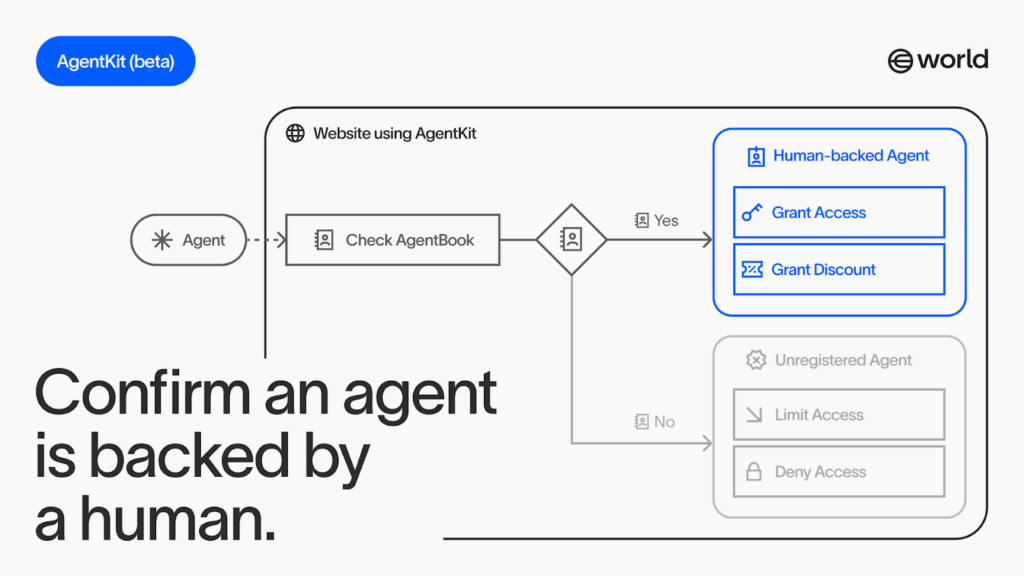
A supplementary signal, proof of unique human, is introduced by AgentKit. Without disclosing personal information, people may use World ID to cryptographically demonstrate their uniqueness as human beings. This feature is extended to AI agents by AgentKit, which enables platforms and websites to confirm that an agent is supported by a real person while protecting privacy.

Websites that currently use x402 may seek verification of unique human identity in addition to or instead of micropayments thanks to the toolkit’s integration with the x402 protocol. Verified World ID holders may use standard verification procedures to register their agents. Before allowing access, the platform may ask for payment, evidence of a unique person, or both when an agent visits a website that is compatible.

Although a single person may assign their World ID to many agents, platforms are able to identify that the agents come from the same person. This enables websites to detect abuse, establish limitations, and distribute resources based on the number of distinct persons interacting rather than the number of agents.

Numerous possible use cases are supported by the paradigm. Reservation systems might prevent scalpers from using a lot of automated agents to stockpile bookings while enabling human-backed agents to book tables. Ticketing systems could guarantee that actual fans, not automated networks, buy concert tickets. Instead of allocating access based on wallets or payments, websites that provide free trials might do so based on each individual person.

Additionally, AgentKit presents infrastructure that might facilitate services that need distinct identification signals, like age or country of residence, by sharing only relevant information using privacy-preserving zero knowledge proofs. Platforms may better control access while safeguarding user privacy by confirming the number of unique people responsible for agent activity.

Nearly 18 million verified people from more than 160 countries make up World’s network. With World ID, users may use cryptographic verification to anonymously demonstrate their uniqueness, enabling platforms to create trust signals without gathering or retaining personal information.

Developers creating AI agents with a validated World ID may now use the AgentKit beta. Developer access and documentation are accessible here.

A more sophisticated version is anticipated when the next iteration of the protocol is launched. The present beta version is based on the World ID architecture. The first release aims to collect developer input and show how proof of unique human may be extended to the expanding autonomous agent ecosystem.

World is meant to be the biggest, most inclusive network of actual people on the planet. The initiative, which was first conceptualized by Sam Altman, Max Novendstern, and Alex Blania, seeks to demonstrate humanity, finance, and connection for all people in the era of artificial intelligence. Visit world.org and X to learn more about the world.


TagsAltcoinBlockchain

Trending Cryptos

Related Questions

QWhat is AgentKit and what problem does it aim to solve?

AAgentKit is a developer toolkit for the agentic web that integrates with the x402 protocol. It allows AI agents to cryptographically prove they are backed by a unique, verified human using World ID, without revealing the person's identity. It aims to solve the problem of establishing trust and accountability for AI agents operating online, distinguishing legitimate human-backed activity from malicious bot swarms.

QHow does the integration of World ID with the x402 protocol create a 'complete trust stack'?

AThe integration combines two key components: the x402 protocol provides a micropayment system that allows agents to pay for the resources and APIs they use (the 'how'), while World ID provides proof of a unique human behind the agent (the 'who'). This gives developers a way for agents to transact and a way for platforms to verify there is a real human behind the wallet, creating a more trustworthy ecosystem for agentic commerce.

QWhy are micropayments alone insufficient for managing AI agent access, and how does AgentKit address this?

AMicropayments control access but don't solve the issue of uniqueness or identity. A single person could run thousands of agents that can all pay tiny fees, making it hard to distinguish coordinated abuse from genuine users. AgentKit addresses this by adding a supplementary signal: proof of a unique human. This allows platforms to verify that an agent represents a distinct person, enabling them to be allocated based on the number of people, not the number of agents or wallets.

QWhat are some potential use cases for human-verified AI agents as described in the article?

APotential use cases include: reservation systems preventing scalpers from using automated agents to hoard bookings; ticketing systems ensuring concert tickets are bought by real fans, not bots; and websites offering free trials allocating access based on unique individuals rather than wallets or payments. It also enables services that require verification of specific attributes like age or country using privacy-preserving zero-knowledge proofs.

QWhat is the current status of AgentKit and what are the future plans?

AAgentKit is currently in a beta release, which is based on the existing World ID architecture. The goal of this initial release is to gather developer feedback and demonstrate how proof of unique human can be extended to autonomous agents. A more sophisticated version is anticipated with the launch of the next iteration of the protocol.

Related Reads

a16z: From Companies to DAOs, DUNA May Become the Next Generation Organizational Form

This article, "From Companies to DAOs: How DUNA Could Become the Next Organizational Form," traces the 500-year evolution of business collaboration. It begins with medieval structures like the *commenda* and Florentine *compagnia*, which exposed partners to personal risk. The modern corporation, exemplified by the Dutch East India Company (VOC), was a revolutionary leap, enabling large-scale, capital-intensive ventures by offering limited liability and reducing coordination costs. However, corporations introduced new challenges like principal-agent problems and bureaucratic overhead. The piece argues that software and internet-native protocols are now reducing these traditional overheads. Decentralized Autonomous Organizations (DAOs) emerged as a new model for coordination without centralized management. Yet, DAOs face a significant legal vacuum: they lack legal recognition, leaving members exposed to unlimited personal liability, and their tokens are vulnerable to being classified as securities under unclear regulations (e.g., the Howey Test). This has forced projects into suboptimal workarounds like offshore foundations. The article identifies the Decentralized Unincorporated Nonprofit Association (DUNA) as a potential solution. Recently legalized in states like Wyoming, the DUNA provides a legal wrapper for decentralized networks. It grants key protections—legal personality, limited liability, and perpetual existence—to a group without imposing a traditional hierarchical management structure. This allows token-holder communities to govern, hold assets, and contract as a single legal entity, aligning with their decentralized nature. While DUNA doesn't solve all governance challenges or magically resolve securities law questions, it represents a crucial step. It fills the legal recognition gap, offering a native legal form for internet-scale, decentralized collaboration and extending the separation of personal risk from organizational venture into a new domain.

marsbit28m ago

a16z: From Companies to DAOs, DUNA May Become the Next Generation Organizational Form

marsbit28m ago

2026 Mid-Year Report On-Chain RWA: Tokenized Stock Market Cap Doubles in a Year, But 90% of Rights Are Hollow Shells

The 2026 Mid-Year Report on On-Chain RWA highlights a significant growth in tokenized stock market capitalization, which nearly doubled from $951 million in March to $1.89 billion by July. However, the report reveals a fundamental contradiction in this "layer 2.5" ecosystem: products with the strongest legal foundation (like regulated U.S. infrastructure) lack liquidity and distribution, while freely tradable offshored wrapper products often lack substantive ownership rights. The increase is driven largely by a few products (SECZ, FGRS, STRCx) and platforms (Ondo, xStocks, Securitize collectively hold over 85% share). While distributed value across networks like Ethereum, Solana, and BNB Chain has grown, the market remains fragmented. Products referencing the same underlying asset (e.g., Apple stock) are distinct legal liabilities with different intermediaries and jurisdictional rules, offering varying degrees of legal claim. The report cautions that headline numbers are misleading, as they reflect changes in distributed token value—driven by issuance, conversions, and price movements—not pure investor inflows. True "canonical shares" with legal ownership, wide wallet distribution, institutional liquidity, and independent on-chain price discovery do not yet exist at scale. Tokenized treasuries show stronger product-market fit, and ETFs may be easier to scale than single stocks. The core takeaway is a trade-off: legal certainty versus liquidity and composability.

marsbit1h ago

2026 Mid-Year Report On-Chain RWA: Tokenized Stock Market Cap Doubles in a Year, But 90% of Rights Are Hollow Shells

marsbit1h ago

Coldcard Hardware Wallet Hacked: 594 Bitcoin Withdrawn in 25 Minutes

The Coldcard hardware wallet has been compromised, with hackers stealing approximately 594.5 Bitcoin (~$40 million) from 500 addresses in just 25 minutes. The root cause was a critical software bug, undetected for five years, which disabled the device's secure chip for generating true random numbers. This led to the creation of private keys based on predictable data like the processor's serial number, drastically reducing cryptographic security. The attackers exploited this offline by brute-forcing possible seed phrases, finding active addresses on the public ledger, and signing transactions. Initially, Coinkite (Coldcard's maker) claimed only older models were at risk but later admitted all devices running the compromised firmware were vulnerable. CEO Rodolphe Novak (NVK) apologized but ruled out financial compensation for affected users. To secure funds, owners must urgently update their firmware to specific safe versions, generate a completely new seed phrase on the updated device, and transfer all assets to new addresses created with that new seed. While a BIP-39 passphrase can help, it does not replace this migration process. Other Coinkite products like TAPSIGNER were not affected. This incident underscores that even specialized hardware requires rigorous, independent code audits, especially for cryptographic functions. It parallels past failures, like a 2006 OpenSSL bug in Debian, and raises questions about whether automated code analysis can ever fully replace human scrutiny in critical security areas.

cryptonews.ru3h ago

Coldcard Hardware Wallet Hacked: 594 Bitcoin Withdrawn in 25 Minutes

cryptonews.ru3h ago

Trading

Spot

Hot Articles

Discussions

Welcome to the HTX Community. Here, you can stay informed about the latest platform developments and gain access to professional market insights. Users' opinions on the price of AI (AI) are presented below.

活动图片