What Does the Top AI Influencer Karpathy Seek by Joining Anthropic?

marsbitPublished on 2026-05-21Last updated on 2026-05-21

Abstract

AI pioneer Andrej Karpathy, a founding member of OpenAI, has joined AI safety-focused company Anthropic to lead a new team focused on pre-training research. His role will specifically involve using Anthropic's Claude model to accelerate exploration in pre-training, the foundational stage of large language model development. Karpathy's move is seen as a significant signal in the AI industry, combining his deep technical credibility with substantial public influence. It follows a period of momentum for Anthropic, which recently surpassed OpenAI in enterprise adoption rates and has expanded its offerings to smaller businesses. The move also highlights a continuing trend of talent migration from OpenAI to Anthropic, often linked to differing priorities on commercialization versus research depth and safety. By placing Karpathy on pre-training, Anthropic is making a long-term bet on fundamental AI advancements, exploring the meta-idea of using current AI to help build the next generation of models.

Author|桦林舞王

Editor| Jingyu

If someone had told me a few years ago that one of the co-founders of OpenAI would go to Anthropic to help a competitor with pre-training research, I probably would have thought they were describing a plot from a sci-fi novel.

But this is something that really happened today.

Andrej Karpathy, a name that hardly needs introduction in the AI community. Main lecturer of Stanford's CS231n course, the most popular science communicator in the field of deep learning, OpenAI co-founder, former head of Tesla's Autopilot team. A single tweet from him can make a technical direction skyrocket in popularity; a video he uploads to YouTube explaining Transformers easily gets millions of views.

And it is this very person who announced today that he is joining Anthropic.
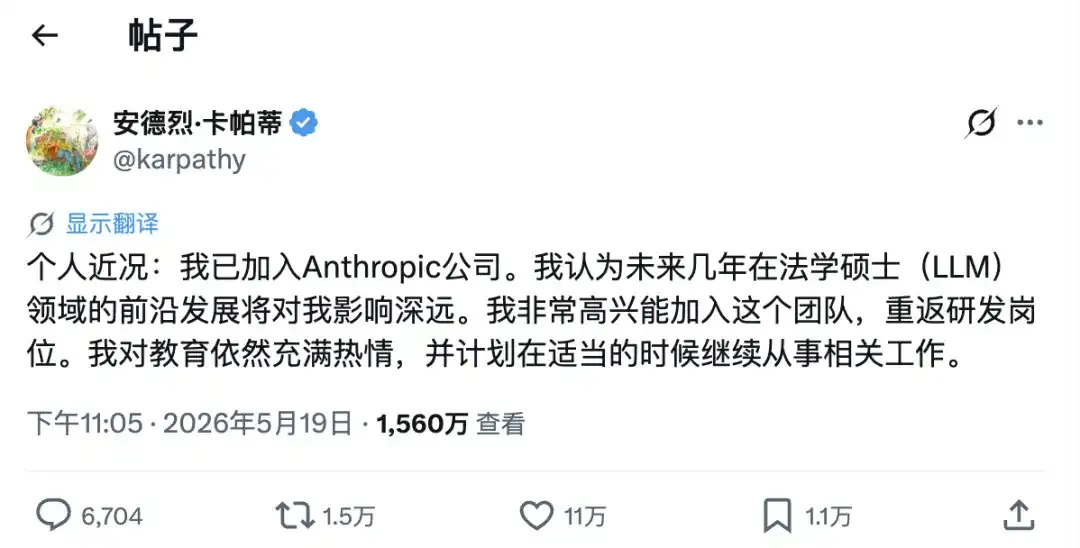
Karpathy's official announcement on X|Image Source: X

Karpathy's role at Anthropic will focus on pre-training research, leading a new team whose core mission is to use Claude to accelerate exploration in pre-training directions.

Pre-training is the foundation of large model capabilities. Whoever makes a breakthrough at this level holds the initiative in the competition for the next few years. Placing Karpathy here makes Anthropic's intent abundantly clear.

But if we only understand this event as "a talented person changing jobs," we are severely underestimating its significance.

Karpathy embodies something extremely rare in the AI community—a dual overlay of technical credibility and mass influence. He is not just a researcher who can write great code and publish papers; he is the kind of person whom other top researchers willingly follow.

There's a saying in the industry: the addition of a prestigious researcher often prompts a group of people to reassess their career choices. Karpathy's arrival could be the signal flare for an impending wave of talent influx at Anthropic.

Even more intriguing is his motivation. In 2015, he was one of the co-founders of OpenAI, witnessing firsthand the company's entire transformation from its non-profit idealistic beginnings. He later went to Tesla, then briefly returned to OpenAI, before leaving again to start his own venture.

This choice of Anthropic carries a certain degree of "statement".

01 Anthropic on a Winning Streak

Viewing Karpathy's joining in isolation misses an important context: Anthropic has recently been in a state of uncommon upward momentum.

Two weeks ago, data from the Ramp AI Index quietly went viral among tech media circles.

The data showed that Anthropic's enterprise adoption rate rose by 3.8 percentage points in April to 34.4%, while OpenAI's fell by 2.9 percentage points during the same period, dropping to 32.3%. This marks the first time in history that Anthropic has surpassed OpenAI in enterprise adoption rate. Though the gap isn't yet wide, the directional significance is strong.

In the same week, Anthropic launched a version of Claude for small businesses, integrating tools like QuickBooks, PayPal, HubSpot, Canva, and DocuSign that small and medium-sized enterprises rely on daily, embedding AI capabilities directly into these users' workflows. This is a clear signal of moving down-market; Anthropic is no longer just targeting large enterprise clients, it's moving into a broader market.

Just the day before that, Anthropic announced a partnership with the Gates Foundation, committing $200 million in funding, Claude usage credits, and technical support over four years for global health, education, and economic development, among other areas. The financial amount of this collaboration isn't the most eye-catching, but its narrative value is high. A company originally focused on "AI safety" is increasingly solidifying its identity around "responsible AI."

At the moment when financing valuations are nearing the trillion-dollar mark and enterprise adoption has just completed an overtake, Karpathy's joining is the highlight at the end of all this.

Fortune magazine's headline put it bluntly: "Anthropic Can't Seem to Stop Winning."

02 Why Not Return to OpenAI?

Where there are winners, there are inevitably those feeling the pressure.

Karpathy is not the first person to leave the OpenAI system for Anthropic.

Anthropic's founding team itself—Dario Amodei, Daniela Amodei, and a group of core researchers at the time—were a collective that left OpenAI to found the company in 2021. To some extent, from its very first day, Anthropic was the product of an internal divergence in philosophy at OpenAI.

In the years since, as OpenAI has moved faster and faster on commercialization and productization—accelerating releases, chasing revenue, increasingly aligning with Microsoft—some researchers who place greater value on "pure research" or "safety first" have begun voting with their feet.

Karpathy's choice of Anthropic comes at a sensitive time. OpenAI has been quite intensive in its external narrative recently, with the GPT series, the o series, Sora, and Operator all advancing simultaneously. The internal pace is so fast that some in the industry privately describe it as "running three marathons at once." Amid such rapid expansion, how to retain those who truly care about research depth and not just valuation is a difficult puzzle to solve.

Of course, OpenAI still possesses immense talent density and resource scale; a single departure won't shake its foundation. But if such movement becomes a trend, what truly warrants attention is the shift in industry expectations it signals.

A tech analyst put it bluntly: "AI development is no longer just a technical race; it's a war of intellectual leadership. The movement of an influential researcher can reshape the entire industry's research priorities."

Karpathy's own influence in the deep learning community perfectly fits this assessment. His Stanford lectures and YouTube videos are introductory material for many researchers now working in top AI labs. Where he goes carries a certain endorsement of "this direction is worth betting on."

03 Pre-training: Fighting for the Future

Returning to the specific focus of Karpathy's joining Anthropic—pre-training.

Over the past two years, the industry's attention has heavily concentrated on relatively "application-layer adjacent" directions like inference, multimodal capabilities, agents, and RAG. Breakthroughs in foundational model capabilities are seen by some as having entered a stage of "fine-tuning and optimization" rather than fundamental leaps.

Anthropic clearly doesn't see it that way. Tasking Karpathy with specifically forming a team to explore "using Claude to accelerate pre-training research" is a bet on a more foundational, longer-cycle, but potentially higher-reward direction.

There's an interesting logic hidden here: using existing large models to assist in the pre-training of the next generation of large models is an "AI helping AI evolve" approach. This path is still very new, without a mature roadmap, but if it can be made to work, it could mean nonlinear improvements in training efficiency and capability boundaries.

Entrusting this to Karpathy is a bold bet by Anthropic on a technical direction.

The talent war in the AI industry has reached an intensity today that can no longer be described as simply poaching a few engineers. It's more like a battle for "narrative control." Whoever attracts the people who can define research directions is sending a signal to the entire industry: we are the future protagonists of this game.

Karpathy's choice is perhaps just such a signal.

Related Questions

QWhat is the core mission of Karpathy's new team at Anthropic, and why is it strategically important?

AAndrej Karpathy's new team at Anthropic will focus on pre-training research, specifically on using Claude to accelerate exploration in pre-training. This is strategically important because pre-training forms the foundational capabilities of large language models. A breakthrough at this fundamental level could provide a significant competitive edge in the future AI landscape, as it could lead to non-linear improvements in model efficiency and capability.

QAccording to the article, what makes Andrej Karpathy's move to Anthropic particularly significant beyond just a job change?

AKarpathy's move is significant due to his unique combination of technical credibility and broad public influence. He is not only a top researcher but also a highly respected educator and communicator in the AI community. His choice signals to other top talent that Anthropic is a serious contender for defining future research priorities, potentially triggering a wave of further talent inflow to the company. It also carries an element of "statement," given his history as an OpenAI co-founder.

QWhat recent key business milestone did Anthropic achieve according to the Ramp AI Index data mentioned in the article?

AAccording to the Ramp AI Index data cited in the article, Anthropic achieved a key milestone in April: its enterprise adoption rate rose to 34.4%, surpassing OpenAI's rate of 32.3%. This marked the first time Anthropic has surpassed OpenAI in enterprise adoption, indicating a strong and growing competitive position in the business market.

QHow does the article contrast the recent trajectories of Anthropic and OpenAI?

AThe article contrasts the two companies' trajectories by describing Anthropic as being on a clear upward trend, "seemingly unable to stop winning," with rising enterprise adoption, product expansion for small businesses, and high-profile partnerships. In contrast, it portrays OpenAI as under pressure, with a fast-paced, multi-front expansion (GPT, o-series, Sora, Operator) that some perceive as potentially straining its ability to retain researchers deeply focused on fundamental research or safety, leading to talent outflow like Karpathy's.

QWhat is the novel technical approach Karpathy's team is expected to explore at Anthropic, and what is its potential implication?

AKarpathy's team is expected to explore the idea of using the existing Claude model to accelerate the pre-training research for the next generation of models. This represents an "AI helping AI to evolve" approach. If successful, this novel method could lead to non-linear improvements in training efficiency and the ultimate capability boundaries of future models, offering a potentially transformative advantage in foundational model development.

Related Reads

Musk Posted a Recruitment Ad for SpaceX, and After Reading the Comments Section, I Understood

On May 20th, SpaceX filed for a landmark IPO with a $1.75 trillion valuation. Shortly after, Elon Musk posted a recruitment call on X, seeking "world-class engineers and physicists" for SpaceX. The application process was starkly simple: email with three bullet points proving "exceptional ability," with real, complex projects as a plus. Musk promised to review qualifying emails himself. The post garnered millions of views and thousands of replies, revealing a spectrum of responses. Most comments, including a highly-upvoted humorous one listing absurd "skills," merely listed credentials or experiences in a conventional, non-differentiating way. This highlighted a key insight: a traditional resume listing degrees and skills often fails to demonstrate true exceptionalism. Effective self-presentation requires "performance efficiency." A standout reply came from an OpenAI engineering lead, who simply stated "codex." This demonstrated that for those who have built significant, recognized products, the product itself becomes the ultimate resume. The article argues that in the AI era, any tangible, shareable output—a tool, research, or online project—serves as a living, self-evident credential more powerful than a list of attributes. However, a twist emerged when applicants found the provided email address non-functional, leading to speculation that the post might also serve as an IPO publicity stunt, projecting an image of aggressive talent acquisition to investors. Ultimately, the episode served as a microcosm: some participate through performance, others through proof of work, while some question the reality of the stage itself. It underscores the enduring challenge of defining and demonstrating value in an age of abundant, yet often superficial, content.

marsbit49m ago

Musk Posted a Recruitment Ad for SpaceX, and After Reading the Comments Section, I Understood

marsbit49m ago

Cutting Off OpenAI, Anthropic Acquires the Tool Provider Used by a Quarter of Global Developers

Anthropic has acquired Stainless, a developer tool company that automatically generated official SDKs (Software Development Kits) for AI giants including OpenAI, Anthropic, Meta, and Cloudflare. The deal, reportedly valued at around $300 million, marks a strategic shift for Anthropic as it builds its "AI agent" infrastructure. Stainless acted as a "translator," converting complex API specifications into ready-to-use code libraries for developers. Its tools indirectly reached about a quarter of professional software developers globally. Following the acquisition, Stainless will shut down its public products and its team will join Anthropic to focus on internal platform development, notably for the Claude Platform. Existing SDKs remain with their respective client companies but will no longer receive updates from Stainless. This move is part of Anthropic's broader 18-month strategy to assemble a complete "agent stack." The stack consists of the Claude model at its core, the newly acquired Stainless for standardized API interfaces, and the Model Context Protocol (MCP), an open standard for connecting agents to external tools and data. This contrasts with OpenAI's focus on model generations and consumer-scale compute. Anthropic believes an agent's ultimate utility depends on its ability to connect to external systems. By internalizing the SDK layer and promoting MCP as a connection standard, Anthropic aims to lock in long-term ecosystem advantages and create path dependency, moving beyond the transient lead provided by any single model generation.

marsbit51m ago

Cutting Off OpenAI, Anthropic Acquires the Tool Provider Used by a Quarter of Global Developers

marsbit51m ago

Bankless Founder Sells Off ETH, Collective Collapse of Ethereum Faith

Ethereum faces a "crisis of faith" as David Hoffman, co-founder of the prominent pro-Ethereum media outlet Bankless, announces he has sold all his ETH. This move, coupled with reports of major layoffs at Bankless, signals a potential retreat of Ethereum's staunchest supporters. Hoffman and co-founder Ryan Sean Adams confirm Bankless is entering a "second era," with Adams stepping back and Hoffman exploring new frontiers. Hoffman sharply criticizes the Ethereum Foundation, stating that ETH's poor price performance cannot be separated from its leadership. He has a history of public dissatisfaction, citing the Foundation's failure to drive market growth and its "endless manifestos." His frustration coincides with ETH/BTC hitting multi-month lows and a significant exodus of senior researchers and executives from the Ethereum Foundation, partly attributed to controversial "loyalty oaths." The article contrasts Ethereum's current predicament—with its Layer-2 narrative discredited and ecosystem stagnant—against what should have been a highlight year in 2026 amid tokenization trends. While a previous surge to near $5,000 was driven by corporate buybacks (DAT热潮), ETH has since fallen over 50%. The core question remains: with fading faith and intense competition, what is Ethereum's next solution? Hoffman's divestment symbolizes a growing disconnect between the community and the ecosystem's direction.

Odaily星球日报1h ago

Bankless Founder Sells Off ETH, Collective Collapse of Ethereum Faith

Odaily星球日报1h ago

Trading

Spot
Futures

Hot Articles

Discussions

Welcome to the HTX Community. Here, you can stay informed about the latest platform developments and gain access to professional market insights. Users' opinions on the price of AI (AI) are presented below.

活动图片















