Bankless Founder Sells Off ETH, Collective Collapse of Ethereum Faith

Odaily星球日报Published on 2026-05-21Last updated on 2026-05-21

Abstract

Ethereum faces a "crisis of faith" as David Hoffman, co-founder of the prominent pro-Ethereum media outlet Bankless, announces he has sold all his ETH. This move, coupled with reports of major layoffs at Bankless, signals a potential retreat of Ethereum's staunchest supporters. Hoffman and co-founder Ryan Sean Adams confirm Bankless is entering a "second era," with Adams stepping back and Hoffman exploring new frontiers. Hoffman sharply criticizes the Ethereum Foundation, stating that ETH's poor price performance cannot be separated from its leadership. He has a history of public dissatisfaction, citing the Foundation's failure to drive market growth and its "endless manifestos." His frustration coincides with ETH/BTC hitting multi-month lows and a significant exodus of senior researchers and executives from the Ethereum Foundation, partly attributed to controversial "loyalty oaths." The article contrasts Ethereum's current predicament—with its Layer-2 narrative discredited and ecosystem stagnant—against what should have been a highlight year in 2026 amid tokenization trends. While a previous surge to near $5,000 was driven by corporate buybacks (DAT热潮), ETH has since fallen over 50%. The core question remains: with fading faith and intense competition, what is Ethereum's next solution? Hoffman's divestment symbolizes a growing disconnect between the community and the ecosystem's direction.

Original|Odaily Planet Daily(@OdailyChina)

Author|Wenser(@wenser 2010 )
ETH faces another "crisis of faith." This time, the trigger is Bankless, the crypto media that has long been a cheerleader for Ethereum. Co-founder David Hoffman proactively published an article stating he had "sold his last ETH." Community user @Ox_Lucas also revealed that Bankless recently appeared to have laid off most of its team members. Undoubtedly, "the loyal Ethereum guards are witnessing their moment of exit."

In 2026, as the wave of stock tokenization surges and crypto ETF assets have become standard for institutions, this should have been Ethereum's moment of glory. However, the invalidation of the L2 roadmap, the wave of resignations among foundation leadership, and the reality of ETH's price following declines but not gains have left its survival situation quite awkward.

David Hoffman's sell-off might just be the beginning of "the Ethereum guards' exit."

Co-founder Steps Back, Bankless Enters Its Second Phase

Perhaps newcomers are not very familiar with Bankless. Since its founding in 2020, it has been the "mouthpiece media" for the Ethereum ecosystem. The Bankless DAO, established based on this media, was once the "premier DAO community." But now, Bankless has concluded its "first phase" of development and must usher in its second phase.

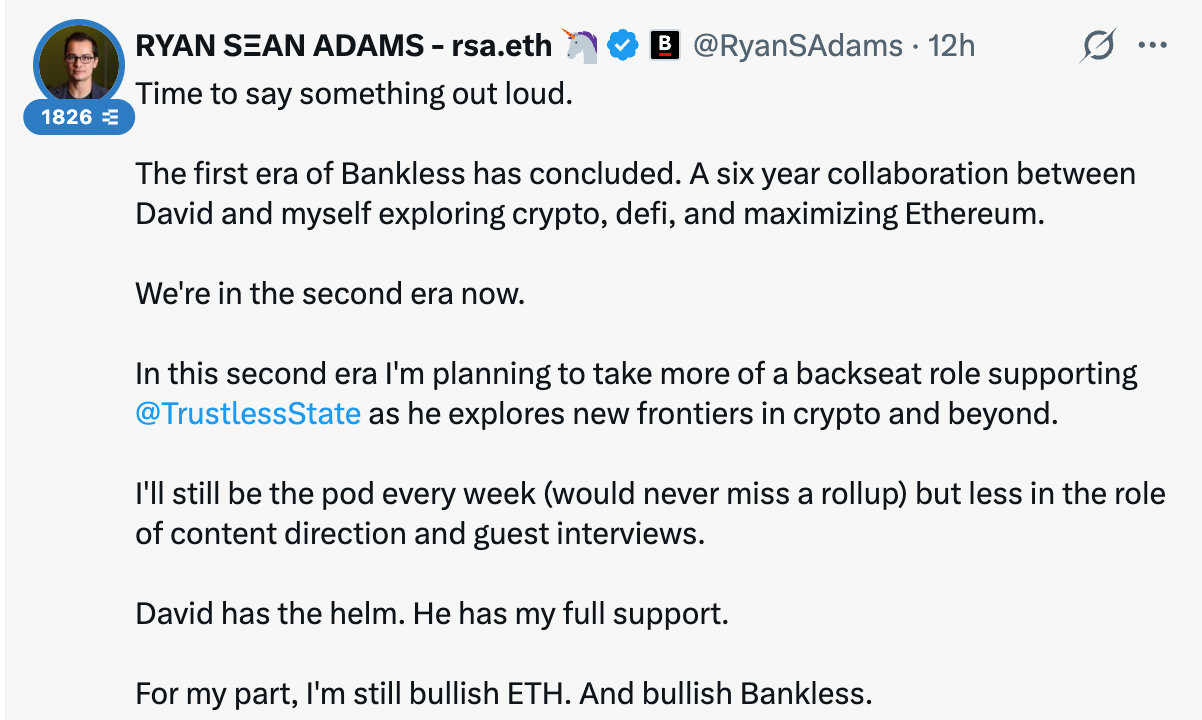
Shortly after David Hoffman's post about selling ETH, the other co-founder, Ryan Sean Adams, also posted, stating: "Time to make it public. The first era of Bankless is over. This marks six years of collaboration between David and me, exploring cryptocurrency, DeFi, and Ethereum maximalism. We are now in the second era.

In this era, I plan to step back from the forefront to support David as he explores new frontiers in crypto and beyond. I will still host the podcast weekly (never missing a recap meeting), but my role in content direction and guest interviews will diminish. David continues to steer the ship, and I fully support him. Personally, I remain bullish on ETH and bullish on Bankless."
Six years after its founding, Bankless has achieved remarkable success: apart from interviews with prominent figures like Vitalik, Chris Dixon, and Hayden Adams, the media has amassed 280,000 subscribers on YouTube, with a newsletter readership of 350,000. Its podcast has received high ratings of 4.7 stars on platforms like Spotify and Apple Podcasts, has been listed among the "Top 10 Best Crypto Podcasts" by multiple media outlets, and is hailed by many as the "ultimate guide to Web3 education."

But now, David Hoffman's discontent is evident, even resorting to "selling off ETH" to express his stance. His criticism is directly aimed at the current Ethereum Foundation.

"When the Most Loyal Ethereum Guard Decides to Sell Off ETH": Bankless Co-founder Blasts Ethereum Foundation

Following David Hoffman's post, the Ethereum community engaged in lively discussion. Some teased him, saying his "routine of periodically leaving the Ethereum ecosystem and returning" is a regular act, calling him a "seasonal barometer." They suggested that when he becomes bullish on ETH again, it might signal a market peak and a time for caution.

Subsequently, David Hoffman responded directly: "I have always supported the Ethereum blockchain network, but the ETH asset is becoming increasingly questionable. Let's not conflate the two."

A community member then pointedly asked: "Is it that you support ETH but doubt the Ethereum Foundation?"

David Hoffman's answer was straightforward: "Unfortunately, you cannot separate ETH's price performance from its leadership." His dissatisfaction with the Ethereum Foundation, the "ecosystem leader," is palpable.

It is worth noting that this is not the first time David Hoffman has expressed dissatisfaction with the Ethereum Foundation:

  • In April of last year, when ETH prices fell below $1,500, he publicly stated, "Ethereum's leadership and culture are driving away users and developers";
  • In October of last year, the departure of Ethereum Foundation researcher Dankrad Feist prompted him to express concern about the brain drain in the Ethereum ecosystem;
  • In March of this year, he directly criticized the Ethereum Foundation in his article "The EF's Endless Manifestos," stating it "does not strive for Ethereum's market expansion."

Now, it seems David Hoffman's attitude towards ETH and the Ethereum Foundation has already transitioned from "frustration at its stagnation and misfortune" to a state of "hopeless despair."

On the other side of the story, naturally, lies ETH and the Ethereum Foundation's own "lack of drive."

According to Coinglass data, the ETH/BTC exchange rate briefly fell to 0.02835 on May 12, marking its lowest level since July 2025, with a cumulative decline of over 35% from the August 2025 high of 0.04324.

Simultaneously, the Ethereum Foundation is experiencing a wave of resignations: On May 19, Ethereum Foundation researchers Carl Beek and Julian Ma officially announced their imminent departure. The former had been with the organization for seven years, while the latter had worked at the Ethereum Foundation for four years, accompanying it through thousands of days and nights.

Prior to this, several executives and researchers from the Ethereum Foundation had already left, including Co-Executive Director Tomasz K. Stańczak, who departed in February of this year, Josh Stark, who left in March, and Protocol team leads Barnabé Monnot, Tim Beiko, and Alex Stokes, who announced their resignations earlier this month. So far this year, at least 8 senior figures at the Ethereum Foundation have resigned.

Absurdly, a primary reason for these departures appears to be the ludicrous requirement for employees to sign loyalty pledges, a factor that is both laughable and infuriating.

Paired with previous incidents where the Ethereum Foundation continued selling ETH regardless of market cycles, and even engaged in direct OTC transactions with DAT treasury company Bitmine, this organization seems to have lost its "last bit of fundamental support." Internal brain drain, external competitive weakness—the future of the Ethereum Foundation appears even bleaker than that of Bankless.

After DAT, What Is Ethereum's Next Solution?

In April of last year, based on interviews from attending an ETH Hangzhou offline event, the author wrote the article "ETH Hangzhou On-site Investigation: Ethereum Has Entered Middle Age, No Hope for Price Highs Within Three Years." At that time, ETH prices were also struggling, and countless people held little hope for its future performance. However, with the DAT frenzy arriving in June and July, buying pressure from listed companies like Bitmine and Sharplink still managed to push ETH's price high to nearly $5,000.

Now, ETH's price has more than halved from its peak. The difference is that when people discuss Ethereum, it is no longer seen as the sole answer for "new financial infrastructure." The L2 roadmap has been thoroughly invalidated, and Hyperliquid has emerged as the new "on-chain infrastructure." What is the next solution awaiting ETH and Ethereum? No one can provide a definitive answer.

Compared to the past when token prices fell but ecosystem development was booming, perhaps the current silence within the Ethereum ecosystem is even more despairing. David Hoffman's sale of ETH may have its own reasons, but his growing distance from the Ethereum ecosystem has become an undeniable fact.


Related Reads

Musk Posted a Recruitment Ad for SpaceX, and After Reading the Comments Section, I Understood

On May 20th, SpaceX filed for a landmark IPO with a $1.75 trillion valuation. Shortly after, Elon Musk posted a recruitment call on X, seeking "world-class engineers and physicists" for SpaceX. The application process was starkly simple: email with three bullet points proving "exceptional ability," with real, complex projects as a plus. Musk promised to review qualifying emails himself. The post garnered millions of views and thousands of replies, revealing a spectrum of responses. Most comments, including a highly-upvoted humorous one listing absurd "skills," merely listed credentials or experiences in a conventional, non-differentiating way. This highlighted a key insight: a traditional resume listing degrees and skills often fails to demonstrate true exceptionalism. Effective self-presentation requires "performance efficiency." A standout reply came from an OpenAI engineering lead, who simply stated "codex." This demonstrated that for those who have built significant, recognized products, the product itself becomes the ultimate resume. The article argues that in the AI era, any tangible, shareable output—a tool, research, or online project—serves as a living, self-evident credential more powerful than a list of attributes. However, a twist emerged when applicants found the provided email address non-functional, leading to speculation that the post might also serve as an IPO publicity stunt, projecting an image of aggressive talent acquisition to investors. Ultimately, the episode served as a microcosm: some participate through performance, others through proof of work, while some question the reality of the stage itself. It underscores the enduring challenge of defining and demonstrating value in an age of abundant, yet often superficial, content.

marsbit41m ago

Musk Posted a Recruitment Ad for SpaceX, and After Reading the Comments Section, I Understood

marsbit41m ago

Cutting Off OpenAI, Anthropic Acquires the Tool Provider Used by a Quarter of Global Developers

Anthropic has acquired Stainless, a developer tool company that automatically generated official SDKs (Software Development Kits) for AI giants including OpenAI, Anthropic, Meta, and Cloudflare. The deal, reportedly valued at around $300 million, marks a strategic shift for Anthropic as it builds its "AI agent" infrastructure. Stainless acted as a "translator," converting complex API specifications into ready-to-use code libraries for developers. Its tools indirectly reached about a quarter of professional software developers globally. Following the acquisition, Stainless will shut down its public products and its team will join Anthropic to focus on internal platform development, notably for the Claude Platform. Existing SDKs remain with their respective client companies but will no longer receive updates from Stainless. This move is part of Anthropic's broader 18-month strategy to assemble a complete "agent stack." The stack consists of the Claude model at its core, the newly acquired Stainless for standardized API interfaces, and the Model Context Protocol (MCP), an open standard for connecting agents to external tools and data. This contrasts with OpenAI's focus on model generations and consumer-scale compute. Anthropic believes an agent's ultimate utility depends on its ability to connect to external systems. By internalizing the SDK layer and promoting MCP as a connection standard, Anthropic aims to lock in long-term ecosystem advantages and create path dependency, moving beyond the transient lead provided by any single model generation.

marsbit43m ago

Cutting Off OpenAI, Anthropic Acquires the Tool Provider Used by a Quarter of Global Developers

marsbit43m ago

a16z Invests Heavily with $356 Million in HYPE, Surpassing Paradigm to Become the Largest External Holder

On May 21st, HYPE surged past $59, reaching a new high since September 2025, with a market cap nearing $150 billion. Analysts attribute the rally to a short squeeze and significant ETF inflows. The launch of two U.S. spot ETFs for Hyperliquid has driven substantial capital, with their inflows at times surpassing those of Bitcoin and Ethereum ETFs. Major institutions are actively accumulating HYPE. Venture firm a16z has become the largest external holder with a $356 million position, surpassing Paradigm. Other firms like Goldman Sachs, Grayscale, and Galaxy Digital have also made large purchases, with Goldman reportedly selling portions of its XRP, ETH, and BTC holdings to buy HYPE. Bitwise CIO Matt Hougan calls HYPE one of the most "mispriced" assets, arguing its valuation should reflect Hyperliquid's broader platform beyond just a perpetual DEX token. The protocol generates substantial real revenue, using 97% of fees to buy back and burn HYPE. Its expansion into RWA commodities and prediction markets has driven user growth and transaction volume, now commanding about 70% of the on-chain perpetual DEX market. However, this rapid growth faces challenges. Traditional exchanges CME and ICE are pressuring the CFTC to regulate Hyperliquid, citing concerns over its impact on global commodity benchmarks. Concurrently, some major market makers have withdrawn significant liquidity from the platform. With HYPE up over 125% year-to-date, operational risks are rising. Large holders are reportedly hedging with sizable short positions. The regulatory outlook from the CFTC remains a key uncertainty, adding another layer to the ongoing battle over the future of on-chain finance.

链捕手1h ago

a16z Invests Heavily with $356 Million in HYPE, Surpassing Paradigm to Become the Largest External Holder

链捕手1h ago

Trading

Spot
Futures

Hot Articles

Discussions

Welcome to the HTX Community. Here, you can stay informed about the latest platform developments and gain access to professional market insights. Users' opinions on the price of ETH (ETH) are presented below.

活动图片














