Too busy to vote? Vitalik Buterin says AI can do it for you!

ambcryptoPublished on 2026-02-23Last updated on 2026-02-23

Abstract

Vitalik Buterin, Ethereum Co-Founder, has proposed a novel solution to address low participation and centralization in DAO governance: AI-powered voting agents. Instead of requiring users to manually vote on every proposal, each user would have a personal AI model trained on their messages, opinions, and past decisions. This AI would then vote on their behalf, exactly as the user would. Buterin highlights that the current delegation model is disempowering and leads to voting power being concentrated with a few large token holders. His proposal aims to make DAOs more scalable and truly decentralized. A key aspect is ensuring user privacy and security. These AI agents would operate within secure systems like trusted execution environments, and zero-knowledge proofs could be used to protect voter identity and prevent risks like bribery or coercion. Furthermore, AI agents could automatically handle routine votes, alerting users only for important decisions, and prediction markets could be used to filter out spam proposals. In summary, this AI voting system could fundamentally transform DAO governance by increasing participation, reducing centralization, and maintaining user privacy.

What if you never had to vote in a DAO again? That’s the future Ethereum Co-Founder Vitalik Buterin is imagining.

Instead of users showing up for every proposal, AI agents could step in and vote based on what you actually believe.

AI will vote, so you don’t have to

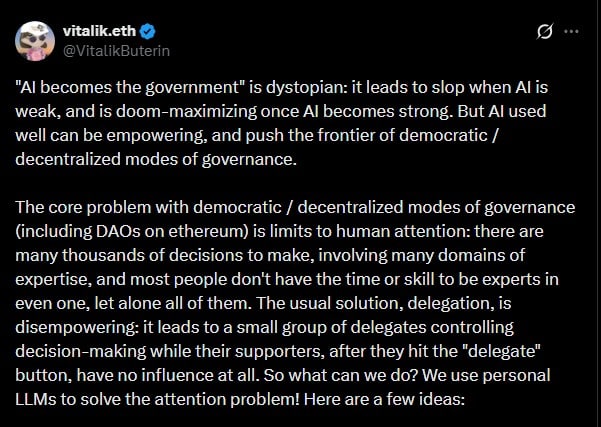
Buterin recently noted that DAO voting has a serious participation problem, and his solution sounds straight out of the future. Instead of users manually voting on every proposal, he’s proposed letting personal AI agents do the job.

The idea is that each user would have their own AI model, trained on their messages, opinions, and past decisions. This AI would then vote on DAO proposals exactly how the user would.

“Making good decisions often cannot come from a linear process of taking people’s views that are based only on their own information, and averaging them (even quadratically).”

Most people don’t have the time or expertise to vote on thousands of complex decisions. As a result, voting power often ends up concentrated with a few large token holders. Buterin stated,

“The usual solution, delegation, is disempowering”

What’s interesting is that this comes a month after Buterin ripped into DAOs for low participation and growing centralization.

A key part of the idea…

…is making sure users don’t have to give away privacy for convenience.

These AI agents would run inside secure systems, like trusted execution environments and multi-party computation. This would allow them to process sensitive information without exposing it publicly.

Source: X

To protect voter identity, Buterin suggested using zero-knowledge proofs.

This would let users prove they’re eligible to vote without revealing their wallet address or their decision. It could also reduce risks like bribery, coercion, or blindly copying large token holders.

AI agents could also automatically handle routine votes and alert users only when something important comes up.

To deal with spam proposals, prediction markets are the idea on the table. This is where AI agents would back strong proposals and ignore weak ones.


Final Summary

  • Vitalik Buterin’s AI voting proposal could change DAO governance forever.
  • If adopted widely, AI agents could make DAOs more scalable and truly decentralized.
Next: Why is Cardano’s share rising in Grayscale’s fund? Explained!
Share
  • Share
  • Tweet

Related Questions

QWhat problem with DAO voting does Vitalik Buterin identify, and what is his proposed solution?

AVitalik Buterin identifies that DAO voting has a serious participation problem, where most people don't have the time or expertise to vote on thousands of complex decisions, leading to centralized voting power. His solution is to have personal AI agents, trained on a user's messages, opinions, and past decisions, vote on their behalf.

QHow would the proposed AI agents protect user privacy according to the article?

AThe AI agents would run inside secure systems like trusted execution environments and multi-party computation to process sensitive information without exposing it publicly. Buterin also suggested using zero-knowledge proofs to allow users to prove they are eligible to vote without revealing their wallet address or decision.

QWhat are two potential benefits of using AI agents for DAO voting, as mentioned by Buterin?

ATwo benefits are: 1) It could reduce risks like bribery, coercion, or blindly copying large token holders. 2) AI agents could automatically handle routine votes and only alert users for important decisions, making DAOs more scalable and decentralized.

QWhat mechanism does the article suggest for dealing with spam proposals in a DAO?

AThe article suggests using prediction markets to deal with spam proposals, where AI agents would back strong proposals and ignore weak ones.

QWhat did Vitalik Buterin criticize about the 'usual solution' of delegation in DAOs?

AVitalik Buterin stated that the usual solution of delegation is 'disempowering,' as it often leads to voting power becoming concentrated with a few large token holders instead of being truly decentralized.

Related Reads

Morgan Stanley Digital Asset Head: Bitcoin Reaching $1M Would Not Be Surprising, But a Real Catalyst Might Require a Crisis That Shatters the Old System

Summary: In a podcast interview, Morgan Stanley's Head of Digital Asset Strategy, Amy Oldenburg, discusses Bitcoin's potential and institutional adoption. She argues Bitcoin's next major surge might require a catalyst—a crisis that shatters the traditional financial system, after which Bitcoin could emerge as the only intact asset. While she sees a $1 million price as possible within five years, she expects slower, more stable growth. Oldenburg traces Bitcoin's logic to her experience in emerging markets, where decentralized mobile money (like M-Pesa) provided critical financial security where traditional banks failed. She notes that early Bitcoin adopters often came from international finance, seeking alternatives to centralized systems. Regarding institutions, she explains that Morgan Stanley, as a bank holding company, faces stricter regulatory hurdles than pure asset managers like BlackRock. While client demand drove their Bitcoin ETP launch (MSBT), which set a firm record, most financial advisors remain hesitant due to Bitcoin's recent price stagnation and volatility. She identifies an education gap as a major barrier, with many advisors and clients not understanding the differences between various crypto assets or between holding spot Bitcoin versus an ETP. Oldenburg also discusses the tension between Bitcoin's cypherpunk, self-custody ethos and the convenience of centralized financial products, acknowledging the value of both approaches. She concludes that the digital asset space is still in its early stages, with a long journey ahead involving more complex products and technologies.

marsbit2m ago

Morgan Stanley Digital Asset Head: Bitcoin Reaching $1M Would Not Be Surprising, But a Real Catalyst Might Require a Crisis That Shatters the Old System

marsbit2m ago

Cursor: Why Did It Board Elon Musk's Rocket?

SpaceX announced its first major acquisition after its historic IPO: a $60 billion all-stock deal to acquire AI programming startup Cursor (parent company Anysphere). Cursor is a popular AI coding assistant that allows developers to switch between models from OpenAI, Anthropic, Google, and others. Founded in 2022 by MIT graduates including CEO Michael Truell, Cursor saw explosive revenue growth, reaching a $4 billion annualized run rate by early 2026. However, its market share had declined as key supplier Anthropic launched its own competing product, Claude Code. Facing dependency risks, Cursor decided to build its own AI model, Composer, but lacked the necessary computing power. In April 2026, Cursor and SpaceX revealed a partnership and an option agreement: SpaceX could acquire Cursor for $60 billion post-IPO, or pay a breakup fee and provide substantial computing resources. After SpaceX's successful IPO, it exercised the option. The deal gives Cursor access to SpaceX's massive "Colossus" supercomputer, while SpaceX gains Cursor's strong foothold among elite software engineers to boost its AI capabilities, as Musk's xAI model Grok lags in programming. The acquisition aligns with SpaceX's broader AI and orbital data center ambitions, as Musk targets $1 trillion in revenue by 2030. For Truell, who once aimed to build an enduring independent company, joining SpaceX represents a monumental bet on an unprecedented scale.

marsbit3m ago

Cursor: Why Did It Board Elon Musk's Rocket?

marsbit3m ago

Wintermute Market Weekly: Iran War Ends, Inflation Meets Expectations, BTC Rebounds to Lower 60ks But Don’t Rush to Buy the Dip

**Wintermute Market Weekly: BTC Rebounds to $60K Lows, But Caution Advised** This week saw a broad market rebound, primarily driven by two converging factors: a US CPI inflation reading that met expectations (4.2% YoY) and former President Trump's announcement of a deal to end the Iran conflict. The latter triggered a sharp drop in oil prices, reducing geopolitical risk premiums and easing inflation fears. Consequently, risk assets like equities and cryptocurrencies rallied, with Bitcoin recovering from lows around $60,000 to close the week up 1.9%, while altcoins gained 3.1%. Despite the price bounce, the underlying liquidity picture for crypto remains weak. Key funding channels—stablecoin flows, ETF inflows, and Digital Asset Treasury (DAT) activity—show no signs of structural improvement. ETF outflows recently hit a record streak, and DAT assets have declined significantly. The rally from $60K to $83K earlier is now viewed as a bear-market rally that has failed. The current environment is characterized by low directional conviction and choppy, range-bound trading, likely persisting into summer. The report advises caution against aggressively buying the dip. While the $60K area offers attractive long-term risk/reward, a sustained bull run requires a visible turnaround in capital inflows, which hasn't materialized. The upcoming FOMC meeting and Powell's commentary, alongside the formal Iran deal signing, are noted as near-term catalysts. The core takeaway is to watch fund flows rather than price action and avoid being whipsawed by volatility before clear signs of institutional or retail capital returning emerge.

marsbit17m ago

Wintermute Market Weekly: Iran War Ends, Inflation Meets Expectations, BTC Rebounds to Lower 60ks But Don’t Rush to Buy the Dip

marsbit17m ago

Trading

Spot
Futures

Hot Articles

Discussions

Welcome to the HTX Community. Here, you can stay informed about the latest platform developments and gain access to professional market insights. Users' opinions on the price of AI (AI) are presented below.

活动图片