This Could Be the AI-Powered Siri We Get

marsbitPublished on 2026-05-29Last updated on 2026-05-29

Abstract

Apple is set to unveil a major overhaul of Siri at its upcoming WWDC event, marking its most significant update since the AI assistant's debut in 2011. Faced with criticism for lagging behind competitors like ChatGPT and Google Gemini, the new Siri will feature a completely redesigned interface with a dark theme and chatbot-style interaction, deeply integrated with the Dynamic Island. Key upgrades include persistent conversation memory, addressing a long-standing user complaint. Most notably, Apple will reportedly allow third-party AI models, such as Google Gemini and Anthropic's Claude, to be integrated directly into Siri, transforming it into an AI model distribution platform. This strategic shift positions iOS not as having the single best AI model, but as the best platform for accessing and utilizing various AI models through superior system-level integration. Apple's approach leverages its strengths in hardware-software integration, privacy, and access to user data (contacts, calendar, photos) to create a differentiated experience, even while potentially relying on external infrastructure like Google's for some queries. This move represents a calculated bet that the ultimate AI advantage lies not in having the most powerful model, but in which system can integrate and utilize AI most seamlessly for the user. The success of this strategy will be tested by whether the new Siri can win back users who have grown accustomed to more advanced standalone AI tools.

Once again, Apple's WWDC is just around the corner. For Apple, the most important thing is not just the farewell speech by 'old leader' Tim Cook, but the urgent need to answer the world's expectations for 'AI'.

Apple must confront its most embarrassing question of the past three years—why does the world's most expensive smartphone come with the dumbest AI assistant?

On May 28th local time, ten days before the event, foreign media provided a glimpse of the answer.

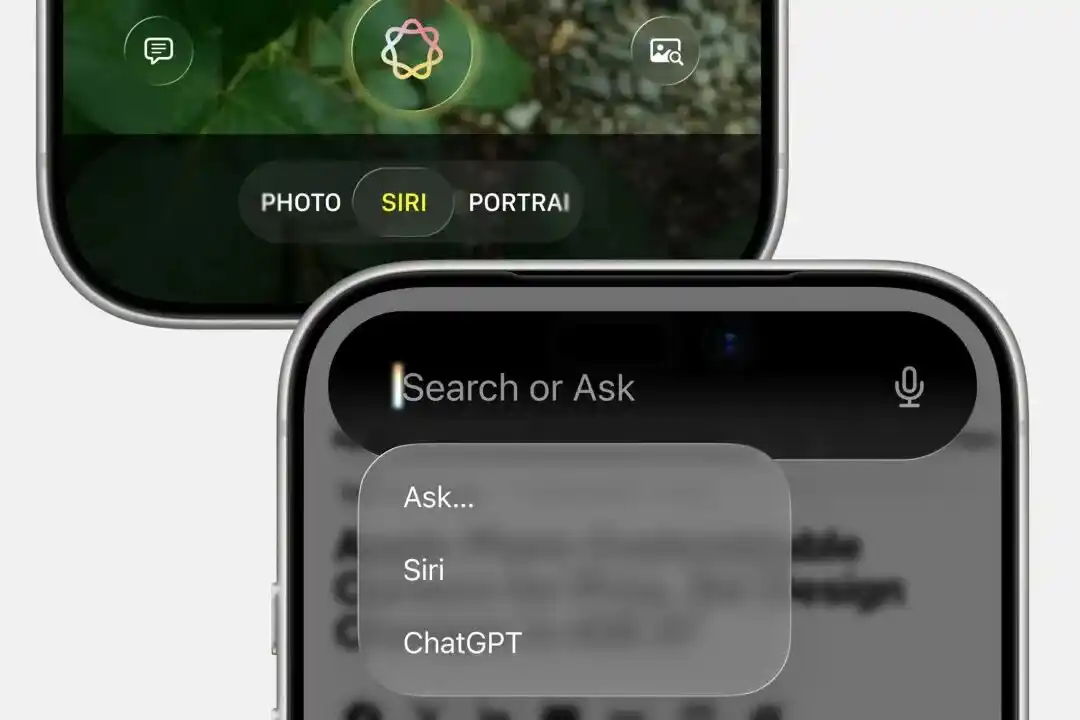
Reportedly, the scale of this Siri revamp is unprecedented since Siri's debut with the iPhone 4S in 2011. The new interface adopts a dark color scheme, is rebuilt with a chatbot interaction paradigm, and is deeply integrated with the Dynamic Island.

More crucially, Apple will allow users to directly 'plug in' Google's Gemini and Anthropic's Claude into the Siri experience—Siri is set to become a distribution platform for AI models.

Everyone will wonder, what will Siri infused with AI actually look like?

01. A Complete Interface Overhaul

According to a Bloomberg report, the new version of Siri has several core changes. Looking at them together reveals Apple's complete logic.
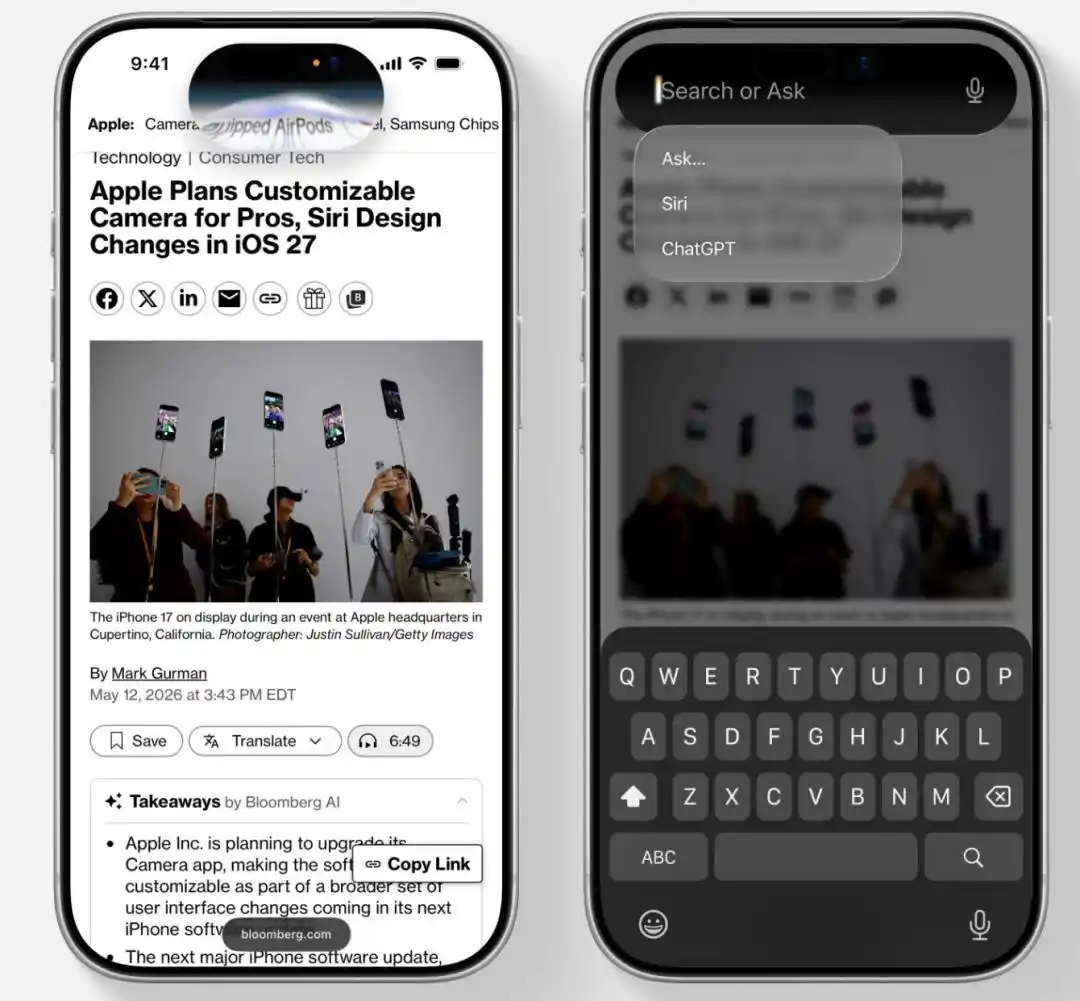
Possible Siri and Dynamic Island fusion interaction | Image source: Instagram

The first is a complete interface rebuild. A chatbot-style interaction interface, dark color scheme, Dynamic Island integration—Siri transforms from a 'pop-up layer' into an independent application experience entry point. This is more than a visual upgrade; it importantly implies that Apple wants users to treat Siri as a tool they 'actively use', not a voice command line occasionally summoned.

The second is conversational persistence. For years, one of the biggest pain points of talking to Siri was its lack of memory. Every wake-up started from zero—no context, no continuity. The new Siri reportedly fixes this issue—it sounds like a small thing, but it's the foundational condition for the 'assistant' feeling to be valid.

The third, and most noteworthy, is the 'Extensions framework'—allowing third-party AI models to plug into Siri.

The deeper implication of this design is that Apple is no longer taking 'building the best AI model' as its sole path, but rather repositioning iOS as 'the platform for the best AI models to compete'. Just as the App Store doesn't require Apple to develop all apps itself, the new Siri ecosystem doesn't need Apple to outperform everyone in model capabilities—it just needs to bring in all the models and retain users through system-level integration.

Put simply, Apple is fighting the 'model' war with a 'platform' logic.

02. Siri's Three Years of Debt

To understand the weight of this revamp, one must first understand how passive Apple has been in recent years.

In 2023, ChatGPT burst onto the scene, redefining 'conversational AI'. In 2024, Google embedded Gemini into Android, and Samsung turned AI features into selling points. The entire industry accelerated at a breakneck pace, and what was Siri doing? It was still misunderstanding user commands, still interpreting 'set an alarm for 8 AM tomorrow' as opening the alarm app.

Apple, of course, hasn't been idle. At WWDC 2024, Apple Intelligence debuted with great fanfare, promising a host of deeply integrated AI features. But the reality is that many features were either delayed, available only in specific regions, or their actual experience fell far short of the on-stage demos. A long-time Apple tech analyst bluntly stated, 'This doesn't feel like a finished comeback; it feels more like Apple finally arrived at the AI race—only to find itself still in mid-development.'

After three years of accumulated disparity, Apple desperately needs a true turnaround victory.

Two days ago, Apple quietly launched the subdomain genai.apple.com. This small move created significant ripples in tech circles—many interpreted it as a signal that Apple is making final public relations preparations for this WWDC's 'AI transformation'.

03. The Must-Answer Conundrum

But there is a paradox here, already being discussed by many media outlets.

One of Apple's long-standing core moats is privacy. 'Your data is processed only on your device' is Apple's core promise to users and the reason for architectures like Private Cloud Compute.

Now, to make Siri more powerful, Apple is planning to introduce Google's infrastructure to handle some AI queries.

This isn't a technical problem; it's a trust problem.
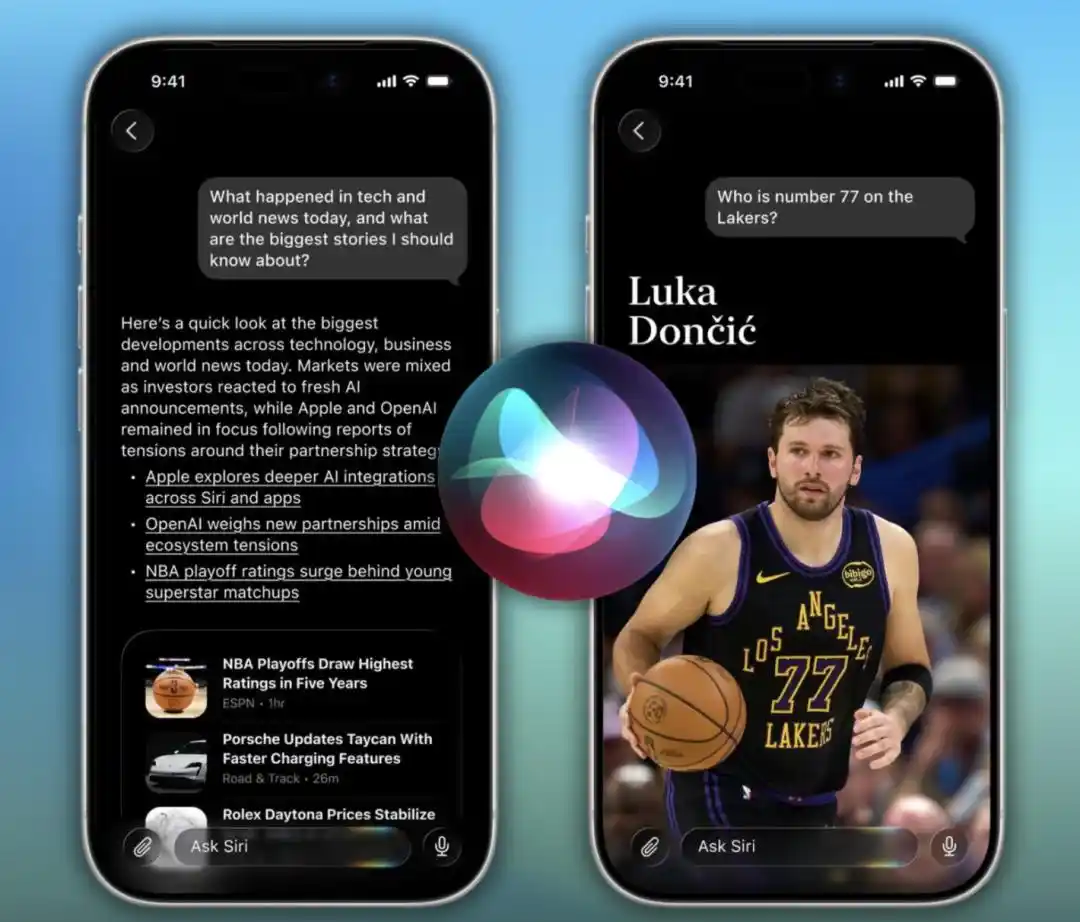
Possible Siri Q&A interface | Image source: Instagram

When Apple personally breaks the red line of 'only using its own computing infrastructure', its privacy promise to users is no longer absolute. Users can, of course, choose not to use the Google Gemini integration, but 'can choose not to use' and 'doesn't touch by default' are two entirely different things. How Apple explains this shift to users during the keynote will be one of the most-watched details on June 8th.

Furthermore, there's an even more fundamental question. A user on Reddit asked a simple but pointed question—if the Claude inside Siri offers the same experience as using Claude directly, why would I use a shelled version?

Apple must provide a compelling answer, and currently, there seems to be only one candidate—system-level integration: an AI that can access contacts, calendar, photos, health data is a completely different experience from an AI that runs in isolation.

This is Apple's last and most important bargaining chip.

While there is much criticism of Apple's AI pace, a counter-narrative is also circulating—maybe Apple is slow because it's waiting for others to step on the landmines first.

Over the past two years, OpenAI, Google, and Meta have invested hundreds of billions of dollars in data centers, chips, and model training, raising concerns about an AI bubble. In contrast, Apple's strategy seems to be: don't rush to build the 'strongest model', but once the track stabilizes, use its core strength of 'system integration' to catch up from behind.

To some extent, the iOS 27 layout is fulfilling this logic. Don't compete head-on in model capability, but bring in both Gemini and Claude, then build differentiated experience moats using capabilities Android cannot replicate, like the Dynamic Island, personal data permissions, and on-device processing.

This isn't a hasty catch-up by a laggard; it's a calculated bet.

The bet is: the endgame of AI is not about whose model is strongest, but whose system uses models most seamlessly.

On June 8th, Apple will present its complete answer. Whether Siri can truly impress users already accustomed to ChatGPT and Gemini will be the real test of this high-stakes gamble.

Fifteen years later, Siri owes its users an explanation.

*Cover image source: Instagram

This article is from the WeChat public account "GeekPark" (ID: geekpark), author: Hua Lin Wu Wang


Related Questions

QWhat is the most significant change to Siri's interface according to the article?

AThe most significant change is a complete rebuild of Siri's interface, adopting a chatbot-style interactive interface with a dark color scheme and deep integration with Dynamic Island. This transforms Siri from a pop-up layer into an independent application experience entry point.

QWhat is one of the biggest historical shortcomings of Siri that the new version aims to fix?

AOne of the biggest historical shortcomings is Siri's lack of conversational persistence. Siri did not remember context from previous interactions, forcing users to start from scratch with each new request. The new version reportedly fixes this by introducing memory and continuity to conversations.

QHow is Apple's strategy for the new Siri described in relation to competing AI models?

AApple's strategy is described as positioning iOS as a 'platform for the best AI models to compete.' Instead of solely trying to build the best AI model itself, Apple is introducing an 'Extensions framework' to allow third-party AI models like Google Gemini and Anthropic's Claude to be integrated into Siri. This approach uses a 'channel' logic to compete in the 'model' war.

QWhat privacy paradox does Apple face with the new Siri, according to the article?

AApple faces the paradox of needing to utilize external AI infrastructure, like Google's, to enhance Siri's capabilities, which may conflict with its long-standing core promise of user privacy that emphasizes on-device data processing. This move challenges Apple's principle of 'only using its own computing infrastructure' and raises a user trust issue that Apple must address.

QWhat is described as Apple's 'final and most important chip' in creating a differentiated AI experience?

AApple's 'final and most important chip' is its system-level integration. The ability of its AI to access and utilize personal data from contacts, calendar, photos, and health data—coupled with features like Dynamic Island and on-device processing—creates a fundamentally different experience compared to isolated AI models, which Android cannot easily replicate.

Related Reads

How to Define "Real U.S. Stocks": Differences Between On-Chain Tokens, Price Contracts, and Direct Broker Connections

**Title:** Defining "Real US Stocks": Differences Among On-Chain Tokens, Price Contracts, and Broker-Direct Access **Summary:** In 2026, using stablecoins to purchase US stocks is mainstream, but products marketed as "buying US stocks with USDT" offer fundamentally different assets. This article analyzes three primary models. **1. Tokenized Stocks:** These are on-chain tokens representing economic exposure to underlying stocks, held by an issuer or custodian. They offer benefits like 24/7 trading and DeFi composability (e.g., use as loan collateral). However, users lack direct legal shareholder status; dividends may not be paid in cash, and voting rights are typically non-binding advisory expressions. Examples include platforms like Ondo Finance. **2. Stock Futures / Equity Perpetuals:** These are derivative contracts tracking a stock's price, allowing leveraged long/short positions 24/7, similar to crypto perpetuals. They offer high efficiency and flexibility but involve funding fees, which can be a significant long-term cost, especially during strong trends. Crucially, they confer no ownership rights (dividends, voting) to the holder. **3. Broker-Direct Model:** This model provides access to real securities via licensed broker-dealers. Stocks/ETFs are bought and held within the US clearing and custodial system (e.g., DTCC), making it the only path to genuine stock ownership. Users receive cash dividends and formal proxy voting rights (where applicable). It supports thousands of stocks and ETFs, far exceeding the coverage of the other two models. Key advantages include no funding fees, a clean cost structure for long-term holds, and the potential to transfer holdings to other brokers. Some platforms facilitate stablecoin (USDT/USDC) deposits, reducing reliance on traditional banking. A critical distinction exists *within* the broker-direct model: the underlying brokerage architecture (e.g., Fully Disclosed IB, Omnibus IB, Self-Clearing) determines how client assets are held, protected, and how safeguards like SIPC insurance are conveyed. Users should verify the specific clearing structure and regulatory compliance of any platform. In conclusion, "buying US stocks with USDT" can mean holding an on-chain economic proxy (Tokenized Stocks), trading a price derivative (Stock Futures), or owning the actual security (Broker-Direct). For users seeking full ownership rights and long-term investment, the broker-direct model is the definitive choice, though its implementation details require careful scrutiny.

marsbit39m ago

How to Define "Real U.S. Stocks": Differences Between On-Chain Tokens, Price Contracts, and Direct Broker Connections

marsbit39m ago

NVIDIA Launches DSX Platform, Expanding into AI Factory Infrastructure

NVIDIA has unveiled the DSX platform at its GTC Taipei event, marking a strategic expansion from GPU sales into comprehensive AI factory infrastructure solutions. The platform addresses challenges like power supply, cooling, and resource orchestration as AI models scale, shifting the industry focus from single-chip performance to overall infrastructure efficiency. DSX integrates NVIDIA's chips, systems, software, and partner technologies to cover the entire AI factory lifecycle—from design and simulation to deployment and operations. It aims to accelerate deployment, improve reliability and operational efficiency, and reduce the cost per generated token in AI inference. The software suite includes DSX MaxLPS, which uses 45°C liquid cooling and rack-level optimization to allow up to 40% more GPUs per megawatt, and DSX OS, an open-source platform for AI factory operations. The platform also encompasses reference designs, digital twin simulation (DSX Sim), dynamic workload adjustment based on grid conditions (DSX Flex), and data exchange between systems. Early adopters include cloud providers like CoreWeave and Lambda. Major hardware partners, including Dell, HPE, Lenovo, and Supermicro, are developing DSX-ready systems. Pilot projects for DSX Flex are underway with energy providers. Strategically, DSX represents NVIDIA's ongoing transition from an AI chip supplier to a full-stack AI infrastructure platform provider, aiming to set industry standards and solidify its market leadership.

marsbit44m ago

NVIDIA Launches DSX Platform, Expanding into AI Factory Infrastructure

marsbit44m ago

After Burning Tens of Billions of Dollars in Tokens, Silicon Valley Giants Start Limiting Employee Token Usage

After burning tens of billions of dollars on AI tokens, major Silicon Valley firms are now restricting employee usage. Companies like Microsoft, Uber, and Salesforce, which heavily promoted AI for "efficiency," are facing a cost crisis. The practice of "tokenmaxxing"—pushing employees to maximize AI tool usage—led to wasteful spending on trivial tasks like checking the weather or writing birthday messages, with studies showing significant hidden costs for bug fixes and code rewrites. The core issue is a misalignment between individual productivity gains and actual business value. While employees use AI to automate tasks they dislike, such as writing reports, this often doesn't translate to increased company revenue or improved core business outcomes. For instance, AI-generated code speeds up development but also sees an 800% increase in "code churn" (code being discarded or rewritten). As a result, only 14% of CFOs report seeing a clear, measurable return on AI investments. Firms are now shifting strategies. Microsoft has revoked most internal licenses for Claude Code, while others are implementing monitoring and cost controls. New tools from companies like Harness and CloudZero aim to track AI spending and tie costs to business results. Some AI vendors, like HubSpot, are moving from token-based pricing to charging based on outcomes, such as "resolved conversations" or "leads generated." This represents a necessary correction in the AI adoption cycle. The challenge now is for companies to move beyond using AI merely to speed up old tasks and instead rethink their workflows and business models fundamentally. The future of enterprise AI depends on proving its value, not just its usage.

marsbit1h ago

After Burning Tens of Billions of Dollars in Tokens, Silicon Valley Giants Start Limiting Employee Token Usage

marsbit1h ago

Trading

Spot
Futures

Hot Articles

Discussions

Welcome to the HTX Community. Here, you can stay informed about the latest platform developments and gain access to professional market insights. Users' opinions on the price of AI (AI) are presented below.

活动图片














