The First Case on AI Agents: What Was Adjudicated?

marsbitPublished on 2026-06-08Last updated on 2026-06-08

Abstract

"The First 'Agent' Ruling: What Was Decided?" On April 30, the Guangzhou Internet Court issued a ruling—China's first behavior preservation order in the intelligent agent (AI agent) field. The defendant, an open-source AI agent software, was ordered to stop downloads, cease actions that bypassed a platform's technical protection measures, and delete related tutorials and data. The core issue: the software used the operating system's "accessibility service" permissions to automate user interactions within other apps without those platforms' authorization. This mirrors a recent US case where Amazon sued Perplexity for similar reasons—bypassing Amazon's API to directly scrape and interact with its pages—and won a preliminary injunction. Both rulings establish a crucial legal boundary for the AI agent era: agents cannot operate unchecked. The article argues the fundamental legal principle emerging is one of **dual authorization**. An AI agent requires both **user consent** AND **platform consent** to operate legitimately within that platform's ecosystem. Bypassing platform rules through system-level permissions, even with user permission, undermines platform responsibilities for content moderation, data security, and user privacy, creating liability issues. The piece uses the evolution of "Doubao Phone" (an AI-integrated smartphone) as a case study. Its initial, aggressive version that bypassed platform controls faced roadblocks. Its upcoming 2.0 version is reportedly pivotin...

By Wave Not Crazy

On April 30, the Guangzhou Internet Court issued a ruling.

The defendant was an open-source AI agent software. The reason for the lawsuit: It called the underlying operating system permissions without authorization, circumvented the plaintiff platform's technical management measures, and achieved automated operations.

The court ruled: Immediately stop providing downloads, immediately stop the act of circumventing technical measures, delete relevant tutorials, and delete relevant data.

This is the first behavior preservation ruling in the field of AI agents in China.

Less than two months ago, the United States District Court for the Western District of Washington was also hearing an almost identical case: Amazon sued Perplexity, alleging that the latter bypassed Amazon's API to directly operate Amazon's pages. Amazon won, and the court issued a preliminary injunction.

In two lawsuits in China and the United States, one using a behavior preservation ruling and the other a court injunction, both are setting the same "legal bottom line" for the AI agent era—AI agents cannot act recklessly.

It is said that this year AI has entered the era of agents. These two lawsuits are of significant indicative value. After digesting the news, your Bro Wave found that there is an even more thought-provoking question behind this:

Why are they the targets?

01 Two Judgments, Same Principle

If you look carefully at the complaint in Amazon's lawsuit against Perplexity, the core is just one sentence:

Perplexity bypassed our API, directly operated our pages, and undermined our technical management measures.

Translated, this means: You used our things without our permission.

There is a specific legal term for this: "circumventing technological protection measures." It is explicitly prohibited both in China's "Anti-Unfair Competition Law" and in the U.S. "Computer Fraud and Abuse Act" (CFAA).

But why Perplexity?

Because Perplexity is currently one of the most aggressive AI agent companies. Its product logic is: Users grant me authorization, and I can operate any platform on behalf of the user.

This logic sounds reasonable—the user authorized it, why should the platform interfere?

But platforms and courts see it differently.
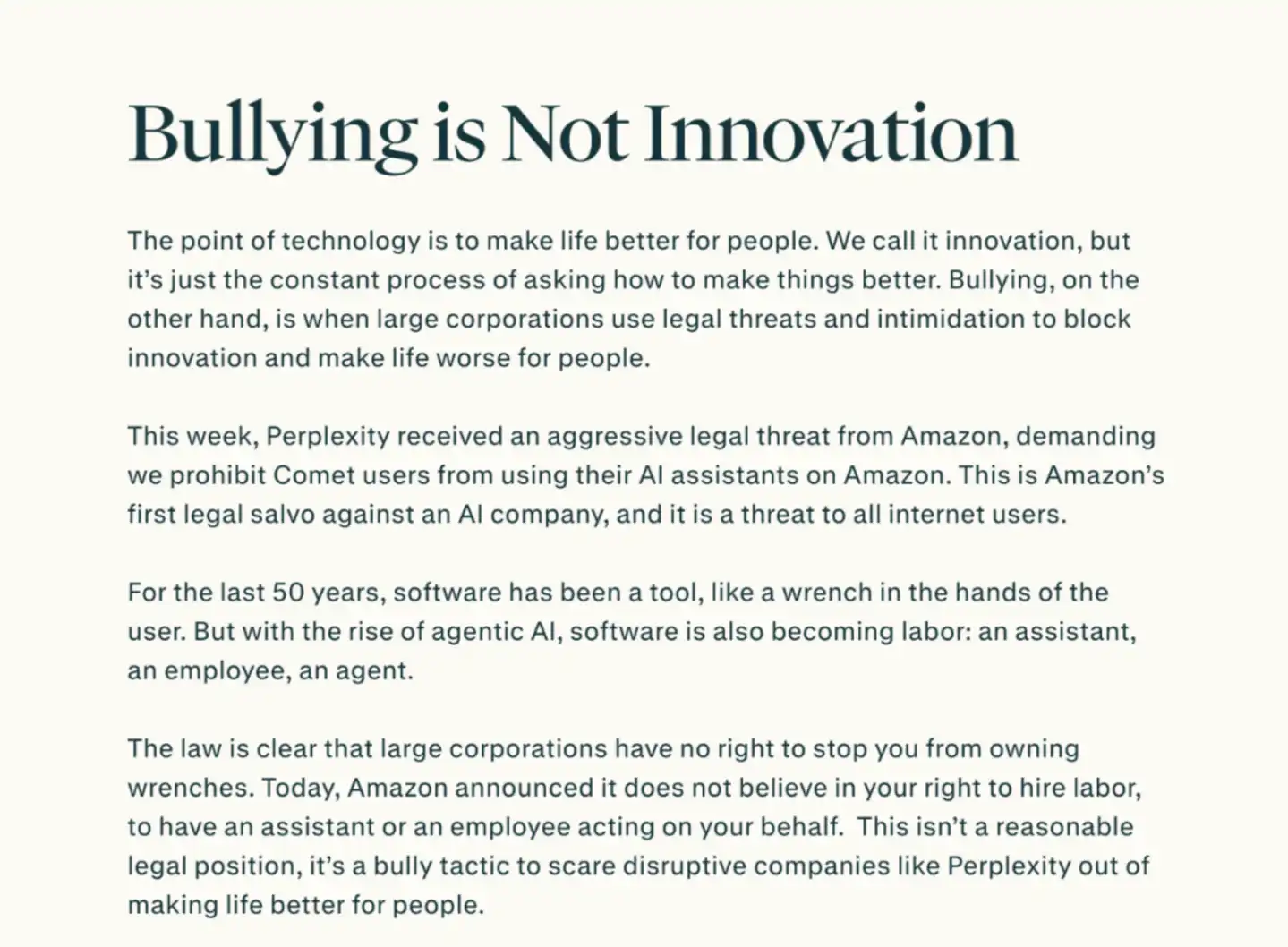
Perplexity's official website article criticizing Amazon for being a bully

Because there is a second layer of authorization: platform authorization.

To operate Alipay, you need not only the user's consent but also Alipay's consent. To access WeChat chat records, you need not only the user's consent but also consider whether others in the group chat are aware. To operate Amazon, you need not only the user's consent but also Amazon's consent—the platform has the right to decide who can operate within its territory.

The problem with Perplexity lies in this: It only obtained the user's authorization, not the platform's.

If a small-scale AI agent company does this, the platform might not bother. But Perplexity's current daily active users have reached a level that forces Amazon to take notice.

Now look at the domestic case.

The defendant is an open-source AI agent software, with an operational logic almost identical to Perplexity's: It calls the operating system's "accessibility service" permissions to click, swipe, and input on behalf of the user.

This "accessibility service" permission was originally intended for people with disabilities, but AI agents have turned it into a tool to "bypass platform rules."

Because "accessibility service" is a permission at the operating system level, higher than permissions at the app level. Once this permission is obtained, it's like getting a "master key" that can open any house. The AI agent can then operate any app without needing separate authorization from each one.

Platforms, of course, do not welcome this "master key."

Many interpret this as commercial competition, fearing others will take their turf, but that's too simple. From a legal perspective, it's a question of whether rights and responsibilities are balanced.

Once an AI agent can bypass platform rules, all the content review, data security, and user privacy protection mechanisms that platforms have built up over the years become ineffective.

Douyin (TikTok) is not against you using external AI agents; it's against you bypassing its review mechanisms. Meituan is not against you using AI agents; it's against you bypassing its data security rules. The logic is simple: If a user's delivery address and phone number are leaked, who is responsible?

This isn't about whether you can use it; it's about who the user holds accountable if something goes wrong after using it.

02 The AI Phone Following the Trend

Speaking of this, the iterative path of a blockbuster product is worth comparing: Doubao Phone.

In 2025, Doubao Phone 1.0 chose an aggressive path: directly obtaining underlying operating system permissions from phone manufacturers to operate other apps on behalf of the user. Order takeout, hail a ride, send a WeChat message—all with one sentence.

This path soon proved infeasible. It kept running into security walls and was later forced to suspend some automated operation scenarios itself.

A product hailed as the "First Phone of the AI Era" hit a wall when facing the ecosystem.

Where did the problem lie? Again, that term: Dual Authorization.

Doubao Phone obtained user authorization but did not obtain authorization from any platforms, not even its own Douyin (TikTok). Legally, this is a "gray area"—the user did authorize it, but the platform definitely did not.

The ruling from the Guangzhou Internet Court draws a clear red line for this gray area.

Doubao Phone is also astute; it didn't confront head-on but chose a smarter path: a rapid change of course.

Recent reports indicate that Doubao Phone 2.0 will be released in the first half of the year. Unlike version 1.0, version 2.0 is negotiating authorizations one by one with ecosystem partners. It is said that agreements may have been reached with the Alibaba ecosystem, opening necessary permissions, i.e., API interface cooperation, for high-frequency scenarios like ride-hailing, food delivery, and ticket booking. This is equivalent to being compatible with Alibaba's Qianwen AI agent.
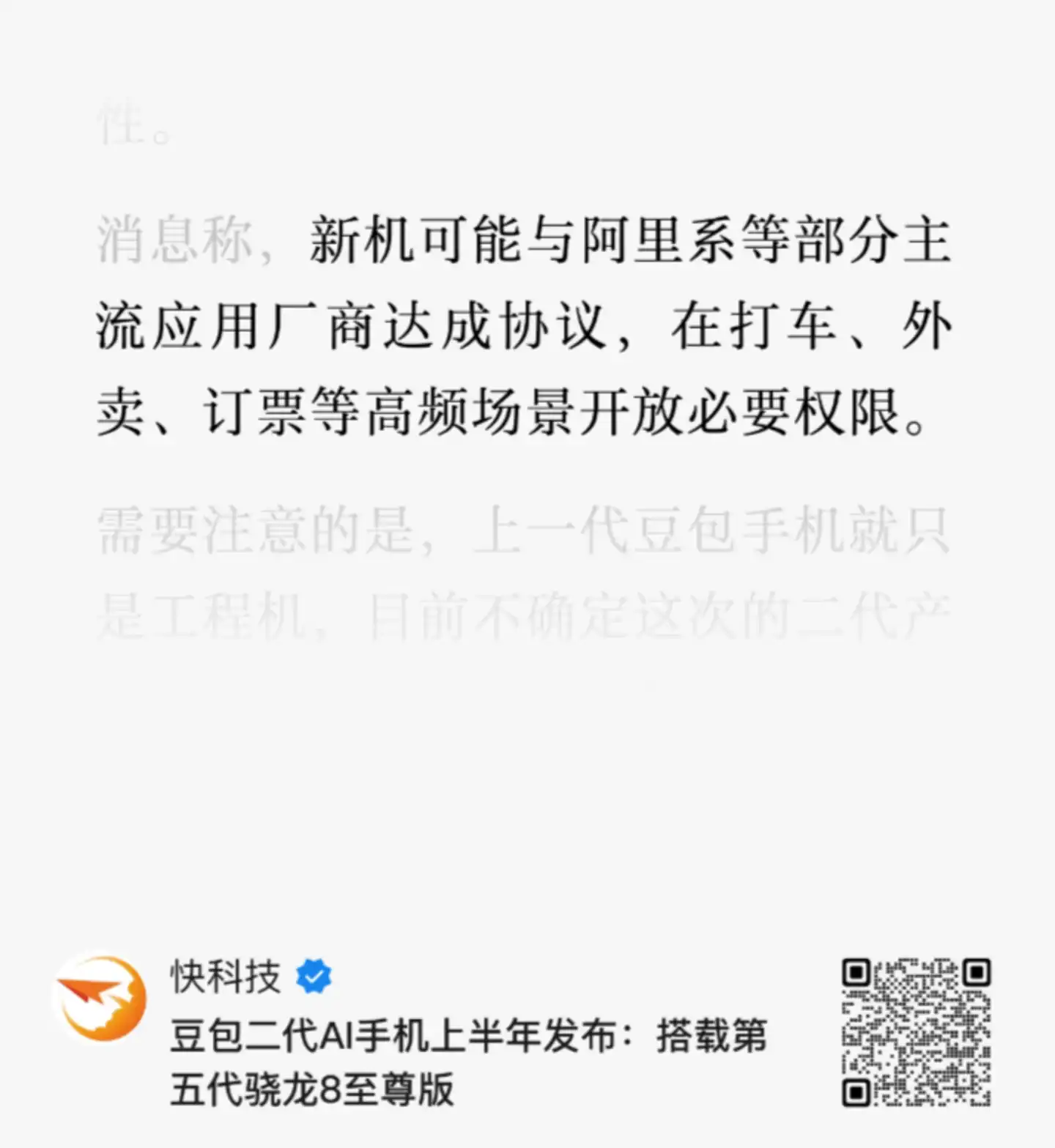
Following this win-win model, interface cooperation with WeChat, Meituan, Alipay, and JD.com is also within sight.

Looking at the judicial precedent again, you can't say Doubao Phone compromised. Rather, it demonstrates a strategic capability of recognizing the times.

The judiciary provided the answer: Bypassing platform rules won't work. So, take the proper path—negotiate one by one.

This is what a major company aiming to build a world-leading AI agent product should look like.

03 A Shared Consensus Is Forming

Looking at three things together: Amazon vs. Perplexity in the U.S., the Guangzhou Internet Court ruling, and Doubao Phone's shift from "bypassing" to "negotiating."

A global trend can be observed:

The era of unbridled growth for AI agents is over; the era of compliance competition has begun.

This shift has multi-layered impacts on the industry.

First, compliance costs are becoming the "entry fee" for AI agent companies. Before, making an AI agent only required caring about "whether it could be made." Now, they must also care about "whether it can legally operate on other platforms." This gives larger AI agent companies (those with resources to negotiate authorizations) a greater advantage. Small and medium-sized AI agent companies will either be acquired or pivot to developing "AI agents within platforms."

Second, "dual authorization" is becoming an industry standard. This actually aligns with user interests. Users aren't afraid of AI helping with operations, but they fear AI operating secretly. If every AI agent requires both "platform authorization + user authorization" to operate, users can feel more at ease.

Furthermore, open source can no longer be a reason for exemption. In the domestic case, the defendant argued, "I am open-source software, non-profit, and should not be restricted." The court did not accept this. Because open source does not equal exemption from liability. Even if you are open source, if your code is used to circumvent technical protection measures, you are responsible.

Returning to the initial question: Many are making AI agents. Why were these first penalized?

The answer is actually quite simple: It's not because they are the largest, but because they are the most aggressive and the most representative.

Perplexity is one of the most aggressive AI agent companies in the U.S. The domestic open-source software is also one of the earliest practitioners of "bypassing platform rules."

Penalizing them first isn't because they are the "worst," but because they are the "most typical."

This is a wisdom in regulation: targeting the most typical and aggressive ones makes the rest adjust on their own.

It is foreseeable that more AI agent companies will negotiate authorizations with platforms, more platforms will introduce "AI Agent Access Specifications," and fewer courts will hear similar cases.

The rules of the game for the AI agent industry have been quietly redefined.

Trending Cryptos

Related Questions

QWhat are the key legal issues raised in the first domestic case involving an intelligent agent?

AThe key legal issue was that an open-source intelligent agent software allegedly bypassed the plaintiff's technical protection measures by invoking underlying OS permissions (specifically, 'accessibility services') to perform automated operations without authorization. The court ordered it to cease distribution, stop bypassing technical measures, and delete related tutorials and data, establishing that such actions violate rules against circumventing technical protection measures.

QWhy is the 'dual authorization' concept critical in regulating intelligent agents?

ADual authorization is critical because it ensures that an intelligent agent must obtain both the user's consent and the platform's authorization before operating on that platform. This prevents agents from bypassing platforms' content moderation, data security, and privacy mechanisms, which could lead to unchecked risks and unclear liability if problems arise, such as data breaches.

QHow did the Doubao Phone (Bean Bag Phone) adapt its strategy following the legal ruling?

ADoubao Phone shifted from its initial aggressive approach of using OS-level permissions to directly operate other apps without platform consent. For version 2.0, it is now negotiating API access agreements with ecosystem partners (like Alibaba) to obtain proper platform authorization, moving towards a compliant cooperation model instead of bypassing rules.

QWhat global trend does the article identify regarding the development of intelligent agents?

AThe article identifies a global trend where the era of unchecked, 'wild growth' for intelligent agents is ending, transitioning into an era of 'compliance competition.' This means legal and regulatory compliance, particularly regarding platform authorization and technical measure circumvention, is becoming a new standard and barrier to entry in the industry.

QWhat is the significance of targeting Perplexity and the open-source software in these cases according to the article?

ATargeting Perplexity and the open-source software is significant because they were among the most aggressive and representative examples of intelligent agents bypassing platform rules. By addressing these prominent cases first, regulators and courts aim to set clear legal precedents, which are expected to prompt the broader industry to self-adjust and comply, thereby efficiently shaping new rules for the entire sector.

Related Reads

Misjudged A-Shares: Resilience, Expectations, and Confidence

China's A-share market recently faced selling pressure, especially in tech sectors, initially triggered by a global tech sell-off that began in South Korea. However, the article argues this is a case of "mistaken injury" and highlights the market's underlying resilience. This resilience stems from three main pillars: **1) Tech Sector Fundamentals:** Unlike Korea's market dominated by a few memory chip stocks, China's tech sector is diversified across computing, communications, electronics, and semiconductors, supported by dual narratives of global AI supply chains and domestic substitution. Core areas like optical modules and fiber optics continue to show strong earnings growth. **2) "National Team" Support:** State-backed institutions and large corporations have made significant market purchases and announced buybacks, providing liquidity and signaling confidence. This is seen as a stabilizing policy signal, often associated with market bottoms. **3) Broader Market Pillars:** Other major sectors are showing endogenous recovery momentum. Consumer stocks benefit from stabilizing CPI and signs of sector recovery (e.g., liquor price hikes). Cyclical sectors like aluminum have high earnings, potential price increases due to tight supply, and low valuations. The financial sector offers stable dividends and low valuations. The conclusion is that the sell-off was driven by external contagion, not a collapse in fundamentals. With strong policy support and recovering momentum across key sectors, the A-share market possesses the toughness to regain stability.

marsbit7m ago

Misjudged A-Shares: Resilience, Expectations, and Confidence

marsbit7m ago

The Clarity Act's Journey Through Congress: The Thorny Path of Bipartisan Compromise in the U.S.

The U.S. Congress is struggling to advance the crypto market structure bill known as the Clarity Act, with bipartisan compromise proving difficult. Key hurdles include unresolved disputes over "yield" products and, more critically, the inclusion of strong ethics provisions for elected officials—a non-negotiable demand for many Democrats. While a compromise on yield was reached in May, securing only limited Democratic support in committee, the separate Senate Agriculture Committee version later passed with no Democratic votes due to the ethics impasse. As Republicans push for a full Senate vote in July, demands for ethics rules have expanded, and other contentious issues like developer protections and concerns from law enforcement and large banks further complicate negotiations. Despite consensus on the need for legislation, the path forward is unclear. Recent discussions between senators and White House officials aim to find acceptable ethics language. Some lawmakers question whether a compromise text can garner enough bipartisan support, with one Democrat stating the current proposal lacks the strong ethics provisions required for their vote. Potential short-term goals for the crypto community include symbolic Senate action before the August recess, a longer-term aim for passage by 2026, or establishing a detailed framework that addresses ethics and other compromises. The process remains arduous, relying on the traditional, vote-by-vote effort to build bipartisan support.

marsbit27m ago

The Clarity Act's Journey Through Congress: The Thorny Path of Bipartisan Compromise in the U.S.

marsbit27m ago

Are Kalshi and Polymarket Founders at Odds? This Business Rivalry Is More Brutal Than You Think

"The Rivalry Between Kalshi and Polymarket Founders Turns Bitter and Litigious" The intense feud between Tarek Mansour, CEO of Kalshi, and Shayne Coplan, founder of Polymarket, has escalated far beyond typical business competition into personal animosity and regulatory battles. Both lead billion-dollar prediction market platforms, but their approaches differ sharply. Kalshi positions itself as the compliant operator, securing U.S. regulatory approval before launching. In contrast, Polymarket initially operated offshore, allowing U.S. users to access its platform via VPN, which drew regulatory scrutiny. The conflict reached a peak in November 2024 when FBI agents raided Coplan's New York apartment. While Coplan publicly blamed political motives, his team privately suspected Kalshi was involved. According to sources, Kalshi's lawyers had previously reported Polymarket's operations to federal prosecutors, highlighting its accessibility to U.S. users despite a ban. This incident fueled mutual accusations and underhanded tactics, including social media smear campaigns and attempts to sabotage each other's major business deals. Their rivalry also played out in Washington, influencing regulatory debates. Kalshi actively lobbied against Polymarket's practices, framing them as illegal and unethical. Polymarket, after facing a CFTC fine and investigation, later acquired a licensed U.S. firm to launch a domestic app, regaining a foothold. Despite the hostility, both companies have seen massive growth, with combined trading volumes soaring. However, increased regulatory scrutiny, particularly around insider trading on Polymarket's platform, continues to pose challenges. The founders' deep-seated mutual disdain ensures their battle for market dominance remains as much a personal vendetta as a commercial one.

marsbit36m ago

Are Kalshi and Polymarket Founders at Odds? This Business Rivalry Is More Brutal Than You Think

marsbit36m ago

Trading

Spot

Hot Articles

Discussions

Welcome to the HTX Community. Here, you can stay informed about the latest platform developments and gain access to professional market insights. Users' opinions on the price of AI (AI) are presented below.

活动图片