Original / Odaily Planet Daily (@OdailyChina)
Author / Wenser (@wenser2010)
AI is devouring the world at an unprecedented speed, but the worldline has quietly diverged into two paths.
One path is the expansion of the AI landscape monopolized by tech giants: NVIDIA has become the world's first company with a market capitalization of $5 trillion, thanks to its chips and graphics card resources; Google and Amazon have successively entered the chip manufacturing arena, striving to secure advantageous positions; OpenAI, Anthropic, and other AI giants have seen their valuations soar to hundreds of billions of dollars. The other path is the rapid development at the micro-level of the AI industry: Jensen Huang, founder of NVIDIA, mentioned at CES 2025 earlier this year that "AI Agents are expected to become the next robotics industry, with an industry scale reaching trillions of dollars," which is gradually coming true. Tens of millions of AI Agents are permeating every aspect of human society daily, which also means that tech giants are gradually becoming the key players "holding the keys to the gates of the AI world." Based on the development history of the internet industry, many might wonder: Is AI about to become "another game for tech giants?"
Sentient's answer to this is—"No."
As an open-source AI platform adhering to internet fundamentalism, it previously secured $85 million in seed funding, led by prominent institutions including Peter Thiel's Founders Fund, Pantera Capital, and Framework Ventures. On the inevitable path of AI devouring the world, Sentient has chosen a route截然不同 from that of giant corporations. And this is precisely the "Prologue to Open-Source AGI" that Odaily Planet Daily will systematically deconstruct today.
First Look at Sentient: Raising the Banner of Open-Source AI, Challenging Monopoly Giants Valued at Hundreds of Billions
Last July, Sentient announced the completion of an $85 million seed funding round, with its backing investors堪称豪华—led by Peter Thiel's Founders Fund, Pantera Capital, and Framework Ventures; participants included Ethereal Ventures, Robot Ventures, Symbolic Capital, Delphi Ventures, Hack VC, Arrington Capital, HashKey Capital, Canonical Crypto, LD Capital, and Foresight Ventures, among other well-known VC investment institutions in the crypto industry.
It's worth noting that crypto projects securing this amount in seed funding have always been few and far between, let alone the strong endorsement from this series of star capital behind this investment. Previously, only a few天王级 L1 public chain projects could receive such powerful support. For a time, "What did Sentient rely on to gain such favor from capital?" became one of the hot topics in the crypto circle. Soon, the answer was provided.
Targeting OpenAI, Sentient Team Faces Giant Competition Head-On
In subsequent media interviews, several partners of Sentient's lead investors gave their answers—
Founders Fund partner Joey Krug stated that the primary reason for investing in Sentient was its team, praising the technical acumen of co-founders Sandeep (founder of Polygon) and Pramod (professor at Princeton University), among others; Pantera Capital managing partner Paul Veradittakit expressed that if AI development remains closed-source, many critical aspects of society will be vulnerable to the集中效应 of censorship and rent-seeking. Sentient's open, monetizable, and loyal (OML) AI model "has enormous potential to disrupt the AI development industry"; Framework Ventures partner Brandon Potts also gave high praise regarding the team and technology,直言 "The Sentient team is the most capable team to solve the economic problems of open-source AI."
In Sentient's impressive seed funding round, the golden rule of "investing in people" was vividly体现, and the team members behind the Sentient project can indeed be called a "founding dream team" (compiled from Grok)—
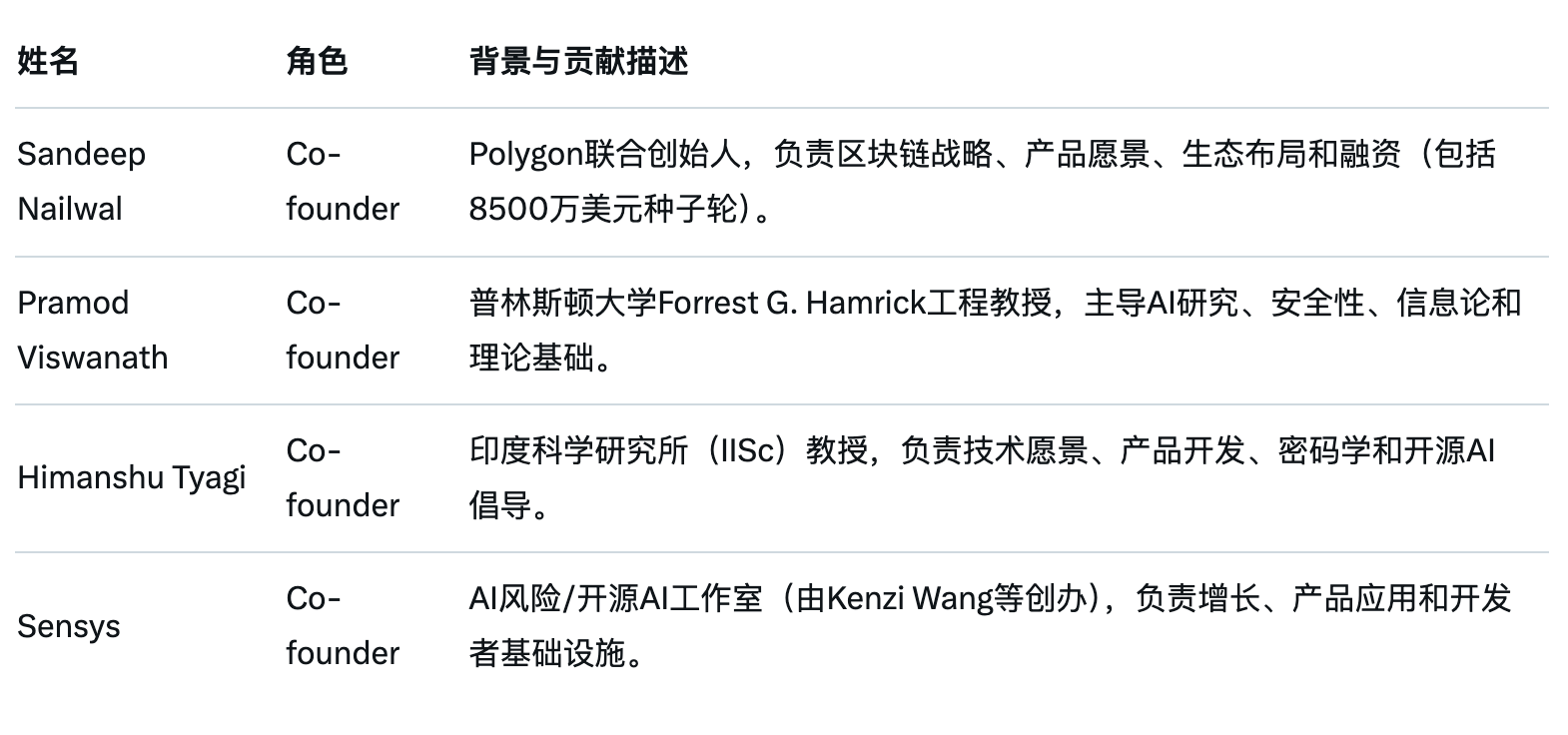
Sentient's 4 Co-Founders
More importantly, during this interview, Sentient's ambition was再次强调—to compete head-on with the AI giant, OpenAI, the company behind ChatGPT, with its main competitive手段 being the use of community contributions to build open-source AI models.
The Universal Value of an Open-Source AI Platform: Decentralization, Censorship Resistance, Monetization
Different from the closed-source models of AI giant companies like OpenAI, Anthropic, and Google, Sentient has chosen a "difficult but correct" path for AGI development—an open-source AI platform.
Using "taking a taxi" as an analogy, the AI models and applications provided by commercial companies like OpenAI and Anthropic are like "centralized AI platforms" that blindfold passengers. Users, as passengers, don't know the route, let alone whether the charges are reasonable; everything is subject to the "black box arrangements" of the commercial companies. In contrast, Sentient's open-source AI approach chooses to lay out the route, specific costs, and diverse options in front of users, allowing them to choose freely. Users can even "join the platform" to provide corresponding "solutions" for more users. Specifically, compared to the related products of existing AI monopoly giants on the market, Sentient's open-source AI platform has the following advantages:
1. Ensures diversity and interoperability of AI products. Unlike the single AI models of various giant companies, the Sentient platform offers users more AI models to choose from, and various AI models can产生一定的协作效应,具有一定的互操作性, enabling users to enjoy a one-stop AI experience.
2. Avoids downtime and malicious behavior issues of centralized AI applications and models. Previously, OpenAI's model training data involved issues like copyright infringement of news media. The fact that AI models avoid sensitive information of their parent companies and centralized censorship mechanisms is also indisputable. The recent Cloudflare outage that caused ChatGPT to go offline also reflected the "fragility" of centralized AI models from the side. In these aspects, Sentient's open-source AI can provide certain technical guarantees for the censorship resistance, security redundancy, and stable service of output content.
3. Disintermediation and efficiency improvement in the AI field. The main advantage of an open-source AI platform comes from "from the masses, to the masses." A decentralized architecture builds a multi-sided network that can directly connect developers and users, matching supply and demand more efficiently, allowing AI models to truly serve real market needs.
4. Monetization platform tools for AI application and development processes. Sentient's OML (Open, Monetizable, Loyal) AI model and the already launched open-source AGI network GRID can help AI models and applications use the SENT token economy to reward development, feedback the ecosystem, and quantify growth. While ensuring ownership, control, and alignment, Sentient has thus established a monetization platform network that balances AI development and commercial operation.
Based on the above unique advantages,时至今日, Sentient has already established a mature open-source AI ecosystem network.
Entering Sentient: Starting with Applications, Going Beyond Applications, Using Ecology to Fuel Network Growth
After about a year of development, Sentient has successively launched a series of self-developed products like Dobby, the Model Fingerprinting library, and Open Deep Search, the open-source AGI network GRID (Global Research & Intelligence Directory), ROMA (Recursive Open Meta AI Agent), and diverse network applications like the open-source AI research agent SERA-Crypto.
Moreover, with the emergence of GRID and the construction and gradual improvement of the SENT token economic model, the "AI Ecosystem Map" built around the Sentient open-source AI platform is also in a rapid phase of completion.
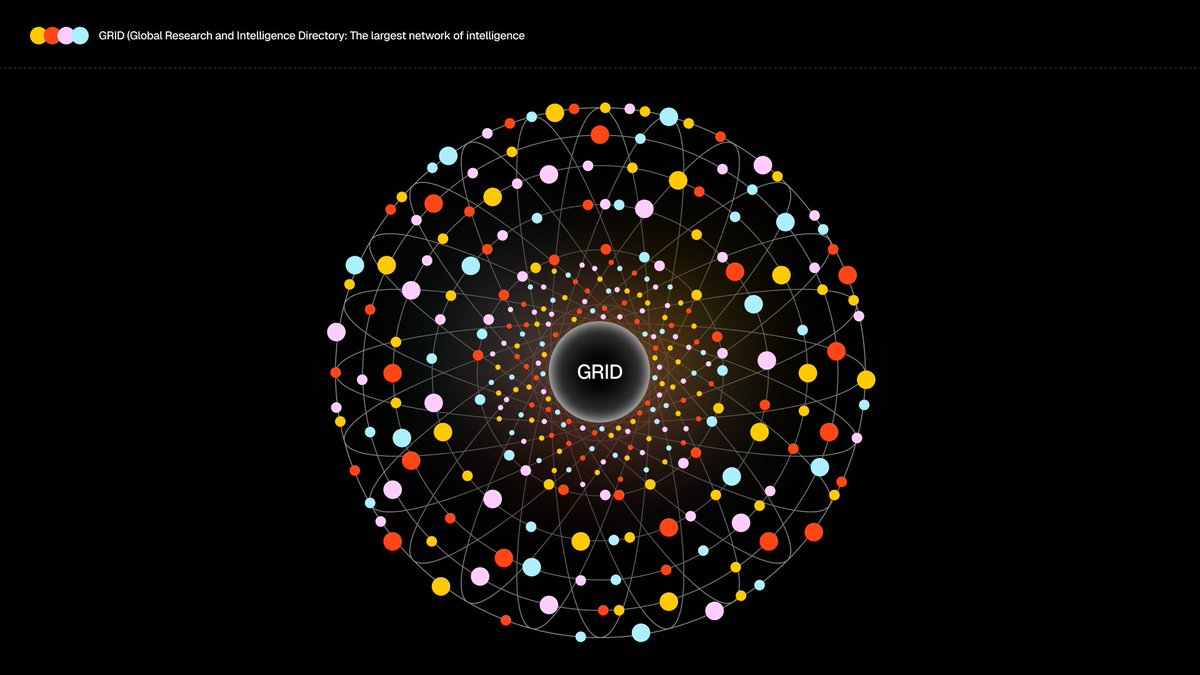
According to official news, the open-source AGI network GRID now includes over 110 partners, among which are:
- Over 50 professional AI agents;
- Over 50 professional data providers;
- 6 AI models;
- Over 10 computing and verifiable AI infrastructure suppliers.
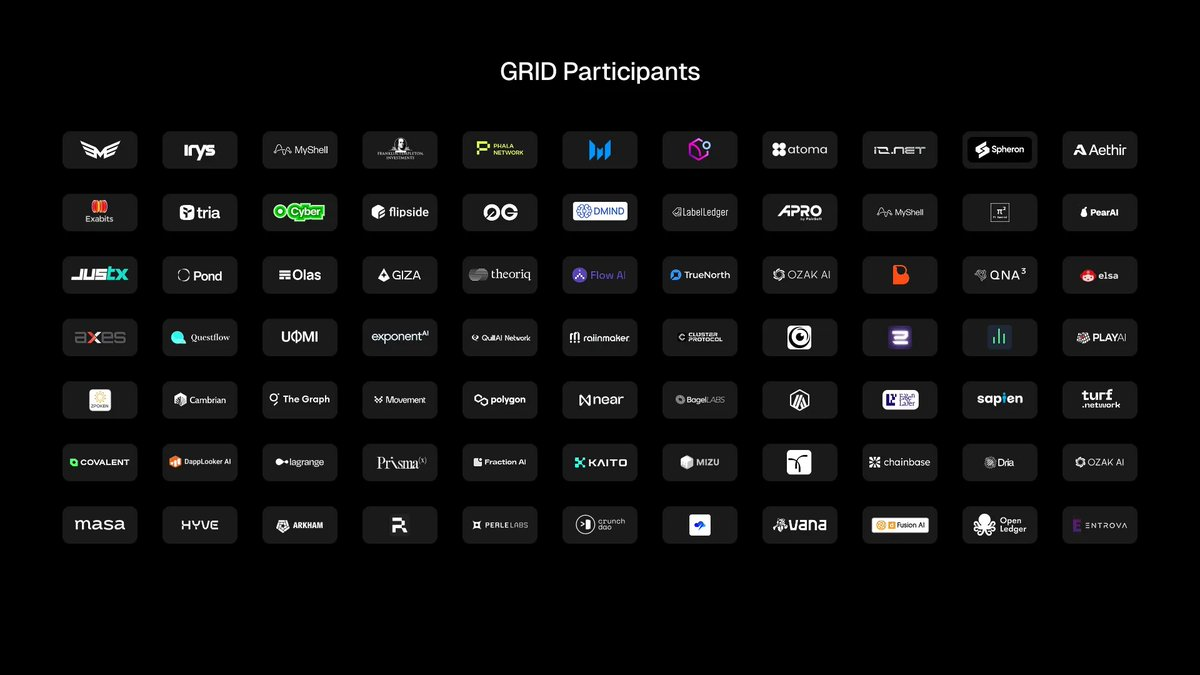
List of GRID Network Partners
Representative partners include the following projects: AI chart generation project Napkin, LLM (Large Language Model) search engine Exa, AI-driven people search platform Caldo, on-chain data tracking platform Arkham, enterprise-grade decentralized computing power platform Aethir,加密社交数据平台 Kaito,加密洞察代理平台 Messari Co-Pilot, blockchain indexing data platform The Graph, cryptocurrency exchange Crypto.com, Polygon public chain, and the Dobby Judge AI arbitration system EigenLayer network, etc. Based on the development of ecological synergy effects, the value of Sentient as an open-source AI platform is mainly reflected in two aspects: first, it can attract builders like developers, computing power, and data to participate in ecological construction; second, through token incentives and staking models, it can feedback the development of the open-source AI ecosystem. In particular, vertical AI models and applications closely integrated with the needs of the cryptocurrency industry are expected to experience a period of explosive growth.
A prime example is the open-source AI research agent SERA-Crypto recently launched by Sentient. Here we有必要多展开一下—For a long time, combining AI with cryptocurrency market trends to assist trading decisions has been a real need for countless people and a direction many developers have been striving to research. However, limited by the hallucinations of large models,难以实时更新的市场数据, and the complexity of querying on-chain status and operating wallet accounts, "an AI Agent born for crypto research" has始终处于缺位状态.
SERA Crypto emerged in response to this. This AI Agent,主打 "Semantic Embedding & Reasoning Agent Architecture,"甫一出世就摘获 the殊荣 of "the number one open-source agent on DMind"; in real-time crypto benchmark tests包含时间相关性、数据一致性、研究深度以及相关性, SERA Crypto ranked first with a score of 34.3 points, its overall performance even surpassing mainstream AI models like GPT-5, Grok 4, Gemini 3 Pro, and Perplexity Finance, with all operations completed within 45 seconds.
After integrating advantages like routing framing, data clarity, architecture optimization, and structured reasoning, SERA can filter out real-time, usable, and instructive reasoning information from the flood of "large and comprehensive but useless" and "small and beautiful but false" information. Thus, the Sentient team successfully created an "AI Agent that understands cryptocurrency better," rather than the previous僵化机器型助手 that seemed毫无思考能力、只会总结陈词. Of course, the creation of SERA also离不开 the nearly 300,000 users of the Sentient community and over 22 million user queries.
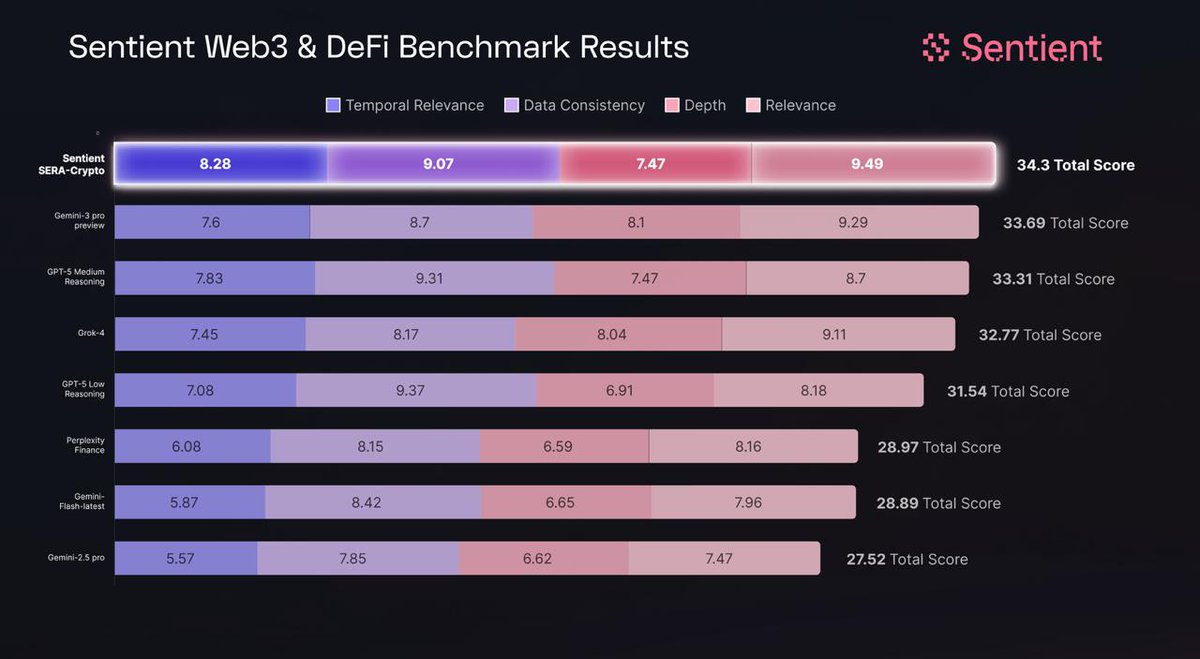
SERA Crypto Model's Comprehensive Performance Ranks First
From now on, users can use SENT tokens to access various AI applications (including various platform agent units) through the Sentient open-source platform to meet their real AI application reasoning needs; Sentient生态开发者 can receive SENT token incentives through user-paid fees; additionally, the SENT token staking model can, to a certain extent, ensure the smooth operation of the economic循环体系 within the ecosystem.
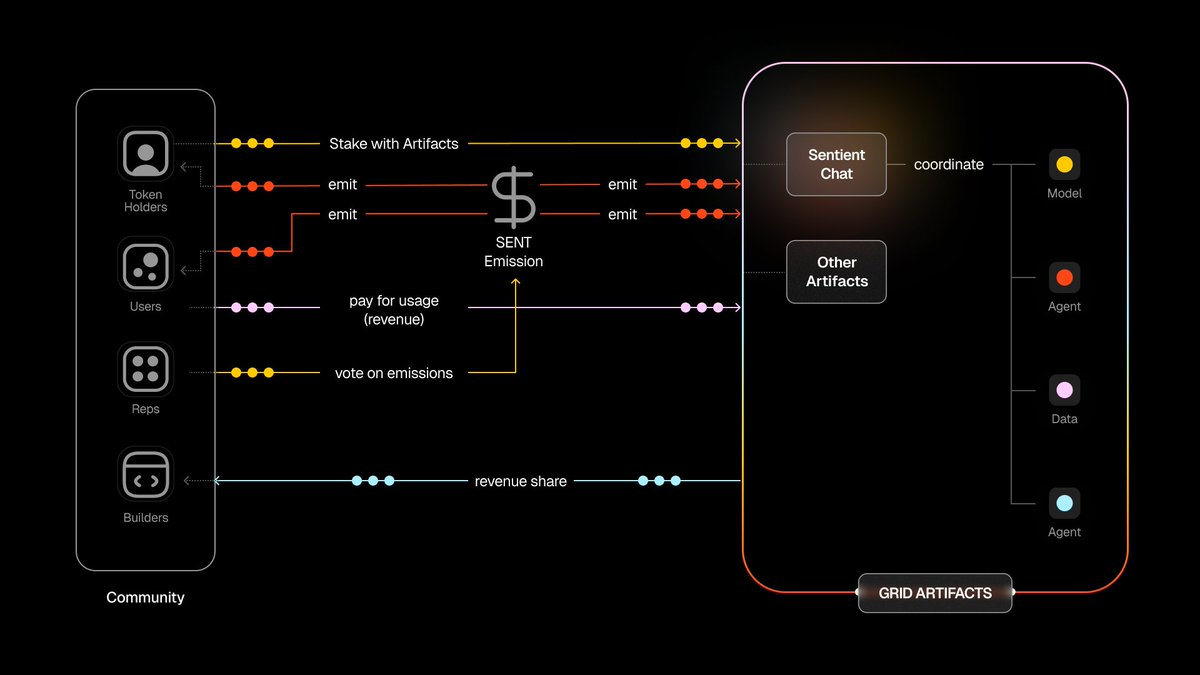
GRID Network and Sentient Community Ecological Flywheel Diagram
Ultimately, the monetized AI ecological economy built on the Sentient open-source AI platform彻底成型. The subsequent optimization direction evolved into—better AI models and applications attract more AI users and developers to participate and join, which in turn催生 more high-quality AI models and applications,共同构筑 a development flywheel integrating "users - tokens - developers - products" into one.
SENT Token Introduction: The "Core Energy" Driving the Open-Source AI Platform
As the "engine energy" supporting the continuous operation of Sentient's vast ecosystem, the role of the SENT token is crucial.
Previously, the SENT token was listed on OKX Pre-Market and Binance Futures; on December 6th, Coinbase officially announced adding SENT to its listing roadmap. Since then, as the core token of the Sentient ecosystem, SENT successfully achieved the feat of "landing on 3 major CEXs."
Previously, Sentient官方 announced on November 17th that the first season activity had ended. At that time, the token airdrop was mainly面向 Sentient community members (including Discord community members), AI chat users, crypto KOLs, open-source researchers, etc. On November 18th, its official airdrop registration link was officially opened, originally scheduled to close on November 29th. Later, the official extended the registration deadline to December 5th.
According to subsequently released official information and messages from official personnel, more SENT token incentives for the community will be closely related to content contributions on social media platforms like X and the AI mind share份额 on加密社交数据平台 like Kaito.
Apart from常规 paths like participating in the Sentient Chat platform and application usage, AI model, AI Agent, and application development, helping the Sentient ecosystem expand its宣传营销 might be the main theme of the SENT token second season airdrop activity. For more detailed information, you can follow the official X account or check the official website.
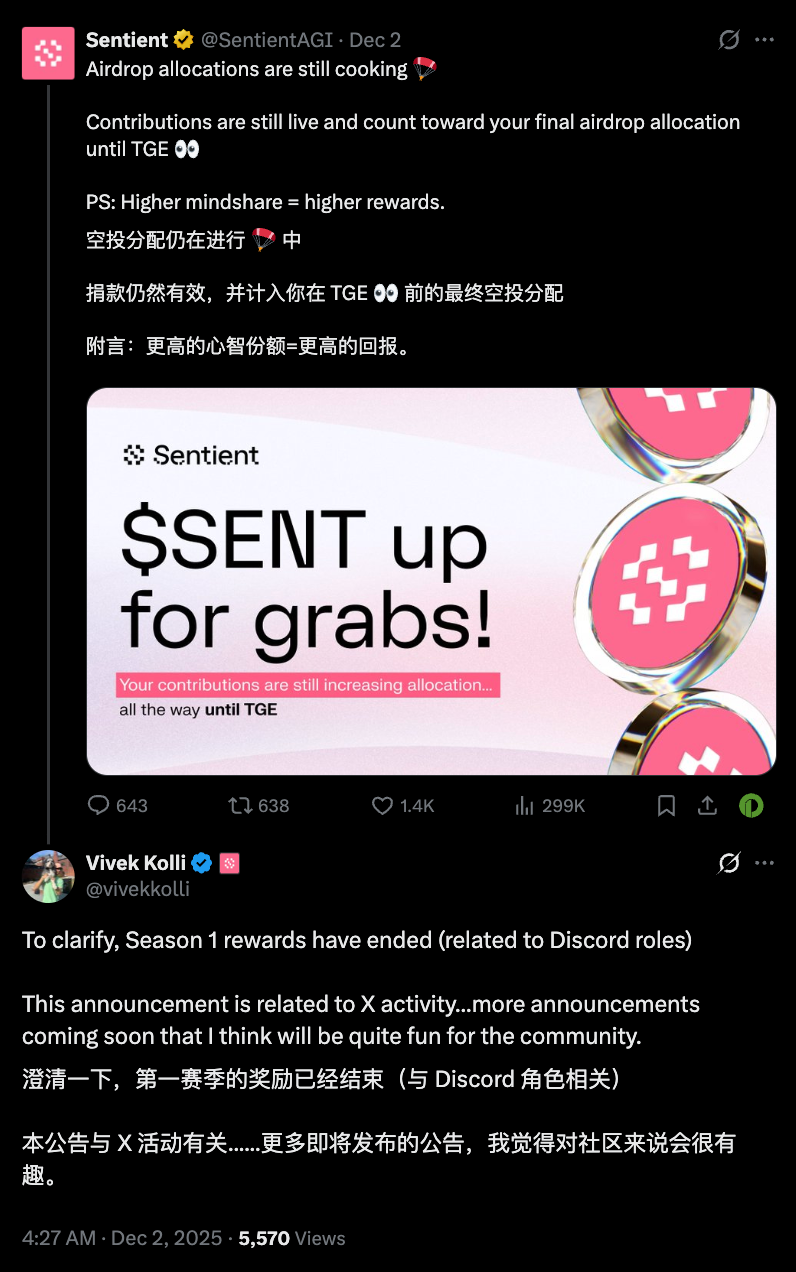
Official Personnel Hinting Plainly
Conclusion: The Limits of Open-Source AI's Self-Evolution Far Exceed Human Imagination
As the development of closed-source AI large models gradually falls into a homogenization僵局, open-source AI may become an important force pushing artificial intelligence into deeper waters. Just as the open-source Android system once led to the rapid development of smartphone devices and the advent of the mobile internet, open-source AI platforms like Sentient are not just creating an AI chat application but an entire open-source AI ecosystem—including underlying protocols, system architecture, as well as specific models and AI Agent applications.
More importantly, unlike the closed-door development of closed-source AI models and applications, open-source AI can, to a certain extent, achieve "self-evolution," which was the direction Sentient decided upon from the very beginning when it chose this "difficult but correct path."
While OpenAI is still troubled by the endless stream of new products from competitors and不得不关停 Sora, Sentient is determined to forge a more universal AI development path that aligns with the pursuit of the open-source community. In the哨兵时代 of carbon-based life guiding silicon-based life, the open-source AI platform brings not only the dawn of an AGI network but also an open-source AI ecological network that places greater emphasis on loyalty, monetization incentives, consistent service, and fewer "AI hallucinations."




















