# Halving Related Articles

HTX News Center provides the latest articles and in-depth analysis on "Halving", covering market trends, project updates, tech developments, and regulatory policies in the crypto industry.

'The Idea of Catching the Absolute Bottom Is Wrong': Experts on a New Phase of Bitcoin Capitulation

Analysts from CryptoQuant advise investors against trying to pinpoint the exact bottom of Bitcoin's price. Their data shows the percentage of the Bitcoin supply in profit has fallen to 51.4%, a level historically associated with capitulation phases followed by accumulation. This means approximately 48.6% of circulating coins are held at an unrealized loss. The metric, based on UTXO analysis comparing a coin's last moved price to its current market value, last neared this level in early 2023 when Bitcoin traded between $16,000 and $20,000. CryptoQuant states that the idea of catching the "absolute bottom" is flawed. The decline in the average cost basis during a bear market reflects coins transferring from weak hands to stronger, long-term holders. While some investors realize losses, others may use the decline for gradual accumulation. The accumulation window may last longer than many expect, even as fear drives some participants away. Historically, a supply in profit below 55% has been linked to re-accumulation periods. Separately, Swan Bitcoin CEO Cory Klippsten offered a forecast, suggesting Bitcoin could form a bottom in October 2026, followed by a recovery towards approximately $130,000 ahead of the 2028 halving. This aligns with the historical pattern of local lows forming about 12 months after bull market peaks; Bitcoin hit its all-time high above $126,000 in early October 2025. However, Klippsten cautioned against over-relying on past cycles due to limited historical data.

cryptonews.ru08/17 13:14

'The Idea of Catching the Absolute Bottom Is Wrong': Experts on a New Phase of Bitcoin Capitulation

cryptonews.ru08/17 13:14

Peter Todd's Remarks on Emissions Spark Debate Over Bitcoin Inflation

Peter Todd's recent speech on "Tail Emissions and Demurrage" has reignited the intense debate around Bitcoin's 21 million supply cap. He argues that after block subsidies end around 2140, a fee-only model could create security risks by enabling powerful miners to perform chain reorganizations. His proposed solution is a small, fixed "tail emission" of new coins per block or a demurrage fee on dormant coins to provide predictable miner income. The backlash was swift and severe across social media. Critics denounced the proposals as "inflation by another name" and a violation of Bitcoin's foundational social contract of absolute scarcity. They argue that tinkering with the fixed monetary policy undermines Bitcoin's core value proposition versus fiat currencies. Alternatives like relying on Layer-2 solutions and a robust fee market were emphasized as the correct path forward. While a few figures like Starkware's Eli Ben-Sasson have expressed sympathy for limited permanent emission to offset lost coins, Todd acknowledges a hard-fork implementing his idea is highly unlikely in the near future. The consensus remains that any change to the 21 million limit faces insurmountable opposition from the ecosystem of node operators, miners, and holders. The debate underscores that Bitcoin's security budget challenge will ultimately be tested by future halvings and the organic development of its transaction fee economy.

cryptonews.ru08/16 20:46

Peter Todd's Remarks on Emissions Spark Debate Over Bitcoin Inflation

cryptonews.ru08/16 20:46

Mining the Last 929,465 Bitcoins Will Take Over a Century

Title: Mining the Final 929,465 Bitcoins Will Take Over a Century The article clarifies a common misconception about Bitcoin's remaining supply. While 95.57% of the total 21 million BTC are already in circulation, the predetermined mining schedule means the last 4.43% will be produced very slowly. Currently, miners receive 3.125 BTC per block, with a new block added roughly every 10 minutes, resulting in about 164,250 new BTC annually. This emission rate is cut in half every 210,000 blocks (approximately every four years) in an event called a "halving." The next halving in 2028 will reduce the block reward to 1.5625 BTC. This process continues until rewards become minuscule fractions of a bitcoin (satoshi). The final satoshi is projected to be mined around 2140, with the last 1% of supply taking roughly a century to produce. This diminishing new supply has significant implications for miners, whose revenue primarily comes from these block rewards. Post-halving, their income from new coins is cut in half, forcing greater reliance on transaction fees for sustainability. The article notes current mining economics are strained, with transaction fees constituting a very small portion of total revenue. For investors, the predictable and decreasing issuance schedule is a key feature, creating a known scarcity. However, the article emphasizes that scarcity alone doesn't determine price, which is influenced by adoption, regulation, and broader economic factors. The upcoming 2028 halving will be a key test of whether transaction fees can sufficiently support network security as the block subsidy continues to shrink.

cryptonews.ru08/16 10:08

Mining the Last 929,465 Bitcoins Will Take Over a Century

cryptonews.ru08/16 10:08

Lone Bitcoin Miner Defies All Odds, Hits $200,000 Jackpot with Block Reward

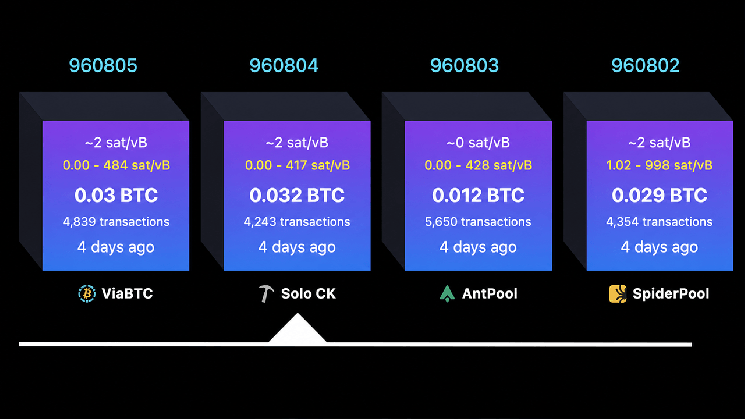
A solo Bitcoin miner, contrary to all predictions, won a $200,000 jackpot as a block reward. The payment went to an address linked to CKPool, a solo-mining service. This was the 317th solo block found by the pool. The reward consisted of the 3.125 BTC fixed subsidy and about 0.032 BTC in transaction fees from 4,243 transactions. CKPool operator Dr -ck (Con Kolivas) confirmed the win, noting the miner's hashrate was "extremely volatile, presumably rented," peaking at 100 PH/s. This represented about 0.011% of Bitcoin's total network hashrate. At that level, a miner could statistically expect to find a block roughly every 64 days, far more likely than for a typical small home setup. Solo mining differs from pool mining, where rewards are shared based on contributed work. In solo mining, a miner gets nothing unless they personally find a block, but then receives the entire reward. CKPool charges a ~2% fee on blocks found. Dr -ck noted the hashrate pattern suggested rented computing power, a practice making solo wins more accessible. He also highlighted this was the first mainnet block mined after integrating Stratum V2 code into ckpool, though the block itself was found using the older Stratum V1 protocol. Against a backdrop of mining concentration in large industrial pools, such solo finds remain rare but demonstrate that anyone with sufficient hashrate can claim a full reward without corporate or government permission. The block subsidy will remain 3.125 BTC until the next halving around April 2028. The miner's identity remains unknown, as is typical. Bitcoin's mining difficulty is due for an adjustment, and network hashrate has declined from late 2025 peaks, partly due to competition for power and hardware from AI data centers.

cryptonews.ru08/06 20:34
Lone Bitcoin Miner Defies All Odds, Hits $200,000 Jackpot with Block Reward

cryptonews.ru08/06 20:34

Michael Saylor: Bitcoin Halved, My Digital Credit is Making Money

Michael Saylor discusses Bitcoin, digital credit, and corporate treasury strategies in a recent roundtable. He explains that while Bitcoin remains "digital capital" with no counterparty risk, its ~40% annual volatility makes it unsuitable for most institutional and retail capital. To attract this capital, he advocates for Bitcoin-backed "digital credit" and "digital currency" products. These offer low volatility against fiat currencies, generate yield, and compete with traditional money market funds, stablecoins, and other yield-bearing crypto assets. Saylor clarifies that these products are not meant to replace direct Bitcoin ownership but to onboard capital that otherwise wouldn't enter the Bitcoin ecosystem. He provides examples: during a period when Bitcoin fell 50%, his company's digital credit products (STRC, SATA) delivered positive returns of 3-4%, demonstrating their ability to strip out ~90% of Bitcoin's volatility. He frames "digital currency" as a fiat-referenced, yield-bearing, stable-value asset backed by Bitcoin, designed to meet the needs of the global capital pool. This approach, he argues, can expand the Bitcoin network's reach by 10x to 100x more effectively than pure education. The discussion also covers corporate finance for Bitcoin treasury companies. Saylor argues that equity issuance is not inherently dilutive if done above net asset value per share and if the acquired asset (Bitcoin or cash) supports future value creation. He distinguishes between debt with maturity dates and hybrid capital like preferred shares (e.g., STRC), which offer issuer options and do not force liquidation. Evaluating these companies requires modeling based on future Bitcoin price and volatility assumptions, not relying on a single metric like mNAV (market-adjusted net asset value). The business models are still evolving, and investors must analyze full disclosures to form a complete view.

marsbit08/06 01:13

Michael Saylor: Bitcoin Halved, My Digital Credit is Making Money

marsbit08/06 01:13

活动图片