This aspect is often overlooked in headlines like "Bitcoin is almost fully mined." Yes, 95.57% of the nominal supply is already in circulation. But the Bitcoin network was built to concentrate most of the issuance in its early years and then make mining the remaining coins more difficult and slower. The last few percentage points are not a short countdown. It is undoubtedly a process spanning generations.
At the time of writing, at 8:00 AM Eastern Daylight Time (EDT) on August 15, 2026, Bitcoin miners receive 3.125 $BTC for each block added to the blockchain. A block is simply a bundle of transactions that has been verified and permanently recorded. Bitcoin aims to produce one block approximately every ten minutes, leading to a current emission rate of about 450 $BTC per day, or about 164,250 $BTC per year if the network operates on schedule.
The Bitcoin Emission Faucet Continues to Close
The emission schedule is hardcoded. No central bank can vote to change it, and no government can print more Bitcoin in a crisis. Every 210,000 blocks, or roughly every four years, the reward paid to miners is cut in half. Bitcoin users call this event a "halving."
When Satoshi first launched Bitcoin, the reward was initially 50 $BTC per block, then dropped to 25, 12.5, 6.25, and today's 3.125 $BTC. The next halving is expected around 2028. By then, the reward will drop to 1.5625 $BTC per block, reducing the expected daily issuance from about 450 $BTC to around 225 $BTC. The 2028 halving will be the last time miners receive a full coin as a reward, as by 2032 it will shrink to 0.78125 $BTC.
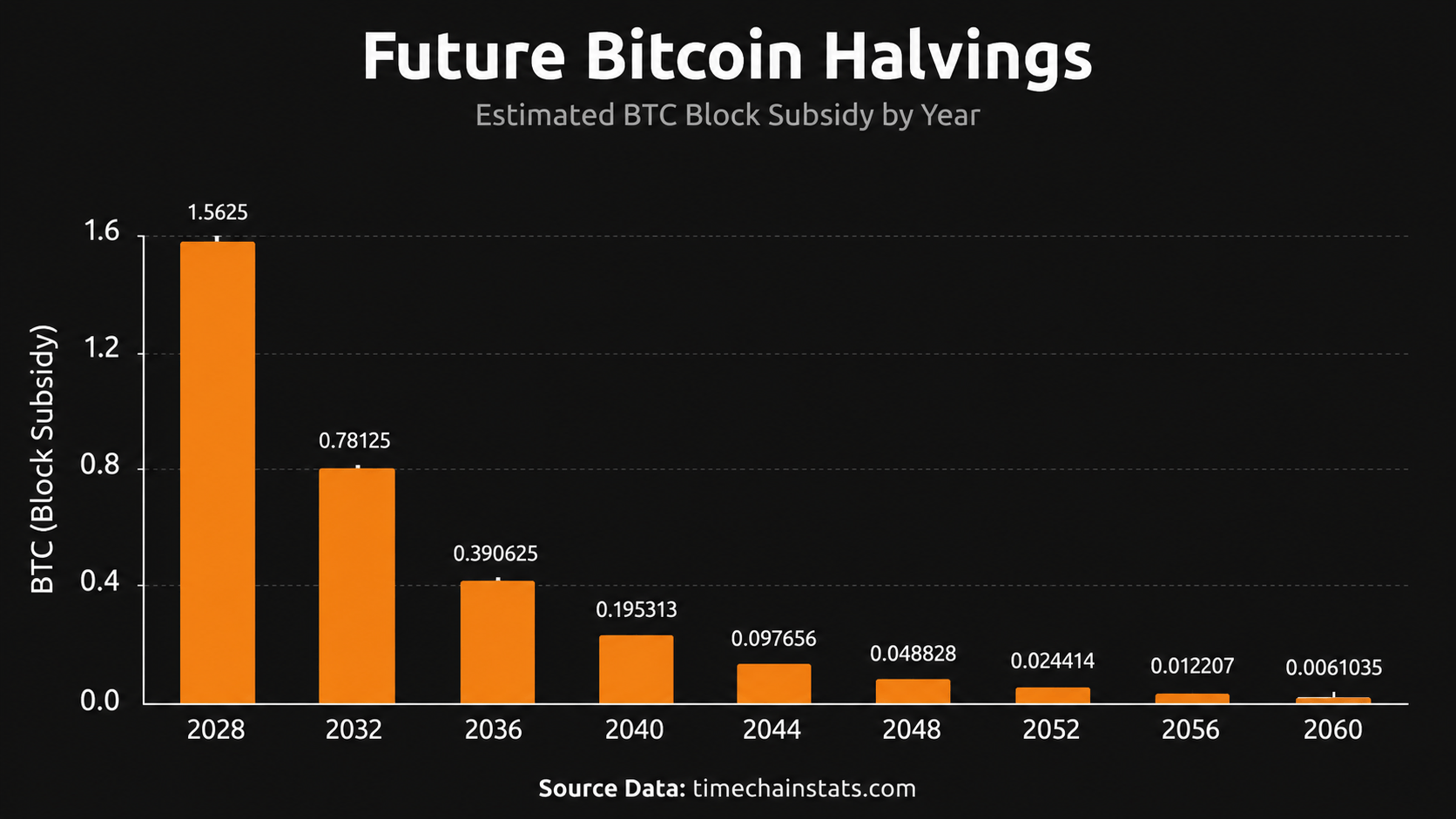
This is why the remaining 4.43% matters more than it might seem at first glance. The share of Bitcoin mined went from 25% to 50% in less than two years. Reaching 75% took less than four years. Then the pace slowed dramatically. Bitcoin crossed the 95% threshold around December 3, 2025, and is projected to reach 99% around February 2035. Surprisingly, the last 1% will take about another century.
The Phrase 'The Last Bitcoin' is Misleading
In 2140, there won't be some dramatic final block that issues the last whole $BTC. By then, the mining reward will be minuscule. One Bitcoin ($BTC) is divisible into 100 million satoshis, and the block reward will continue halving until miners receive rewards of a few satoshis instead of whole coins.
The projected schedule illustrates this decline vividly. According to halving statistics published on timechainstats.com, the reward is expected to be 74 satoshis in 2112, 37 in 2116, 18 in 2120, nine in 2124, four in 2128, and just two satoshis in 2132. Following a final period of one-satoshi-per-block payouts, the reward will effectively reach zero around 2140. So far, everything is proceeding according to plan.
But even that date is an approximation. Halvings are triggered by the number of blocks mined, not a calendar date. Bitcoin aims for an average block time of ten minutes, but blocks can come faster or slower until the network adjusts the mining difficulty. However, the overall timeline is clear: issuance does not stop suddenly. It tapers off gradually, one tiny reward at a time.
There's also a small nuance regarding the 21 million figure. Bitcoin cannot create fractional satoshis. Eventually, through halvings, rewards become too small to pay out, resulting in a theoretical maximum of approximately 20,999,999.9769 $BTC. The difference is tiny, but it's a useful reminder that the famous 21 million cap is a simplified shorthand, not a precise mathematical and final payout amount.
Miners Will Feel It Again Soon
The network halving is important because miners receive a reward for keeping Bitcoin operational. They use specialized computers that confirm transactions and secure the network. Their revenue comes from two sources: newly created $BTC and transaction fees paid by users.
Currently, newly minted coins still constitute the bulk of the income. In the 24-hour period reflected in network data, mining revenue was approximately $28.7 million. Transaction fees accounted for just 0.69% of that amount. Fees can spike during periods of high activity, but low fees have been the norm lately, and this shows how heavily miners still depend on the subsidy.
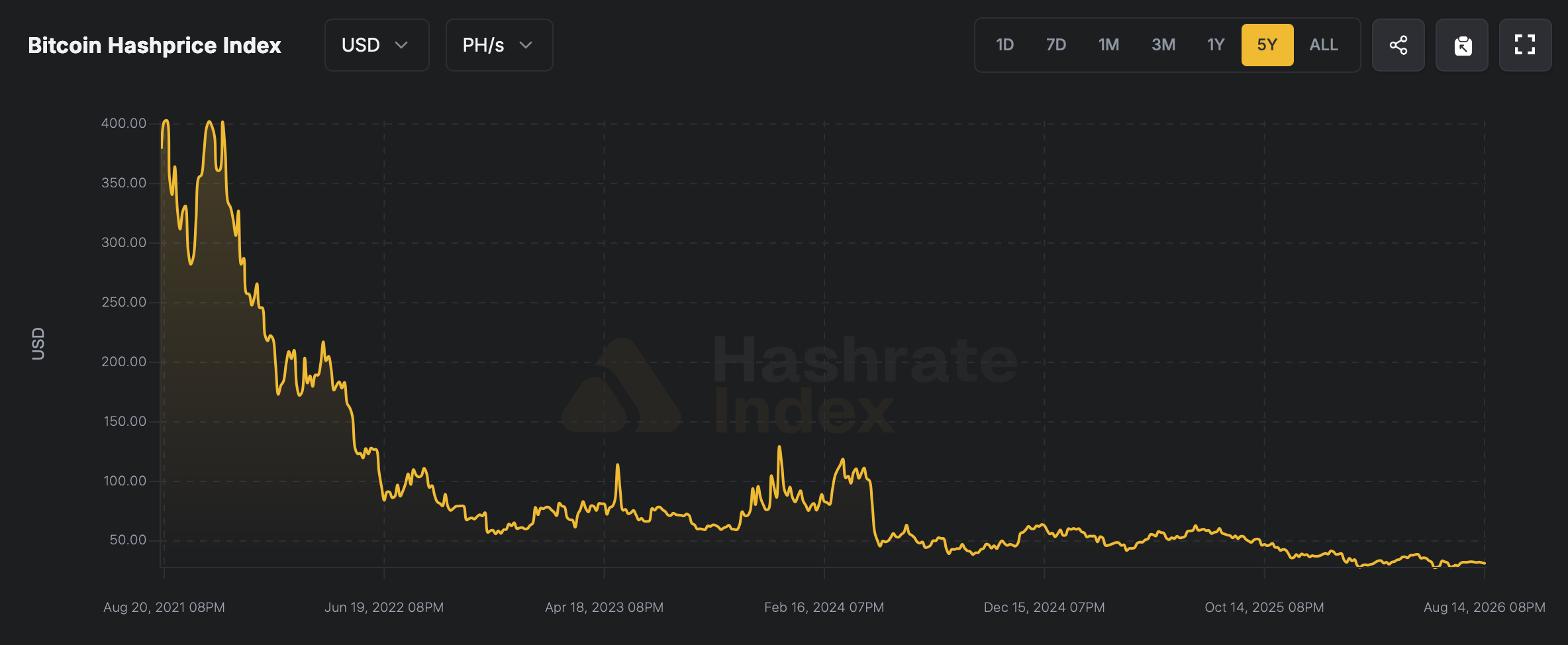
This dependency becomes more acute after each halving. In 2028, miners will receive half as many new bitcoins for performing the same basic work. If the price of $BTC rises, fees increase, equipment becomes more efficient, or electricity gets cheaper, the industry can weather the blow. If these compensating factors don't materialize, weaker operators will be the first to shut down.
In 2026, two years after the 2024 halving, miners are struggling through a bear market for hashprice. The exodus of publicly-traded miners pivoting to AI infrastructure has only compounded the situation.
Bitcoin's Security Budget Under Review
Hashrate — the total computational power dedicated to mining — is Bitcoin's first line of defense. The higher the hashrate, the more expensive an attack on the network becomes. This weekend's figure of around 900 exahashes per second (EH/s) demonstrates how massive the mining industry has become, but it does not guarantee that this power will stay in the network forever.
Mining is a low-margin, volatile business. When revenues fall, less efficient machines are turned off. In this case, Bitcoin's difficulty adjustment mechanism reduces the amount of work required to mine blocks, helping block production return to its target pace. The system keeps functioning, but the economics underpinning it are constantly shifting.
This is why the real question is not whether Bitcoin can last until 2140. The question is whether transaction fees will become a sustainable revenue source for miners as the subsidy diminishes. The network doesn't need to wait for the last satoshi to face this challenge. It's already tackling it every four years.
Scarcity is a Strength, Not Magic
For investors, the emission schedule remains one of Bitcoin's most compelling advantages. At the current rate, approximately 164,250 $BTC are issued annually. After the next halving, this annual flow will shrink to about 82,125 $BTC. Four years later, it will drop again. New supply becomes increasingly hard to ignore when demand is rising.
But scarcity alone does not determine price. Priced at just under $63,000 per coin at 8 AM EDT on Saturday, Bitcoin still trades on factors like adoption, regulation, investor appetite, liquidity, and indeed, the state of the broader economy. A predictable supply schedule may distinguish Bitcoin from state-issued currencies, but it cannot force buyers into the market.
The 929,465 $BTC left to be mined are not the same as coins available for purchase. Some of the already mined Bitcoin is likely lost forever due to lost private keys, failed devices, or irreversible owner errors. No one knows exactly how much. A wallet that hasn't seen movement in years could be lost, or it could belong to someone who is simply waiting.
The next real test will come in 2028, when the mining reward is expected to drop again. The Bitcoin price will be the focus of media headlines, but miner revenue, fees, and hashrate will reveal a deeper picture. These numbers will show whether the network can continue to pay for security as the new issuance runs out.
end-content