'The Idea of Catching the Absolute Bottom Is Wrong': Experts on a New Phase of Bitcoin Capitulation

cryptonews.ruPublished on 2026-08-17Last updated on 2026-08-17

Abstract

Analysts from CryptoQuant advise investors against trying to pinpoint the exact bottom of Bitcoin's price. Their data shows the percentage of the Bitcoin supply in profit has fallen to 51.4%, a level historically associated with capitulation phases followed by accumulation. This means approximately 48.6% of circulating coins are held at an unrealized loss. The metric, based on UTXO analysis comparing a coin's last moved price to its current market value, last neared this level in early 2023 when Bitcoin traded between $16,000 and $20,000. CryptoQuant states that the idea of catching the "absolute bottom" is flawed. The decline in the average cost basis during a bear market reflects coins transferring from weak hands to stronger, long-term holders. While some investors realize losses, others may use the decline for gradual accumulation. The accumulation window may last longer than many expect, even as fear drives some participants away. Historically, a supply in profit below 55% has been linked to re-accumulation periods. Separately, Swan Bitcoin CEO Cory Klippsten offered a forecast, suggesting Bitcoin could form a bottom in October 2026, followed by a recovery towards approximately $130,000 ahead of the 2028 halving. This aligns with the historical pattern of local lows forming about 12 months after bull market peaks; Bitcoin hit its all-time high above $126,000 in early October 2025. However, Klippsten cautioned against over-relying on past cycles due to limited historica...

Analysts at CryptoQuant believe that investors should not try to determine the exact bottom of Bitcoin. According to their data, the proportion of the first cryptocurrency's supply in profit has fallen to 51.4% — a level that historically corresponded to phases of capitulation and subsequent accumulation.

According to CryptoQuant, the share of Bitcoin supply in profit has rapidly decreased to 51.4%. Thus, about 48.6% of coins in circulation are in a state of unrealized loss.

The indicator is determined based on UTXO: analysts compare the price at which a coin last moved with its current market value. CryptoQuant noted that the indicator was last near 51% in early 2023 when Bitcoin traded in the $16,000-$20,000 range.

The current value also marks the lowest level of Bitcoin's overall profitability in more than three years.
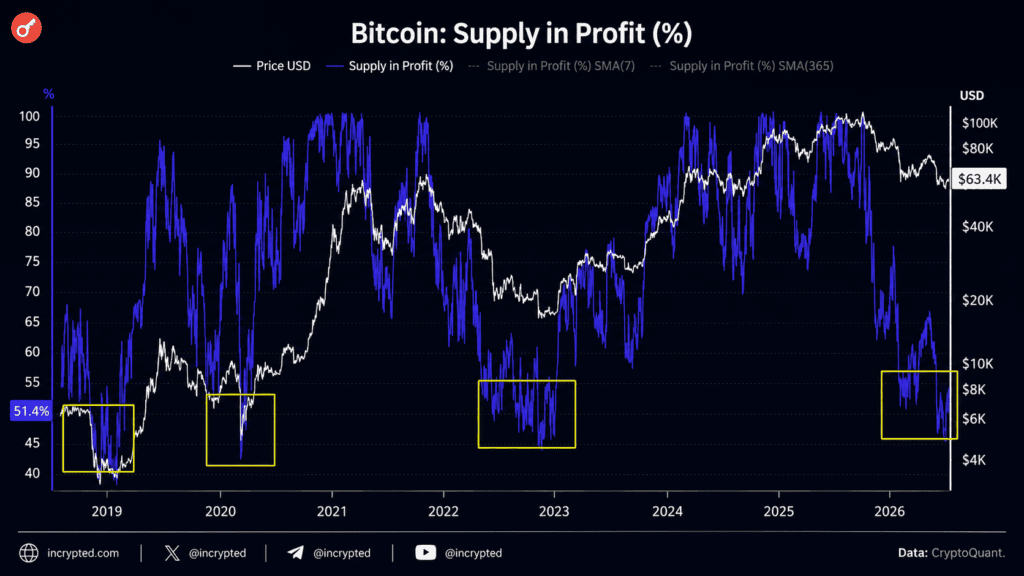
Number of Bitcoins in Profit. Infographic: Incrypted.

Analysts Urged Not to Look for the 'Absolute Bottom'

According to CryptoQuant's assessment, the decline in the average cost basis of Bitcoin holders during a bear market reflects the transfer of coins from investors with high purchase prices to stronger holders.

Under such conditions, some participants realize losses, while long-term investors may use the decline for gradual accumulation.

'The idea of catching the absolute bottom is wrong,' CryptoQuant stated.

Analysts believe the window for accumulation may last longer than most market participants expect. At the same time, it is precisely during such periods that some investors exit the market due to fear of further decline. CryptoQuant also noted that historically, a drop in supply profitability below 55% has been associated with periods of re-accumulation.

Bottom in October

Swan Bitcoin CEO Cory Klippsten shared his own forecast regarding further market dynamics. According to him, the first cryptocurrency could form a bottom in October 2026, followed by a recovery to around $130,000 ahead of the 2028 halving.

Klippsten drew attention to Bitcoin's historical cyclicality. Previous local lows of the asset formed approximately 12 months after bull market peaks.

Bitcoin reached an all-time high of over $126,000 in early October 2025. Accordingly, October 2026 falls roughly 12 months after the peak.

At the same time, Klippsten cautioned against overly extrapolating past cycles, as there is a limited number of historical observations available for such a conclusion.

Earlier, analysts pointed to weak demand for Bitcoin and pressure from the United States.

end-content

Trending Cryptos

Related Questions

QAccording to CryptoQuant analysts, what is the current percentage of Bitcoin supply in profit, and why is this level significant?

AThe percentage of Bitcoin supply in profit has fallen to 51.4%. This level is historically significant as it has corresponded to phases of capitulation and subsequent accumulation in the market.

QWhat is the core argument made by CryptoQuant regarding the attempt to find the absolute bottom of Bitcoin's price?

ACryptoQuant argues that the idea of trying to catch the absolute bottom of Bitcoin's price is a mistake. They advise against attempting to determine the precise lowest point.

QBased on the article, when does Cory Klippsten, CEO of Swan Bitcoin, predict Bitcoin might form a price bottom?

ACory Klippsten predicts that Bitcoin could form a price bottom in October 2026.

QWhat historical pattern does Cory Klippsten cite to support his October 2026 bottom prediction?

AHe cites the historical pattern where previous local bottoms for Bitcoin formed approximately 12 months after the peaks of bull markets. Bitcoin reached its all-time high in early October 2025, making October 2026 about 12 months later.

QAccording to the analysis, what typically happens when the percentage of profitable Bitcoin supply falls below 55%?

AHistorically, when the percentage of profitable Bitcoin supply falls below 55%, it has been associated with periods of re-accumulation, where long-term investors may use the price drop to gradually accumulate assets.

Related Reads

Tiger Research: How Far Can the On-Chain Foreign Exchange Settlement Layer Go?

"Tiger Research: How Far Can On-Chain FX Settlement Layers Go?" The article examines KiiChain, a startup aiming to create an on-chain foreign exchange settlement layer, focusing on its potential to address inefficiencies in cross-border payments, especially for emerging markets. The core problem is the slow, costly, and fragmented traditional FX infrastructure, where bank hours, regulations, and thin liquidity for local currencies create delays. KiiChain, founded by OTC veterans, proposes aggregating USD and local currency stablecoin liquidity on one chain to enable 24/7 settlement. The platform consists of four components: 1) The KiiChain App uses an Atomic Quote Network (RFQ-style price discovery with on-chain settlement) to tackle settlement delays, but not underlying liquidity scarcity. 2) The RWA Protocol tokenizes collateral using compliant standards (like ERC-3643), shifting trust from bank relationships to coded rules, though regulatory anchors remain. 3) Kii Oracle uses a decentralized validator network to create consensus pricing from fragmented data, improving transparency but not market depth. 4) KiiChain Pay bundles fiat on/off-ramps and swap services; only the DEX swap bypasses banking bottlenecks, while others still rely on licensed operators. The analysis concludes KiiChain doesn't eliminate intermediaries but creates a unified settlement layer where they can interact without geographic or time constraints. It streamlines the process—three of eight traditional steps are removed—by moving infrastructure on-chain, improving speed and accessibility for digital asset swaps. However, fiat entry/exit points remain subject to off-chain service limitations. Current metrics show over $500M in transaction volume. The future depends on ecosystem growth—attracting liquidity partners and users—to evolve beyond settlement into a broader financial hub. Ultimately, the on-chain structure currently solves settlement friction and time, not liquidity depth. Success will be determined by execution in building partnerships and market presence, not by architectural design alone.

marsbit20m ago

Tiger Research: How Far Can the On-Chain Foreign Exchange Settlement Layer Go?

marsbit20m ago

Trading

Spot

Hot Articles

What is $BITCOIN

DIGITAL GOLD ($BITCOIN): A Comprehensive Analysis Introduction to DIGITAL GOLD ($BITCOIN) DIGITAL GOLD ($BITCOIN) is a blockchain-based project operating on the Solana network, which aims to combine the characteristics of traditional precious metals with the innovation of decentralized technologies. While it shares a name with Bitcoin, often referred to as “digital gold” due to its perception as a store of value, DIGITAL GOLD is a separate token designed to create a unique ecosystem within the Web3 landscape. Its goal is to position itself as a viable alternative digital asset, although specifics regarding its applications and functionalities are still developing. What is DIGITAL GOLD ($BITCOIN)? DIGITAL GOLD ($BITCOIN) is a cryptocurrency token explicitly designed for use on the Solana blockchain. In contrast to Bitcoin, which provides a widely recognized value storage role, this token appears to focus on broader applications and characteristics. Notable aspects include: Blockchain Infrastructure: The token is built on the Solana blockchain, known for its capacity to handle high-speed and low-cost transactions. Supply Dynamics: DIGITAL GOLD has a maximum supply capped at 100 quadrillion tokens (100P $BITCOIN), although details regarding its circulating supply are currently undisclosed. Utility: While precise functionalities are not explicitly outlined, there are indications that the token could be utilized for various applications, potentially involving decentralized applications (dApps) or asset tokenization strategies. Who is the Creator of DIGITAL GOLD ($BITCOIN)? At present, the identity of the creators and development team behind DIGITAL GOLD ($BITCOIN) remains unknown. This situation is typical among many innovative projects within the blockchain space, particularly those aligning with decentralized finance and meme coin phenomena. While such anonymity may foster a community-driven culture, it intensifies concerns about governance and accountability. Who are the Investors of DIGITAL GOLD ($BITCOIN)? The available information indicates that DIGITAL GOLD ($BITCOIN) does not have any known institutional backers or prominent venture capital investments. The project seems to operate on a peer-to-peer model focused on community support and adoption rather than traditional funding routes. Its activity and liquidity are primarily situated on decentralized exchanges (DEXs), such as PumpSwap, rather than established centralized trading platforms, further highlighting its grassroots approach. How DIGITAL GOLD ($BITCOIN) Works The operational mechanics of DIGITAL GOLD ($BITCOIN) can be elaborated on based on its blockchain design and network attributes: Consensus Mechanism: By leveraging Solana’s unique proof-of-history (PoH) combined with a proof-of-stake (PoS) model, the project ensures efficient transaction validation contributing to the network's high performance. Tokenomics: While specific deflationary mechanisms have not been extensively detailed, the vast maximum token supply implies that it may cater to microtransactions or niche use cases that are still to be defined. Interoperability: There exists the potential for integration with Solana’s broader ecosystem, including various decentralized finance (DeFi) platforms. However, the details regarding specific integrations remain unspecified. Timeline of Key Events Here is a timeline that highlights significant milestones concerning DIGITAL GOLD ($BITCOIN): 2023: The initial deployment of the token occurs on the Solana blockchain, marked by its contract address. 2024: DIGITAL GOLD gains visibility as it becomes available for trading on decentralized exchanges like PumpSwap, allowing users to trade it against SOL. 2025: The project witnesses sporadic trading activity and potential interest in community-led engagements, although no noteworthy partnerships or technical advancements have been documented as of yet. Critical Analysis Strengths Scalability: The underlying Solana infrastructure supports high transaction volumes, which could enhance the utility of $BITCOIN in various transaction scenarios. Accessibility: The potential low trading price per token could attract retail investors, facilitating wider participation due to fractional ownership opportunities. Risks Lack of Transparency: The absence of publicly known backers, developers, or an audit process may yield skepticism regarding the project's sustainability and trustworthiness. Market Volatility: The trading activity is heavily reliant on speculative behavior, which can result in significant price volatility and uncertainty for investors. Conclusion DIGITAL GOLD ($BITCOIN) emerges as an intriguing yet ambiguous project within the rapidly evolving Solana ecosystem. While it attempts to leverage the “digital gold” narrative, its departure from Bitcoin's established role as a store of value underscores the need for a clearer differentiation of its intended utility and governance structure. Future acceptance and adoption will likely depend on addressing the current opacity and defining its operational and economic strategies more explicitly. Note: This report encompasses synthesised information available as of October 2023, and developments may have transpired beyond the research period.

1.9k Total ViewsPublished 2025.05.13Updated 2025.05.13

What is $BITCOIN

Discussions

Welcome to the HTX Community. Here, you can stay informed about the latest platform developments and gain access to professional market insights. Users' opinions on the price of BTC (BTC) are presented below.

活动图片