Still Not Enough? Prediction Market Giants Set Sights on Payments and AI

Odaily星球日报Published on 2026-03-16Last updated on 2026-03-16

Abstract

Prediction market giants Kalshi and Polymarket are aggressively expanding their user base and capabilities, targeting payment integration and AI agents as new growth vectors. During the recent awards season, the two platforms saw combined betting volumes surpass $100 million, a significant jump from the previous year. A Paradigm survey indicates that 36% of U.S. voters have used prediction markets, highlighting their growing mainstream relevance. To capture the remaining market, Kalshi partnered with Block’s Cash App, simplifying deposits and tapping into its 59 million monthly active users for potential growth. Meanwhile, Polymarket, which has processed over $750 million in nominal volume since resuming U.S. operations, is exploring AI-driven expansion. It now supports AI Agent trading via Alchemy’s AgentCard, enabling 24/7 market participation. This aligns with a broader industry trend of integrating AI agents into financial ecosystems. Both platforms are validating new revenue models—Polymarket has generated over $11.2 million in fees since introducing them—and are positioning themselves at the forefront of fintech and AI convergence, signaling a new phase of competition and innovation in prediction markets.

Original|Odaily Planet Daily (@OdailyChina)

Author|Wenser(@wenser 2010)

Time is running out for traditional betting companies. This might be the latest consensus in the prediction market sector.

At the recently concluded Oscars event, the total funds wagered on Kalshi and Polymarket surpassed $100 million for the first time, a figure that was still under ten million dollars last year. On another front, Kalshi partnered with Cash APP to streamline user payment channels; after launching its AI Agent CLI application, Polymarket now supports 24/7 trading by AI Agents through the AgentCard launched by Alchemy. In this "big year for predictions" full of historic moments in 2026, the two giants of the prediction market are finding their own ways to attract new users from traditional betting companies, internet platforms, and even traditional media and finance industries. This time, they have first targeted real users from payment channels and tireless AI Agents.

New Victories for Prediction Market Giants: Payment Channels and AI Agent Users

Last week, renowned investment firm Paradigm released its first public opinion survey report of the year, also the firm's first survey report on prediction market platforms.

The survey results show that over one-third (approximately 36%) of American voters have already used prediction markets, either to place bets or to browse the markets for information.

In terms of user demographics, the prediction market user base under 50 years old accounts for a high 66%, with 18-34 year olds making up 20% and 35-49 year olds making up 27%; the usage rate among non-white voters is slightly higher than that of white voters, and the usage rate among men is significantly higher than that of women (46% vs. 31%).

From this perspective, in the US market, prediction markets are no longer a "niche sector" but have become an "information source," "trading desk," and "information pool" closely related to millions of households.
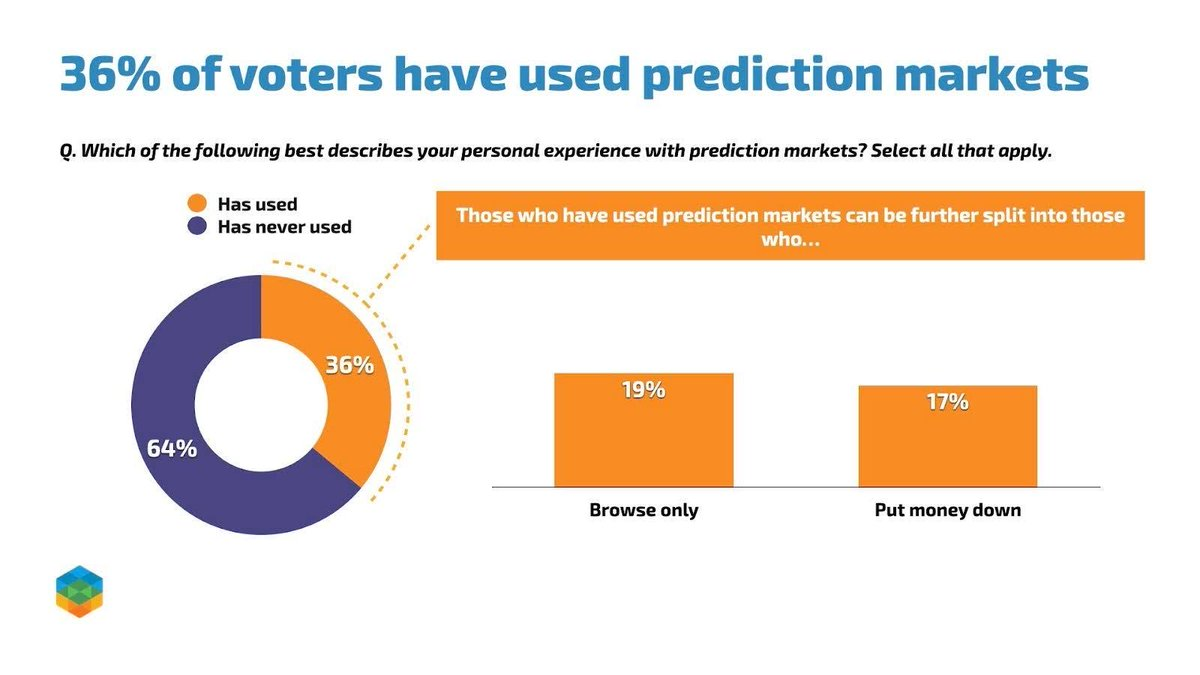
Of course, as the lead investor in Kalshi's last $1 billion funding round, Paradigm's move is undoubtedly "shouting out for his bag" (promoting his investment), which is understandable. However, a new question is reflected behind this survey—how will the prediction market duopoly, Kalshi and Polymarket, penetrate the remaining 64% of American voters and even the entire US citizenry?

The answer is naturally: either wage war against the old forces; or find new growth avenues.

Kalshi's New Growth Method: Opening Payment Channels, Encouraging User Deposits

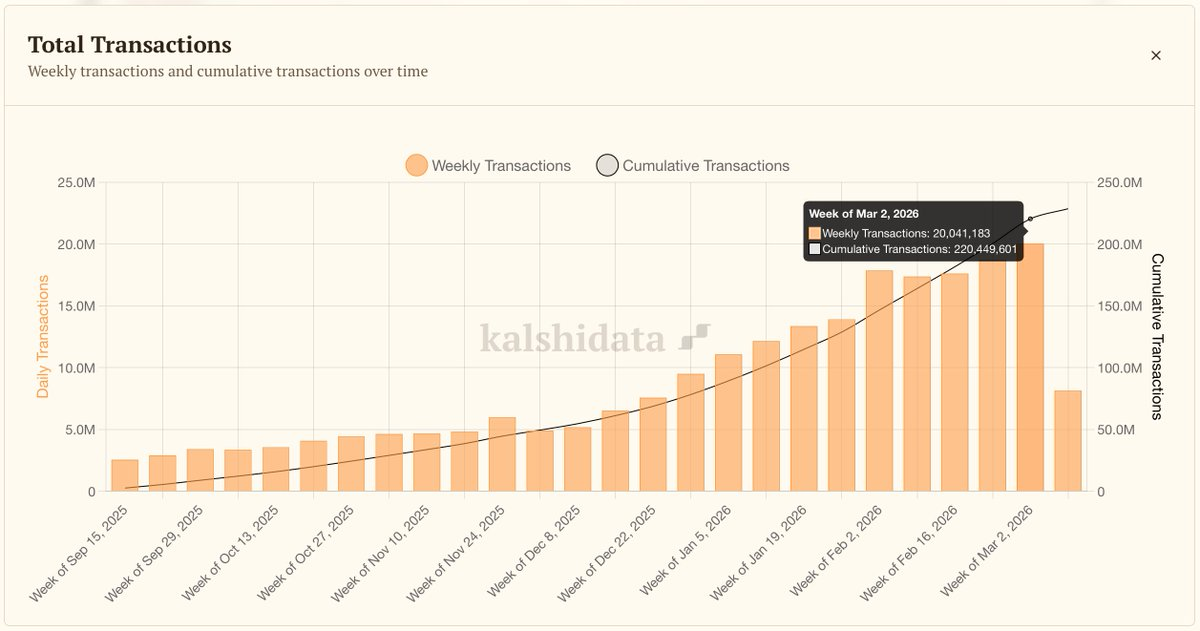
During the week of March 2nd to March 8th, the number of transactions on Kalshi exceeded 20 million for the first time, setting a new weekly transaction record since the platform's inception. With trading volume and transaction numbers continuously hitting new highs, tapping into existing user pools would be an efficient strategy to reach even further.
This is likely the reason Kalshi announced a partnership with Block's payment application, Cash APP, last week. Kalshi's official statement was even more direct—"Make funding your Kalshi account easier with Cash App Pay." The wording almost spells out "Quick, use Cash App Pay to deposit money and start betting" on its face.

After all, even a one percent conversion rate from Cash App's 59 million monthly active transacting users would bring Kalshi close to 600,000 new users, equivalent to the user base it might gain from two or three years of hard work. More importantly, these are all "incremental gains."
Polymarket's Market Expansion Method: Targeting AI Agents as Well as Humans

On the other side of the prediction market, the other duopoly, Polymarket, is also performing impressively.

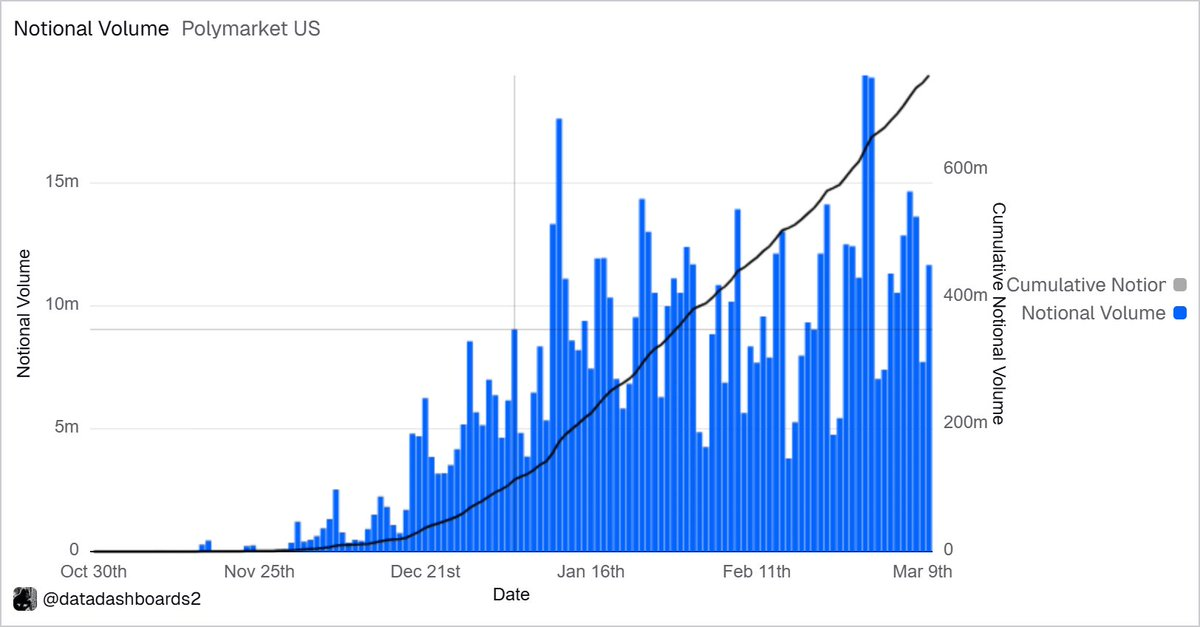
Since resuming operations in the US last November, as of March 14th, the nominal trading volume on Polymarket's US platform has exceeded $750 million, with over 5 million transactions. The platform's open interest once reached as high as $2.6 million and has recently settled around $1 million.
Furthermore, according to Dune data, since it began charging transaction fees on certain markets (including NCAA and crypto price movement markets) starting January 6th, Polymarket has accumulated over $11.2 million in fee revenue. In other words, Polymarket has fully validated its ability to generate revenue.
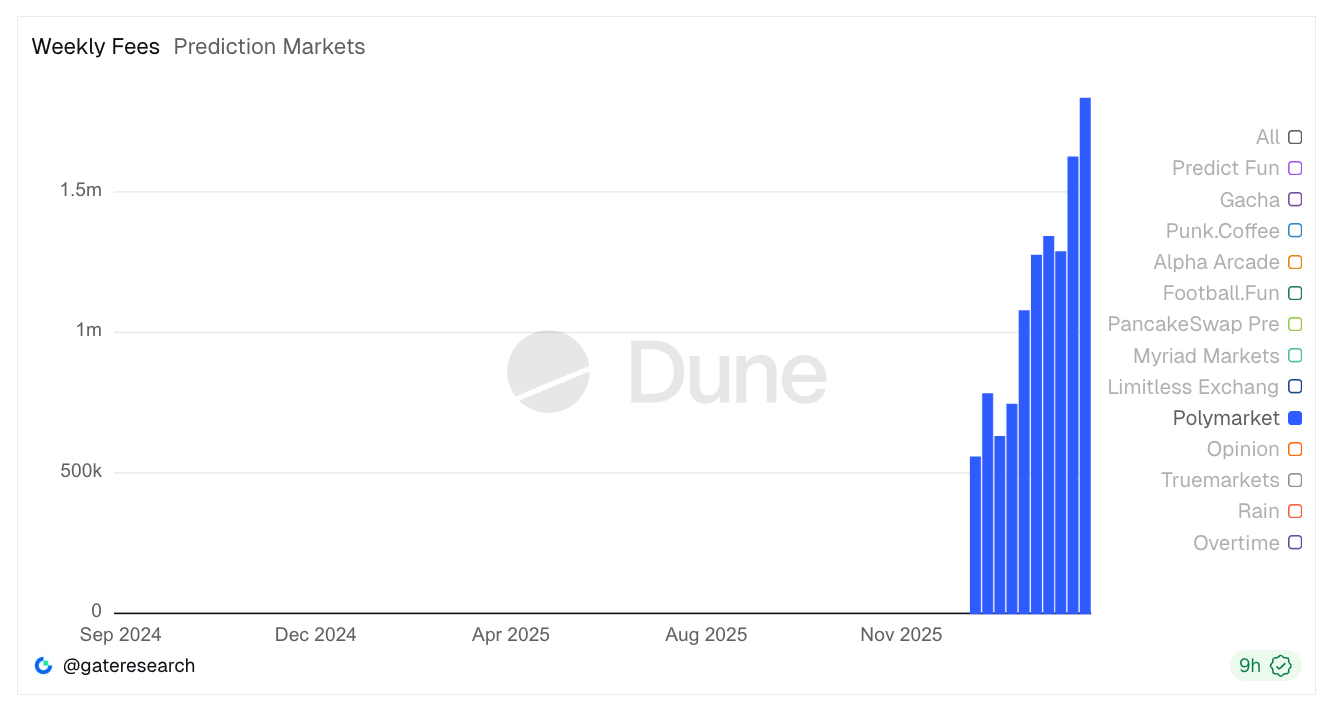
Therefore, the ambitious Polymarket is no longer satisfied with just the existing market of human users and has instead begun betting on enabling 24/7 trading by AI Agents.

Last weekend, the crypto payment platform Alchemy officially launched the AI agent payment platform AgentCard. In addition to conventional functions like food delivery ordering and AI application subscriptions, it specifically emphasized that "users' AI Agents can now trade on Polymarket 24/7"; this announcement was subsequently confirmed by a repost from Polymarket's official account.
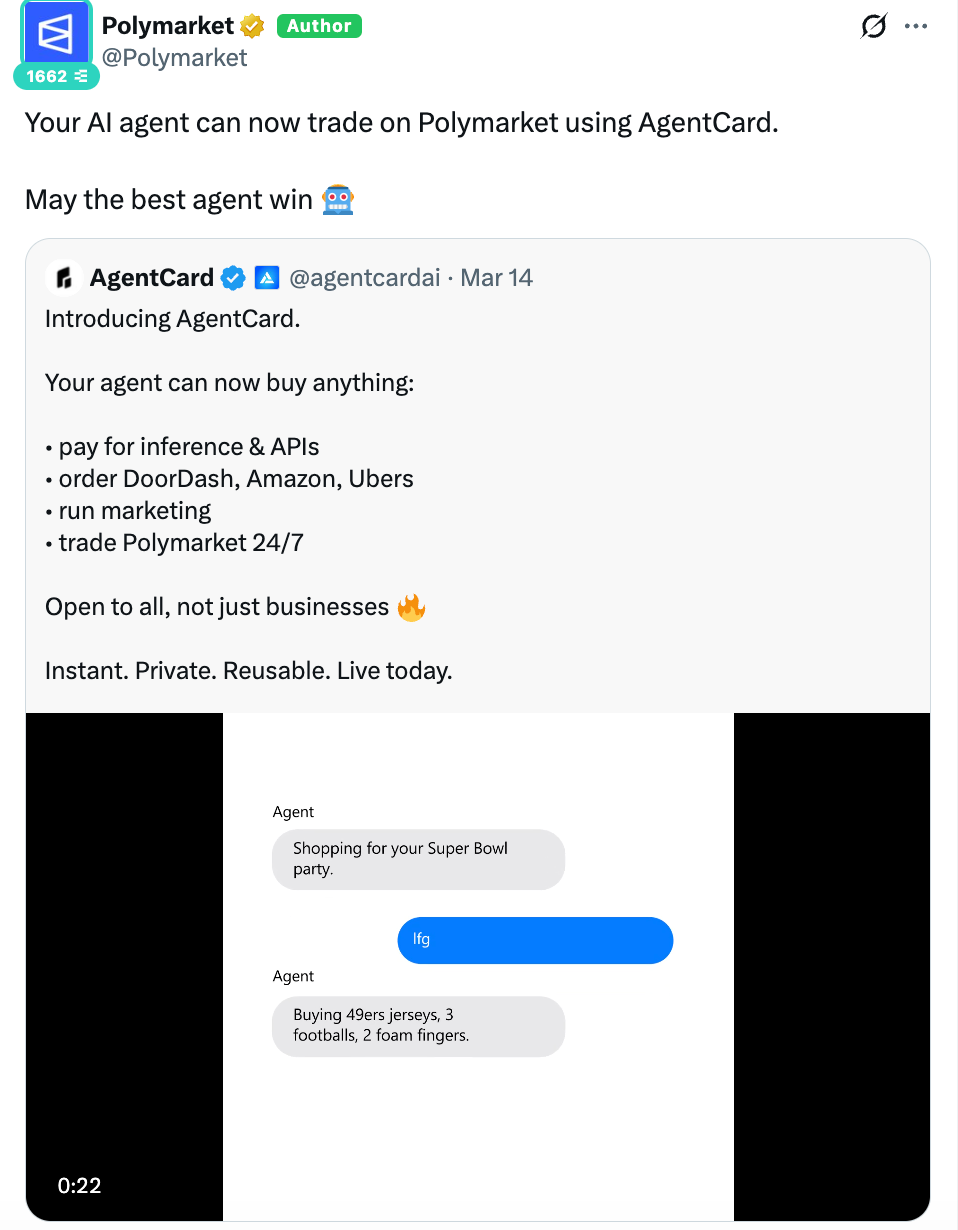
Against the backdrop of OpenClaw "Lobster" going viral, and the emergence of standards like x402, ERC8004, and ERC8183 supporting AI Agent payments, combined with Polymarket's previously designed Polymarket CLI for AI Agents—a tool for querying prediction market data, executing orders, managing positions, and interacting with on-chain contracts—a prediction market platform tailored for AI Agents is gradually taking shape.

Much like Circle, which transformed from a "stablecoin issuer" into an "infrastructure builder for the AI era finance," Polymarket has抢先 seized the crucial position of being a "prediction market platform for AI Agents." As Nvidia founder Jensen Huang stated at last year's CES, the AI Agent industry will become a trillion-dollar market, much like the robotics industry, and the 24/7 tireless AI Agents might first shine brightly in prediction markets.

Conclusion: The New War in Prediction Markets Has Begun

Undoubtedly, a new war for prediction market platforms has quietly begun. This includes deeply activating existing users, continuously incentivizing active users, and constantly converting new users; it also involves expanding the boundaries of event types, engaging in dialogue with regulatory forces, and even future-oriented development targeting "potential active users" like AI Agents.

Previously, Dingaling, founder of the BSC ecosystem prediction market platform Predict.fun, also planned to launch products combining prediction markets with DeFi, intending to provide users with interest-bearing收益型 products related to account fund management, which can be considered a form of "PayFi yield product" and is also quite值得期待.

Regardless of how the prediction market develops, on the path to seeking $20 billion or more in funding, Kalshi and Polymarket have already activated new growth levers.


Related Questions

QWhat are the two major prediction market platforms mentioned in the article, and what new user segments are they targeting for growth?

AThe two major prediction market platforms are Kalshi and Polymarket. Kalshi is targeting users from payment channels by integrating with Cash App, while Polymarket is focusing on AI Agents as new users by enabling 24/7 trading through AI integration.

QHow did the betting volume on Kalshi and Polymarket for the Oscar Awards event change compared to the previous year?

AThe cumulative betting volume on Kalshi and Polymarket for the Oscar Awards event exceeded $100 million, a significant increase from less than $10 million the previous year.

QWhat partnership did Kalshi announce to facilitate easier funding for its users, and what is the potential user base of this partner?

AKalshi announced a partnership with Cash App, a payment application under Block, which has a potential user base of 59 million monthly active users.

QWhat new capability did Polymarket introduce to support AI Agents, and which platform collaborated to enable this feature?

APolymarket introduced the capability for AI Agents to trade 24/7 on its platform, enabled through a collaboration with Alchemy's AgentCard payment platform.

QAccording to Paradigm's survey, what percentage of American voters have used prediction markets, and what are the key demographic trends among these users?

AApproximately 36% of American voters have used prediction markets. Demographically, 66% are under 50 years old, with 20% aged 18-34 and 27% aged 35-49. Non-white voters use prediction markets slightly more than white voters, and men use them significantly more than women (46% vs. 31%).

Related Reads

The Value Distribution of Stablecoins

**Summary: The Value Distribution of Stablecoins** The article argues that stablecoins are evolving from mere trading tools into broader channels for dollar access. It divides the stablecoin ecosystem into four layers to analyze how value is distributed: 1. **Issuance Layer:** Mints stablecoins, holds reserve assets, and captures the spread between reserve yield and user costs (e.g., Tether, Circle). This layer currently earns the largest profit margin. 2. **Infrastructure Layer:** Connects stablecoins to the traditional financial system, handling fiat on/off-ramps, banking integration, compliance (KYC/AML), and asset management (e.g., Bridge, BVNK). This is the "unglamorous" but critical work, building the essential bridges between crypto and real-world finance. 3. **Acquiring/Distribution Layer:** Integrates stablecoins into merchant systems, manages payment flows, and provides enterprise financial software (e.g., Stripe, Coinbase). They act as the access point for businesses. 4. **Application Layer:** The end-users and businesses that ultimately use stablecoins for payments, settlements, or as a store of value. They benefit from convenience but have little pricing power. The core thesis is that while the issuance layer currently dominates profits, the often-overlooked **infrastructure layer holds significant long-term potential**. The real challenge and barrier to mass adoption is not the on-chain transfer of stablecoins (which is simple), but the complex "last mile" integration into existing business workflows, banking systems, and regulatory frameworks across different countries. Companies in this layer are currently in a "land grab" phase, investing heavily to build networks, secure bank partnerships, and establish compliance pathways. While their position is currently pressured by the profitable issuers above and distribution platforms below, the article suggests that if stablecoins become a default financial rail for businesses, the infrastructure providers who have done the hard work of integration will ultimately gain strong pricing power and become entrenched, essential players.

marsbit6h ago

The Value Distribution of Stablecoins

marsbit6h ago

The Value Distribution of Stablecoins

The Value Distribution of Stablecoins The article argues that stablecoins are evolving from a mere trading tool into a broad "dollar channel." It analyzes the industry's value chain through four layers: 1. **Issuance Layer (e.g., Tether, Circle):** The top layer that mints stablecoins, holds reserve assets, and captures the thickest interest rate spread. 2. **Infrastructure Layer (e.g., Bridge, BVNK):** Connects stablecoins to the traditional financial system, handling critical but complex "dirty work" like fiat on/off-ramps, banking integration, compliance (KYC/AML), and cross-border settlement. 3. **Acquiring/Distribution Layer (e.g., Stripe, Coinbase):** Embeds stablecoins into merchant systems, manages payment flows, and integrates with enterprise software. 4. **Application Layer:** End-users and businesses that ultimately use stablecoins for payments, settlement, or storing value. The author posits that while the issuance layer currently captures the most profit, the most overlooked and potentially critical layer is infrastructure. The core challenge for stablecoin adoption isn't the on-chain transfer (which is simple), but bridging the gap between blockchain and the real-world financial system. This involves solving practical problems for businesses: fiat conversion, reconciliation, tax handling, and user onboarding. Infrastructure companies are currently in a difficult "land-grab" phase—building networks, securing banking relationships, and achieving compliance country-by-country. They face pressure from both the profitable issuance layer above and distribution platforms below. However, the author suggests this layer is building a crucial moat. Once stablecoins become a default business rail, the infrastructure players who have done the hard work of integration may gain significant, durable value and pricing power.

链捕手6h ago

The Value Distribution of Stablecoins

链捕手6h ago

Trading

Spot
Futures

Hot Articles

Discussions

Welcome to the HTX Community. Here, you can stay informed about the latest platform developments and gain access to professional market insights. Users' opinions on the price of AI (AI) are presented below.

活动图片