Still Not Enough? Prediction Market Giants Set Sights on Payments and AI

marsbitPublished on 2026-03-16Last updated on 2026-03-16

Abstract

Prediction market giants Kalshi and Polymarket are aggressively expanding their user base and influence, moving beyond traditional betting sector. During the recent Oscars, the two platforms saw over $100 million in bets, a significant jump from the previous year. Kalshi is focusing on payment integration, partnering with Block’s Cash App to simplify funding and tap into its 59 million monthly active users. This move aims to attract new users from an established financial platform. Polymarket, on the other hand, is targeting AI agents as potential users. After resuming U.S. operations, it has processed $750 million in nominal trading volume. It now supports AI Agent trading through integrations like Alchemy’s AgentCard and its own CLI tool, enabling 24/7 automated trading. This positions Polymarket at the forefront of AI-driven prediction markets. A Paradigm survey notes that 36% of U.S. voters have used prediction markets, with stronger adoption among younger and non-white demographics. Both platforms are exploring new growth avenues—Kalshi through payment accessibility and Polymarket through AI automation—as they compete for a larger share of the evolving market.

Original|Odaily Planet Daily(@OdailyChina)

Author|Wenser(@wenser 2010)

Time is running out for traditional gambling companies—this might be the latest consensus in the prediction market sector.

At the recently concluded Oscars event, the total betting volume on Kalshi and Polymarket surpassed $100 million for the first time, a significant jump from the less than $10 million mark last year. Meanwhile, Kalshi partnered with Cash APP to streamline user payment channels, while Polymarket, after launching its AI Agent CLI application, now supports 24/7 trading by AI Agents through Alchemy's AgentCard. In 2026, a year filled with historic "prediction milestones," the two giants of the prediction market are leveraging their strategies to attract new users from traditional gambling firms, internet platforms, and even conventional media and finance industries. This time, they are targeting real users from payment channels and tireless AI Agents.

New Victories for Prediction Market Giants: Payment Channels and AI Agent Users

Last week, renowned investment firm Paradigm released its first public opinion survey of the year, also marking its inaugural survey on prediction market platforms.

The results showed that over one-third (approximately 36%) of American voters have used prediction markets, either placing bets or browsing markets for information.

In terms of user demographics, 66% of prediction market users are under 50 years old, with 20% aged 18–34 and 27% aged 35–49. Non-white voters use prediction markets slightly more than white voters, and men use them significantly more than women (46% vs. 31%).

This indicates that in the U.S., prediction markets are no longer a "niche sector" but have become a vital "information source," "trading desk," and "news pool" for millions of households.
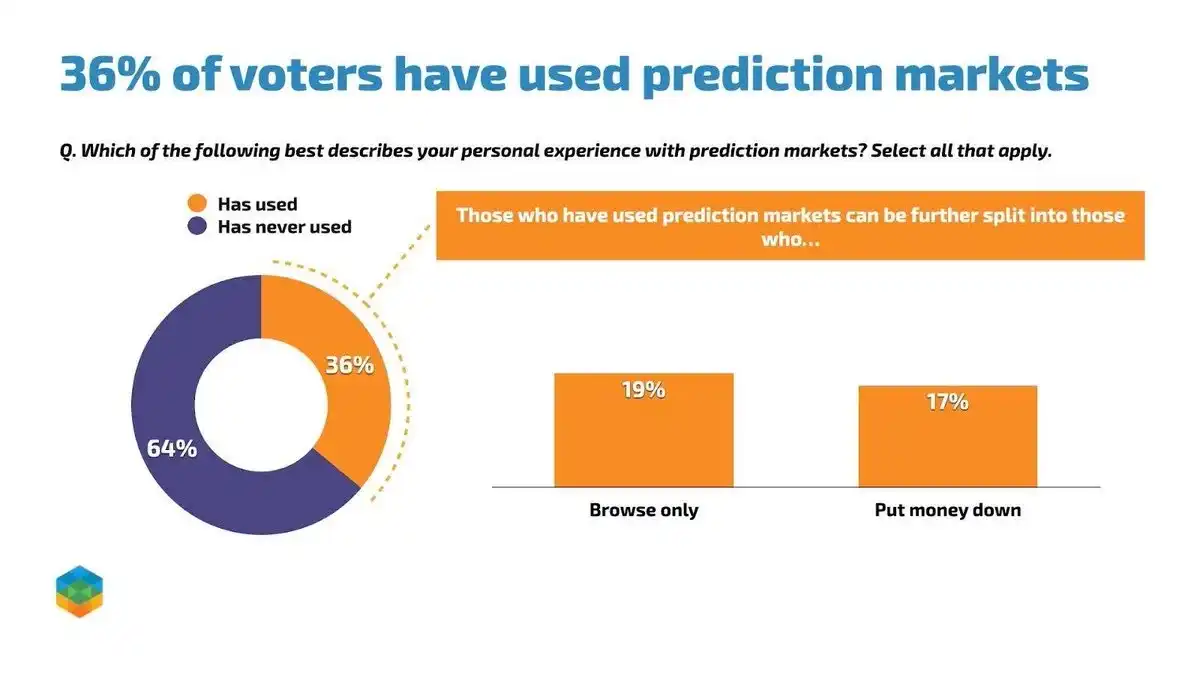
Of course, as the lead investor in Kalshi's recent $1 billion funding round, Paradigm's move is undoubtedly a way to "shout out for his bag" (promote their investment). This is understandable, but the survey also raises a new question: How will the prediction market duopoly of Kalshi and Polymarket penetrate the remaining 64% of American voters and even the entire U.S. population?

The answer is clear: either challenge the old guard or seek new growth avenues.

Kalshi's New Growth Strategy: Integrating Payment Channels to Encourage User Deposits

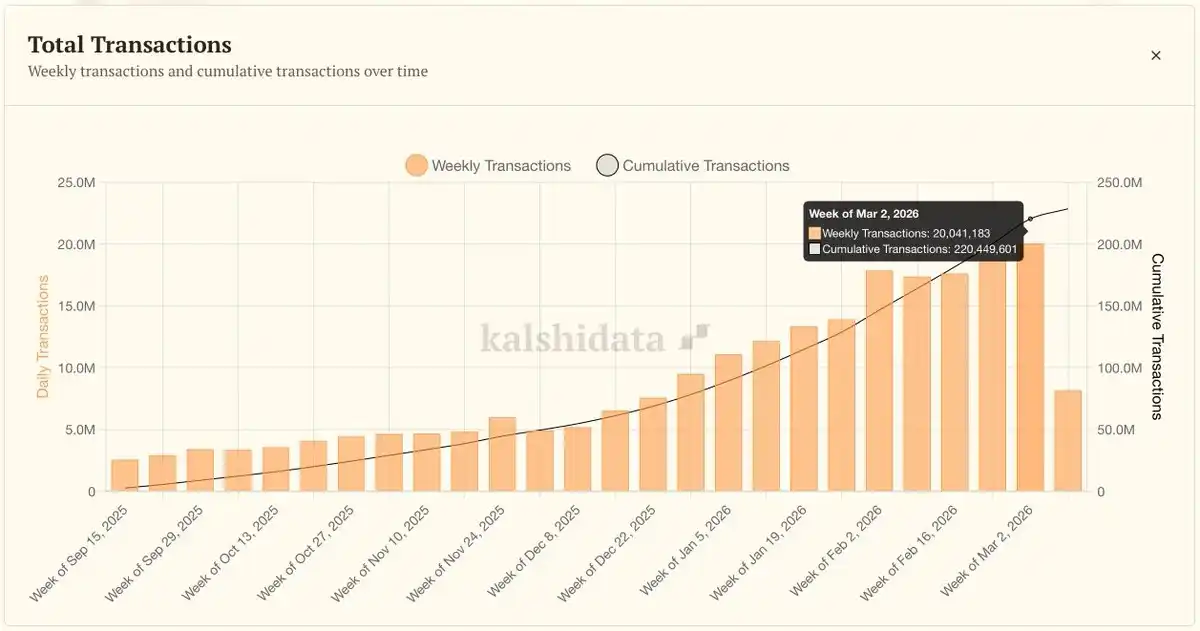
During the week of March 2–8, Kalshi recorded over 20 million transactions, setting a new weekly transaction record since its inception. With trading volume and transaction numbers consistently hitting new highs, tapping into existing user pools is undoubtedly an efficient strategy to achieve further growth.
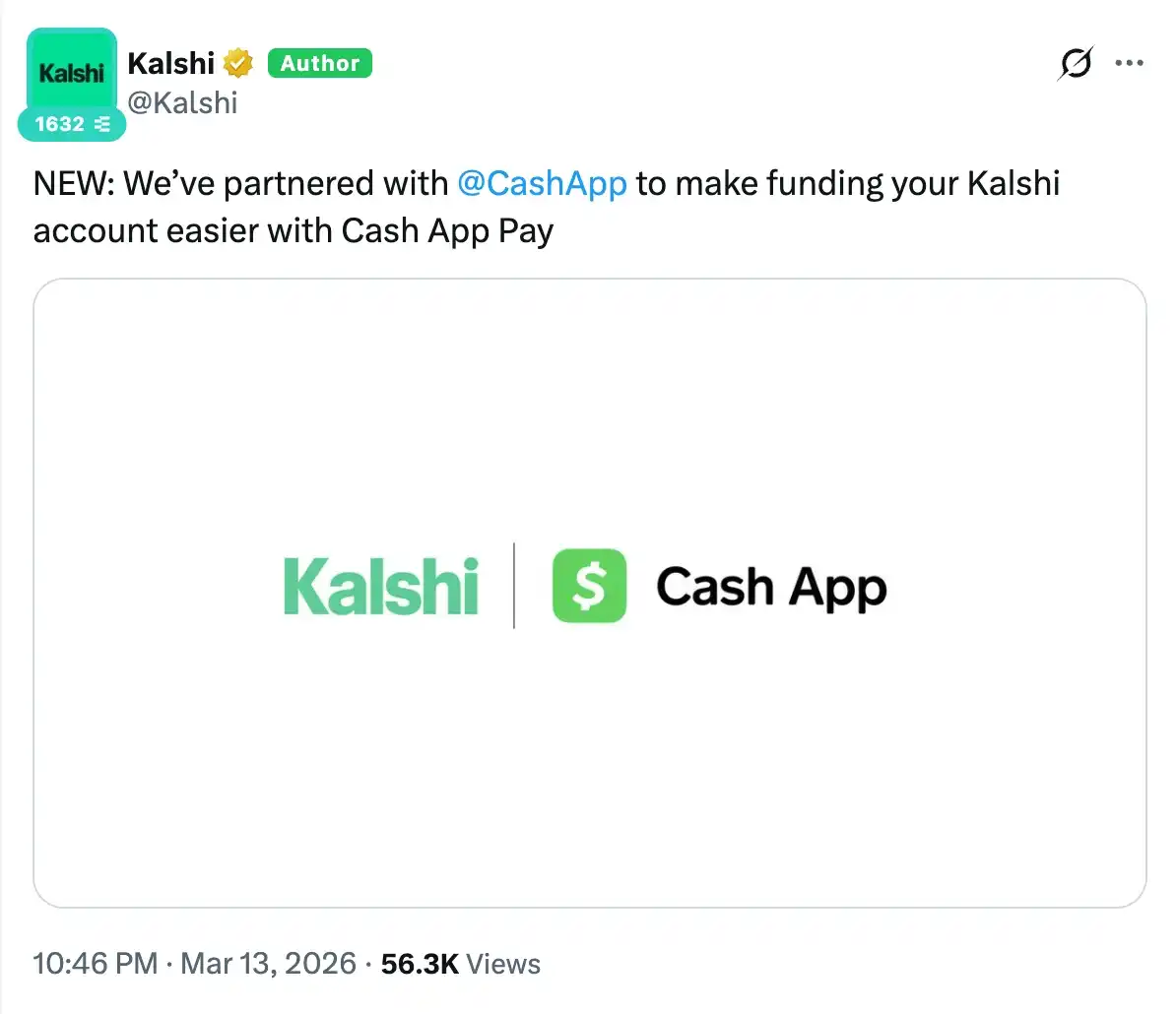
This likely explains why Kalshi announced a partnership with Block's payment app, Cash APP, last week. Kalshi's official statement was even more direct: "Make funding your Kalshi account easier with Cash App Pay." The message was practically written on their faces: "Use Cash App Pay to deposit money and start betting."

After all, even a 1% conversion rate from Cash App's 59 million monthly active users would bring Kalshi nearly 600,000 new users—equivalent to two or three years of hard work. More importantly, these are all "incremental gains."
Polymarket's Market Expansion Strategy: Targeting AI Agents as Users

On the other side of the prediction market, Polymarket, the other half of the duopoly, is also performing impressively.

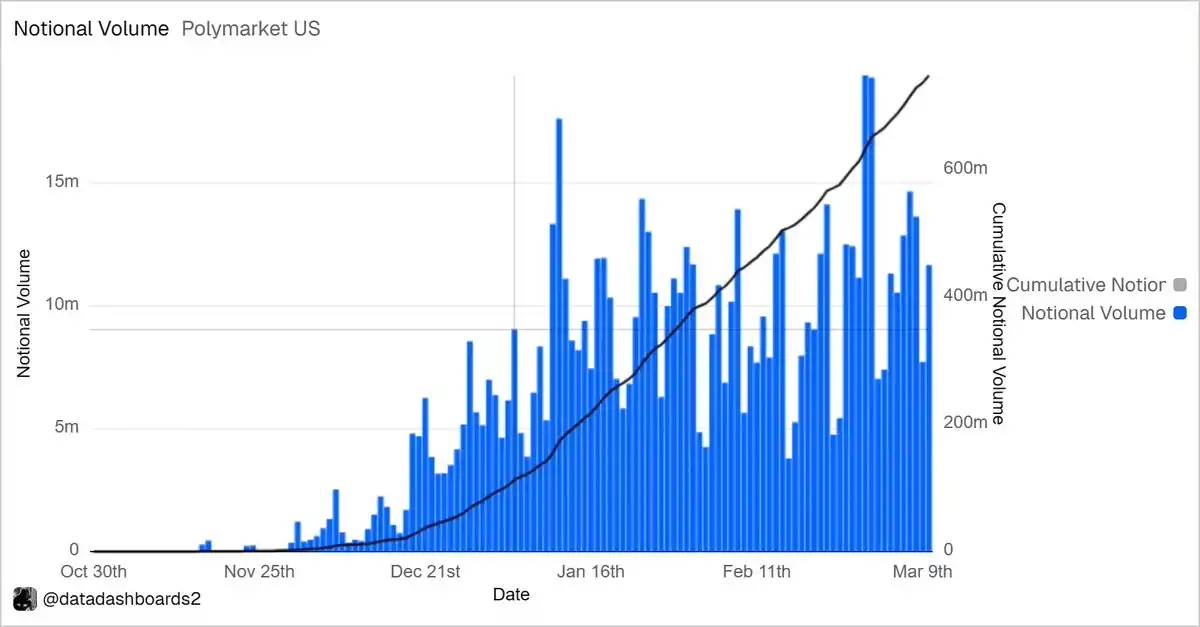
Since resuming operations in the U.S. last November, as of March 14, Polymarket's U.S. platform has seen a nominal trading volume exceeding $750 million, with over 5 million transactions. The platform's open interest once reached $2.6 million but has recently settled around $1 million.
Additionally, according to Dune data, since introducing trading fees for certain markets (including NCAA and crypto price fluctuations) on January 6, Polymarket has accumulated over $11.2 million in fee revenue. In other words, Polymarket has already proven its ability to generate sustainable revenue.
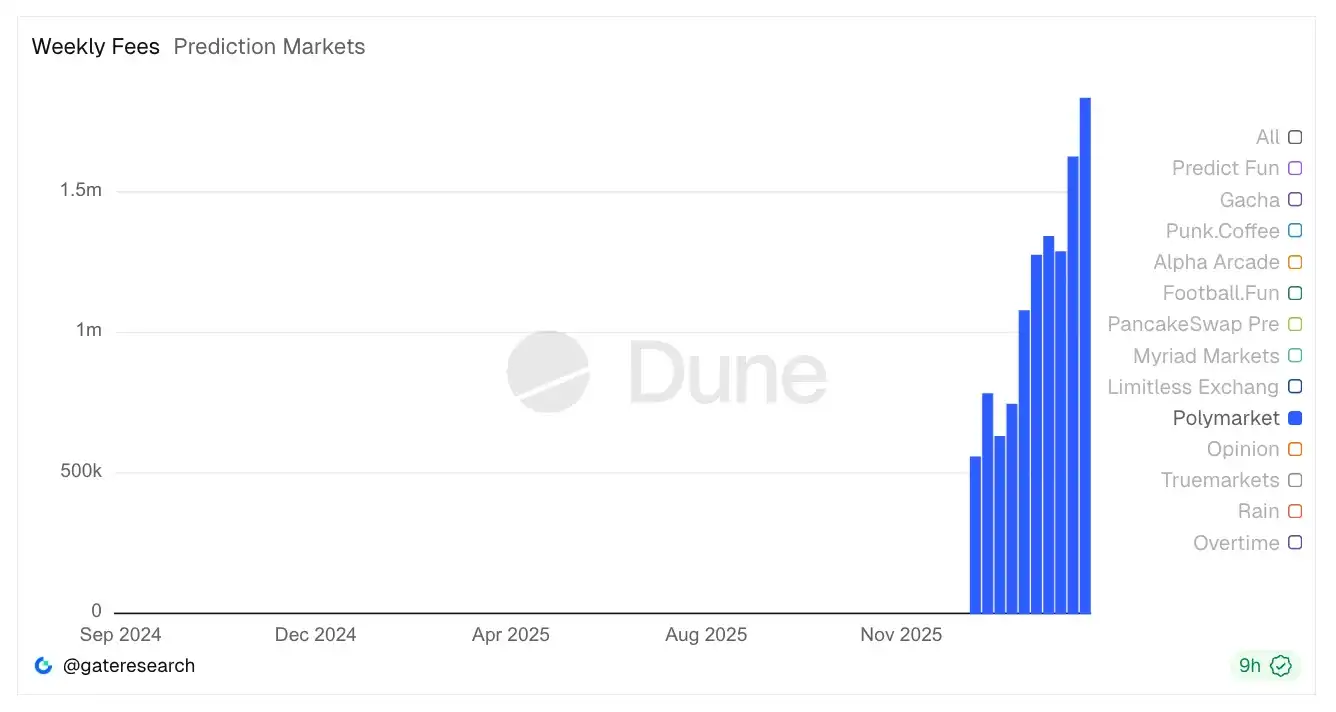
With such success, the ambitious Polymarket is no longer content with just the human user market and is now betting on enabling 24/7 trading for AI Agents.

Last weekend, crypto payment platform Alchemy launched its AI agent payment platform, AgentCard. In addition to standard features like food delivery and AI app subscriptions, it emphasized that "users' AI Agents can now trade on Polymarket 24/7." This announcement was later confirmed by Polymarket's official account.
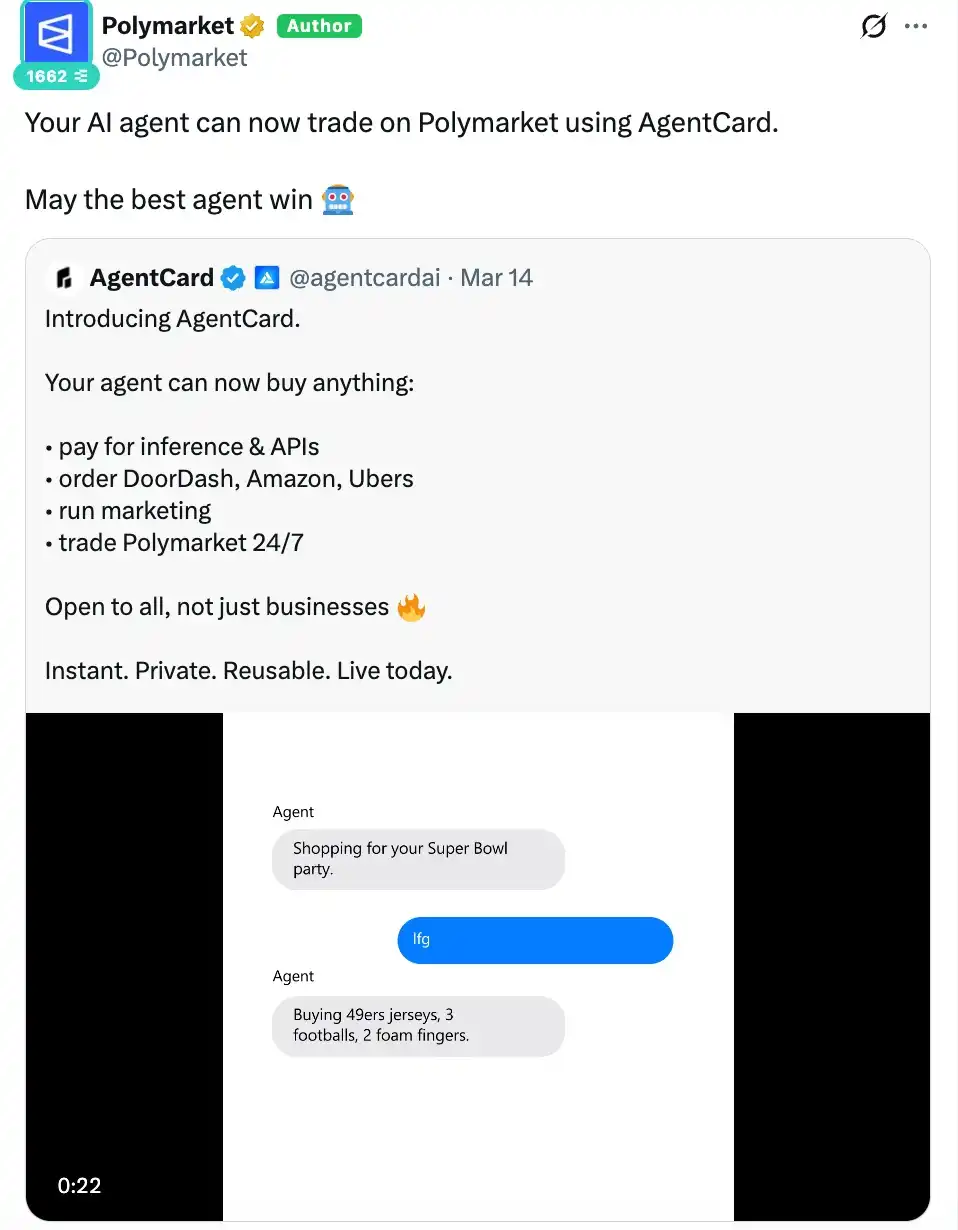
Against the backdrop of OpenClaw's "Lobster" going viral and the emergence of x402, ERC8004, and ERC8183 supporting AI Agent payments, combined with Polymarket's earlier Polymarket CLI designed for AI Agents, a prediction market platform capable of querying market data, executing orders, managing positions, and interacting with on-chain contracts is taking shape.

Much like Circle's transformation from a "stablecoin issuer" to an "AI-era financial infrastructure builder," Polymarket has already secured the critical position of being the "prediction market platform for AI Agents." As NVIDIA founder Jensen Huang stated at last year's CES, the AI Agent industry will become a trillion-dollar market, much like the robotics industry. And 24/7 AI Agents may first shine in prediction markets.

Conclusion: The New War in Prediction Markets Has Begun

There is no doubt that a new war in the prediction market sector has quietly begun. This includes deepening engagement with existing users, incentivizing active users, converting new users, expanding the scope of betting events, negotiating with regulators, and even preparing for future developments like catering to "potential active users" such as AI Agents.

Earlier, Dingaling, founder of the BSC ecosystem prediction market platform Predict.fun, also planned to launch products combining prediction markets and DeFi, aiming to offer users interest-earning opportunities on account funds—a kind of "PayFi yield product" that is also worth watching.

Regardless of how the prediction market evolves, in their quest to raise $20 billion or more in funding, Kalshi and Polymarket have already activated new growth levers.


Trending Cryptos

Related Questions

QWhat are the two main prediction market giants mentioned in the article, and what new user segments are they targeting?

AThe two main prediction market giants are Kalshi and Polymarket. Kalshi is targeting new users by integrating with the Cash App to facilitate easier payments and deposits. Polymarket is targeting AI Agents as a new user segment by enabling 24/7 trading through integrations like the AgentCard from Alchemy and its own CLI tool.

QAccording to the Paradigm survey cited in the article, what percentage of American voters have used a prediction market?

AAccording to the Paradigm survey, approximately 36% of American voters have used a prediction market, either to place bets or to browse the markets for information.

QWhat significant milestone did Kalshi achieve in terms of transaction volume during the week of March 2nd to March 8th?

ADuring the week of March 2nd to March 8th, Kalshi's number of transactions exceeded 20 million for the first time, setting a new single-week transaction record for the platform.

QHow much fee revenue has Polymarket accumulated since it began charging trading fees on certain markets on January 6th?

ASince it began charging trading fees on certain markets on January 6th, Polymarket has accumulated over $11.2 million in fee revenue.

QWhat new capability did the integration between Alchemy's AgentCard and Polymarket provide?

AThe integration between Alchemy's AgentCard and Polymarket enables users' AI Agents to trade on the Polymarket prediction platform 24 hours a day, 7 days a week.

Related Reads

In Conversation with Ray Dalio: We Are Currently in an AI Bubble, with 1% of My Portfolio in Bitcoin

Ray Dalio, founder of Bridgewater Associates, warns in an interview that the current AI boom shows classic bubble characteristics, which could lead to significant economic downturns as seen in past cycles like 1929 or 2000. He explains that speculative enthusiasm, fueled by debt and overvaluation, often precedes a crash when rising rates or taxation force asset sales, causing widespread losses and recession. Dalio also outlines his "Big Cycle" theory, describing an approximate 80-year pattern where widening wealth gaps, massive government deficits, and shifting geopolitical power (like China's rise) create internal conflict and global instability. He emphasizes that we are in a late-cycle, transitional phase where traditional powers like the US and UK face decline. For personal wealth protection, Dalio advises diversification beyond cash into assets like stocks, bonds, real estate, and particularly gold, which he prefers over Bitcoin. While he holds about 1% of his portfolio in Bitcoin as a non-printable hard asset, he views gold as more secure from technological or governmental threats. Regarding AI's impact, Dalio believes it will disproportionately benefit capital owners, worsening inequality by replacing both physical and cognitive labor. He suggests that human intuition and emotional intelligence, combined with AI, will be key for future workers. On taxation, Dalio argues that wealth taxes are impractical and risk triggering asset sell-offs, reducing productive investment. He points to the UK as a cautionary example of debt, low productivity, and political strife. Geopolitically, Dalio foresees a more regionalized world, with the US showing weakness in prolonged conflicts like with Iran, akin to past imperial declines. The ideal outcome, he suggests, is coexisting powerful blocs (e.g., Americas, China-Asia Pacific) without major war.

marsbit2h ago

In Conversation with Ray Dalio: We Are Currently in an AI Bubble, with 1% of My Portfolio in Bitcoin

marsbit2h ago

Daily 7.2 Trillion KRW: Foreign Capital's Record Net Buying on Friday! Wall Street Says Headwinds for Korean Stock Fund Flows Have Subsided

South Korean stock market sees a dramatic shift in fund flows. On July 31, foreign investors made a record net purchase of approximately KRW 7.2 trillion in KOSPI stocks, marking a fundamental reversal from the persistent large-scale net outflows seen in previous months. This contributed to a significant narrowing of foreign net selling in July to KRW 9.8 trillion, down sharply from KRW 48.4 trillion in June and KRW 44.5 trillion in May. Simultaneously, domestic institutional pressure eased. South Korean pension funds and asset managers turned to a net buying position in July, purchasing KRW 1.0 trillion worth of KOSPI shares, contrasting with net sales in May and June. Market volatility is expected to be dampened by new financial regulations. Effective July 31, the Financial Services Commission tightened access for retail investors to single-stock leveraged ETFs by raising the minimum cash deposit requirement. Trading volumes for these products subsequently dropped to about 50% of their monthly average. Citigroup Research maintains its year-end KOSPI target of 10,000 points. The firm cites several supportive factors: the substantial easing of headwinds from capital outflows, a robust fundamental outlook for the semiconductor sector, historically low market valuations, strong economic fundamentals, and the potential for policy support from financial authorities if needed.

marsbit2h ago

Daily 7.2 Trillion KRW: Foreign Capital's Record Net Buying on Friday! Wall Street Says Headwinds for Korean Stock Fund Flows Have Subsided

marsbit2h ago

Thanks to Dice Rolls, Bitcoin Keys Are Stored Offline, But Not Everyone Will Do It

The article discusses using dice rolls to generate secure Bitcoin wallet seeds, providing entropy independent of potentially flawed hardware random number generators. It explains that each fair dice roll offers about 2.585 bits of entropy, with around 50 rolls needed for a standard 12-word seed phrase and 99+ recommended for higher security. This method gained attention after a vulnerability was revealed in some Coldcard hardware wallets, where a faulty firmware RNG (dating back to 2021) compromised generated keys. The analysis notes that while a dice-generated main seed was safe from this specific flaw, other Coldcard functions (like creating paper wallets, backup keys, or passwords) could still be vulnerable if they used the defective RNG. The piece argues that while dice-based entropy is technically robust, the manual process is error-prone, tedious, and unrealistic for most new users, who might make mistakes in recording or inputting rolls. It concludes that while manual entropy generation should remain an option for advanced users, the long-term goal is to develop reliable, user-friendly hardware and software that securely generates randomness without requiring specialized knowledge. Coldcard users are advised to check their firmware version and replace any secondary secrets (like paper wallet keys) created with vulnerable devices, while also considering multi-signature setups with devices from different manufacturers for added security.

cryptonews.ru7h ago

Thanks to Dice Rolls, Bitcoin Keys Are Stored Offline, But Not Everyone Will Do It

cryptonews.ru7h ago

Trading

Spot

Hot Articles

Discussions

Welcome to the HTX Community. Here, you can stay informed about the latest platform developments and gain access to professional market insights. Users' opinions on the price of AI (AI) are presented below.

活动图片














