Still Not Enough? Prediction Market Giants Set Sights on Payments and AI

marsbitPublished on 2026-03-16Last updated on 2026-03-16

Abstract

Prediction market giants Kalshi and Polymarket are aggressively expanding their user base and influence, moving beyond traditional betting sector. During the recent Oscars, the two platforms saw over $100 million in bets, a significant jump from the previous year. Kalshi is focusing on payment integration, partnering with Block’s Cash App to simplify funding and tap into its 59 million monthly active users. This move aims to attract new users from an established financial platform. Polymarket, on the other hand, is targeting AI agents as potential users. After resuming U.S. operations, it has processed $750 million in nominal trading volume. It now supports AI Agent trading through integrations like Alchemy’s AgentCard and its own CLI tool, enabling 24/7 automated trading. This positions Polymarket at the forefront of AI-driven prediction markets. A Paradigm survey notes that 36% of U.S. voters have used prediction markets, with stronger adoption among younger and non-white demographics. Both platforms are exploring new growth avenues—Kalshi through payment accessibility and Polymarket through AI automation—as they compete for a larger share of the evolving market.

Original|Odaily Planet Daily(@OdailyChina)

Author|Wenser(@wenser 2010)

Time is running out for traditional gambling companies—this might be the latest consensus in the prediction market sector.

At the recently concluded Oscars event, the total betting volume on Kalshi and Polymarket surpassed $100 million for the first time, a significant jump from the less than $10 million mark last year. Meanwhile, Kalshi partnered with Cash APP to streamline user payment channels, while Polymarket, after launching its AI Agent CLI application, now supports 24/7 trading by AI Agents through Alchemy's AgentCard. In 2026, a year filled with historic "prediction milestones," the two giants of the prediction market are leveraging their strategies to attract new users from traditional gambling firms, internet platforms, and even conventional media and finance industries. This time, they are targeting real users from payment channels and tireless AI Agents.

New Victories for Prediction Market Giants: Payment Channels and AI Agent Users

Last week, renowned investment firm Paradigm released its first public opinion survey of the year, also marking its inaugural survey on prediction market platforms.

The results showed that over one-third (approximately 36%) of American voters have used prediction markets, either placing bets or browsing markets for information.

In terms of user demographics, 66% of prediction market users are under 50 years old, with 20% aged 18–34 and 27% aged 35–49. Non-white voters use prediction markets slightly more than white voters, and men use them significantly more than women (46% vs. 31%).

This indicates that in the U.S., prediction markets are no longer a "niche sector" but have become a vital "information source," "trading desk," and "news pool" for millions of households.
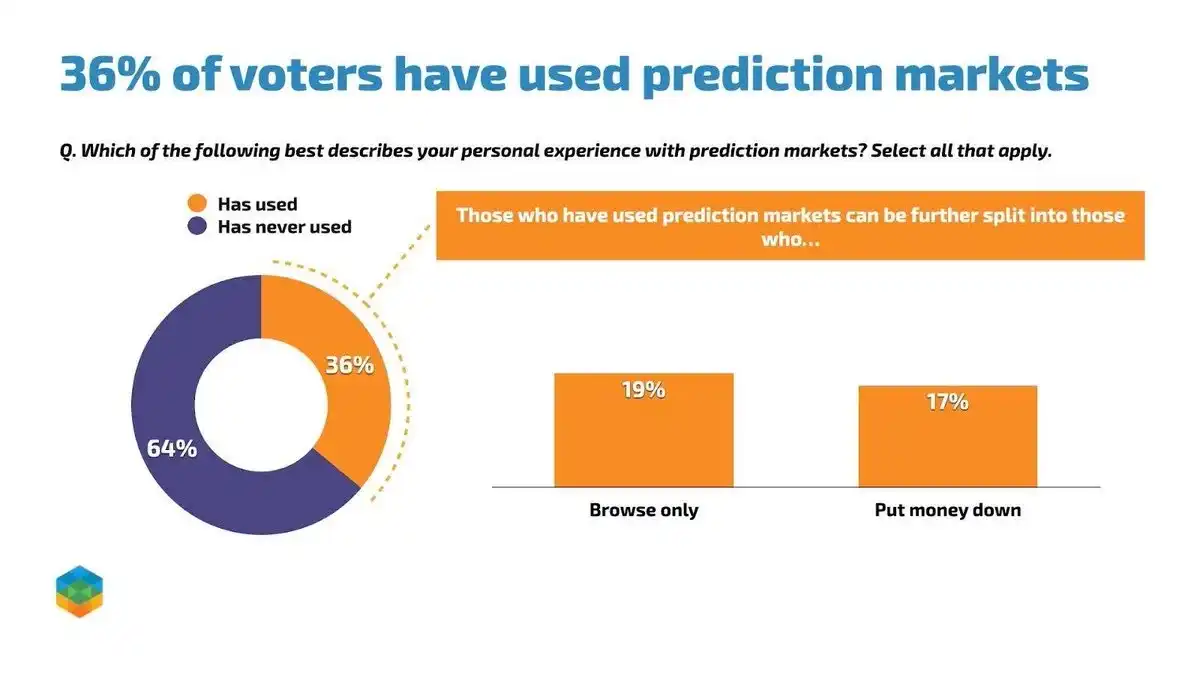
Of course, as the lead investor in Kalshi's recent $1 billion funding round, Paradigm's move is undoubtedly a way to "shout out for his bag" (promote their investment). This is understandable, but the survey also raises a new question: How will the prediction market duopoly of Kalshi and Polymarket penetrate the remaining 64% of American voters and even the entire U.S. population?

The answer is clear: either challenge the old guard or seek new growth avenues.

Kalshi's New Growth Strategy: Integrating Payment Channels to Encourage User Deposits

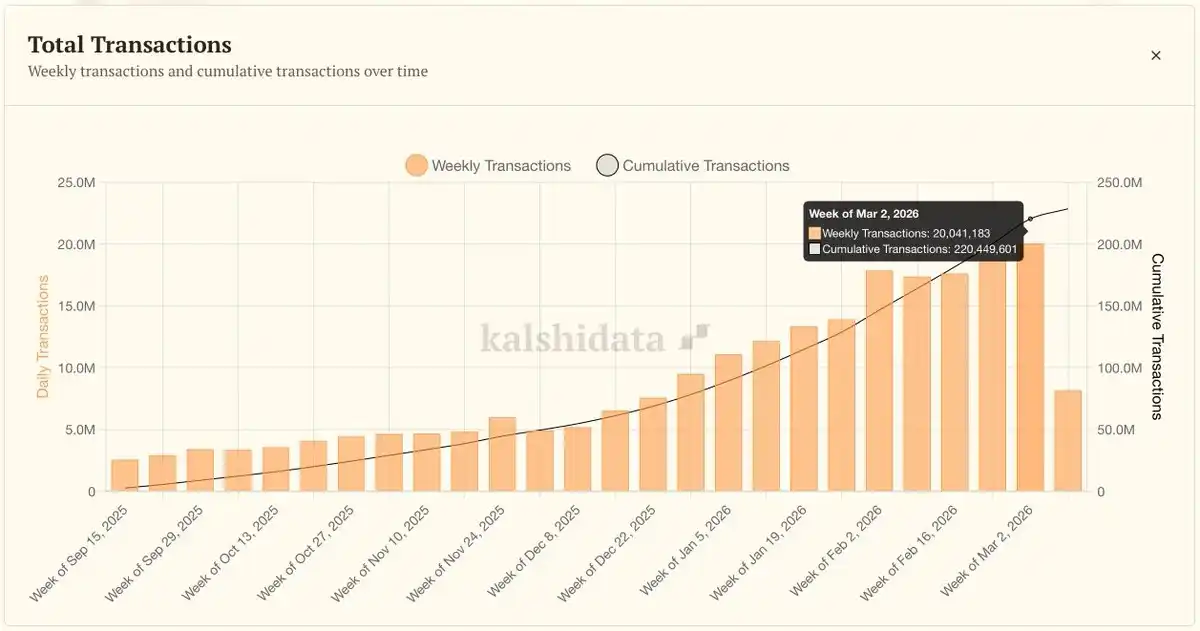
During the week of March 2–8, Kalshi recorded over 20 million transactions, setting a new weekly transaction record since its inception. With trading volume and transaction numbers consistently hitting new highs, tapping into existing user pools is undoubtedly an efficient strategy to achieve further growth.
This likely explains why Kalshi announced a partnership with Block's payment app, Cash APP, last week. Kalshi's official statement was even more direct: "Make funding your Kalshi account easier with Cash App Pay." The message was practically written on their faces: "Use Cash App Pay to deposit money and start betting."

After all, even a 1% conversion rate from Cash App's 59 million monthly active users would bring Kalshi nearly 600,000 new users—equivalent to two or three years of hard work. More importantly, these are all "incremental gains."
Polymarket's Market Expansion Strategy: Targeting AI Agents as Users

On the other side of the prediction market, Polymarket, the other half of the duopoly, is also performing impressively.

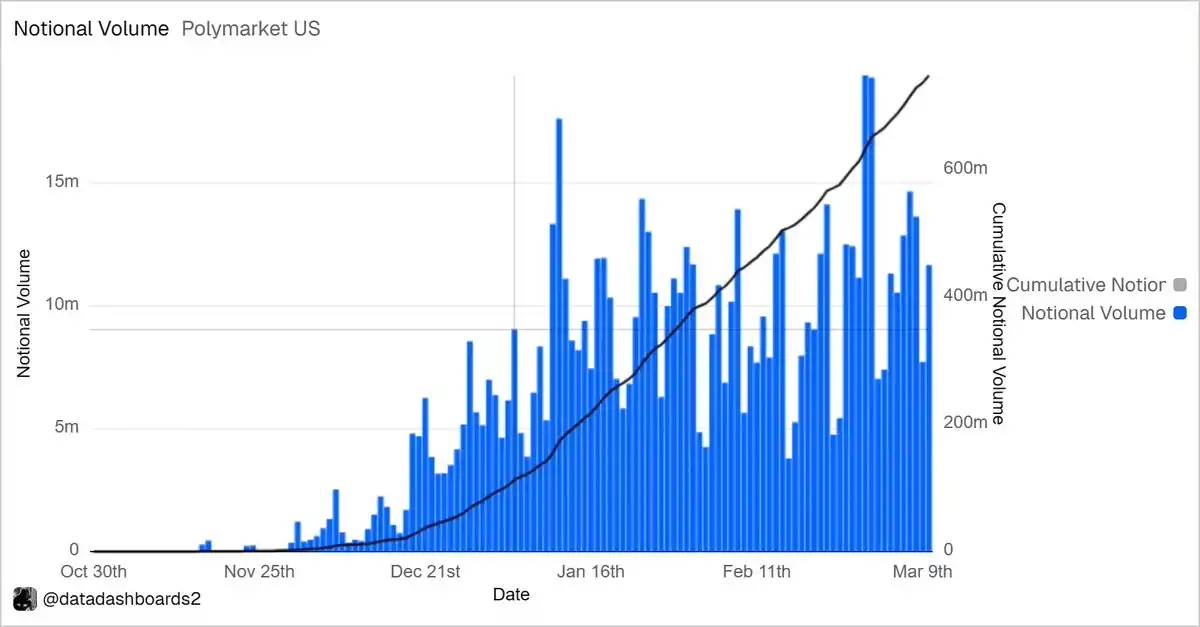
Since resuming operations in the U.S. last November, as of March 14, Polymarket's U.S. platform has seen a nominal trading volume exceeding $750 million, with over 5 million transactions. The platform's open interest once reached $2.6 million but has recently settled around $1 million.
Additionally, according to Dune data, since introducing trading fees for certain markets (including NCAA and crypto price fluctuations) on January 6, Polymarket has accumulated over $11.2 million in fee revenue. In other words, Polymarket has already proven its ability to generate sustainable revenue.
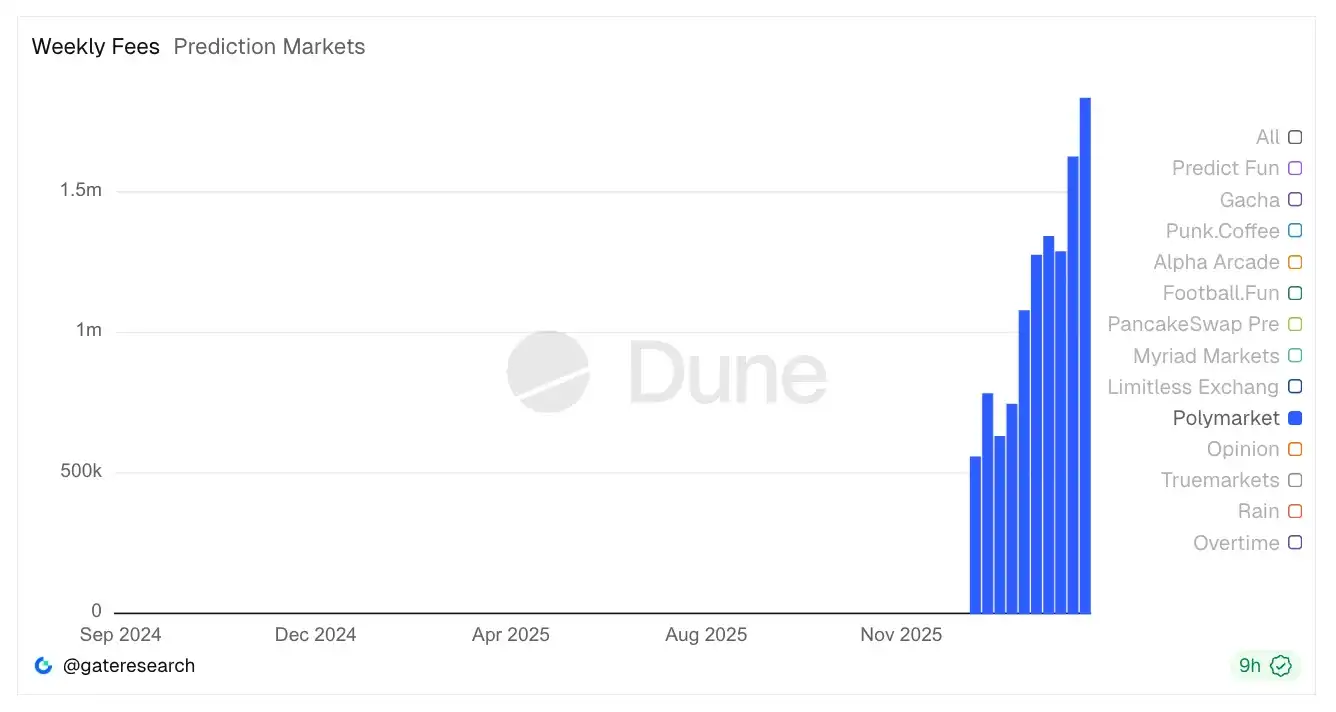
With such success, the ambitious Polymarket is no longer content with just the human user market and is now betting on enabling 24/7 trading for AI Agents.

Last weekend, crypto payment platform Alchemy launched its AI agent payment platform, AgentCard. In addition to standard features like food delivery and AI app subscriptions, it emphasized that "users' AI Agents can now trade on Polymarket 24/7." This announcement was later confirmed by Polymarket's official account.
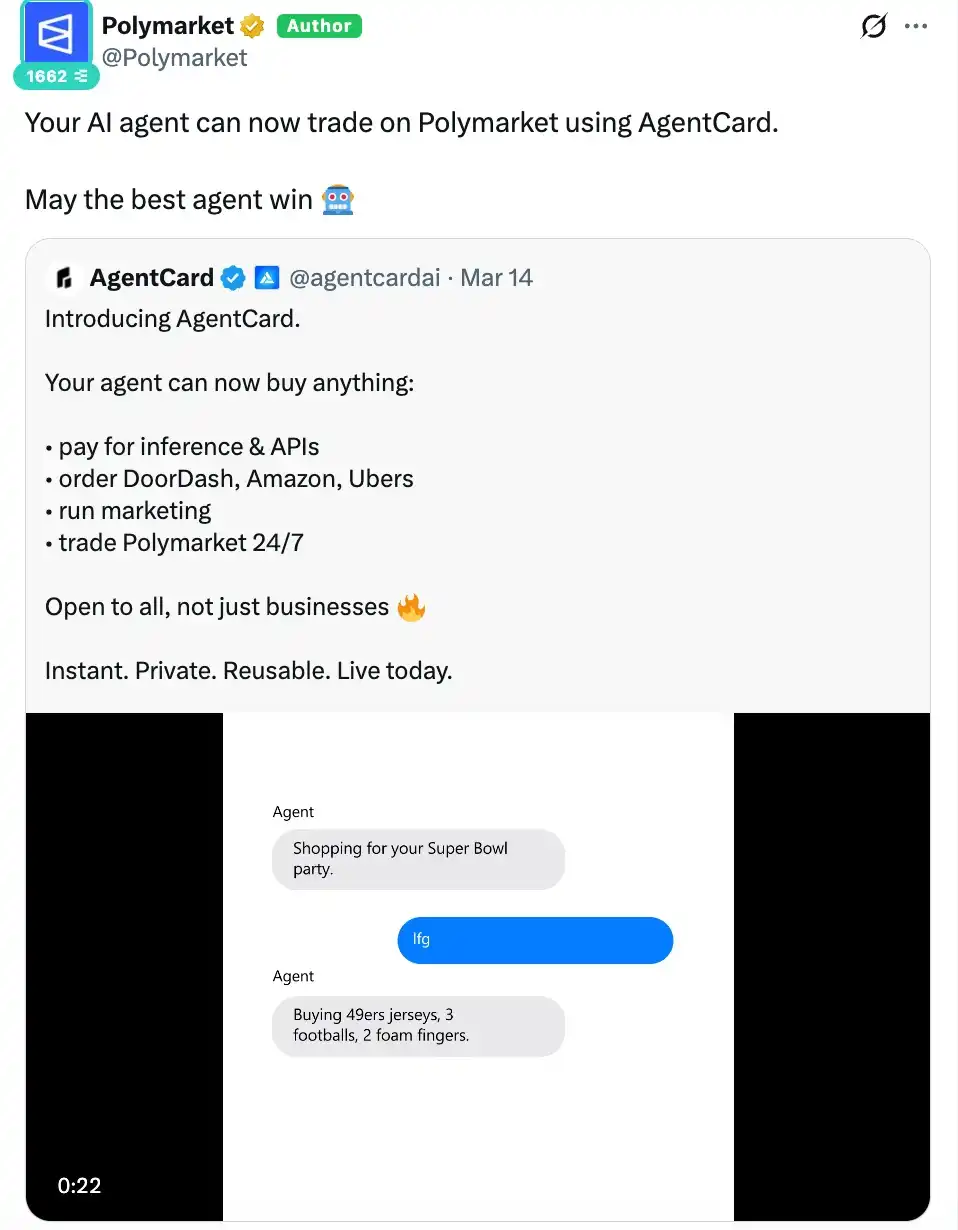
Against the backdrop of OpenClaw's "Lobster" going viral and the emergence of x402, ERC8004, and ERC8183 supporting AI Agent payments, combined with Polymarket's earlier Polymarket CLI designed for AI Agents, a prediction market platform capable of querying market data, executing orders, managing positions, and interacting with on-chain contracts is taking shape.

Much like Circle's transformation from a "stablecoin issuer" to an "AI-era financial infrastructure builder," Polymarket has already secured the critical position of being the "prediction market platform for AI Agents." As NVIDIA founder Jensen Huang stated at last year's CES, the AI Agent industry will become a trillion-dollar market, much like the robotics industry. And 24/7 AI Agents may first shine in prediction markets.

Conclusion: The New War in Prediction Markets Has Begun

There is no doubt that a new war in the prediction market sector has quietly begun. This includes deepening engagement with existing users, incentivizing active users, converting new users, expanding the scope of betting events, negotiating with regulators, and even preparing for future developments like catering to "potential active users" such as AI Agents.

Earlier, Dingaling, founder of the BSC ecosystem prediction market platform Predict.fun, also planned to launch products combining prediction markets and DeFi, aiming to offer users interest-earning opportunities on account funds—a kind of "PayFi yield product" that is also worth watching.

Regardless of how the prediction market evolves, in their quest to raise $20 billion or more in funding, Kalshi and Polymarket have already activated new growth levers.


Trending Cryptos

Related Questions

QWhat are the two main prediction market giants mentioned in the article, and what new user segments are they targeting?

AThe two main prediction market giants are Kalshi and Polymarket. Kalshi is targeting new users by integrating with the Cash App to facilitate easier payments and deposits. Polymarket is targeting AI Agents as a new user segment by enabling 24/7 trading through integrations like the AgentCard from Alchemy and its own CLI tool.

QAccording to the Paradigm survey cited in the article, what percentage of American voters have used a prediction market?

AAccording to the Paradigm survey, approximately 36% of American voters have used a prediction market, either to place bets or to browse the markets for information.

QWhat significant milestone did Kalshi achieve in terms of transaction volume during the week of March 2nd to March 8th?

ADuring the week of March 2nd to March 8th, Kalshi's number of transactions exceeded 20 million for the first time, setting a new single-week transaction record for the platform.

QHow much fee revenue has Polymarket accumulated since it began charging trading fees on certain markets on January 6th?

ASince it began charging trading fees on certain markets on January 6th, Polymarket has accumulated over $11.2 million in fee revenue.

QWhat new capability did the integration between Alchemy's AgentCard and Polymarket provide?

AThe integration between Alchemy's AgentCard and Polymarket enables users' AI Agents to trade on the Polymarket prediction platform 24 hours a day, 7 days a week.

Related Reads

How Does Codex Use a Computer? Three Entry Points and Permission Boundaries

This article explains the three primary methods for Codex to interact with a computer, each with distinct use cases, permission boundaries, and trust levels. **1. Computer Use:** This offers the broadest access, allowing Codex to visually control and interact with the graphical user interface of authorized macOS/Windows apps, system settings, and even iOS simulators. It's ideal for tasks lacking APIs or structured tools, such as operating legacy software or multi-app workflows. However, it's the slowest method and has the widest permission scope, requiring careful supervision for sensitive actions. **2. Chrome Extension:** This grants Codex access to the user's logged-in Chrome browser state, including cookies, profiles, and open tabs. It's best for tasks requiring user identity across websites like Gmail, LinkedIn, Salesforce, or internal dashboards. Its key advantage is multi-tab control for complex workflows. While more powerful for browser-based tasks than Computer Use, it carries higher sensitivity as actions are performed under the user's identity. **3. In-App Browser:** This is a browser isolated within the Codex thread, separate from the user's personal browsing data. It excels in web development and debugging scenarios—previewing local servers, testing responsive layouts, or annotating designs directly on the page. Its isolation is a strength for development but a limitation for tasks requiring login sessions. The core principle is to choose the narrowest, safest, and most structured interface for the task. Use plugins or MCPs first, resort to visual control (Computer Use) only for GUI-dependent tasks, employ the Chrome extension for identity-reliant browser work, and prefer the In-App Browser for isolated development. **Appshots** are clarified as a fourth, complementary tool for *inputting* context—capturing a screenshot of a window to point Codex to something—rather than a method for Codex to *act*. Together, this layered approach highlights a key to AI agent productization: not granting unlimited permissions, but constraining them within clear boundaries for specific tasks while preserving user oversight.

marsbit10m ago

How Does Codex Use a Computer? Three Entry Points and Permission Boundaries

marsbit10m ago

The "Iron Rule" of Chip Equipment Is Being Broken

For years, the semiconductor equipment industry followed an unwritten "iron rule": suppliers offered steep discounts for new tool introductions (Design-in) and faced consistent price pressure during repeat orders, especially during market downturns. This long-standing buyer's market dynamic is now being upended. Recently, SK Hynix's primary equipment suppliers have reportedly requested a 3-4% price *increase*, a nearly unprecedented move. This shift is driven by a severe supply-demand imbalance fueled by the AI compute boom. Securing equipment has become an urgent arms race as chipmakers' expansion speed dictates their ability to fulfill massive AI chip orders. Key areas feeling the strain include: **TCB (Thermal Compression Bonding) Equipment:** Demand is exploding, driven by the simultaneous needs of HBM4 memory stacking, AI chip Chip-on-Substrate (C2S), and logic Chiplet Chip-on-Wafer (C2W) packaging. Players like Hanmi Semiconductor, Hanwha Semitech, and ASMPT are receiving major orders. While hybrid bonding is seen as the future, TCB remains the pragmatic choice for HBM4 mass production, with its lifecycle extended by relaxed specifications and ongoing technological upgrades. **Test Equipment Bottlenecks:** Ironically, AI-driven shortages are now crippling test equipment manufacturing. Critical components like FPGAs, Driver ICs, and CPUs face severe shortages and extended lead times (up to 52 weeks for FPGAs), as AI data center and server vendors prioritize supply. This creates a paradoxical cycle: AI chip shortages drive fab expansion, which requires more test equipment, whose production is delayed because its key parts are diverted to make AI chips. The industry is entering a broad, AI-powered upcycle. SEMI forecasts global semiconductor equipment sales to hit a record $156 billion by 2027, fueled by investment in advanced logic/foundry, HBM-driven DRAM, and advanced packaging (like CoWoS). Major players like TSMC, SK Hynix, and Micron are aggressively ramping capital expenditure. In conclusion, leading equipment vendors are no longer just selling tools; they are selling the critical capability to deliver AI-era capacity. Pricing power is shifting decisively to those with indispensable technology in key process nodes like advanced logic, HBM, and advanced packaging, rewriting the industry's traditional power structure.

marsbit23m ago

The "Iron Rule" of Chip Equipment Is Being Broken

marsbit23m ago

Trading

Spot
Futures

Hot Articles

Discussions

Welcome to the HTX Community. Here, you can stay informed about the latest platform developments and gain access to professional market insights. Users' opinions on the price of AI (AI) are presented below.

活动图片