Shiba Inu Project Calls Out SHIB X Account Over ‘Personal Financial Interests’

bitcoinistPublished on 2025-12-19Last updated on 2025-12-19

Abstract

The Shiba Inu ecosystem is facing internal conflict as the Oscar community (@oscar_shibainu) publicly severed ties with the official @Shibtoken X account. Oscar accused the account of promoting personal financial interests over the broader SHIB community's welfare, stating it no longer represents founder Ryoshi's vision. The SHIB Army. The dispute was triggered by a Dec. 17 post from @Shibtoken that promoted a separate token, Hachiko (HACHI), which many followers viewed as inappropriate marketing. Despite including a disclaimer, the post received significant backlash, with users criticizing the account for straying from its original purpose. Oscar emphasized that it will continue supporting Shibarium through its charity portal but will distance itself from the main account's messaging strategy. At the time of reporting, @Shibtoken had not publicly responded to the allegations, and SHIB was trading at $0.00000726.

The Shiba Inu ecosystem’s long-running tension between “official messaging” and meme-coin marketing resurfaced this week after Oscar (@oscar_shibainu) published a public break with the @Shibtoken X account, accusing it of drifting into promotional behavior that benefits individuals rather than the broader SHIB community.

In a statement posted on X, Oscar said it had previously defended the Shiba Inu account “in good faith,” but now considers that effort misplaced.

OSCAR Blasts Shiba Inu Account

“For a long time, we believed that something positive could emerge from the SHIB account,” the Oscar team wrote. “We defended it in good faith, even at a high personal cost, trusting that past mistakes had been left behind and that something constructive could flow from that platform. Unfortunately, we were wrong. Nothing changed. For that, we sincerely apologize.”

The group then drew a hard line: “The OSCAR community — the same community that has consistently stood up for SHIB and, in many cases, personally financed initiatives to defend both SHIB and this specific account — no longer supports this account,” the statement said. “It does not represent Ryoshi’s vision, it is not aligned with the interests of the SHIB Army, and it has become a stage for personal financial interests. This is not SHIB. It never was.”

The immediate catalyst was a Dec. 17 post from the official @Shibtoken account amplifying a separate token, Hachiko (HACHI), with messaging that some Shiba Inu holders interpreted as promotional. The post read: “$HACHI X95 🤝 $SHIB 0X95,” referencing a superficial similarity between contract/address prefixes highlighted by the Hachiko account: “Only $HACHI contract created on November 2nd: ... Starting X95 ... $SHIB starts 0x95.”

@Shibtoken included a disclaimer underneath: “Friendly heads-up: This post is from a partner project, not an official Shib token. Always DYOR, frens.”

Even with that caveat, the reaction in the comment section was sharply negative, with several users arguing the account has increasingly functioned as a marketing channel rather than a source of official ecosystem updates.

“Very irritating to the Shib community,” one user wrote. “The reason I followed @shibtoken account many years ago because it stated it was the official account. I would be able to get official updates. Now it appears that it is marketing other projects. (for a while) Go back to your roots.”

Another commenter urged holders to ignore promoted projects altogether: “I encourage all #SHIBARMY to don’t buy anything that the @Shibtoken account promotes. Just give up on that account.”

Oscar’s statement attempted to separate the dispute from Shibarium-related efforts, saying it will continue building support infrastructure while distancing itself from the main account’s messaging strategy.

“That said, we want to make it clear that we will continue to support Shibarium through our charity portal, as we have done since day one,” the Oscar team wrote. “The SHIB community will always be welcome within our ecosystem. However, the time has come for us to follow our own path and focus on the interests and values of our own community.”

At press time, there was no visible public response from the official @Shibtoken account addressing the allegations, and no reaction from any Shiba Inu developer or marketing lead. SHIB traded at $0.00000726.
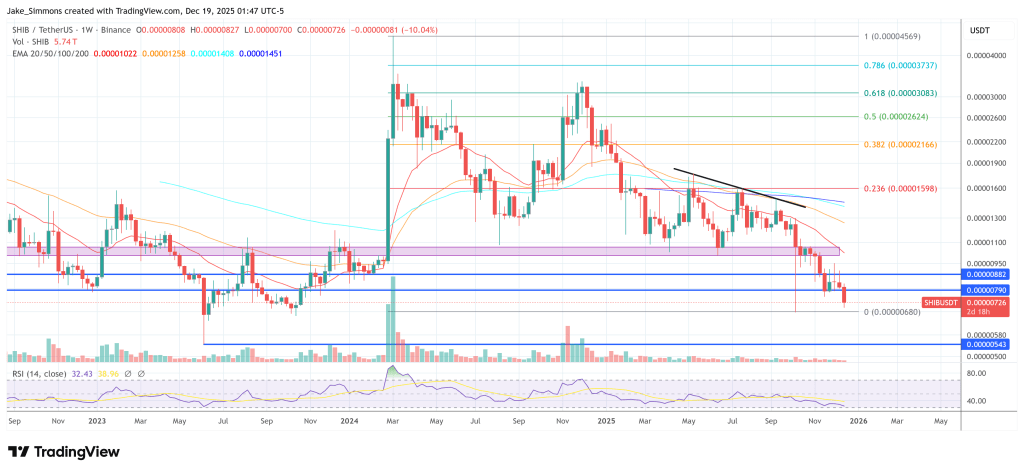
Shiba Inu falls below key support, 1-week chart | Source: SHIBUSDT on TradingView.com

Trending Cryptos

Related Questions

QWhat is the main reason for the public break between Oscar and the @Shibtoken X account?

AOscar accused the @Shibtoken account of drifting into promotional behavior that benefits individuals rather than the broader SHIB community, specifically citing its amplification of the Hachiko (HACHI) token as a catalyst.

QWhat specific event on December 17th triggered Oscar's statement?

AThe official @Shibtoken account posted a message amplifying a separate token called Hachiko (HACHI), which many in the community interpreted as promotional content for personal financial gain.

QHow did the Oscar team say they will continue to support the Shiba Inu ecosystem despite the break?

AThe Oscar team stated they will continue to support Shibarium through their charity portal, as they have done since day one, while distancing themselves from the main account's messaging strategy.

QWhat was the community's reaction to the @Shibtoken account's post about Hachiko?

AThe reaction in the comment section was sharply negative, with users expressing irritation and arguing that the account has become a marketing channel rather than a source of official ecosystem updates.

QWhat did the Oscar team apologize for in their statement?

AThe Oscar team apologized for having previously defended the @Shibtoken account in good faith, believing it could produce something positive, which they now consider a misplaced effort as nothing changed.

Related Reads

Beyond the Stadium: The Profitable Games Surrounding the World Cup

"Beyond the Pitch: The Profit Game Around the World Cup" The FIFA World Cup transcends being a sporting spectacle, evolving into a massive global arena for speculation and profit-seeking. The 2026 tournament has amplified this dynamic, creating a multi-layered ecosystem of financial opportunism alongside the football. **Prediction markets** have surged into the mainstream. Platforms like Polymarket and Kalshi saw trading volumes for World Cup contracts soar, attracting new users with their financial trading model and high-profile, chain-based wealth stories that overshadow traditional sports betting in terms of growth and narrative. However, **traditional sportsbooks** remain the dominant force, leveraging established user habits, legal markets, and comprehensive product offerings to handle the vast majority of speculative wagers, with projections suggesting record-breaking betting volumes. Capital markets also react. **"Concept stocks"** in countries like South Korea and Japan experience volatile price swings based on team performance and anticipated fan spending on items like chicken, beer, and viewing parties, effectively becoming a stock market reflecting fan sentiment. The **ticket resale market** has become a sophisticated arena for arbitrage. Prices fluctuate wildly based on team draws and star power, with sellers sometimes listing tickets they don't yet own in a practice akin to short-selling, while FIFA's own "Right to Buy" tokens add another layer of speculative trading. **Collectibles and merchandise** offer another avenue. Panini sticker albums, with their inherent scarcity and nostalgic value, can become high-value collectibles. Limited-edition or locally themed jerseys command significant premiums on secondary markets, and even counterfeit vendors profit from fans' desire for affordable match-day identity. The **cryptocurrency** space has seen a frenzy of speculative, unauthorized World Cup-themed meme coins on chains like Solana. These tokens, often exploiting team names and player imagery, experience extreme pump-and-dump cycles, creating stories of massive gains for a few early entrants and steep losses for many others. Finally, an entire industry thrives on **providing information and tools** to other speculators. Developers create platforms like SeatSidekick to track ticket inventory and prices, while paid Telegram groups and subscriptions sell betting tips and predictions, monetizing the widespread desire for an informational edge. In essence, the World Cup has become a compressed, global laboratory for speculation. While the games determine champions on the field, a parallel, complex network of financial transactions—spanning prediction contracts, bets, stocks, tickets, collectibles, crypto, and information services—settles its own scores in the global market.

marsbit2m ago

Beyond the Stadium: The Profitable Games Surrounding the World Cup

marsbit2m ago

How Does Codex Use a Computer? Three Entry Points and Permission Boundaries

This article explains the three primary methods for Codex to interact with a computer, each with distinct use cases, permission boundaries, and trust levels. **1. Computer Use:** This offers the broadest access, allowing Codex to visually control and interact with the graphical user interface of authorized macOS/Windows apps, system settings, and even iOS simulators. It's ideal for tasks lacking APIs or structured tools, such as operating legacy software or multi-app workflows. However, it's the slowest method and has the widest permission scope, requiring careful supervision for sensitive actions. **2. Chrome Extension:** This grants Codex access to the user's logged-in Chrome browser state, including cookies, profiles, and open tabs. It's best for tasks requiring user identity across websites like Gmail, LinkedIn, Salesforce, or internal dashboards. Its key advantage is multi-tab control for complex workflows. While more powerful for browser-based tasks than Computer Use, it carries higher sensitivity as actions are performed under the user's identity. **3. In-App Browser:** This is a browser isolated within the Codex thread, separate from the user's personal browsing data. It excels in web development and debugging scenarios—previewing local servers, testing responsive layouts, or annotating designs directly on the page. Its isolation is a strength for development but a limitation for tasks requiring login sessions. The core principle is to choose the narrowest, safest, and most structured interface for the task. Use plugins or MCPs first, resort to visual control (Computer Use) only for GUI-dependent tasks, employ the Chrome extension for identity-reliant browser work, and prefer the In-App Browser for isolated development. **Appshots** are clarified as a fourth, complementary tool for *inputting* context—capturing a screenshot of a window to point Codex to something—rather than a method for Codex to *act*. Together, this layered approach highlights a key to AI agent productization: not granting unlimited permissions, but constraining them within clear boundaries for specific tasks while preserving user oversight.

marsbit1h ago

How Does Codex Use a Computer? Three Entry Points and Permission Boundaries

marsbit1h ago

The "Iron Rule" of Chip Equipment Is Being Broken

For years, the semiconductor equipment industry followed an unwritten "iron rule": suppliers offered steep discounts for new tool introductions (Design-in) and faced consistent price pressure during repeat orders, especially during market downturns. This long-standing buyer's market dynamic is now being upended. Recently, SK Hynix's primary equipment suppliers have reportedly requested a 3-4% price *increase*, a nearly unprecedented move. This shift is driven by a severe supply-demand imbalance fueled by the AI compute boom. Securing equipment has become an urgent arms race as chipmakers' expansion speed dictates their ability to fulfill massive AI chip orders. Key areas feeling the strain include: **TCB (Thermal Compression Bonding) Equipment:** Demand is exploding, driven by the simultaneous needs of HBM4 memory stacking, AI chip Chip-on-Substrate (C2S), and logic Chiplet Chip-on-Wafer (C2W) packaging. Players like Hanmi Semiconductor, Hanwha Semitech, and ASMPT are receiving major orders. While hybrid bonding is seen as the future, TCB remains the pragmatic choice for HBM4 mass production, with its lifecycle extended by relaxed specifications and ongoing technological upgrades. **Test Equipment Bottlenecks:** Ironically, AI-driven shortages are now crippling test equipment manufacturing. Critical components like FPGAs, Driver ICs, and CPUs face severe shortages and extended lead times (up to 52 weeks for FPGAs), as AI data center and server vendors prioritize supply. This creates a paradoxical cycle: AI chip shortages drive fab expansion, which requires more test equipment, whose production is delayed because its key parts are diverted to make AI chips. The industry is entering a broad, AI-powered upcycle. SEMI forecasts global semiconductor equipment sales to hit a record $156 billion by 2027, fueled by investment in advanced logic/foundry, HBM-driven DRAM, and advanced packaging (like CoWoS). Major players like TSMC, SK Hynix, and Micron are aggressively ramping capital expenditure. In conclusion, leading equipment vendors are no longer just selling tools; they are selling the critical capability to deliver AI-era capacity. Pricing power is shifting decisively to those with indispensable technology in key process nodes like advanced logic, HBM, and advanced packaging, rewriting the industry's traditional power structure.

marsbit1h ago

The "Iron Rule" of Chip Equipment Is Being Broken

marsbit1h ago

Trading

Spot
Futures

Hot Articles

How to Buy SHIB

Welcome to HTX.com! We've made purchasing SHIBA INU (SHIB) simple and convenient. Follow our step-by-step guide to embark on your crypto journey.Step 1: Create Your HTX AccountUse your email or phone number to sign up for a free account on HTX. Experience a hassle-free registration journey and unlock all features.Get My AccountStep 2: Go to Buy Crypto and Choose Your Payment MethodCredit/Debit Card: Use your Visa or Mastercard to buy SHIBA INU (SHIB) instantly.Balance: Use funds from your HTX account balance to trade seamlessly.Third Parties: We've added popular payment methods such as Google Pay and Apple Pay to enhance convenience.P2P: Trade directly with other users on HTX.Over-the-Counter (OTC): We offer tailor-made services and competitive exchange rates for traders.Step 3: Store Your SHIBA INU (SHIB)After purchasing your SHIBA INU (SHIB), store it in your HTX account. Alternatively, you can send it elsewhere via blockchain transfer or use it to trade other cryptocurrencies.Step 4: Trade SHIBA INU (SHIB)Easily trade SHIBA INU (SHIB) on HTX's spot market. Simply access your account, select your trading pair, execute your trades, and monitor in real-time. We offer a user-friendly experience for both beginners and seasoned traders.

11.1k Total ViewsPublished 2024.03.29Updated 2026.06.02

How to Buy SHIB

Discussions

Welcome to the HTX Community. Here, you can stay informed about the latest platform developments and gain access to professional market insights. Users' opinions on the price of SHIB (SHIB) are presented below.

活动图片