Source: 21st Century Business Herald
Reporter: Lin Dianchi
An open-source AI agent project named OpenClaw, which has attracted attention due to its icon resembling a red lobster, has recently gone viral, making "raising lobsters" the new trend in the AI community.
OpenClaw is an open-source, local-first AI agent platform and automation gateway. It does not come with built-in large models but connects to various mainstream large models and instant messaging platforms through a unified gateway. This allows users to drive AI to perform practical tasks locally or in the cloud—such as browser operations, file processing, and email organization—using natural language via everyday chat interfaces like WeChat, DingTalk, and Feishu, achieving "chat as operation." As one of the phenomenal AI projects of 2026, it has garnered over 260,000 stars on GitHub.
To seize the opportunities presented by the intelligent economy, Shenzhen's Longgang District released the "Several Measures of Shenzhen Longgang District to Support the Development of OpenClaw & OPC (Draft for Solicitation of Comments)" (hereinafter referred to as the "Lobster Ten") on March 7. The policy aims to make "zero-cost startup" its core highlight, extending an olive branch to global AI agent developers and OPC (One Person Company) entrepreneurs, and positioning the district as the preferred destination for global AI agent entrepreneurship.
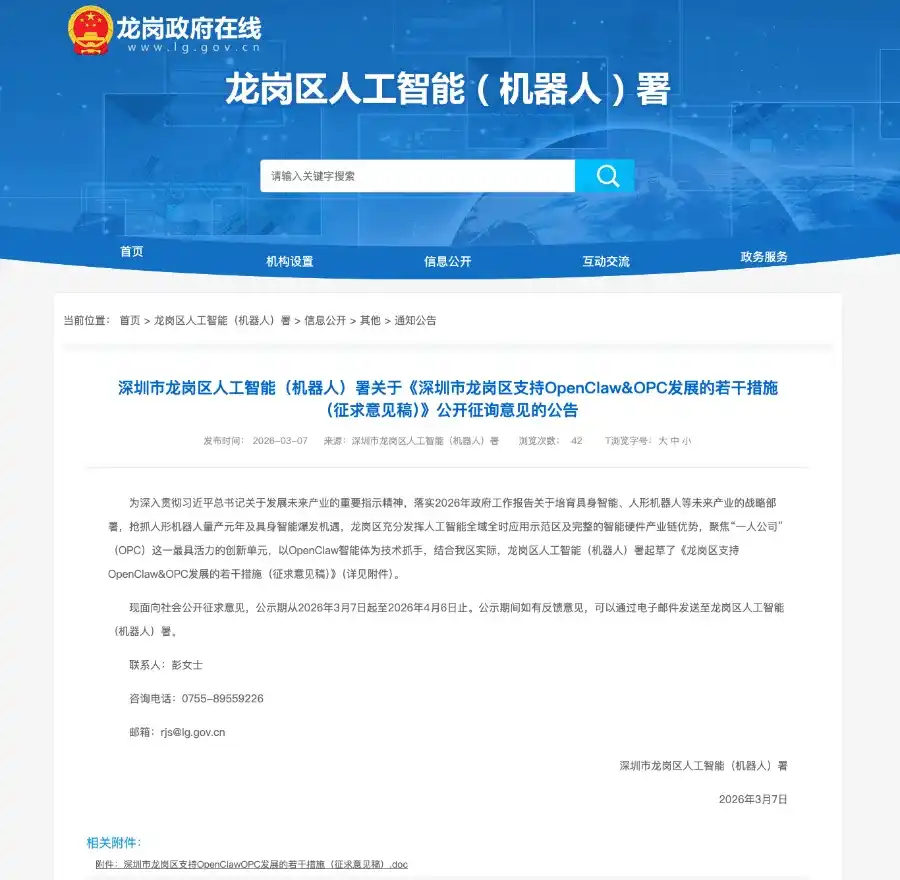
This year's government work report首次提出 the concept of "intelligent agents," explicitly calling for "cultivating new forms of intelligent economy" and emphasizing "supporting entrepreneurial forms adapted to the AI era." The introduction of the "Lobster Ten" is a rapid and precise response to this strategic deployment.
Free Deployment, Data Subsidies, Hardware Subsidies
Addressing the key needs in the evolution of AI agents from "seeing and speaking" to "doing and acting," the "Lobster Ten" introduces a series of comprehensive services, focusing on supporting OpenClaw—a project hailed as the "operating hand" of AI agents.
Free deployment, ready to use out of the box. The policy encourages platform companies to create "Lobster Service Zones," offering free OpenClaw deployment services to developers, eliminating the hassle of complex environment setup. The government will provide corresponding subsidies to the platforms, truly enabling developers to "move in with just a suitcase."
Data elements, open and shared. Longgang plans to open large-scale, high-quality, desensitized public data in areas such as low-altitude economy, smart transportation, healthcare, and urban governance, reducing the cost of using public data. Enterprises purchasing data governance, labeling, and other services for OpenClaw development will receive a 50% subsidy on the fees; those purchasing plug-and-play "Lobster Box" (AI NAS) hardware will receive a 30% subsidy based on the market price.
Encouraging innovation, rewarding applications. To incentivize technological breakthroughs, Longgang plans to offer subsidies of up to 2 million yuan to enterprises that contribute key code to international mainstream communities or develop and list skill packages for Longgang's advantageous industries, subject to approval. Additionally, the "OpenClaw Digital Employee Application Voucher" will be implemented, supporting enterprises in purchasing or building solutions with a 40% subsidy on investment, up to 2 million yuan per enterprise annually. Each year, a selection of demonstration projects with deep applications in areas like smart manufacturing and smart governance will be recognized with titles and rewards of up to 1 million yuan.
Three Months of Free Computing Power, 30% Subsidy on Large Model Usage Fees
With the advancement of AI technology, it is becoming a reality for one person to operate a competitive company (OPC, One Person Company) with the help of intelligent tools and a complete supply chain. Increasing numbers of "super individuals" juggling multiple roles are emerging.
In 2026, the "Shenzhen Plan for Building a Leading Hub for AI OPC Entrepreneurship Ecology (2026-2027)" was officially issued, explicitly proposing the construction of an industrial cluster and an innovation-active AI OPC entrepreneurship ecology.
In line with this trend, Longgang District has tailored support measures for this new entrepreneurial form in the proposed policy, helping "individuals" start with light loads.
Regarding computing power and model subsidies, to address the computing power and model bottlenecks in the early stages of entrepreneurship, newly入驻 recognized OPC community enterprises will receive up to three months of free computing power. Eligible AIGC enterprises in the district that use domestic leading large models for creation and production will receive a 30% subsidy on actual usage fees, with each enterprise eligible for up to 1 million yuan annually.
Regarding scenario对接, Longgang plans to select示范场景 projects with industry leadership annually, providing support of up to 50% of the actual project investment, not exceeding 4 million yuan, to help innovative technologies quickly find application stages.
Community operations, ecological support. Recognized OPC communities will receive up to 4 million yuan in annual support for their operating institutions, fostering a "tropical rainforest"般的 entrepreneurial ecology.
Talent settlement, housing保障. The policy plans to provide tiered settlement subsidies for talent of up to 100,000 yuan, offer up to two months of free accommodation and 18 months of discounted office space for newly registered OPC enterprises, creating a growth environment that starts "from a single desk." The "Longgang District OPC Person of the Year" award will be established, with winners receiving up to 100,000 yuan in rewards and comprehensive services such as medical care and children's education.
To adapt to this "light-asset, high-innovation" entrepreneurial model, Longgang has precisely launched a series of "cost-reduction" measures to create an OPC创业友好城区. Eligible OPC projects will have access to industrial space at 30-70% of market rent; the district has taken the lead in establishing "OPC专属咨询窗口" (OPC exclusive consultation windows)配套 "一人公司"开办指南 (one-person company startup guides); entrepreneurs can complete business registration within 3 working days through the "开办企业一窗通" (one-stop business startup window), enabling a easy start.
Three Major Moves to Promote OPC Growth
To ensure OPC entrepreneurial dreams take root and grow, the policy brings together three key elements—capital, global expansion, and competitions—to build a full-chain support system.
In terms of capital empowerment, Longgang plans to coordinate the use of the科技 innovation 'seed fund', the artificial intelligence industry母基金, and others to provide投融资 channels for seed-stage OPC projects with high technological content and strong innovation capabilities (especially youth talent projects). Eligible projects can receive up to 10 million yuan in equity investment support.
Regarding global expansion services, Longgang plans to leverage the district's international service base for enterprises to specifically establish OPC "出海服务站" (global expansion service stations), integrating one-stop services such as market expansion, cross-border logistics, and compliance consulting. It will also provide premium support for eligible export credit insurance, helping enterprises explore global markets worry-free.
In terms of attracting talent through competitions, Longgang plans to host brand events like "OPC Hackathons" and innovation and entrepreneurship competitions, offering winning teams rewards of up to 500,000 yuan. This aims to discover and储备一批优秀创业团队与个人 (a batch of excellent entrepreneurial teams and individuals), continuously injecting fresh blood into industrial development.
It is reported that the measures are currently open for public comment and are planned to take effect from 2026, valid for 3 years. The head of the Longgang District Artificial Intelligence (Robotics) Office stated: "Workstations are ready, computing power is prepared, funds are in place. Longgang sincerely invites global developers, geeks, and super individuals to gather in Longgang to jointly define the new form of the intelligent economy. Particularly regarding the safety concerns everyone has, we will establish strict technical standards and regulatory mechanisms to ensure full lifecycle security and controllability from data collection and storage to application, while promoting domestic substitution to reduce reliance on external risks. For example, in identity authentication and permission management, we will enable mandatory dual-factor authentication and set passwords that meet complexity requirements with regular changes. During operation, the principle of least privilege will be followed, using普通用户权限 (standard user permissions) rather than管理员权限 (administrator privileges); strictly limit its file system access scope, only opening necessary working directories, and prohibiting access to any paths containing sensitive data."