SemiAnalysis Report Claims Delay in Two Key Technologies, Triggers Sharp Decline in 'Optoelectronics', Sparking Online Debate Over CPO

marsbitPublished on 2026-06-10Last updated on 2026-06-10

Abstract

A report from analysis firm SemiAnalysis, claiming significant delays in two key AI data center technologies, triggered a sharp sell-off in the photonics sector and sparked intense online debate. The report, dated June 10, states that NVIDIA's 800VDC power architecture rollout is pushed to 2028 and CPO (Co-Packaged Optics) mass production is likely delayed until 2028 or even 2029. Following the news, U.S. optical communication stocks fell sharply, with AAOI dropping 17% and Lumentum down about 8%. The delays were attributed to engineering challenges like photonic engine yield and cost-effectiveness, not a disappearance of demand. Simultaneously, an interview with NVIDIA's networking SVP Gilad Shainer presented an opposing, optimistic view, stating CPO is "the most exciting thing" and shipments would begin scaling in the second half of the year. This contradiction fueled debate on social media. Bears pointed to unresolved reliability and maintenance hurdles for CPO. Bulls argued the delay simply redirects capital to interim solutions like traditional pluggable optical modules and NPO (Near-Packaged Optics), extending their revenue runway. Some users questioned the report's internal logic and timing, noting similar views had circulated earlier. Analysts highlighted potential beneficiaries, including companies in the 1.6T pluggable modules, NPO, and 400VDC power transition supply chains. The consensus suggests the market reaction reflects a recalibration of the technology ado...

Source: Wall Street News

A report from the star AI industry chain analysis firm SemiAnalysis, which directly pointed to delays in two core technological pathways for AI data centers, ignited severe volatility in the optical communication sector on June 10th, simultaneously sparking intense debate about future technology roadmaps and investment opportunities in both the investment and industrial communities.

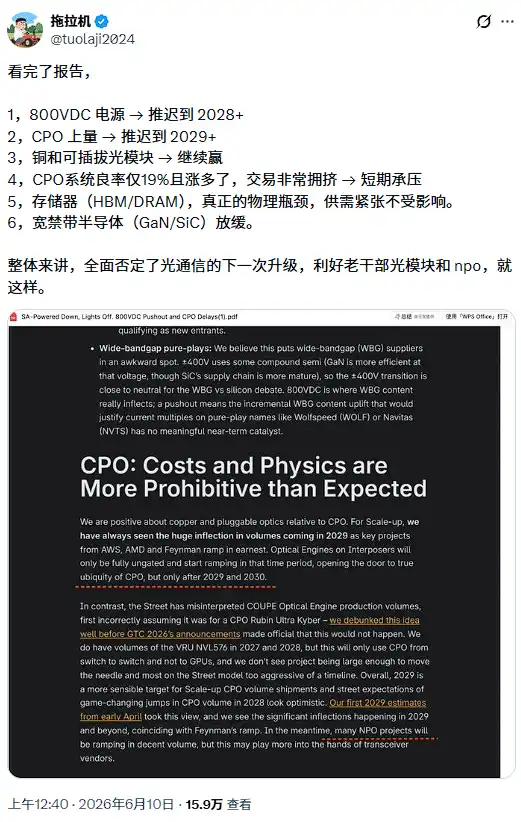
The report suggests that NVIDIA's 800VDC power architecture shipments will be delayed until 2028, and the mass production of CPO (Co-Packaged Optics) may be postponed to 2028 or even 2029. The simultaneous downward revision of these two expectations caught the market off guard.

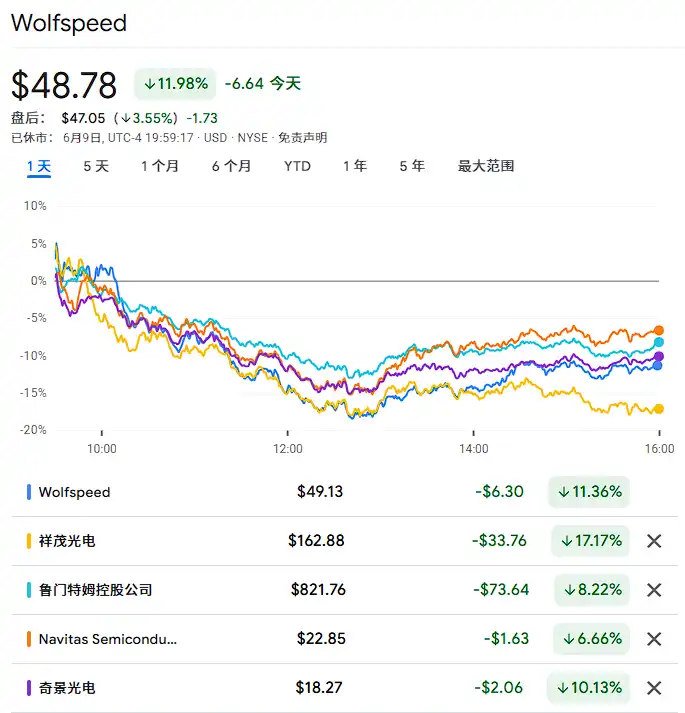
After the news broke, the US stock market's optical communication sector generally suffered heavy losses. Applied Optoelectronics (AAOI) plummeted by 17% in a single day, Lumentum fell by about 8%, and companies mentioned in the report as warranting caution, such as Himax Technologies (HIMX), Navitas Semiconductor Corp, and Wolfspeed, also faced significant pressure.
Concurrently with the release of the SemiAnalysis report, interview content with an NVIDIA executive was also published. According to资深半导体和科技投资记者Tae Kim, NVIDIA's Senior Vice President of Networking, Gilad Shainer, expressed a starkly optimistic stance on CPO's prospects at the 2026 Computex exhibition, stating directly that "CPO is the most exciting technology right now," and announced that volume shipments would begin in the second half of the year. This sparked a heated online debate about the CPO timeline on social platforms.

Notably, several market observers pointed out that the CPO delay does not mean the demand for optical interconnects disappears, but rather it is more likely to redirect capital flows back to traditional pluggable optical modules and the NPO (Near Package Optics) track — this logic led some investors to seek opportunities among oversold stocks during the panic selling.

SemiAnalysis Report Core: Dual Delays in Two Technological Pathways

In this research note distributed to institutional clients, SemiAnalysis presented two core judgments with profound market impact.

800VDC Power Architecture Delayed Until After 2028.

The report indicates that NVIDIA's originally planned large-scale adoption of a single-ended 800VDC power design has seen its shipment window significantly pushed back. Hyperscale cloud providers are currently more inclined to stick with mature low-voltage solutions or gradually transition to 400VDC, rather than rushing to switch to 800VDC.

The report argues that the marginal efficiency gains of 800VDC under current grid power supply conditions are insufficient to justify its system complexity. In contrast, 400VDC products are expected to start ramping in Q2 2026, with significant growth in 2027.

CPO Mass Production Timeline Lags Significantly Behind Market Expectations.

The report states that CPO shipment volumes in 2027 will be substantially lower than previous aggressive forecasts, and the timeline for mass production may be delayed until 2028 or even 2029. The main bottlenecks are concentrated at three levels:

Optical engine connection yield (optimistically around 95%, but CPO production driven by a single ASIC remains extremely limited), ASIC integration difficulty, and overall cost economics.

Scale-out CPO switch shipment volumes face downward revision risks, and shipments of Sidecar relying on new platforms like Rubin Ultra/Kyber are also postponed to a 2028 window.

At the individual stock level, SemiAnalysis maintains a relatively positive view on companies like Amphenol, Vertiv, and Legrand, while adopting a cautious stance towards Lumentum, Himax Technologies, Navitas Semiconductor, and Wolfspeed.

However, the report itself acknowledges that CPO, as an important direction for future data center network architecture, is not denied; the core reason for the delay lies in unresolved engineering challenges, not disappearing demand.

Simultaneously, the report also points out that some NPO (Near Package Optics) projects may accelerate.

NVIDIA Executive Publicly Counters, Tae Kim's Exclusive Interview Draws Attention

Just as the SemiAnalysis report was widely circulated among institutional circles,资深半导体和科技投资记者Tae Kim published an excerpt from a one-on-one interview with NVIDIA's Senior Vice President of Networking, Gilad Shainer, during Computex in his Substack column. The content starkly contrasted with SemiAnalysis's assessment.
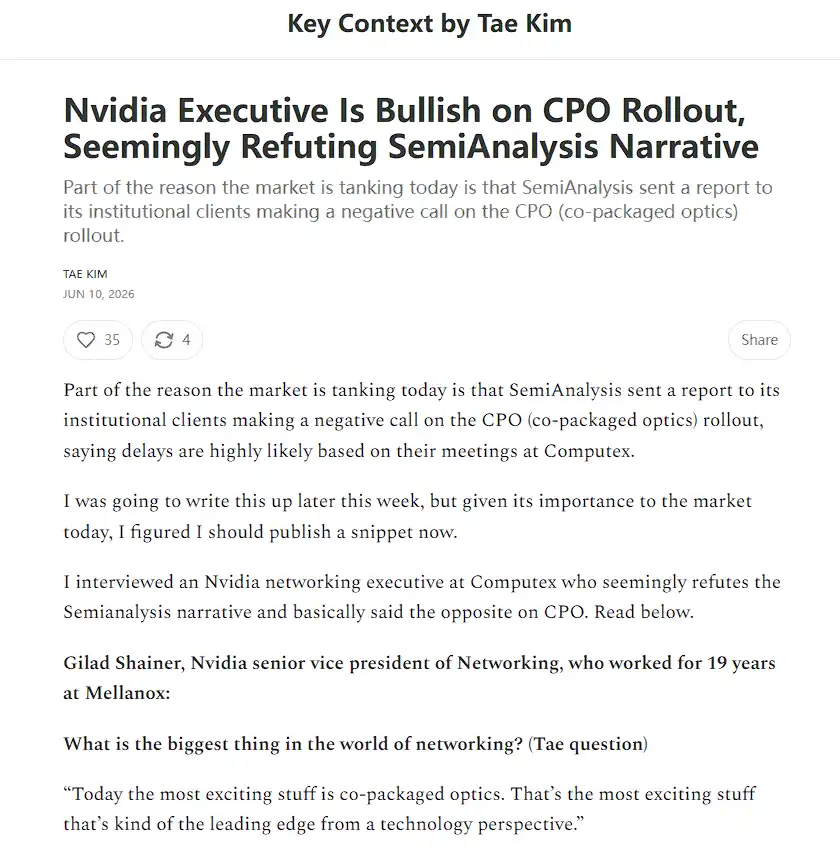
Shainer stated in the interview, "The most exciting thing today is co-packaged optics, it's the leading edge of technology."

He further revealed that NVIDIA is ready to start shipping, that partner Lambda had published a blog confirming receipt of CPO switches, that volume shipments of CPO would accelerate in the second half of the year, extending from scale-out to scale-up scenarios. "If it were up to me, I would put CPO everywhere that we use optical networking."

Tae Kim added in his article that Shainer's overall demeanor and body language during the interview showed high enthusiasm for both near-term and long-term ramp-up of CPO. He stated that this statement "seems to directly contradict the narrative from SemiAnalysis."

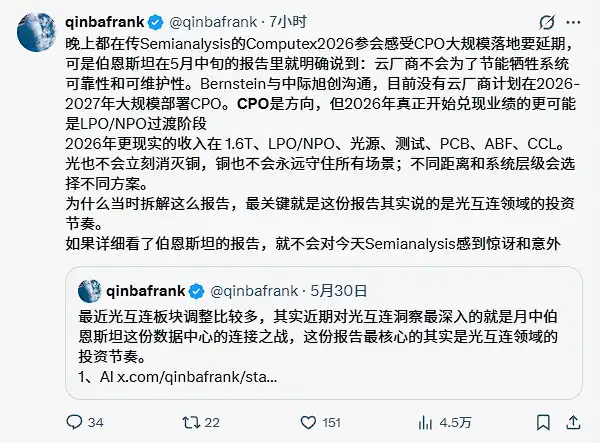
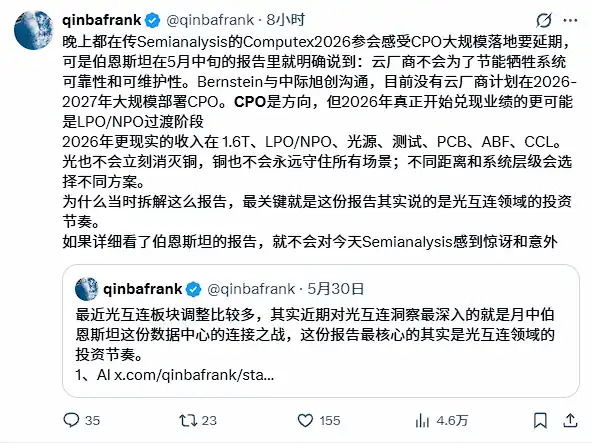
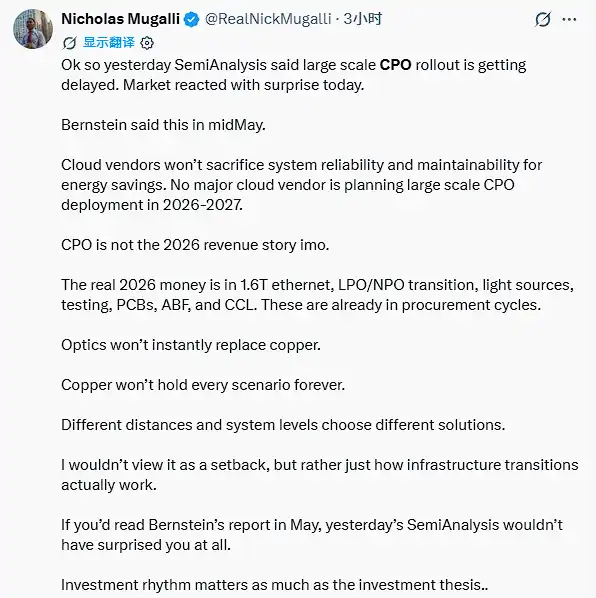
This discrepancy plunged the market into an information war. User @qinbafrank on social platform X pointed out that Bernstein had already clearly stated in a mid-May report that cloud providers would not sacrifice system reliability for energy savings, and that no cloud provider currently plans large-scale CPO deployment in 2026-2027. "If you had read the Bernstein report in detail, you wouldn't be surprised by SemiAnalysis today."
Online Debate: Is CPO Delay a Negative or a Market Overreaction?

The market volatility triggered by the report quickly spread to social media, where opinions on the investment logic surrounding the CPO delay diverged significantly.

Bearish View: Yield and Reliability Are Real Bottlenecks.

SemiAnalysis emphasized in its report that in the CPO architecture, the optical engine is co-packaged with a large ASIC worth tens of thousands of dollars on the same substrate. If the optical engine fails due to laser aging or fiber damage, it often requires the entire motherboard to be disassembled and returned to the factory. The maintenance cost and downtime risk are far higher than with traditional pluggable modules. This engineering challenge is considered the core obstacle preventing large-scale CPO adoption in the short term.

Bullish View: CPO Delay Actually Benefits Pluggable Modules and NPO.

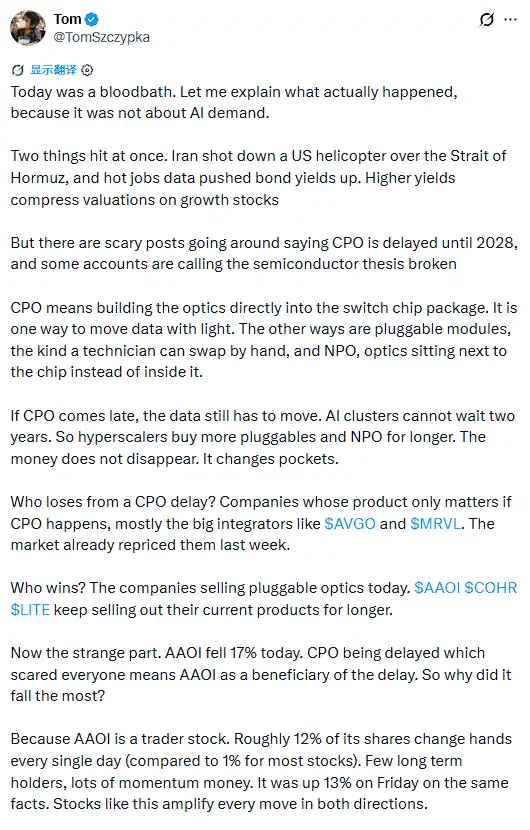
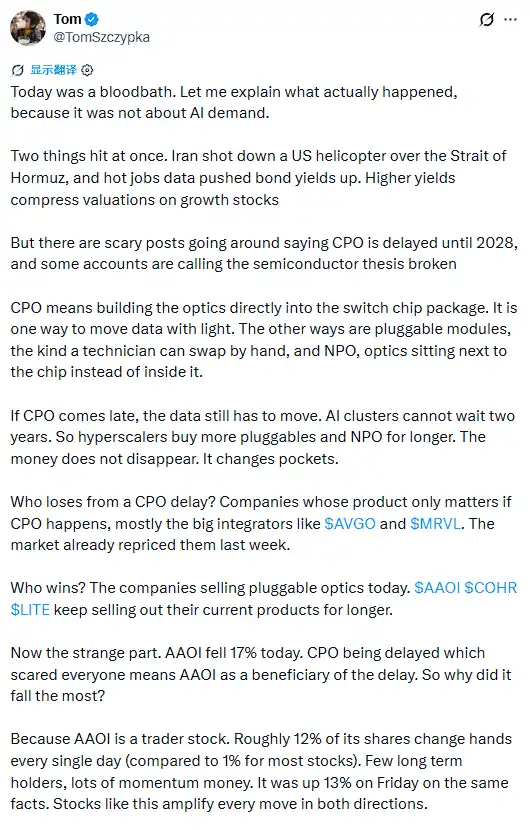
User @TomSzczypka on social platform X analyzed, "If CPO comes later, data still needs to be transmitted, AI clusters can't wait two years, hyperscalers will buy more pluggable modules and NPO for longer. The money doesn't disappear, it just changes pockets."

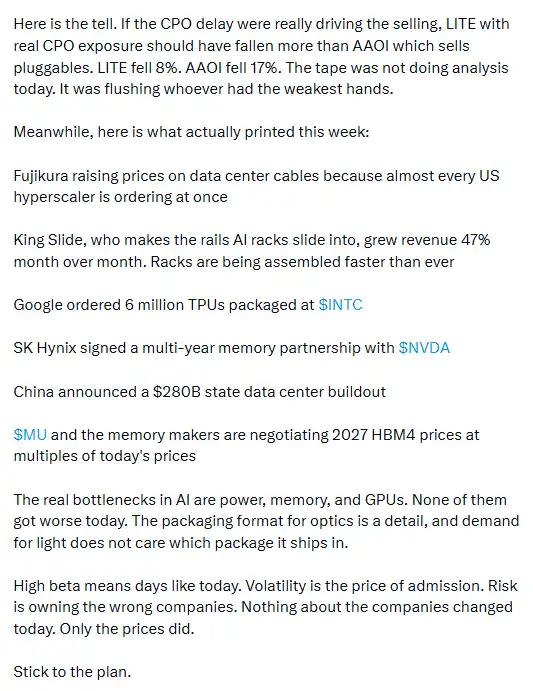
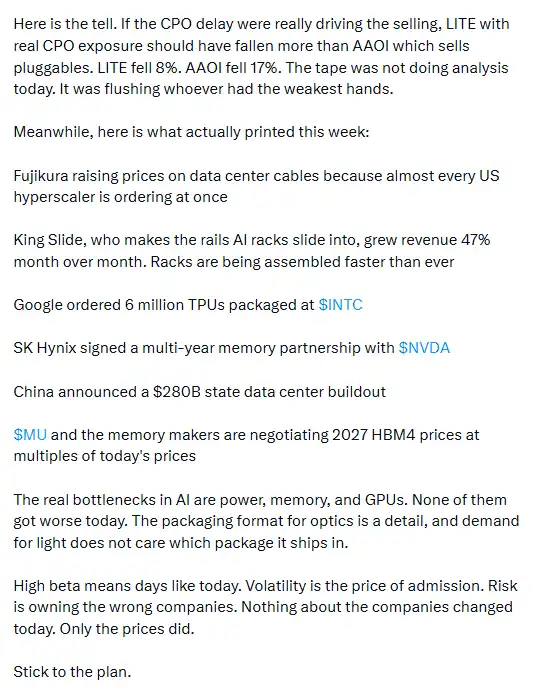
He also pointed out that the fact that Applied Optoelectronics' decline (17%) far exceeded Lumentum's (8%) on that day itself indicated that the market's sell-off was not based on rational analysis but was flushing out the weakest holdings.
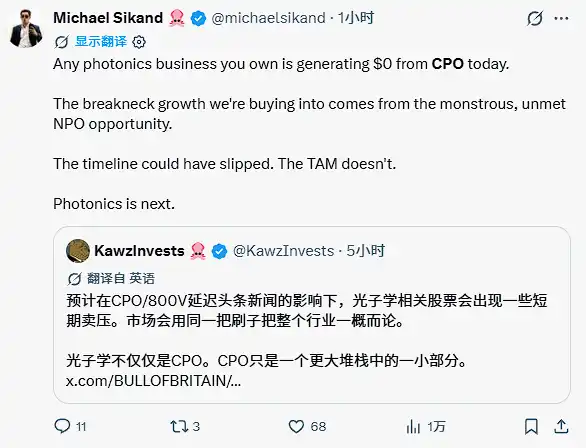
User @michaelsikand stated that currently, revenue from CPO for any photonics company is zero, and the current high growth comes from the huge, unmet NPO opportunity. "The timeline may slip, but the TAM doesn't."
Voices questioning the report's logic also exist.

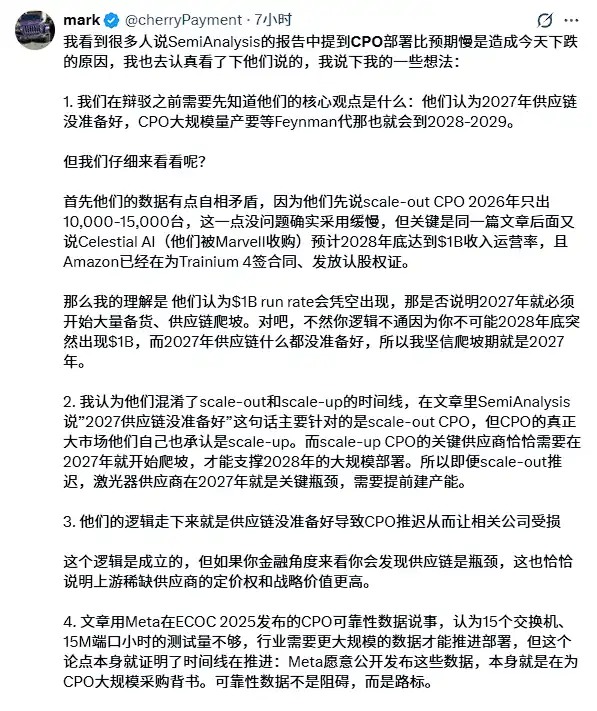
User @cherryPayment posted a lengthy article pointing out internal contradictions in the SemiAnalysis report: on one hand, it says the supply chain won't be ready in 2027; on the other hand, it predicts Celestial AI (acquired by Marvell) will reach a $1 billion revenue run rate by the end of 2028, and Amazon has already signed contracts for Trainium 4. "You can't suddenly have $1 billion by end of 2028 with the supply chain not ready for anything in 2027."

He also pointed out that SemiAnalysis's target audience is the procurement decision-makers at hyperscale cloud providers, and its conclusion is "no need to all-in yet," not an investment timing judgment for the capital market. "They are analyzing deployment pace, not investment timing."
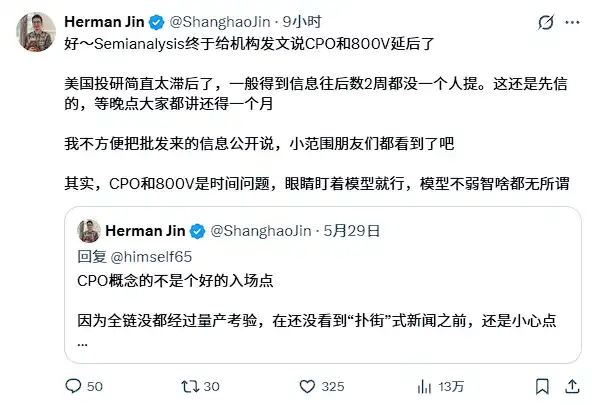
User @Herman Jin on platform X criticized the timeliness of information from US investment research firms, arguing that delays in CPO and 800VDC were "a matter of time," and such information had long been circulating in institutional circles; the SemiAnalysis report merely formalized known information on paper.
Unexpected Beneficiaries: Copper Connections and Pluggable Modules

Against the backdrop of widespread market pressure, some analysts turned their attention to potential beneficiaries of the CPO delay.

User @qinbafrank梳理认为,梳理认为梳理认为梳理认为,梳理认为梳理认为梳理认为 the more realistic revenue opportunities in 2026 are concentrated in 1.6T pluggable modules, LPO/NPO, light sources, testing, PCB, ABF, and CCL segments. "Optics won't eliminate copper immediately, and copper won't hold onto all scenarios forever; different distances and system levels will choose different solutions."
The CEO of Lumentum also recently stated that interest in NPO from non-NVIDIA customers has increased noticeably over the past two months.

User @RealNickMugalli analyzed that at 1.6T rates and 200G per channel, copper cables, even with retimer technology, have reached their physical limits. Optical solutions become a mandatory option, not an optional one, within reasonable distances, and the potential market size for NPO might even exceed that of CPO.
SemiAnalysis also noted in its report that some NPO projects may accelerate, and 400VDC products will start ramping in Q2 2026. For companies like Amphenol and Vertiv, the report maintains a relatively positive stance, believing they benefit from sustained demand during the 400VDC transition.

User @TomSzczypka cited this week's industry chain data to support that AI infrastructure demand has not weakened:

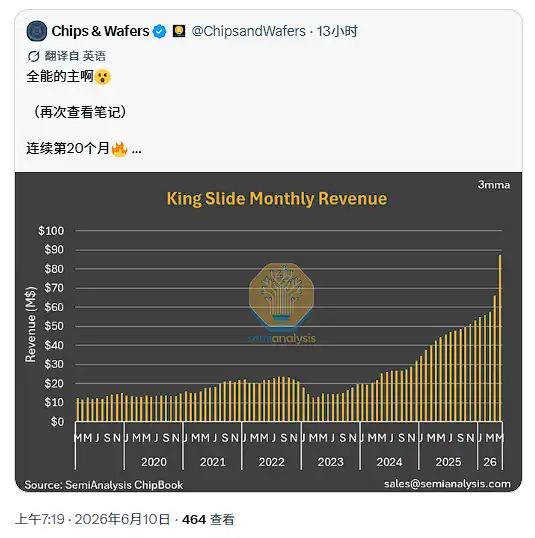
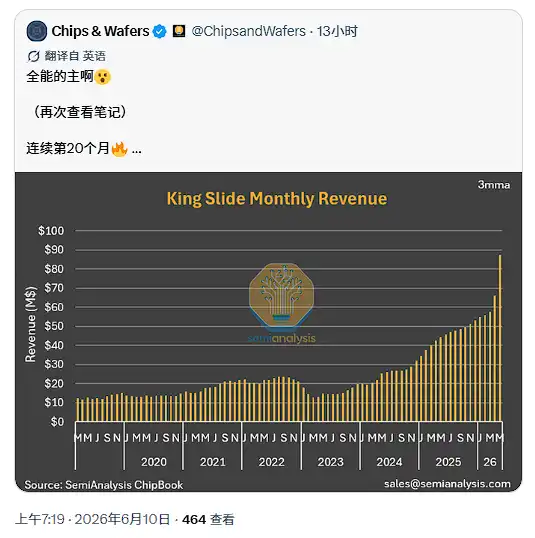
Fujikura raised prices for data center cables because almost all US hyperscalers placed orders simultaneously; King Slide's rack rail revenue increased 47% sequentially; Google ordered 6 million TPUs from Intel; SK Hynix signed a multi-year memory supply agreement with NVIDIA, etc.

"The real bottlenecks for AI are power, memory, and GPUs. None of these three have gotten any worse today."
Meanwhile, @tuolaji2024 posted on social platform X, stating that memory (HBM/DRAM), as the real physical bottleneck, remains completely unaffected by this technology delay event.
Analysis points out that, synthesizing various viewpoints, the market volatility triggered by this SemiAnalysis report reflects more of a recalibration of the technology roadmap timeline, rather than a fundamental reversal of overall AI data center demand.

Trending Cryptos

Related Questions

QWhat are the two key technology delays identified in the SemiAnalysis report that impacted the stock market?

AThe SemiAnalysis report identified that the timeline for mass production of CPO (Co-packaged Optics) has been delayed to 2028 or even 2029, and the deployment of Nvidia's 800VDC power architecture has been postponed to after 2028.

QAccording to the article, what is the primary engineering challenge hindering the large-scale adoption of CPO technology?

AThe primary engineering challenge is the high maintenance cost and downtime risk. If an optical engine fails within a CPO module, it often requires replacing the entire motherboard, which is more complex and costly than simply replacing a traditional pluggable optical module.

QWhat opposing view did NVIDIA executive Gilad Shainer express regarding CPO in his interview with Tae Kim?

ANVIDIA's Senior Vice President of Networking, Gilad Shainer, expressed strong optimism about CPO, calling it 'the most exciting thing in the technology front line.' He stated that NVIDIA is ready to begin shipping and that volume production will accelerate in the second half of the year, seemingly contradicting the delayed timeline in the SemiAnalysis report.

QHow did some investors interpret the CPO delay in terms of potential investment opportunities?

ASome investors argued that a delay in CPO adoption would redirect capital flows to other areas. They saw potential opportunities in established technologies like traditional pluggable optical modules and the accelerating NPO (Near-Package Optics) market, as data transmission needs remain immediate and strong.

QAccording to the article, what are cited as the 'true bottlenecks' for AI infrastructure that remain unaffected by the CPO/800VDC delays?

AThe article cites power supply, storage (specifically HBM/DRAM), and GPUs as the 'true bottlenecks' for AI infrastructure. These areas remain in tight supply and are unaffected by the delays in optical and power delivery technologies discussed in the report.

Related Reads

My Coding Betting Dashboard is Profiting, but Polymarket is Truly Not a Good Place for 'Arbitrage'

The author built a custom monitoring dashboard for Polymarket, a prediction market platform, and tested it with $1,600, achieving over 30% returns. However, the core argument is that Polymarket is not a good venue for traditional arbitrage. The dashboard has two main sections: a "Portfolio Dashboard" for tracking active positions with key metrics like total capital, P&L, and a risk-control module using a tier system (T1, T2, T3), and an "Opportunity Watchlist" for monitoring markets. The article details a critical structural trap in binary markets: a bet with a high perceived probability of success still carries a 100% loss risk if wrong. The author's T1/T2/T3 system is designed to manage this by limiting position sizes based on conviction and time horizon, emphasizing that high confidence should not equal high concentration. A key insight is the danger of "pseudo-diversification"—betting on different markets driven by the same underlying variable. The author concludes that Polymarket offers few true low-risk, arbitrage opportunities. It is instead a high-risk environment where wins can create a false sense of mastery, leading to large losses. The platform is better viewed as a training ground for honing judgment through disciplined, framework-driven betting rather than a reliable income source. The tools help transform intuition into structured, rule-based decisions to mitigate the risk of catastrophic errors.

marsbit2h ago

My Coding Betting Dashboard is Profiting, but Polymarket is Truly Not a Good Place for 'Arbitrage'

marsbit2h ago

WeChat AI Card Hands-On Guide: Has the AI Shopping Era Arrived?

**"WeChat AI Card" Practical Test Guide: Has the Era of AI Shopping Arrived?** WeChat has officially launched the "AI Exclusive Card," a feature integrated into its Workbuddy AI assistant. This card is designed to handle payments for AI-initiated purchases. Our hands-on test reveals it's not yet a tool for fully autonomous AI shopping, but rather a controlled payment layer for AI agents. The AI Card functions as an isolated sub-wallet within WeChat Pay. Users must bind the card and transfer funds into it from their main wallet. Crucially, every transaction requires explicit user confirmation via smartphone scan; AI cannot spend autonomously. Currently accessible through the Workbuddy agent, the card targets specific digital consumption scenarios: purchasing paid content (reports, data), calling paid APIs/tools, and subscribing to services. Its design prioritizes security and control by separating funds and mandating approval for each payment. We tested a real-world scenario: ordering bubble tea via Workbuddy using a "Meituan Life Assistant" skill. The process encountered multiple hurdles: high "skill" usage costs (exceeding daily free credits), and most importantly, while a payment was successfully initiated, the AI purchased an incorrect product (a mismatched group-buy coupon instead of the desired drink). This highlights the current limitation: the **AI Card only solves the payment step**. The broader challenge lies in the **AI agent's execution chain**—accurately understanding intent, navigating third-party platforms, selecting the right product, and ensuring proper fulfillment. The payment succeeded, but the purchase failed to meet the user's need. In conclusion, the WeChat AI Exclusive Card is a cautious, early-step experiment in AI commerce. It provides a secure, user-controlled payment method for agent interactions but is not yet capable of reliable, end-to-end complex purchases. For now, it's best used for low-value, low-risk digital services with careful user verification at each step. The vision of AI handling complete shopping tasks remains a work in progress.

marsbit4h ago

WeChat AI Card Hands-On Guide: Has the AI Shopping Era Arrived?

marsbit4h ago

Deconstructing Notion's Growth: From a Note-taking Tool to 100 Million Users—How Notion Built a Triple Growth Flywheel Through Product, Templates, and Community

Notion's growth from a niche note-taking tool to a platform with 100 million users is powered by three interconnected flywheels: Product-Led Growth (PLG), a Template Economy, and Community-Driven Growth. First, Notion's PLG strategy relies on a highly flexible, "plastic" product that users can adapt to countless personal and team workflows. Its freemium model lowers the barrier to entry, while features like page sharing and collaboration drive organic, usage-based viral growth as users naturally invite others. Second, the Template Economy solves the "blank page" problem. Templates, created by both Notion and its community, transform abstract product capabilities into concrete, copyable solutions for specific scenarios (e.g., project management, content calendars). This dramatically lowers activation costs for new users and fuels SEO-driven discovery. Third, a vibrant Community acts as a distributed growth engine. Users and official Ambassadors create tutorials, share use cases, and host local events. This community not only educates users but also fosters a sense of identity around pursuing "better ways of working," strengthening loyalty and enabling global, low-cost expansion. Together, these flywheels create a self-reinforcing ecosystem: a great product attracts users who create templates and community content, which in turn attracts more users and deepens engagement. This system allowed Notion to scale from individuals to teams and enterprises through a bottom-up adoption path. Looking ahead, AI integration promises to accelerate these flywheels further by making templates smarter and the platform a potential AI-native work operating system. Ultimately, Notion's defensible advantage is not just its features, but this deeply entrenched network of user assets, creators, and community trust.

marsbit4h ago

Deconstructing Notion's Growth: From a Note-taking Tool to 100 Million Users—How Notion Built a Triple Growth Flywheel Through Product, Templates, and Community

marsbit4h ago

$10 Billion, Qualcomm to Acquire Chip Legend Jim Keller's Company

Global mobile chip giant Qualcomm is in advanced talks to acquire AI chip startup Tenstorrent in a deal valued between $8-10 billion, according to media reports. This potential acquisition would be one of the largest in the AI chip sector in recent years. Tenstorrent, led by legendary chip architect Jim Keller, has gained prominence for its RISC-V architecture and AI accelerator designs. The move highlights Qualcomm's strategic push to diversify beyond its core smartphone chip business. As the smartphone market matures, Qualcomm is aggressively targeting growth in automotive, data center, and cloud AI. Acquiring Tenstorrent would allow Qualcomm to rapidly enter the high-end AI computing market, bypassing lengthy in-house development cycles. Tenstorrent's cost-effective system architecture, which avoids expensive HBM memory and relies on standard Ethernet for clustering, offers a potential alternative to Nvidia's costly solutions. Furthermore, Tenstorrent's high-performance RISC-V CPU technology and its focus on the automotive and edge computing segments align with Qualcomm's strategic goals, including its "Snapdragon Digital Chassis" platform. Despite the strategic rationale, the high valuation has sparked some investor caution. The successful integration of Tenstorrent's open-source culture and independent team into Qualcomm's organization, along with the commercialization of its technology, remains a key challenge.

marsbit5h ago

$10 Billion, Qualcomm to Acquire Chip Legend Jim Keller's Company

marsbit5h ago

Trading

Spot
Futures

Hot Articles

Discussions

Welcome to the HTX Community. Here, you can stay informed about the latest platform developments and gain access to professional market insights. Users' opinions on the price of AI (AI) are presented below.

活动图片