Reddit Stock Market Buzz: Is the Second Wave of AI Here? Funds Are Rotating from Compute Stocks to These Application Stocks

marsbitPublished on 2026-05-29Last updated on 2026-05-29

Abstract

Reddit's r/stocks community is actively debating whether a new rotation is underway in the AI sector. With infrastructure stocks like NVIDIA (NVDA) having completed their major rallies, attention is shifting towards application-layer companies that are translating AI into profits. The primary stock under discussion is Reddit (RDDT). Bulls highlight its strong fundamentals, including 70% revenue growth and 90% margins. The core investment thesis is its "data moat," as most major LLMs have been trained on Reddit data, with ongoing lawsuits against companies like Anthropic and Perplexity for non-payment. Supporters argue RDDT's data, serving as a "trust layer" of human feedback, is crucial for future AI applications in areas like e-commerce. The stock is seen as technically poised for a breakout from its current trading range. Other application stocks mentioned include: - **META**: For its profitable AI-powered ad targeting. - **Palantir (PLTR)**: Noted for strong earnings (government +84%, commercial +133% YoY). - **Snowflake (SNOW)**: Its stock surged post-earnings due to market approval of new AI data products. - **ServiceNow (NOW) & Shopify (SHOP)**: For integrating AI into their platforms. However, there is skepticism. Some doubt the depth of RDDT's data moat, arguing data quality is questionable and its pricing power over tech giants may be overestimated. Others maintain the second wave will remain in semiconductors, with cloud/Mag7 stocks following later. A profession...

Author:Select-Leading-4542

Compiled by: Shenchao TechFlow

Recently, the Reddit stock market community r/stocks has ignited a heated discussion – as AI infrastructure stocks represented by Nvidia (NVDA) have completed their major rally, more and more investors are starting to focus on application-layer companies that truly convert AI into profits, believing a new round of rotation is quietly unfolding.

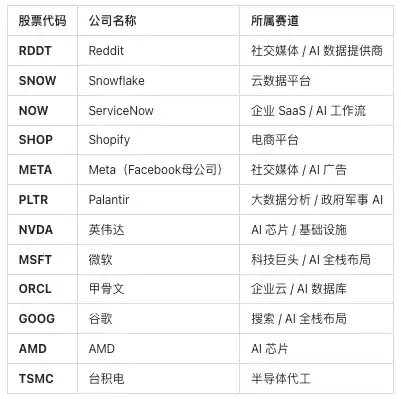
Frequently mentioned targets in this round of discussion include:
Original Post:

NVDA and all AI infrastructure stocks have obviously completed their massive run-up.

I'm starting to wonder if capital is finally rotating to those companies that are actually using AI to enhance their own profit margins.

Currently mainly watching RDDT, SNOW, NOW, and SHOP.

RDDT is clearly positioned centrally as a data provider, fundamentals look very strong indeed. SNOW's crazy spike after earnings shows the market really bought into its new AI products. NOW and SHOP are both heavily integrating AI into their platforms – purely from a chart perspective, both look like good setups for a bounce.

What other targets on your watchlists fit this logic? Any worth deeper research?

Some Representative Replies from the Comments:

DeathStar_81 (10 hours ago): RDDT is literally breaking out right now. Fundamentals are too strong to suppress. 70% revenue growth, 90% gross margins, PEG ratio below 1.

Ambitious_Traffic530 (11 hours ago): Reddit has risen a lot these past few days, is it still worth buying now or wait for a pullback?

tobybells: Reddit has been trading in the same range – down from 120-130, consolidating around 140-150, then running to 160-170. Buying anywhere in this range is fine. I'm long RDDT, 2000 shares, cost basis 170, so you're buying cheaper than me now.

ShowerMotor (12 hours ago): Call me conservative, but I think the second wave is still semiconductors, the third wave will be the hyperscale cloud providers and the Mag7... boring stuff. I plan to move most of my portfolio into Nasdaq 100 next year and hold until who knows when.

AloneStaff5051 (11 hours ago): Adding context: All LLM models are trained on Reddit data. Anthropic and Perplexity haven't paid, there's obviously a lawsuit ongoing against them right now.

PotatoAjacent104937 (12 hours ago): If you're using this logic, Palantir should be on your list. I hold Palantir, but feel their adoption of government contracts is slowing. Last earnings: Government revenue up 84% YoY, Commercial revenue up 133% YoY.

Last year it felt like there were Palantir new contract headlines every day, but the numbers don't lie!

Zipski577: Defense/AI spending increases every year, and Palantir's share increases year after year. I used to think the commercial side was the biggest opportunity, thought it was severely overvalued, but after deep diving into government contracts and historical data to remodel, a $200+ price target looks very realistic.

Hoosier2016: META is too. Their AI-assisted ad targeting is already extremely profitable.

🔴 Bull Camp Summary: RDDT is the Strongest Logic in This Wave

Discussion around Reddit (RDDT) is the most heated within the community, with bullish views centered on its data moat – almost all mainstream Large Language Models (LLMs) have used Reddit data for training, and companies like Anthropic, Perplexity have not yet paid, with related lawsuits in progress. Supporters believe:

  • Revenue growth of 70% YoY, gross margin as high as 90%, PEG ratio near or even below 1, valuation remains severely undervalued
  • As LLMs penetrate e-commerce scenarios, Reddit's value as the "trust layer of authentic human feedback" will continue to rise
  • The stock price is currently consolidating in the 140-170 range, with technical signals pointing to a potential breakout

Point of Contention: How Deep is Reddit's Data Moat Really?

Some investors remain skeptical, arguing: Lots of data doesn't equal high quality, many new models have shifted to fine-tuning small language models (SLMs) on existing datasets, the reliability of Reddit content itself is questionable, and its bargaining power against big tech is overestimated.

For example:

TyrannosPyros (8 hours ago): I've completely sold out of RDDT because it was underperforming and not letting me put more money into AMD and TSMC. The data moat is severely exaggerated. Most new models are created by fine-tuning LLMs on existing datasets. Their ad revenue is fine, but I don't think they have much bargaining power against big tech.

Fireballsdude: I really don't understand why people think that just because LLMs have scraped the existing Reddit dataset, a continuous supply of fresh data isn't important. LLMs won't just be enterprise-facing, they'll do e-commerce too, as another monetization avenue for these huge investments.

🟢 Views on Other Popular Targets

  • META: AI-assisted ad targeting is already significantly improving monetization efficiency. Some investors believe the market has over-penalized it for Metaverse failures and high CapEx, presenting an undervalued opportunity.
  • Palantir (PLTR): Latest earnings show government revenue +84% YoY, commercial revenue +133% YoY, strong numbers, but some investors perceive a disconnect from news hype.
  • Snowflake (SNOW): Surged 30%+ in a single day post-earnings, AI data products gaining market recognition, but some lament "getting on the train too late."
  • Semiconductors & Hyperscale Cloud Providers: Some traditional investors believe the second wave is still semiconductors, and the third wave will be Google, Apple, etc. (Mag7), suggesting simply buying and holding Nasdaq 100 long-term.

Professional Perspective: How Does the Options Market View This Rotation?

A user in the comments offered a more professional analysis from the volatility surface angle: Infrastructure stocks (like Nvidia, Dell) saw volatility compression after earnings, as the market has reached consensus on the direction of CapEx expansion;

However, the uncertainty for application-layer targets (RDDT, SNOW, SHOP) is two-sided, with implied volatility structures not skewed upward like infrastructure stocks. Therefore, rather than using options to lever up on applications, it might be cleaner to simply buy the stocks directly.

This discussion reflects the core market divergence right now: The easy money in AI infrastructure has been made, where is the next ten-bagger?

Most participants tend to believe the monetization logic of the application layer is gradually becoming clearer, but catalysts are not yet fully realized. RDDT has become the most watched target due to its unique data assets, while META and Palantir gain more fundamental support from their already-deployed AI monetization capabilities.


Related Questions

QAccording to the article discussing a potential 'second wave' of AI investment, what specific type of companies are investors shifting their focus towards?

AInvestors are shifting their focus from AI infrastructure companies (like NVIDIA) to AI application-layer companies. These are companies that are actively using AI to improve their own profitability.

QWhich company (ticker symbol) is highlighted in the article as having the most enthusiastic discussion on Reddit, and what is cited as its primary competitive advantage?

AReddit (RDDT) generates the most enthusiastic discussion. Its primary cited competitive advantage is its 'data moat,' as its data is used to train major large language models (LLMs).

QWhat are the key bullish arguments for Reddit (RDDT) presented by the 'bull camp' in the article?

AThe bullish arguments for RDDT include: 70% year-over-year revenue growth, 90% gross margins, a PEG ratio potentially below 1 (suggesting undervaluation), and a crucial role as a 'trust layer' of real human feedback for AI models expanding into commerce.

QWhat counter-argument is presented against the strength of Reddit's 'data moat'?

AA counter-argument suggests the data moat is overstated. Critics claim new AI models are often created by fine-tuning existing LLMs on proprietary datasets, question the reliability of Reddit content, and doubt Reddit's pricing power over large tech companies.

QBesides Reddit, name two other application-layer companies mentioned as popular investment ideas in the community discussion.

ATwo other mentioned application-layer companies are Palantir (PLTR), noted for strong government and commercial revenue growth, and Meta (META), recognized for its profitable use of AI in ad targeting.

Related Reads

US Government Lifts Ban on Crypto Perpetual Contracts for the First Time: What Does It Mean for the Market?

The U.S. Commodity Futures Trading Commission (CFTC) has issued guidance permitting 24/7 trading and clearing for crypto asset derivatives, effectively opening the U.S. market to crypto perpetual contracts for the first time. This move ends the previous ban and allows American individuals and institutions to trade these instruments around the clock. Direct beneficiaries include Kalshi, which received approval to list a Bitcoin perpetual contract; Coinbase, now the first CFTC-regulated futures commission merchant for U.S. clients to access global crypto derivatives; and CME, which will transition its Bitcoin futures and options to 24/7 trading. The CFTC emphasized this is a specific allowance for crypto assets, noting that traditional commodities like agriculture may not be suitable for non-stop trading. It also requires platforms to undergo case-by-case reviews for compliance and risk management. Industry leaders like Michael Saylor and Brian Armstrong praised the decision for integrating Bitcoin into capital markets and granting U.S. users access to a major global market segment. However, consumer advocacy group Better Markets criticized the CFTC for allegedly neglecting investor protection and favoring the industry it regulates. Other platforms like Kraken have announced plans to launch regulated perpetual futures for the U.S. market. The policy shift is expected to redirect significant liquidity and institutional participation to the newly accessible U.S. crypto derivatives landscape.

Odaily星球日报3h ago

US Government Lifts Ban on Crypto Perpetual Contracts for the First Time: What Does It Mean for the Market?

Odaily星球日报3h ago

How the CLARITY Act Reshapes the Stablecoin Yield Economy

The CLARITY Act, recently advanced by the U.S. Senate Banking Committee, fundamentally reshapes the stablecoin yield economy by closing loopholes left by the earlier GENIUS Act. Its Section 404 expands the ban on "hold-to-earn" rewards to all Digital Asset Service Providers (DASPs) and their affiliates, prohibiting any passive, interest-like yield. Crucially, it introduces a legal distinction, permitting "use-to-earn" rewards based on actual activities like spending, trading, or staking. In anticipation of this regulatory shift, major Wall Street asset managers—Morgan Stanley, BlackRock, and JPMorgan—have launched a series of tokenized money market funds (e.g., BlackRock's BRSRV, JPMorgan's JLTXX) designed explicitly for stablecoin reserve assets. These products represent a new, compliant yield layer: the stablecoin issuer earns interest from the underlying tokenized fund, which can then be passed to users through redesigned activity-based rewards. This marks a paradigm shift from a "hold-to-earn" to a "use-to-earn" market. While pathways remain for exchanges to redesign rewards (Path A) and for DeFi protocols to offer yield (Path B), the tokenized reserve asset layer (Path C) emerges as the most robust and strategically positioned infrastructure. However, this concentration—exemplified by BlackRock's BUIDL fund backing over 90% of USDtb's reserves—introduces new systemic risks. The final outcome hinges on regulatory decisions, particularly the OCC's proposed 20% cap on tokenized assets in reserves, which will determine the scalability of this new financial infrastructure layer.

marsbit5h ago

How the CLARITY Act Reshapes the Stablecoin Yield Economy

marsbit5h ago

Trading

Spot
Futures

Hot Articles

Discussions

Welcome to the HTX Community. Here, you can stay informed about the latest platform developments and gain access to professional market insights. Users' opinions on the price of AI (AI) are presented below.

活动图片