Ray Dalio: The Revival of a China-led 'Tribute System', and the AI Industry Will Develop Like the EV Industry

Odaily星球日报Published on 2026-06-08Last updated on 2026-06-08

Abstract

Ray Dalio, founder of Bridgewater Associates, discusses shifting global power dynamics and the AI competition between the U.S. and China. He argues U.S. credibility as a global power willing to fight for its interests is declining, while China is accumulating wealth and influence. Dalio observes a trend where world leaders visit China, which he compares to a modern "tribute system"—not oppressive, but a hierarchy where nations acknowledge China's strength, affecting trade and security. This shift creates market uncertainty, prompting investors to seek asset diversification, including gold. Regarding AI, Dalio contrasts the U.S. and Chinese approaches. U.S. companies like OpenAI focus on monetization and subscriptions for revenue. In contrast, China treats AI as a public utility, akin to electricity or water, aiming for widespread worker accessibility over immediate profitability. He draws a parallel to China's electric vehicle industry success, where companies like BYD achieved rapid market growth. Dalio and JPMorgan's Mary Callahan Erdoes note China lacks U.S.-style fear of AI displacing jobs; instead, it focuses on leveraging AI for development and dominance in next-generation industries like robotics.

Source:"Wall Street Week" Program: Dalio's Warning&Ray Dalio on China-U.S. AI Development

Compiled | Odaily Planet Daily (@OdailyChina)

Translator | Wenser (@wenser2010)
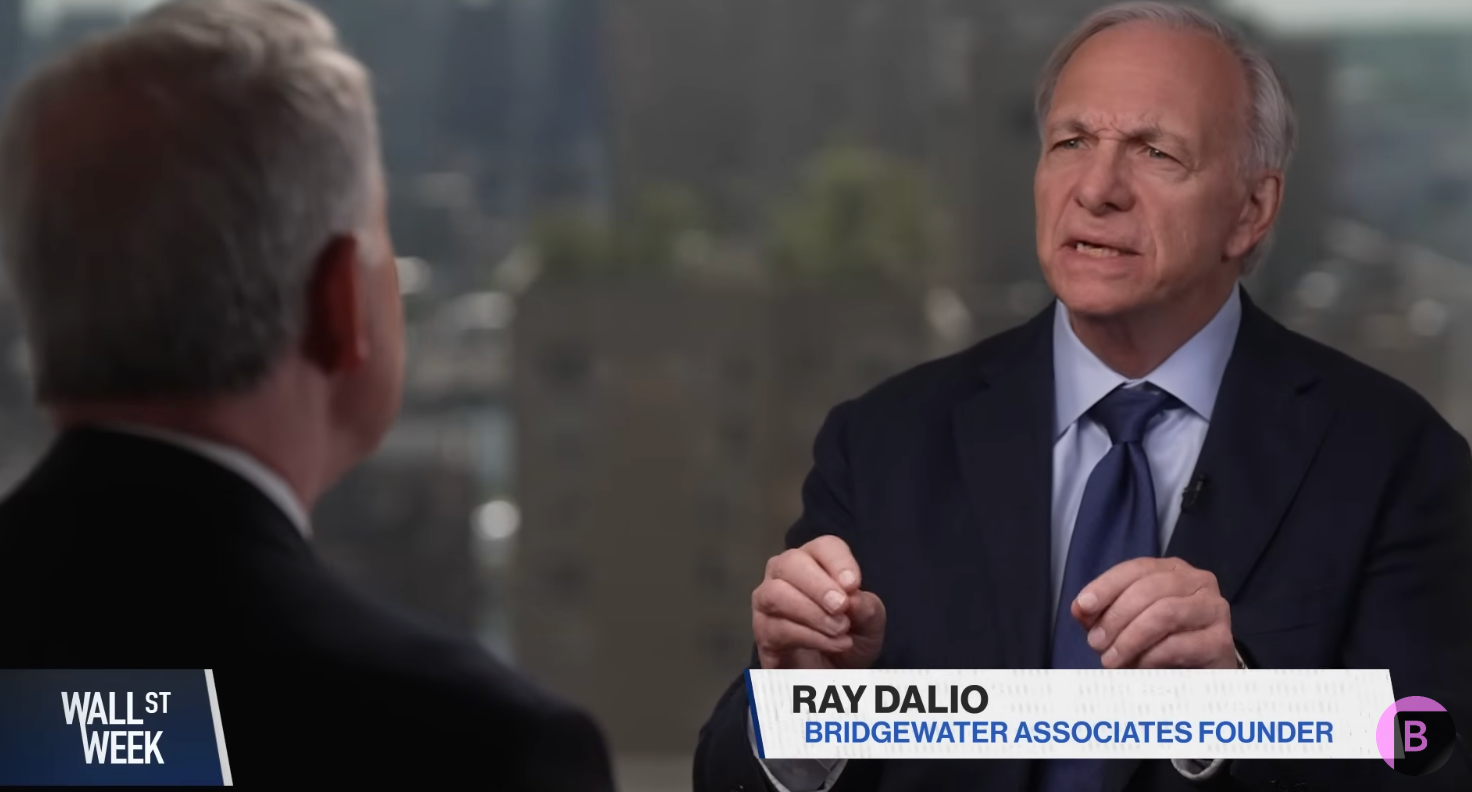
Editor's Note: As the founder of Bridgewater Associates, the world's largest hedge fund, Ray Dalio's remarks have always garnered significant attention from various sectors of society. His insights into the global macroeconomic landscape and different industries, in particular, are a frequent topic of discussion. Following the visits to China last month by leaders including US President Donald Trump and Russian President Vladimir Putin, Ray Dalio has put forward a new perspective – "The world structure is changing, a China-led tribute system is being established." Recently, regarding the "competition landscape between AI giants in China and the US," he has also offered his targeted views. The following content is compiled and translated by Odaily Planet Daily, with some details edited for brevity.

Ray Dalio on a "China-led World": The Reappearance of the Tribute System

Last month, after US President Donald Trump and Russian President Vladimir Putin visited China, Ray Dalio was interviewed by David Westin for Bloomberg's "Wall Street Week" program.

In the interview, Ray Dalio stated directly, "America's credibility as a global power willing to fight for its own interests is declining, while China is continually accumulating its own global wealth and world influence. This situation is fundamentally changing how other countries view these two nations."

"Currently, the United States has about 750 military bases in over 80 countries worldwide, and thus has long been seen as a trustworthy ally when facing (war) attacks." However, after concluding a roughly one-month trip to Asia (which included about 10 days of meetings with multiple leaders in China), Ray Dalio sensed an important shift: a growing number of countries are gradually coming to believe – "America cannot be counted on to win wars."

Dalio's remarks further elaborate on his long-held view: "America's strength is gradually waning, while China's strength is correspondingly increasing." Thanks to Bridgewater's significant engagement with China, this perspective has gained considerable acceptance. On the other hand, due to his relatively close relationship with Chinese leaders, these views have also drawn criticism.

Dalio then stated that international recognition is very important for China. Currently, China's economic scale is about 60% to 70% that of the United States, a proportion that has more than tripled over the past 20 years. He said that while China does not seek to conquer or occupy other countries, it places great emphasis on recognition from political leaders worldwide. "You can see leaders from many countries visiting China one after another, which is akin to the 'tribute system' in Chinese history – countries come to acknowledge and respect China's formidable strength, but this system is not an oppressive or controlling one." (Odaily Planet Daily Note: The original term used was 'tribute system')

"So, this tribute system is essentially a hierarchical structure. When dealing with other countries, what's important is how such a system affects trade and national security between the parties. I believe, from a political perspective, we are now entering a period where arrangements resembling a tribute system will form between (China and) various countries, and the relative strength between nations will become the determining factor (in the world's political landscape)." During the discussion, Ray Dalio also mentioned that concepts like the nation-state and borders only gradually emerged in Western societies around the mid-17th century. Before that, power structures in Western societies were constituted by different royal families, which is fundamentally different from the concept of frontiers consistently maintained throughout Chinese history.

He believes this change will directly impact (global capital and financial) markets. Because investors must navigate the current turbulent situation: currency values are at risk, and (global) uncertainty demands that investors maintain liquidity and diversify their asset allocations, including investments in gold.

Ray Dalio on the "Competition Landscape in AI Between China and the US": China's AI Industry Will Develop Like the EV Industry

In June, Business Insider reported Ray Dalio's views on the competition in the AI sector between China and the United States, similarly highlighting the vast differences and potential implications between the two.

Ray Dalio stated that China views artificial intelligence as an important tool that should be accessible to all workers. "It's like electricity and tap water, something everyone should have access to,"

As a prominent entrepreneur who first visited China as early as 1984, Ray Dalio has long been optimistic about China's development. He previously told attendees at a Forbes magazine conference in New York: "China has earned enormous profits through exports, and these funds are being widely utilized for research and development in the field of artificial intelligence, thereby driving economic growth through improved production efficiency."

It is worth noting that Ray Dalio emphasized that while American companies like OpenAI and Anthropic are adjusting (AI model) subscription package structures, striving to increase revenue in preparation for public listings, Chinese companies are committed to making their models accessible to as many ordinary employees as possible. "It doesn't necessarily have to be expensive, and it doesn't even necessarily have to be profitable (right now)."

"To some extent," Dalio believes, "it mimics the country's successful path in sectors like the electric vehicle industry – where domestic Chinese enterprises like BYD have achieved rapid growth in markets such as Europe."

In a guest discussion following Dalio's speech, JPMorgan Chase executive Mary Callahan Erdoes pointed out that unlike the social atmosphere in the US, where "employment issues are treated as political topics," executives of Chinese AI companies and political figures, when mentioning AI, show "no fear of AI displacing jobs." Instead, the country focuses more on "leveraging AI to drive various developments" and is committed to identifying the next industrial sector where it can achieve dominance. "The robotics sector can basically be seen as China's 'next-generation electric vehicle industry,'" she stated.


Trending Cryptos

Related Questions

QWhat does Ray Dalio mean by the 'tribute system' returning under Chinese leadership?

ARay Dalio suggests that as China's global influence grows, many countries' leaders are visiting China to acknowledge and respect its power. He likens this dynamic to a historical 'tribute system,' where other states recognize a dominant power's strength. He clarifies this is not an oppressive or controlling system, but rather a hierarchical arrangement that influences trade and national security between nations.

QAccording to Ray Dalio, what is the primary difference between U.S. and Chinese AI companies' current goals?

ARay Dalio states that while U.S. AI companies like OpenAI and Anthropic are adjusting subscription models and focusing on increasing revenue for potential IPOs, Chinese AI companies are primarily focused on making their AI models accessible and affordable for as many ordinary workers as possible, even if they are not immediately profitable.

QHow does Ray Dalio compare the development of China's AI industry to its electric vehicle industry?

ARay Dalio draws a parallel by suggesting that China's approach to AI development is mimicking its successful path in the electric vehicle industry. Just as Chinese companies like BYD achieved rapid growth in markets like Europe, the focus in AI is on widespread adoption and technological advancement as a tool for national development, potentially leading to a similar dominant position in the global market.

QWhat key change in global perception does Ray Dalio identify after his recent travels in Asia?

ARay Dalio identifies a significant shift in perception among many countries: a growing belief that they 'cannot count on the U.S. to win a war.' He contrasts this with the past view of the U.S. as a trustworthy ally willing to fight for its interests, noting that this change is fundamental to how nations view both the U.S. and the rising power of China.

QWhat investment advice does Ray Dalio offer in light of the current global geopolitical shifts?

AIn response to the turbulent global situation marked by currency risks and uncertainty, Ray Dalio advises investors to maintain liquidity and diversify their asset allocations. He specifically mentions including investments in gold as part of this strategy to hedge against the prevailing risks.

Related Reads

human.tech Launches Clean SDK for Privacy-First Web3 Apps

human.tech has launched the Clean SDK, a toolkit enabling developers to build privacy-first Web3 applications with transparent accountability. Released alongside Aztec's version 5, the SDK provides components for integrating zero-knowledge identity verification, sanctions screening, and private transactions, without developers handling sensitive user data or building compliance infrastructure from scratch. It uses zero-knowledge proofs and programmable verification to allow apps to confirm user legitimacy and sanctions compliance while keeping identities confidential. The first application built on the SDK, Shield, a privacy bridge to Aztec, also launched. It allows users to transfer assets privately while proving a unique human is behind each transfer and that funds have passed sanctions checks, as verified by a May 2026 audit. The SDK offers three core verification techniques: Proof of Innocence (sanctions screening against 23 sources), Proof of Personhood (simpler verification via Human Passport), and Proof of Clean Hands (higher-assurance zero-knowledge government ID checks). This allows apps to authenticate users and transactions without exposing personal data. Designed for Aztec builders, the SDK lets developers add programmable privacy to decentralized apps, eliminating the need to create their own verification and ZK infrastructure. Shield demonstrates its practical use for private bridges, but the SDK aims to enable a wider ecosystem of private, accountable financial apps and services. The launch addresses growing demand for infrastructure that balances privacy and accountability. The SDK avoids traditional identity databases, storing encrypted data off-chain, screening at both entry and exit points, and including a gated disclosure mechanism for legal requests. human.tech's products, including the Clean SDK, focus on using zero-knowledge technology to enable verifiable personhood and privacy in digital systems.

TheNewsCrypto22m ago

human.tech Launches Clean SDK for Privacy-First Web3 Apps

TheNewsCrypto22m ago

Unlocking $100 Million in Liquidity? Pump.fun's New Policy Tests the 5-Minute Pump Technique

Pump.fun, a popular meme coin launchpad, has introduced a new standard mechanism called BOOST. It aims to address a significant capital efficiency issue: when a newly launched token graduates from its initial bonding curve to a liquidity pool (LP), roughly 20% of its liquidity becomes permanently locked as "dead liquidity," estimated to waste over $100 million annually. Instead of locking these funds permanently, BOOST repurposes them. Upon a token's migration, approximately 20% of the settlement funds (e.g., 17.6 SOL or ~$2516 USDC) are used to buy back the token on the open market over a 5-minute period via a Time-Weighted Average Price (TWAP) mechanism. All purchased tokens are immediately burned. This creates a brief, systematic buy pressure immediately after migration, potentially generating a short-term price surge ("pump") while permanently reducing the token's circulating supply. The goal is to enhance the immediate post-launch trading experience, potentially increasing trader retention and sustainable protocol revenue, which funds ongoing token buybacks. However, concerns exist that this artificial 5-minute boost could lower the barrier for launching low-quality tokens and lead to steeper price crashes once the buy pressure stops, if followed by large sell-offs. The feature automatically applies to tokens migrating after July 21, 2024, but not to previously migrated tokens or those launched via the Mayhem AI Agent lab.

marsbit30m ago

Unlocking $100 Million in Liquidity? Pump.fun's New Policy Tests the 5-Minute Pump Technique

marsbit30m ago

Podcast Notes | Conversation with GSR Asset Management Head: To Determine if This Crypto Rally is Real, Just Watch the Lending Rates on Aave

Podcast Summary: Dialogue with GSR's Head of Asset Management: To Determine if This Crypto Rally is Real, Just Check Lending Rates on Aave Andy Baehr, Managing Director of Asset Management at GSR, discusses the current crypto market, characterizing it as stuck in a state of "ambivalence" with short-lived, unsustainable rallies. He outlines a simple framework: the market moves between "ambivalence" and "conviction" (sustained upward momentum). Currently, every rally resembles a single-stage rocket booster that quickly fizzles out. Baehr identifies three key signals to watch: 1) DeFi lending rates, 2) the potential passage of the CLARITY Act, and 3) the market forming a consensus on the "Fed hawkish peak." He emphasizes that the most immediate indicator for the sustainability of the recent CPI-triggered rally is the USDC borrowing rate on Aave, currently around 3.75%—close to U.S. Treasury yields. The absence of a credit spread indicates low leverage demand and a lack of market energy. He explains that a healthy, sustained rally requires layered buying pressure. Last year's rally progressed from an ETH short squeeze to crypto-native trader influx and finally to ETF inflows. Currently, this structure is missing. Other potential structural buyers like Digital Asset Treasury (DAT) companies are absent, and ETF flows have proven transient. Baehr notes that while small-cap crypto tokens outperformed large caps in Q2—a potential sign of capitation in major assets—capital is also flowing to more exciting opportunities like AI stocks and tech IPOs, leaving crypto sidelined. Regarding DeFi, he highlights that platforms like Aave provide a clear, real-time signal of leverage demand through their supply/demand-driven interest rates. A significant, sustained rate increase would signal genuine market conviction. He also observes the quiet emergence of fixed-income-like products and vaults in DeFi. On regulation, the probability of the CLARITY Act passing before the August 7th deadline has dropped linearly from 75% to below 40% on Polymarket. Baehr suggests its passage would be treated as a bullish surprise, a potent driver for price movement. However, political hurdles, including ethical clause debates and disclosures about the First Family's crypto profits, remain significant obstacles. Ultimately, the market awaits clarity on the Fed's terminal rate under Chair Warsh. Until the "Fed Solstice"—the point where the market collectively understands the peak of hawkish policy—sustained conviction will be difficult to achieve.

marsbit1h ago

Podcast Notes | Conversation with GSR Asset Management Head: To Determine if This Crypto Rally is Real, Just Watch the Lending Rates on Aave

marsbit1h ago

Trading

Spot

Hot Articles

Discussions

Welcome to the HTX Community. Here, you can stay informed about the latest platform developments and gain access to professional market insights. Users' opinions on the price of AI (AI) are presented below.

活动图片