Prediction Markets Hit Record Highs As Bets Explode On Global Conflict

bitcoinistPublished on 2026-03-31Last updated on 2026-03-31

Abstract

Prediction markets are experiencing unprecedented growth, driven by automated AI agents and high-frequency trading bots that extracted approximately $40 million from market inefficiencies in a single month. These markets are increasingly dominated by bets on geopolitical events, such as the US-Israeli conflict with Iran, and major political events like the 2028 US Presidential primary, rather than cryptocurrency prices. TRM Labs reported a 2,800% year-over-year increase, with March 2026 seeing 191 million transactions totaling nearly $24 billion. This surge has attracted regulatory scrutiny over potential insider trading, leading to bipartisan efforts to ban "casino-style" event contracts. Platforms like Kalshi and Polymarket are implementing internal restrictions to preempt stricter regulations, as the industry balances its role as a forecasting tool with concerns over speculation on global conflicts.

Prediction markets are being dominated by automated AI agents and high-frequency trading bots, which extracted around $40 million from market inefficiencies within a single month.

These digital traders look for news of global unrest and respond in milliseconds, often moving the price of a contract before the rest of us can even think about the headline.

This new world of professionalized, machine-based speculation has turned what was once a niche hobby for crypto enthusiasts into a high-stakes financial arena.

Blockchain analytics company TRM Labs reported that prediction markets have seen substantial growth, fueled by greater accessibility, regulatory progress, and integration with mainstream platforms like Google Finance.
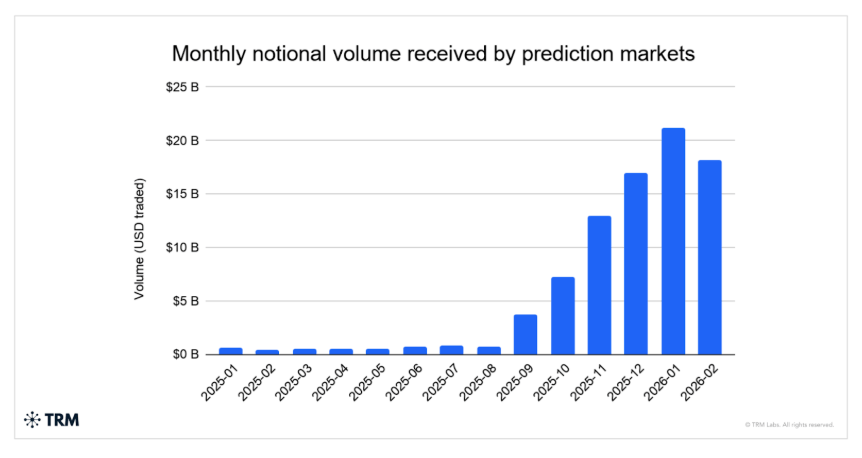
The firm noted that these markets are increasingly serving as real-time indicators for geopolitical and macroeconomic events, gaining attention from major media outlets.

War And Elections Drive Unprecedented Volume

The primary catalyst for this massive activity is no longer the price of digital coins. Instead, traders are putting money on the line over the US-Israeli conflict with Iran and other international flashpoints.
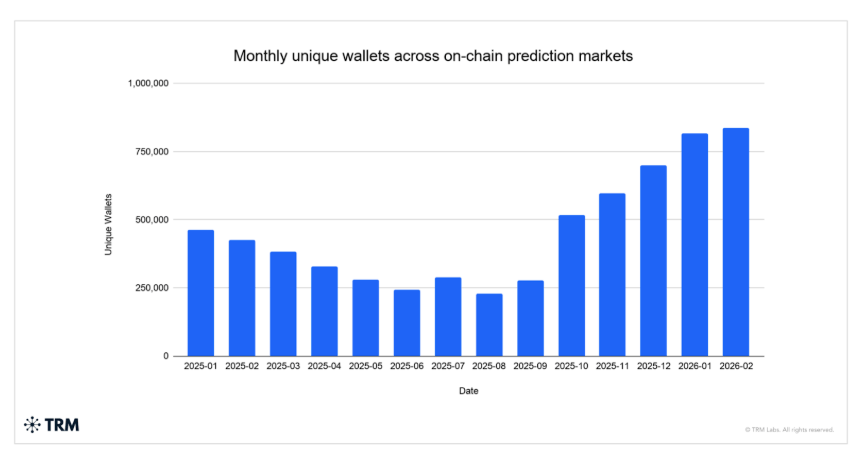
The political implications are also significant, with huge monetary stakes riding on the 2028 US Presidential primary nominations. It has been suggested that such platforms are now being used as a measure of the way in which public opinion is shifting, with their probabilities featured on Google Finance and in the news as a more fluid alternative to traditional political polling.

The extent to which this industry is growing can be quantified by recent figures, which showed an increase of over 2,800% compared to the previous year. Indeed, in March 2026, there were over 191 million transactions in the space.

BTCUSD currently trading at $67,503. Chart: TradingView

To put that in perspective, that figure equates to almost $24 billion in total value for that month alone, representing a staggering increase from the $1.85 billion in March 2025. This indicates that people and investors are viewing these markets as crucial in hedging against any changes in economic policies or shifts in interest rates.

Prediction Markets: Lawmakers Target Event Based Betting

However, the sudden increase in value has caught the attention of regulators in Washington. The regulators have expressed concerns that people may be using inside information to make profits from military actions and other government decisions.

These suspicions of insider trading have led to a bipartisan push for new legislation. US President Donald Trump and members of Congress are looking at a bill that would effectively ban contracts tied to “casino-style” events, potentially stripping the industry of its most popular categories.

Platforms Introduce New Trading Guardrails

In an effort to stave off a total shutdown, major platforms like Kalshi and Polymarket are beginning to implement their own internal restrictions. These measures aim to curb the most controversial types of betting while maintaining the market’s role as a forecasting utility.

Data shows that the outcome of these regulatory battles will determine if the sector stays a permanent fixture of the financial world. For now, the industry remains in a volatile state, balancing between its value as a source of truth and its reputation as a venue for speculating on global tragedy.

Featured image from Unsplash, chart from TradingView

Trending Cryptos

Related Questions

QWhat is the primary catalyst for the massive growth in prediction market activity according to the article?

AThe primary catalyst is no longer the price of digital coins, but traders betting on geopolitical events like the US-Israeli conflict with Iran and other international flashpoints, as well as major political events like the 2028 US Presidential primary nominations.

QHow much value did automated AI agents and trading bots extract from market inefficiencies in a single month?

AAutomated AI agents and high-frequency trading bots extracted around $40 million from market inefficiencies within a single month.

QWhat are US lawmakers concerned about regarding prediction markets, and what action are they considering?

AUS lawmakers are concerned that people may be using inside information to profit from military actions and government decisions. They are considering a bipartisan bill that would ban contracts tied to 'casino-style' events.

QWhat was the reported percentage increase in prediction market transactions in March 2026 compared to the previous year?

AThe reported increase was over 2,800% compared to the previous year, with over 191 million transactions in March 2026.

QHow are major prediction market platforms like Kalshi and Polymarket responding to regulatory pressure?

AThey are implementing their own internal restrictions to curb the most controversial types of betting in an effort to stave off a total shutdown and maintain the market's role as a forecasting utility.

Related Reads

Soaring 20% Then Dropping 5%: When Will the Bottom of the Korean Stock Market Be?

"South Korean stocks face a turbulent period as the KOSPI index, after a 20% surge, fell 5% to 6257 points. The market is grappling with severe issues: over 500,000 leveraged retail accounts have been liquidated, and more than 24 trillion won has flowed from stocks into bank deposits for safety. This reflects a significant loss of market liquidity and shaken investor confidence. In response, Korean financial regulators are taking action. They have tripled the minimum保证金 (margin) requirement for single-stock leveraged ETF trades to 30 million won and are considering granting themselves "emergency intervention" powers. These could include capping leverage ratios and setting investment limits on these ETFs, seen by many as amplifying market volatility. Initial results show a 75% drop in these products' trading volume post-regulation. The market downturn has political repercussions, pushing President Yoon Suk-yeol's approval rating to a new low. Meanwhile, foreign investors made a record net purchase of 7.18 trillion won during a recent rebound, while domestic retail investors sold off massively. Morgan Stanley has upgraded South Korean stocks to "overweight," citing the ongoing "leverage unwinding" and potential for a 36% upside, with giants like Samsung Electronics and SK Hynix providing valuation support. However, analysts caution that the market's structure remains vulnerable to foreign capital flows, and the current low may not be the bottom."

marsbit9m ago

Soaring 20% Then Dropping 5%: When Will the Bottom of the Korean Stock Market Be?

marsbit9m ago

Goldman Sachs Stakes a Clear Position: This Is the Largest Capital Demand Cycle in Human History, and the Fed Is Just an Observer

Goldman Sachs argues that the world is entering the most capital-intensive investment cycle in history, driven by concurrent massive demands from AI infrastructure, reindustrialization, defense reinvestment, power grid rebuilding, supply chain realignment, and sovereign debt financing. This structural competition for capital is pushing its cost higher, fundamentally altering investment paradigms. Goldman's Mark Wilson states that the Federal Reserve is merely a "passenger, not the driver" in this shift, with rising yields rooted in these real economy demands rather than just monetary policy. While major indices appeared calm in July, underlying market movements were historic, featuring extreme stock dispersion and a severe momentum factor crash, leading to significant de-risking by fund managers. Wilson cautions against expecting a quick reversal in August, citing ongoing digestion of higher rates, disrupted risk models, and typically muted market performance ahead of US midterm elections. Corporate fundamentals remain robust with strong earnings, though growth rates are peaking in the US while accelerating in Europe. Notably, hyperscale cloud companies like Amazon and Microsoft are announcing staggering capital expenditure projections for 2027-2028, justified by explosive AI-related revenue growth and high returns. Amazon revealed its AI revenue run-rate exceeds $25 billion, growing triple-digits annually, and expressed confidence that AWS could become a trillion-dollar revenue business. The report concludes that a transitional period is underway, marked by a growing tension between aggressively investing private tech giants and increasingly capital-constrained sovereign governments. The AI super-cycle continues, with August likely being a consolidation phase.

marsbit14m ago

Goldman Sachs Stakes a Clear Position: This Is the Largest Capital Demand Cycle in Human History, and the Fed Is Just an Observer

marsbit14m ago

Outflow of Stablecoins from South Korea Continues for 18 Consecutive Months, Exceeding $360 Million in June

In June 2026, South Korea experienced a net outflow of stablecoins to overseas crypto exchanges, amounting to 560.3 billion won ($367 million). This represents approximately 78% of the net value of foreign stocks purchased by Korean investors in the same period. According to the Financial Supervisory Service (FSS), this marks the 18th consecutive month of net outflows, a trend ongoing since January 2025. The FSS reported that 2.76 trillion won ($1.8+ billion) in stablecoins were withdrawn from the country's five major exchanges to foreign platforms in June, while 2.2 trillion won ($1.4 billion) flowed back in. The second quarter of 2026 saw a significant net outflow of 1.69 trillion won (~$1.1 billion), surpassing net sales of foreign stocks in the same period. Analysts cite access to unavailable domestic financial instruments as a primary driver. Foreign platforms offer crypto derivatives, spot and futures products tied to major Korean stocks like Samsung and Hyundai, along with RWA tokenization, DeFi, staking, and leveraged products. Lawmaker Lee Jong-wook warned that the stablecoin outflows constitute capital flight, exposing investors to risks on unregulated foreign platforms. He called for accelerated regulatory reform and enhanced investor protection measures. The government is reportedly working on a digital assets law to foster the blockchain sector.

cryptonews.ru19m ago

Outflow of Stablecoins from South Korea Continues for 18 Consecutive Months, Exceeding $360 Million in June

cryptonews.ru19m ago

Trading

Spot

Hot Articles

Discussions

Welcome to the HTX Community. Here, you can stay informed about the latest platform developments and gain access to professional market insights. Users' opinions on the price of AI (AI) are presented below.

活动图片