Opinion: EIP-8361 is a Meaningless and Counterproductive 'Helping Hand'—Ethereum Should Not Cut Off Its Own Arms

marsbitPublished on 2026-08-06Last updated on 2026-08-06

Abstract

Author: 0xTodd Discussion of the EIP-8361 proposal submitted by Ethereum France (organizer of ETHCC, considered a core Ethereum organization). In essence, this proposal aims to drastically reduce the APR for ETH staking. If the staking rate exceeds 50%, it would slash the yield to 0%. The author evaluates this as a meaningless and counterproductive proposal. The principle is that a functioning system should not be altered lightly, and Ethereum currently operates well. Based on the author's extensive experience with Ethereum staking, the current staking yield is only about 2.4%, less competitive than half the yield of U.S. Treasury bonds. For individual散户 stakers, solo staking收益 barely covers costs, resulting in minimal profit or even a slight loss, sustained mainly by dedicated supporters. Implementing EIP-8361 would push solo stakers into an untenable position, while large institutional stakers with fixed server costs would be less affected. Solo stakers are crucial for maintaining the decentralization of the Ethereum ledger. Regarding concerns about validator churn rates, the issue has already improved post the large-node era (2048 ETH), and adjusting the churn rate parameter is a low-risk, simple change. In contrast, slashing staking yields requires a hard fork,涉及 the core interests of ETH and could potentially lead to a new token split. For Ethereum in its current volatile state, this carries excessively high risk. The proposal is deemed毫无意义.

Author: 0xTodd

Let's talk about the EIP-8361 proposal submitted by Ethereum France (they are also the organizers of ETHCC, considered a core organization within Ethereum).

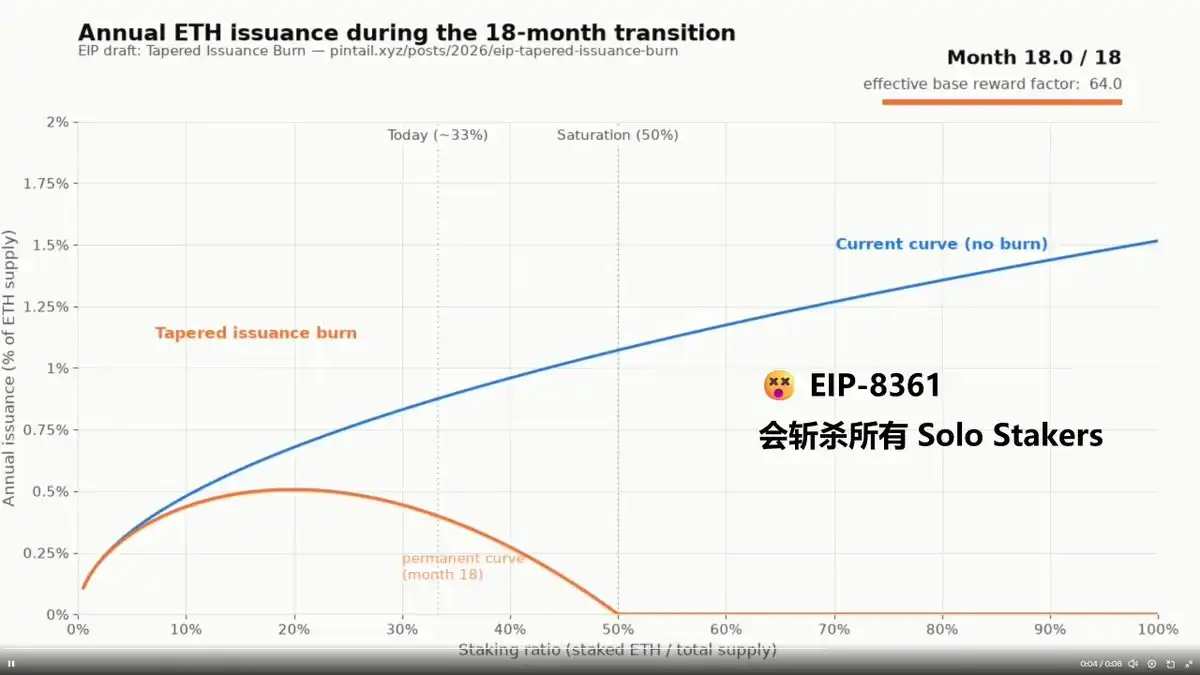
Essentially, this proposal boils down to drastically slashing the APR for $ETH staking.

If the staking ratio exceeds 50%, it would directly cut the yield to 0.

My assessment: A meaningless and counterproductive proposal.

As is well known, if a system is functioning properly, it should not be tinkered with lightly. Ethereum is currently in such a state.

Actually, having been involved in Ethereum staking for so long, I do have a say in this.

According to Ebunker, the current ETH Staking yield is a mere 2.4%, which isn't even half as competitive as U.S. Treasury bonds.

For the average Ethereum retail user, solo staking yields barely break even or even result in a slight loss, with very thin margins. It's the die-hard supporters who run Solo Staking.

If EIP-8361 were to go live, solo stakers would immediately enter the kill zone.

This wouldn't affect institutional stakers as much, given their larger volumes and fixed server costs.

For a protocol like Ethereum, Solo Stakers are crucial; they represent the decentralization of the Ethereum ledger.

As for the entry/exit queue (churn rate) concerns raised by Chairman Tychey, there's even less need to worry.

On one hand, improvements have already been made since the era of larger nodes (2048 ETH); on the other hand, modifying this churn rate requires merely changing a parameter with a flick of the fingers, carrying virtually no risk.

However, slashing Ethereum's yield to this extent also requires a hard fork to implement, as it involves the core interests of $ETH and could even potentially lead to the creation of a new token.

For Ethereum, which is currently in a precarious state, the risk is too high—comparable to childbirth.

This proposal is utterly meaningless.
Trending Cryptos

Related Questions

QAccording to the author, what is the main purpose of the EIP-8361 proposal discussed in the article?

AAccording to the author, the main purpose of the EIP-8361 proposal is to drastically reduce the APR (Annual Percentage Rate) for $ETH staking, potentially cutting the yield to 0% if the staking rate exceeds 50%.

QWhy does the author, 0xTodd, consider the EIP-8361 proposal to be "unhelpful"?

A0xTodd considers the proposal unhelpful because it would severely harm solo stakers, who are crucial for Ethereum's decentralization, by making their operations unprofitable or a loss, while larger institutional stakers with fixed server costs could better withstand the lower yields.

QWhat specific negative consequence does the author predict for solo stakers if EIP-8361 is implemented?

AThe author predicts that if EIP-8361 is implemented, solo stakers would 'directly enter the kill line,' meaning their staking operations would become financially unsustainable, leading to losses or barely breaking even.

QWhat reason does the author give for stating that the concern over 'churn rate' is not a problem needing this proposal?

AThe author states that the concern over churn rate (the rate of validators entering/exiting the network) is not a problem because it was already improved after the 'large node era' (2048 ETH), and adjusting this rate is a low-risk process that only requires changing a parameter.

QAccording to the author, why is implementing EIP-8361 a high-risk action for Ethereum at its current state?

AThe author believes implementing EIP-8361 is high-risk because it would require a hard fork that touches the core economic interests of $ETH staking. This carries significant technical and community coordination risks, potentially even leading to the creation of a new token, which is too dangerous for Ethereum in its currently 'turbulent' state.

Related Reads

Trading

Spot

Hot Articles

Discussions

Welcome to the HTX Community. Here, you can stay informed about the latest platform developments and gain access to professional market insights. Users' opinions on the price of ETH (ETH) are presented below.

活动图片