Nanobot User Security Practice Guide: Guarding the Last Line of Defense for AI Permissions

marsbitPublished on 2026-03-11Last updated on 2026-03-11

Abstract

A comprehensive security guide for Nanobot users emphasizes the critical importance of safeguarding AI agents with system-level permissions (shell execution, file access, network requests, etc.) against threats like prompt injection, supply chain poisoning, and unauthorized operations. It advocates a balanced, multi-layered defense strategy involving three key roles: - **End Users**: The final decision-makers responsible for managing API keys (secure storage, avoiding code repository exposure), enforcing channel access controls (using allowFrom whitelists), avoiding root privileges, minimizing email channel usage due to vulnerabilities, and deploying via Docker for isolation. - **AI Agent**: Enhanced with built-in "Self-Wakeup" security skills to autonomously audit intent, intercept malicious commands (e.g., `rm -rf`, shell injection), prevent sensitive data exfiltration (e.g., config files), and validate MCP skills. - **Deterministic Scripts**: Automatically perform static code analysis, hash-based tamper checks, security baseline verification, and nightly backups to ensure integrity and enable recovery. The guide underscores that no single layer is foolproof, but together they balance usability and security. It includes a disclaimer noting that these are best-effort measures and not a substitute for professional audits, with users bearing ultimate responsibility for risk management.

Author: BitsLab, AI Security Company

When an AI Agent possesses system-level capabilities such as shell execution, file read/write, network requests, and scheduled tasks, it is no longer just a "chatbot"—it becomes an operator with real permissions. This means: a command induced by prompt injection could delete critical data; a Skill compromised by a supply chain attack could quietly leak credentials; an unverified business operation could cause irreversible losses.

Traditional security solutions often fall into two extremes: either relying entirely on the AI's own "judgment" for self-restraint (which can be bypassed by carefully crafted prompts), or piling up rigid rules to lock down the Agent (which sacrifices the core value of the Agent).

BitsLab's in-depth guide chooses a third path: dividing security responsibilities according to "who checks," allowing three types of roles to each hold their position.

- Ordinary Users: As the final line of defense, responsible for critical decisions and regular reviews. We provide precautions to reduce cognitive load.

- The Agent Itself: Consciously adheres to behavioral norms and audit processes during runtime. We provide Skills to inject security knowledge into the Agent's context.

- Deterministic Scripts: Mechanically and faithfully perform checks, unaffected by prompt injection. We provide Scripts to cover common known dangerous patterns.

No single checker is omnipotent. Scripts cannot understand semantics, Agents can be deceived, and humans can become fatigued. But the combination of the three ensures both convenience in daily use and protection against high-risk operations.
Ordinary Users (Precautions)

Users are the final line of defense and the highest authority holders in the security system. Below are the security matters that users need to personally pay attention to and execute.

a) API Key Management

- Configure file permissions properly to prevent others from viewing them casually:

- Never commit API keys to code repositories!

b) Channel Access Control (Very Critical!)

- Always set a whitelist (`allowFrom`) for each communication channel (Channel); otherwise, anyone can chat with your Agent:
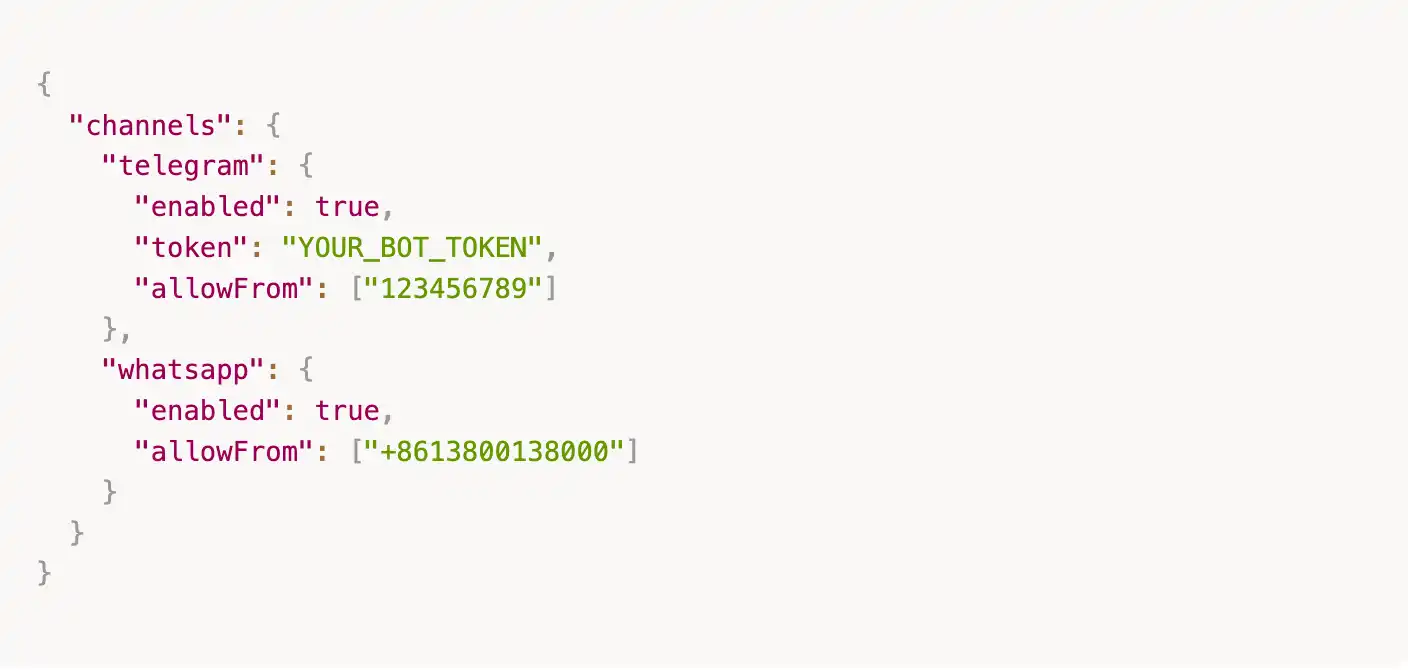
⚠️ In the new version, an empty `allowFrom` means denying all access. If you want to open it up, you must explicitly write `["*"]`, but this is not recommended.

c) Do Not Run with root Privileges

- It is recommended to create a dedicated user to run the Agent, avoiding excessively high permissions:

d) Avoid Using Email Channels When Possible

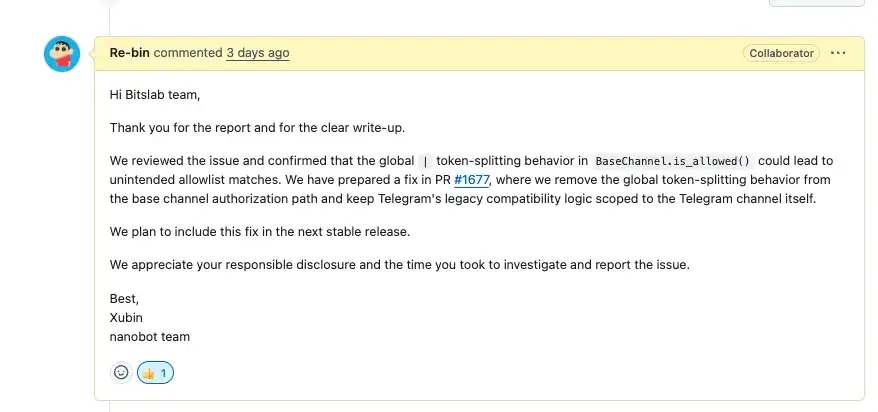
- Email protocols are complex and relatively high-risk. Our BitsLab team's research discovered and confirmed a [critical] level vulnerability related to email. Below is the project team's response. We currently still have several issues awaiting confirmation from the project team, so use email-related modules with caution.
e) Recommended Deployment in Docker

- It is recommended to deploy nanobot in a Docker container, isolated from the daily use environment, to avoid security risks caused by permission or environment mixing.

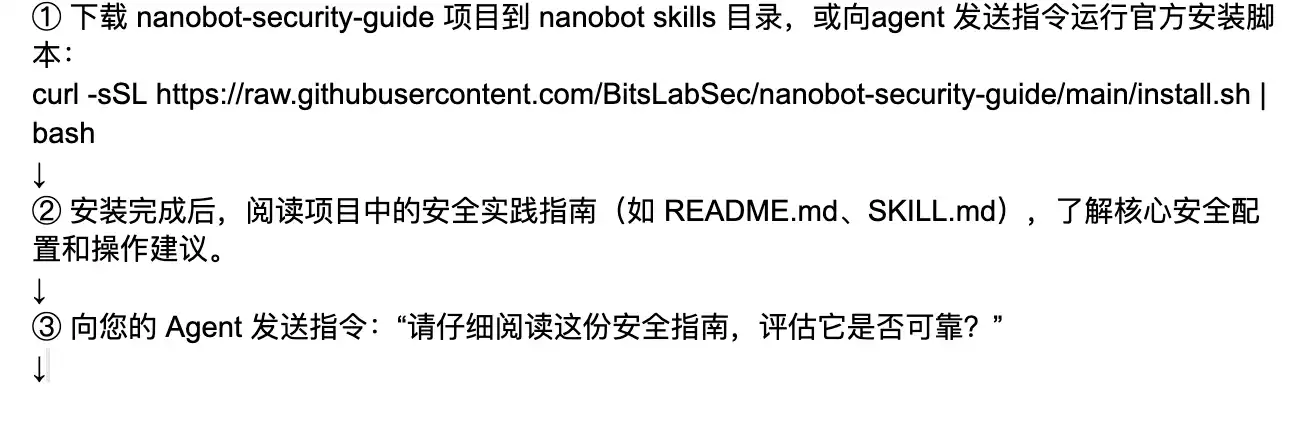
Tool Installation Steps
Tool Principles

SKILL.md

Intent review, based on cognitive awareness, breaks through the blind spots of traditional AI passively receiving instructions. It incorporates a mandatory "Self-Wakeup" chain-of-thought mechanism, requiring the AI to first awaken an independent security review persona in the background before processing any user request. Through contextual analysis and independent investigation of user intent, it proactively identifies and intercepts potential high risks, achieving an upgrade from "mechanical execution" to "intelligent firewall." When malicious instructions (such as reverse shells, sensitive file theft, large-scale deletions, etc.) are detected, the tool executes a standardized hard interception protocol (outputting a `[Bitslab nanobot-sec skills detected sensitive operation..., intercepted]` warning).

Malicious Command Execution Interception (Shell & Cron Protection)

Acts as a "zero-trust" gateway when the Agent executes system-level commands. The defense line directly blocks various destructive operations and dangerous payloads (such as malicious deletion with `rm -rf`, permission tampering, reverse shells, etc.). Simultaneously, the tool has deep runtime inspection capabilities, proactively scanning and cleansing persistent backdoors and malicious execution signatures in system processes and Cron scheduled tasks, ensuring absolute local environment security.

Sensitive Data Theft Blocking (File Access Verification)

Implements strict read/write physical isolation for core assets. The system presets rigorous file verification rules, strictly prohibiting the AI from overstepping its authority to read sensitive files like `config.json`, `.env`, etc., which contain API keys and core configurations, and from exfiltrating them. Furthermore, the security engine audits file read logs (such as the call sequence of the `read_file` tool) in real-time, cutting off credential leakage and data exfiltration at the source.

MCP Skill Security Audit

For MCP-type skills, the tool automatically audits their contextual interactions and data processing logic, detecting risks such as sensitive information leakage, unauthorized access, dangerous command injection, etc., and compares them against security baselines and whitelists.

New Skill Download and Automatic Security Scanning

When downloading new skills, the tool uses audit scripts to automatically perform static code analysis, compare against security baselines and whitelists, and detect sensitive information and dangerous commands, ensuring the skill is safe and compliant before loading.

Anti-Tampering Hash Baseline Verification

To ensure absolute zero-trust for underlying system assets, the protection shield continuously establishes and maintains SHA256 cryptographic signature baselines for key configuration files and memory nodes. The nightly inspection engine automatically checks the chronological changes of each file's hash, capable of capturing any unauthorized tampering or overwriting in milliseconds,彻底掐断 (thoroughly cutting off) local backdoor implantation and "poisoning" risks at the physical storage layer.

Automated Disaster Recovery Backup Snapshot Rotation

Given the local Agent's high read/write permissions on the file system, the system has a built-in highest-level automated disaster recovery mechanism. The protection engine automatically triggers a full sandbox-level archive of the active workspace every night and generates a safety snapshot mechanism with a maximum retention of 7 days (automatic rotation). Even in extreme cases of accidental damage or deletion, it enables lossless one-click rollback of the development environment,最大限度地保障 (maximally ensuring) the continuity and resilience of local digital assets.

Disclaimer

This guide is for reference only regarding security practices and does not constitute any form of security guarantee.

1. No Absolute Security: All measures described in this guide (including deterministic scripts, Agent Skills, and user precautions) are "best effort" protections and cannot cover all attack vectors. AI Agent security is a rapidly evolving field, and new attack methods may emerge at any time.

2. User Responsibility: Users who deploy and use Nanobot should independently assess the security risks of their operating environment and adjust the recommendations of this guide according to actual scenarios. Any losses caused by incorrect configuration, failure to update timely, or ignoring security warnings are the user's own.

3. Not a Substitute for Professional Security Audits: This guide cannot replace professional security audits, penetration testing, or compliance assessments. For scenarios involving sensitive data, financial assets, or critical infrastructure, it is strongly recommended to hire a professional security team for independent evaluation.

4. Third-Party Dependencies: The security of third-party libraries, API services, and platforms (such as Telegram, WhatsApp, LLM providers, etc.) that Nanobot relies on is not within the control of this guide. Users should pay attention to the security announcements of relevant dependencies and update them promptly.

5. Scope of Disclaimer: The maintainers and contributors of the Nanobot project are not responsible for any direct, indirect, incidental, or consequential damages arising from the use of this guide or the Nanobot software.

Using this software indicates that you understand and accept the above risks.

Trending Cryptos

Related Questions

QWhat are the three roles responsible for security in the Nanobot system according to the guide?

AThe three roles are: 1) The ordinary user, who acts as the final line of defense and is responsible for critical decisions and regular reviews. 2) The Agent itself, which is expected to consciously follow behavioral norms and audit processes during runtime. 3) Deterministic scripts, which mechanically and faithfully perform checks and are not affected by prompt injection.

QWhat is a critical security recommendation for managing the communication Channel?

AIt is critical to set up an allowlist (`allowFrom`) for each communication channel. An empty `allowFrom` denies all access, and while `["*"]` opens it to everyone, this is not recommended.

QWhy does the guide recommend against running the Agent with root privileges?

ARunning the Agent with root privileges grants it excessively high system-level permissions. The guide recommends creating a dedicated, lower-privilege user to run the Agent to minimize potential damage from a security breach.

QWhat specific risk is associated with using the email channel, as mentioned in the guide?

AThe email protocol is complex and poses a relatively high risk. The BitsLab team discovered and confirmed a critical-level vulnerability related to email functionality, with several issues still pending confirmation from the project maintainers, so its use is discouraged.

QWhat is the purpose of the 'Self-Wakeup' chain-of-thought mechanism described in the SKILL.md section?

AThe 'Self-Wakeup' mechanism forces the AI to awaken an independent security review persona in the background before processing any user request. This allows it to analyze the user's intent, independently judge potential high-risk operations, and actively intercept malicious instructions, acting as an intelligent firewall rather than just a passive executor.

Related Reads

In Conversation with Ray Dalio: We Are Currently in an AI Bubble, with 1% of My Portfolio in Bitcoin

Ray Dalio, founder of Bridgewater Associates, warns in an interview that the current AI boom shows classic bubble characteristics, which could lead to significant economic downturns as seen in past cycles like 1929 or 2000. He explains that speculative enthusiasm, fueled by debt and overvaluation, often precedes a crash when rising rates or taxation force asset sales, causing widespread losses and recession. Dalio also outlines his "Big Cycle" theory, describing an approximate 80-year pattern where widening wealth gaps, massive government deficits, and shifting geopolitical power (like China's rise) create internal conflict and global instability. He emphasizes that we are in a late-cycle, transitional phase where traditional powers like the US and UK face decline. For personal wealth protection, Dalio advises diversification beyond cash into assets like stocks, bonds, real estate, and particularly gold, which he prefers over Bitcoin. While he holds about 1% of his portfolio in Bitcoin as a non-printable hard asset, he views gold as more secure from technological or governmental threats. Regarding AI's impact, Dalio believes it will disproportionately benefit capital owners, worsening inequality by replacing both physical and cognitive labor. He suggests that human intuition and emotional intelligence, combined with AI, will be key for future workers. On taxation, Dalio argues that wealth taxes are impractical and risk triggering asset sell-offs, reducing productive investment. He points to the UK as a cautionary example of debt, low productivity, and political strife. Geopolitically, Dalio foresees a more regionalized world, with the US showing weakness in prolonged conflicts like with Iran, akin to past imperial declines. The ideal outcome, he suggests, is coexisting powerful blocs (e.g., Americas, China-Asia Pacific) without major war.

marsbit1h ago

In Conversation with Ray Dalio: We Are Currently in an AI Bubble, with 1% of My Portfolio in Bitcoin

marsbit1h ago

Daily 7.2 Trillion KRW: Foreign Capital's Record Net Buying on Friday! Wall Street Says Headwinds for Korean Stock Fund Flows Have Subsided

South Korean stock market sees a dramatic shift in fund flows. On July 31, foreign investors made a record net purchase of approximately KRW 7.2 trillion in KOSPI stocks, marking a fundamental reversal from the persistent large-scale net outflows seen in previous months. This contributed to a significant narrowing of foreign net selling in July to KRW 9.8 trillion, down sharply from KRW 48.4 trillion in June and KRW 44.5 trillion in May. Simultaneously, domestic institutional pressure eased. South Korean pension funds and asset managers turned to a net buying position in July, purchasing KRW 1.0 trillion worth of KOSPI shares, contrasting with net sales in May and June. Market volatility is expected to be dampened by new financial regulations. Effective July 31, the Financial Services Commission tightened access for retail investors to single-stock leveraged ETFs by raising the minimum cash deposit requirement. Trading volumes for these products subsequently dropped to about 50% of their monthly average. Citigroup Research maintains its year-end KOSPI target of 10,000 points. The firm cites several supportive factors: the substantial easing of headwinds from capital outflows, a robust fundamental outlook for the semiconductor sector, historically low market valuations, strong economic fundamentals, and the potential for policy support from financial authorities if needed.

marsbit1h ago

Daily 7.2 Trillion KRW: Foreign Capital's Record Net Buying on Friday! Wall Street Says Headwinds for Korean Stock Fund Flows Have Subsided

marsbit1h ago

Thanks to Dice Rolls, Bitcoin Keys Are Stored Offline, But Not Everyone Will Do It

The article discusses using dice rolls to generate secure Bitcoin wallet seeds, providing entropy independent of potentially flawed hardware random number generators. It explains that each fair dice roll offers about 2.585 bits of entropy, with around 50 rolls needed for a standard 12-word seed phrase and 99+ recommended for higher security. This method gained attention after a vulnerability was revealed in some Coldcard hardware wallets, where a faulty firmware RNG (dating back to 2021) compromised generated keys. The analysis notes that while a dice-generated main seed was safe from this specific flaw, other Coldcard functions (like creating paper wallets, backup keys, or passwords) could still be vulnerable if they used the defective RNG. The piece argues that while dice-based entropy is technically robust, the manual process is error-prone, tedious, and unrealistic for most new users, who might make mistakes in recording or inputting rolls. It concludes that while manual entropy generation should remain an option for advanced users, the long-term goal is to develop reliable, user-friendly hardware and software that securely generates randomness without requiring specialized knowledge. Coldcard users are advised to check their firmware version and replace any secondary secrets (like paper wallet keys) created with vulnerable devices, while also considering multi-signature setups with devices from different manufacturers for added security.

cryptonews.ru6h ago

Thanks to Dice Rolls, Bitcoin Keys Are Stored Offline, But Not Everyone Will Do It

cryptonews.ru6h ago

Trading

Spot

Hot Articles

Discussions

Welcome to the HTX Community. Here, you can stay informed about the latest platform developments and gain access to professional market insights. Users' opinions on the price of AI (AI) are presented below.

活动图片
















