Meme Cultivation Manual: Reborn as a Diamond Hand (Part 4) | Produced by Nan Zhi

marsbitPublished on 2026-01-04Last updated on 2026-01-04

Abstract

"Meme Cultivation Guide: Reborn as a Diamond Hand (Part 4)" by Nan Zhi updates the progress of a meme coin copy-trading experiment on Solana. After implementing a depth evaluation system, Copy 1 and 2 accounts showed improved stability, providing steady returns, while Copy 6 saw a nearly 5x gain in a week (though this was partly due to an unexpected profit event from a split account strategy). As of November 4, the author details various copy-trading strategies: Accounts 1 and 2 follow low-frequency, high-profit-ratio "diamond hand" addresses; Account 5 follows an extremely low-frequency, high-risk address; and test accounts 1-6 track promising but unstable addresses with very small amounts to avoid significant losses. The depth evaluation system was upgraded with two new modules: a "copy-trading effect test" (calculating profit per initial trade round) and an "internal market performance evaluation" (assessing performance on Pump.fun to identify potential scam risks or poor internal trading skill). The author cautions that the system is still in early stages (28 days of operation) and lacks sufficient data for rigorous conclusions. Future plans include further system refinements to improve the copy-trading strategy.

Original | Odaily Planet Daily (@OdailyChina)

Author | Nan Zhi (@Assassin_Malvo)

Last week, after introducing the in-depth evaluation system, the stability of Copy Trading Accounts 1 and 2 significantly improved, beginning to provide sustained funding support for other test accounts. Furthermore, Copy Trading Account 6 achieved a nearly 5x increase in one week.

In this installment, the author will update the progress of each wallet, display the copy trading address tracking charts, and detail the upgrades to the in-depth evaluation system along with future plans.

Risk Warning: This system was launched on October 8th and has only been running for 28 days. While it has achieved certain results, objectively speaking, the data volume and controlled experiments are insufficient, and the rigor is limited. This is for readers' information only.

Funding Progress and Strategy Showcase

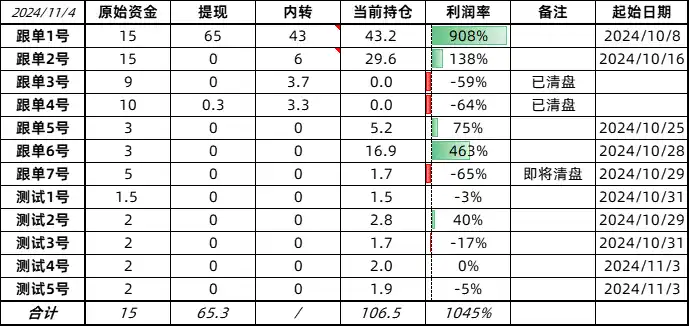
The funding status of each address as of November 4th, 17:30 (UTC+8) is shown below. The profit potential and growth curve vary significantly across accounts based on the style and strategy of the copied target. Notably, Copy Trading Account 6 achieved a nearly fivefold gain in one week under specific circumstances. For details, please refer to the next subsection.

This section will further elaborate on the specific copy trading strategies, showcasing the author's thought process.
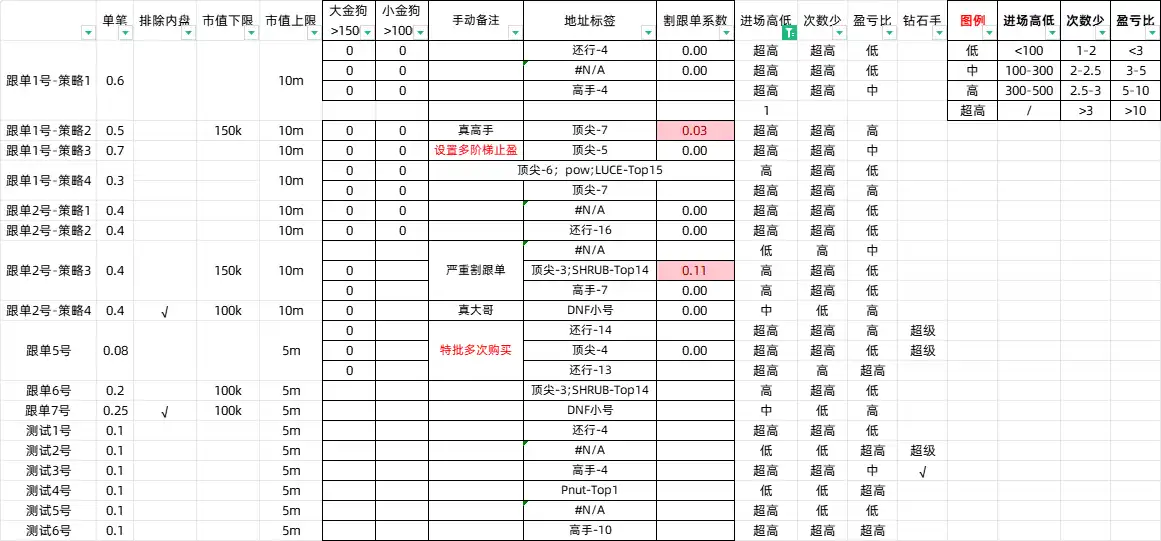
The details of the tracked copy trading targets are shown in the figure below:

  • The left column is the strategy column, with different settings based on the wallet's profitability, purchase frequency, and on-premises market (Pump.fun) profitability.
  • The middle section shows the practical results and preliminary evaluation system labels.
  • The right column shows labels based on the In-depth Evaluation System I, with the label categories as shown in the legend in the top right corner.

(Note: The rationale for the left column settings is detailed in "Diamond Hands, High Profit Ratio? What are the Winning Factors in Solana Meme Trading?" and "Meme Cultivation Manual: Reborn as a Diamond Hand (Part 2)". The right column is detailed in "Meme Cultivation Manual: Reborn as a Diamond Hand (Part 3)".)
Copy Trading Strategy Overview

  • Copy Trading Accounts 1 and 2 are addresses selected early on for their low frequency, high profit ratio, and diamond hand behavior. Furthermore, addresses with high drawdowns were removed based on the guiding principles from Part 3. The results so far are acceptable: Account 1's profit rate increased from 725% to 908% in 6 days, and Account 2's increased from 84% to 138%.
  • Copy Trading Account 5 is an extremely low-frequency (only 11 buy operations to date), high profit ratio, extreme diamond hand address. Because these addresses have historically successfully added positions at highs multiple times, they are the only addresses for which multiple purchases are enabled, and the single purchase amount has been reduced. However, due to the limited total number of transactions, no conclusions can yet be drawn regarding their impact on the system's profitability.
  • Before the split, Wallet B (i.e., Account 7) purchased a certain token. Wallet B performed numerous profit-taking operations on this token, but after the split, Wallet B's operations were no longer copied. This resulted in unexpected gains and profits (accounting for about 50% of Account 6's total profit). Therefore, although Account 6 achieved a fivefold gain in a week, Accounts 6 and 7 should actually be combined with Account 2 for comparison. The combined weekly growth was 10.6 SOL (a 132.5% increase), still showing a certain advantage compared to Account 2's growth of 8.1 SOL.
  • Test Accounts 1-6 are used to test addresses that have outstanding strengths but lack stability. They use ultra-small amounts to test their long-term purchasing ability. If an account gets liquidated (goes to zero), it is cleared and marked as unsuitable for copy trading.

Version Iteration

In-depth Evaluation System (I)

In Part 3, the author introduced the In-depth Evaluation System (I) to further analyze an address's ability to "buy at the bottom," the risk of losing money by "FOMOing at highs," the ability to achieve high returns with small capital, stop-loss style, and the degree of "diamond hands."

Last week, the system was further enhanced with two new sub-modules: "Copy Trading Effect Test" and "On-Premises (Pump.fun) Performance Evaluation." The complete evaluation results of the system are shown in the figure below.

The "Copy Trading Effect Test" is currently still relatively rudimentary. Its calculation method is: Total profit provided by GMGN ÷ Number of first-round transactions. The converted profit for each token is then summed to obtain the "Converted Profit" for each address.

(Number of first-round transactions = the number of transactions from the first buy to the first sell, sourced from GMGN - Address Data - Token Transaction Details. Transferring tokens is also considered a sell.)

The reason for adopting this calculation method is that the copy trading system mostly only copies the buy action once, so it's necessary to evaluate the profit change under this style. A small decrease or even an increase in the converted profit is the ideal scenario. This ideal scenario occurs because the high-profit tokens of the copied target are a result of "buying once after identifying an opportunity," while the high-loss tokens are caused by "multiple additions to the position."

The calculation method for the "On-Premises Performance Evaluation" is also currently quite straightforward. First, it statistics whether the token was purchased on the Pump.fun on-premises market. Then, the win rate and multiple are calculated based on the token's total profit and total cost. The purpose of this data is to evaluate whether to copy on-premises trades. If a situation arises where "on-premises participation rate" is too high + "on-premises win rate" is high + "on-premises multiple" is too low, then this address carries the risk of cutting (scamming) copy traders. In cases where the win rate is low and the profit ratio is not high, it indicates poor on-premises trading skills, and their on-premises trades should not be copied.

Future Outlook

The copy trading system still has many areas that need improvement. Those currently planned include:


Related Questions

QWhat is the main topic of the article 'Meme修炼手册:重生之我要做钻石手(四)'?

AThe article provides an update on the progress of a copy-trading system for Solana Meme coins, detailing the performance of various copy-trading wallets, the upgrades to a deep evaluation system, and future plans.

QWhich copy-trading wallet achieved a nearly 5x increase in one week according to the article?

ACopy-trading Wallet No. 6 achieved a nearly 5x increase in one week.

QWhat new sub-modules were added to the Deep Evaluation System (一) in the past week?

ATwo new sub-modules were added: 'Copy-trading Effect Test' and 'Internal Market Performance Evaluation'.

QWhat is the purpose of the 'Internal Market Performance Evaluation' sub-module?

AIts purpose is to assess whether to follow an address's trades on internal markets (Pump fun) by evaluating their win rate and profit multiple there, helping to identify addresses that might be 'cutting off' copy-traders or have poor trading skills in that specific environment.

QWhat is the calculated metric for the 'Copy-trading Effect Test' sub-module?

AThe metric is 'Converted Profit', calculated as the total profit provided by GMGN divided by the number of first-round transactions (from first buy to first sell, where transferring tokens also counts as a sale), with the converted profit for each token then summed up.

Related Reads

$292 Million KelpDAO Cross-Chain Bridge Hack: Who Should Foot the Bill?

On April 18, 2026, an attacker stole 116,500 rsETH (worth ~$292M) from KelpDAO’s cross-chain bridge in 46 minutes—the largest DeFi exploit of 2026. The stolen assets were deposited into Aave V3 as collateral, causing $177–200M in bad debt and triggering a cascade of losses across nine DeFi protocols. Aave’s TVL dropped by ~$6B overnight. This legal analysis argues that KelpDAO and LayerZero Labs share concurrent liability, with fault apportioned 60%/40%. KelpDAO negligently configured its bridge with a 1-of-1 decentralized verifier network (DVN)—a single point of failure—despite LayerZero’s explicit recommendation of a 2-of-3 setup. LayerZero, which operated the compromised DVN, failed to secure its RPC infrastructure against a known poisoning attack vector. Both protocols’ terms of service cap liability at $200 (KelpDAO) or $50 (LayerZero), but these limits are likely unenforceable due to unconscionability, gross negligence exceptions, and potential securities law invalidation (if rsETH is deemed a security under the Howey test). Aave’s governance also faces fiduciary duty claims for raising rsETH’s loan-to-value ratio to 93%—far above competitors’ 72–75%—without adequately assessing bridge risks, amplifying the systemic fallout. Practical recovery targets include LayerZero Labs (a registered Canadian entity), KelpDAO’s founders, auditors, and identifiable Aave governance delegates. The incident underscores escalating legal risks for DeFi protocols, infrastructure providers, and governance participants.

marsbit34m ago

$292 Million KelpDAO Cross-Chain Bridge Hack: Who Should Foot the Bill?

marsbit34m ago

Insider Trading in War: 5 People Involved, the Highest Earner Was Arrested

On April 24, the U.S. Department of Justice arrested U.S. Army Special Forces Staff Sergeant Gannon Ken Van Dyke for insider trading related to the capture of Venezuelan President Nicolás Maduro on January 3. Van Dyke allegedly profited over $400,000 by placing bets on a prediction market, Polymarket, using insider knowledge of the covert operation. According to the indictment, Van Dyke registered an account (0x31a5) on December 26 and made a series of bets predicting Maduro’s capture and U.S. military involvement in Venezuela. He withdrew most of his funds on the day of the operation and attempted to obscure his tracks by transferring assets through crypto and brokerage accounts. This case marks the first time the DOJ has prosecuted insider trading on Polymarket. PolyBeats had previously identified five suspicious accounts, including Van Dyke’s—the highest earner—in January. The other accounts, with profits ranging from $34,000 to $145,000, remain under unofficial scrutiny but have not been charged. Their lower profits, indirect access to information, and unclear legal boundaries may complicate prosecution. Polymarket has since strengthened its market integrity rules, explicitly prohibiting trading based on confidential or insider information. Van Dyke’s arrest, nearly four months after his trades, signals increased regulatory attention and the persistent traceability of blockchain-based transactions.

marsbit35m ago

Insider Trading in War: 5 People Involved, the Highest Earner Was Arrested

marsbit35m ago

Bitwise: Bullish on Bitcoin's Performance in the Second Half of the Year, AI and Regulation Will Spark a New Altcoin Season

Bitwise CIO Matt Hougan and Research Lead Ryan Rasmussen express strong bullish sentiment on Bitcoin's long-term prospects, suggesting that its $1 million price target may be too conservative. They argue Bitcoin serves a dual role: as digital gold and a potential global settlement asset, especially amid declining trust in traditional monetary systems. Despite a weak Q1 2026 where nearly all crypto assets and prices saw double-digit declines, the analysts remain optimistic due to strong forward-looking catalysts, including institutional adoption via Bitcoin ETFs from major firms like Morgan Stanley and Goldman Sachs. Geopolitical instability, such as Iran’s mention of using Bitcoin for international payments, increases the value of Bitcoin’s “out-of-the-money call option” as a non-political, global settlement currency. This enhances its appeal beyond a mere store of value. . Additionally, Hougan highlights that a clearer regulatory token framework under current SEC leadership, combined with AI efficiency gains and high-performance blockchains, could fuel a new “altseason” by late 2026. This may lead to a wave of legitimate, value-capturing token projects, unlike the earlier ICO boom. . Bitwise also announced an Avalanche ETF, citing its unique architecture and rapid growth in real-world asset (RWA) tokenization, which has surged 10x to nearly $30 billion in two years. The firm believes Layer 1 blockchains are still early in their growth cycle, with significant potential ahead.

marsbit1h ago

Bitwise: Bullish on Bitcoin's Performance in the Second Half of the Year, AI and Regulation Will Spark a New Altcoin Season

marsbit1h ago

Trading

Spot
Futures

Hot Articles

Discussions

Welcome to the HTX Community. Here, you can stay informed about the latest platform developments and gain access to professional market insights. Users' opinions on the price of MEME (MEME) are presented below.

活动图片