Mastercard Just Built A Payment Network For AI Agents — And It Runs On Crypto

bitcoinistPublished on 2026-06-10Last updated on 2026-06-10

Abstract

Mastercard has launched "Agent Pay for AI," a new payment protocol enabling AI agents to conduct small, automated, machine-to-machine transactions. The system addresses a gap in traditional payment infrastructure, which is poorly suited for such micropayments. A key feature is the storage of human-granted permissions on the Polygon blockchain, allowing for decentralized verification without a central authority. Mastercard is developing the protocol with partners Adyen, Coinbase, and Cloudflare. It enters a competitive field where Visa, Stripe, and Google have also introduced similar AI payment tools. While Mastercard's Chief Product Officer, Jorn Lambert, does not expect significant near-term revenue, he views it as a strategic infrastructure investment for an anticipated future where AI agents facilitate a meaningful share of commerce. This move follows Mastercard's recent integration of stablecoins, signaling a broader shift towards incorporating crypto into its core systems.

Mastercard has launched Agent Pay for AI, a new protocol designed to enable artificial intelligence agents to pay each other and send micropayments — storing the permissions that humans grant their AI agents on Polygon, a blockchain network built on top of Ethereum, according to an exclusive report by Fortune published June 10.

Related Reading: Trump’s Crypto Deals May Have Increased The Family Fortune By $2 Billion—At Investors’ Expense

The protocol is built around a specific use case that existing payment infrastructure handles poorly: small, automated, machine-to-machine transactions. When an AI agent needs to access data piecemeal from a website, or pay another service incrementally for a task it is performing on a user’s behalf, traditional card rails — built for human-initiated, merchant-facing transactions — are poorly suited for the job. Agent Pay for AI is designed to fill that gap, per Fortune’s reporting.

The decision to log permissions onto a public blockchain rather than a private database is a deliberate architectural choice. Multiple parties that want to verify whether an agent is acting within the boundaries a human has authorized can access that information directly on-chain, without relying on a single centralized authority to confirm it, per Fortune. Mastercard selected Polygon for the initial deployment.
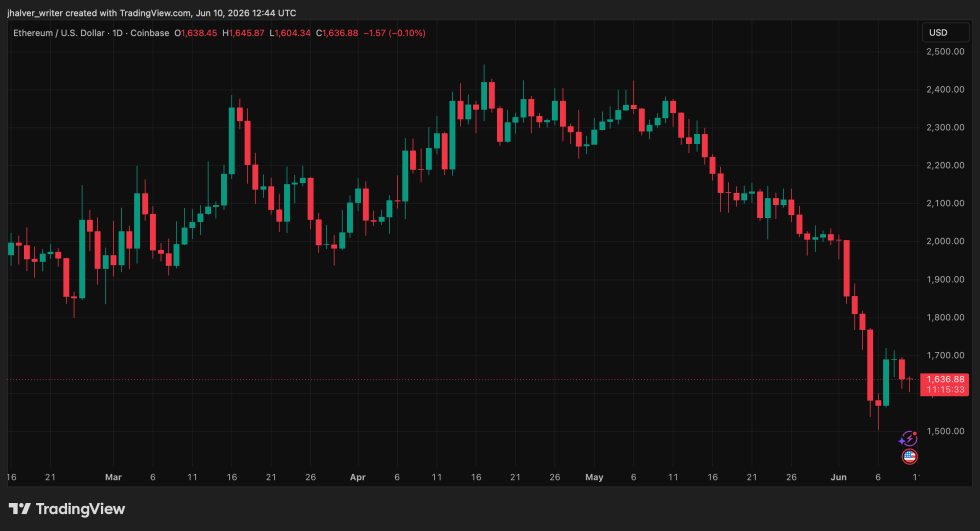
ETH's price trends to the downside on the daily chart. Source: ETHUSD on Tradingview

The Partners And The Crypto Competition

Three companies are working with Mastercard to develop the protocol: fintech platform Adyen, crypto exchange Coinbase, and web infrastructure giant Cloudflare, per Fortune’s reporting. The combination of a payment processor, a crypto-native exchange, and the company that handles a significant share of the internet’s traffic signals that Mastercard is building Agent Pay for AI as interoperable infrastructure rather than a proprietary walled garden.

The competitive landscape is already crowded. Visa and Stripe have each built tools anticipating a world where AI bots buy groceries, manage bank accounts, and pay for subscriptions. Coinbase launched the x402 protocol for AI payments, Stripe collaborated with Tempo to develop the Machine Payments Protocol, and Google released its own standard in September 2025, per Fortune.

Jorn Lambert, Mastercard’s Chief Product Officer, was measured about near-term commercial expectations in his conversation with Fortune. He does not expect Agent Pay for AI to be a significant revenue driver in the next twelve months. Over five years, however, he described it as a meaningful new addressable market. Lambert separately predicted that AI chatbots will eventually sit between a meaningful share of e-commerce transactions — framing the protocol not as a speculative bet but as infrastructure being built ahead of an inevitable shift in how commerce flows.

Related Reading: Japan’s SBI Bank Expands Crypto Push With BTC, ETH, XRP Rewards Program For Depositors

This development marks a pivotal moment for the nascent sector’s convergence with artificial intelligence. Mastercard choosing a public blockchain to anchor the permissions layer of its AI payment infrastructure — one week after opening its global settlement rails to six regulated stablecoins across eight blockchain networks — confirms that the world’s second-largest card network is systematically rebuilding its core architecture around crypto rails rather than alongside them.

Cover image from Grok, ETHUSD chart from Tradingview

Trending Cryptos

Related Questions

QWhat is the name of the new protocol launched by Mastercard for AI agents, and what problem does it aim to solve?

AMastercard launched the Agent Pay for AI protocol. It aims to solve the problem of enabling small, automated, machine-to-machine (AI agent-to-agent) payments and micropayments, a use case poorly handled by traditional card payment infrastructure designed for human-initiated, merchant-facing transactions.

QOn which blockchain network is Mastercard storing the permissions for its Agent Pay for AI protocol, and why was a public blockchain chosen?

AMastercard is storing the permissions for its Agent Pay for AI protocol on the Polygon blockchain. A public blockchain was chosen so that multiple parties can directly verify on-chain whether an agent is acting within authorized boundaries, without relying on a single centralized authority.

QWhich three companies are partnering with Mastercard to develop the Agent Pay for AI protocol?

AThe three companies partnering with Mastercard are the fintech platform Adyen, the crypto exchange Coinbase, and the web infrastructure giant Cloudflare.

QAccording to Mastercard's Chief Product Officer Jorn Lambert, what is the commercial outlook for the Agent Pay for AI protocol in the near term and over a longer period?

AAccording to Jorn Lambert, Agent Pay for AI is not expected to be a significant revenue driver in the next twelve months. However, over a five-year horizon, he described it as a meaningful new addressable market.

QHow does Mastercard's recent launch of Agent Pay for AI, combined with another recent action, indicate its strategic direction regarding cryptocurrency infrastructure?

ACombined with its decision the week prior to open its global settlement rails to regulated stablecoins, the launch of Agent Pay for AI on a public blockchain confirms that Mastercard is systematically rebuilding its core architecture around crypto rails, rather than just operating alongside them.

Related Reads

Base Claims Its Distribution Advantage Can Outlast Robinhood Chain's Initial Surge

Base, a layer-2 blockchain, argues that its established distribution network will outlast Robinhood Chain's initial popularity surge. While Robinhood Chain quickly attracted 230,000 daily active users and over $9 billion in DEX volume (primarily from meme coins) shortly after launch, its core feature of tokenized stocks saw minimal use. Base acknowledged shortcomings in focusing on social blockchain products and lagging in areas like perpetual contracts, predictions markets, and on-chain tokenized stocks—a move Robinhood got right. In response, Base highlights its nearly three-year head start in building infrastructure. It emphasizes its x402 payment protocol, which has processed 187.8 million agent payments, its $3.9 billion in stablecoin deposits (mostly USDC), and its integration with partners like Visa, Shopify, and JPMorgan for institutional and merchant settlements. Base contends these capabilities for corporate payments and stablecoin liquidity represent a more durable and defensible ecosystem than Robinhood's retail trading metrics. Coinbase plans to launch its own on-chain, share-backed tokenized stocks on Base, which would directly challenge Robinhood's key differentiating feature. Base's strategy bets that its deep-rooted distribution and institutional partnerships will prove harder to overcome than Robinhood's early, meme-driven volume, which may fade after the initial launch hype.

cryptonews.ru5m ago

Base Claims Its Distribution Advantage Can Outlast Robinhood Chain's Initial Surge

cryptonews.ru5m ago

The Turning Point of the AI Bull Market: Leverage Blow-ups, Overcapacity in Compute, Why This Macro Analyst is Fully Bearish

AI Bull Market Reaches Inflection Point: Analyst Turns Bearish Due to Leverage, Chinese Competition, and Overcapacity Fidenza Macro analyst Geo Chen explains his decision to sell all AI semiconductor and infrastructure holdings in June, offering a comprehensive bearish thesis. He argues the AI-driven bull market has peaked, citing several key factors. First, unsustainable buying pressure: a massive influx of "low-quality" capital from Korean retail investors using highly leveraged ETFs on stocks like SK Hynix created a parabolic, fragile rally. Recent liquidations have wiped out billions and impacted over a million accounts, removing a key market driver. Second, a competitive threat: the rapid rise of powerful, cost-effective open-source AI models from China, such as MoonShot AI's Kimi K3 and Alibaba's Qwen 3.8, is commoditizing intelligence. This undermines the pricing power and high-valuation financing prospects of closed-source leaders like OpenAI and Anthropic, potentially creating a "single point of failure" for the ecosystem. Third, an impending capacity glut: while AI compute and components are currently in shortage, Chen warns this is typical of a cycle top. Massive, committed capex from cloud providers will likely lead to a supply overhang within 1-2 years. Data shows token spending has already peaked and declined since June, while bond spreads for data center companies are widening, signaling rising credit risk. Chen also highlights broader macro headwinds: the protracted Iran conflict acts as a persistent stagflationary force, and the Federal Reserve under Chair Kevin Warsh is losing credibility in its inflation fight. Long-term Treasury yields breaking above 5.2% present a new challenge for equities. In summary, Chen believes the convergence of speculative excesses, competitive disruption, looming overcapacity, and adverse macroeconomic conditions marks a significant turning point for the AI investment theme.

marsbit20m ago

The Turning Point of the AI Bull Market: Leverage Blow-ups, Overcapacity in Compute, Why This Macro Analyst is Fully Bearish

marsbit20m ago

Trading

Spot

Hot Articles

Discussions

Welcome to the HTX Community. Here, you can stay informed about the latest platform developments and gain access to professional market insights. Users' opinions on the price of AI (AI) are presented below.

活动图片