Source: Wall Street News
As Venezuela's political situation underwent a dramatic reversal within hours, global attention has swiftly shifted from geopolitical shockwaves to a rare and massive financial puzzle: what fate awaits the vast cryptocurrency "shadow reserves" established to evade long-standing sanctions.
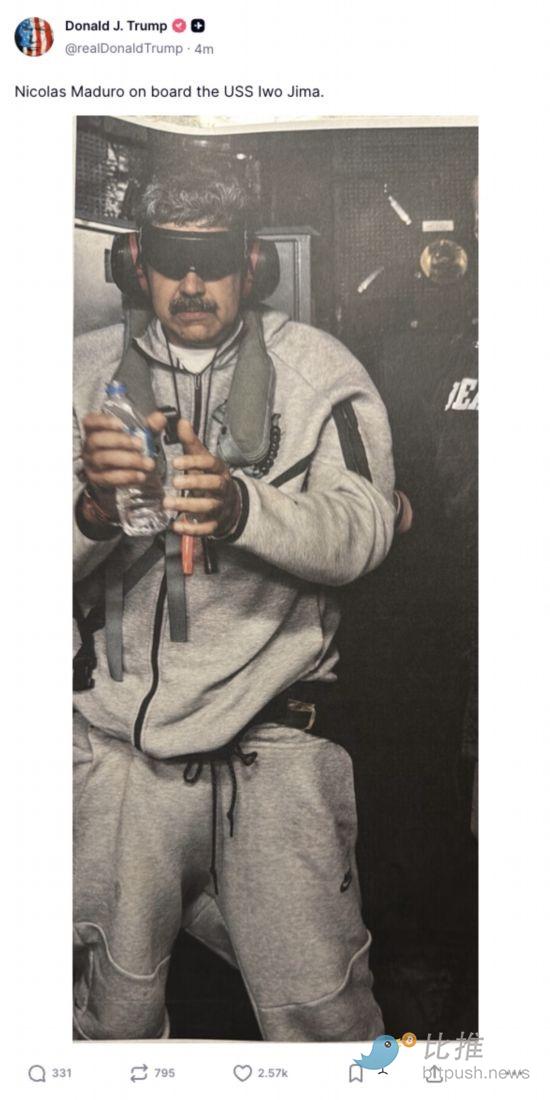
According to CCTV News, in the early hours of January 3 local time, the United States launched a large-scale military operation against Venezuela. Venezuelan President Maduro and his wife have been captured by US forces and taken out of the country. US President Trump subsequently confirmed the operation at Mar-a-Lago, stating that the US would "manage" Venezuela until a secure transition is implemented. He revealed that major US oil companies would enter the country, investing tens of billions of dollars to repair infrastructure.
Beyond physical assets, the whereabouts of a massive digital fortune, allegedly accumulated through "gold swaps" and oil trade, remain a mystery. Citing sources familiar with the matter, media outlets like Whale Hunting report that Venezuela established a complex shadow financial network to circumvent sanctions, converting national resources including gold and oil into Bitcoin and Tether (USDT).
With the collapse of the core circle of the Maduro government, the question of who holds the "private keys" to unlock this digital wealth has become one of Washington's most pressing concerns.
Estimates from some investigative sources suggest this figure could be as high as $60 billion. This colossal sum is believed to have been accumulated over years through complex channels like gold swaps and oil trade. With the regime change, key individuals holding the "private keys" to this wealth have become the focal point, with Alex Saab, identified as the "architect" of this system, being particularly crucial. The destination of these assets has escalated from a financial technicality to a complex game involving intelligence, law, and geopolitics.
Digital Assets of a Shadow Financial Empire
According to Whale Hunting, citing HUMINT (Human Intelligence) sources, the Venezuelan government may control Bitcoin worth up to $60 billion. While this data has not been fully confirmed by on-chain blockchain analysis, the logic behind the calculation has attracted attention within financial intelligence circles.
The report indicates that the fund accumulation began in 2018. At that time, Venezuela exported 73.2 tons of gold, valued at approximately $2.7 billion. Informed sources told the media that if a portion of these funds were converted when Bitcoin's price was at a low between $3,000 and $10,000, and held until its peak of $69,000 in 2021, the appreciation would be staggering.
If this estimate holds true, the scale of these assets would rival the holdings of MicroStrategy and even exceed the national reserves of El Salvador.
Beyond Bitcoin, stablecoins also played a significant role in the country's capital flow. According to Zerohedge, as sanctions tightened, Venezuela's state oil company PDVSA began requiring intermediaries to use Tether (USDT) to settle oil cargoes. By December 2025, about 80% of the country's oil revenue was reportedly received in USDT. Although Tether Ltd. has frozen some associated wallets, this is likely just the tip of the iceberg.
Gold Swaps and Crypto Channels
To achieve the covert transfer of assets, a complex channel spanning Turkey, the UAE, and other locations was established.
According to sources familiar with the operation, the process typically began with gold mining and export from Venezuela. The gold was shipped to Turkey and the UAE for refining and sale. The proceeds were not directly repatriated but were converted into cryptocurrency through Over-The-Counter (OTC) brokers. Subsequently, these funds were processed through "mixers" to obscure their origin before finally being deposited into cold wallets.
Specific individuals played key roles in this process. Media reports mention a person named David Nicolas Rubio Gonzalez, alleged to be a courier coordinating the physical transport of gold. Although he was placed on the US Treasury sanctions list as early as 2019, he has not faced criminal charges, sparking speculation about whether he has reached some form of cooperation with US authorities. Informed sources believe that such intermediaries, who possess specific details of the fund flows, might know the ultimate destination of this huge fortune.
The Role of Key Figure Alex Saab
Within this financial structure, Alex Saab is widely regarded as a central figure. According to Bloomberg, Alex Saab was appointed by Maduro in January 2024 as the head of Venezuela's International Investment Center. From Washington's perspective, he is the "architect" who built this shadow financial system.
Previously disclosed court documents revealed that Alex Saab had a complex relationship with US law enforcement, having acted as an informant for the US Drug Enforcement Administration (DEA) since 2016. With Maduro's arrest, Alex Saab has once again become the focus of attention. Former Venezuelan prosecutor Zair Mundaray stated in a media interview that Alex Saab gained trust due to his lack of ties to traditional political factions and effectively acted as a "guarantor" of assets.
The current suspense lies in the fact that the private keys controlling these cold wallets might not be held by a single individual. Sources透露 (reveal) that there might be a multi-signature mechanism, designed by Swiss lawyers, dispersing the keys among several trusted individuals in different jurisdictions to ensure asset security. With the physical isolation of the regime's core, it remains unknown whether these crypto assets will be permanently sealed like many "dormant" Bitcoin whale addresses, or if they will be recovered by the US through legal and intelligence means.
Market Reaction in Crude Oil and Gold
Back in traditional financial markets, investors are assessing the economic impact of the US "takeover" of Venezuela.
Phil Flynn, senior market analyst at Price Futures Group, pointed out that although Venezuela possesses staggering crude oil reserves of 303 billion barrels, its actual daily production has shrunk to about 1 million barrels, accounting for only 0.8% of global output. Therefore, even a short-term supply disruption would have a relatively limited direct boosting effect on global oil prices. Flynn believes the market reaction is more psychological, and Venezuela's oil share could easily be filled by other producing countries.
Regarding gold, Venezuela's 2024 gold production was approximately 31 tons, a modest share of the global total. Analysis suggests that in the short term, the尘埃落定 (dust settling) of military action may limit gold's safe-haven price gains; however, if subsequent US military involvement in the region triggers broader geopolitical games, it could provide medium-term support for gold prices.
Trump has made it clear that he will have major US oil companies invest tens of billions of dollars to repair Venezuela's dilapidated infrastructure. This means the future market trading logic will shift from fears of "supply disruption" to expectations regarding the speed of Venezuela's production capacity recovery and the return of US energy giants to the country's market.
Twitter:https://twitter.com/BitpushNewsCN
Bitpush TG Discussion Group:https://t.me/BitPushCommunity
Bitpush TG Subscription: https://t.me/bitpush


















