Largest Russian Bank Issues Statement on Bitcoin and Ethereum

cryptonews.ruPublished on 2026-08-30Last updated on 2026-08-30

Abstract

Russia's largest bank, Sberbank, is preparing to expand its range of cryptocurrency-backed loan products. According to deputy chairman Anatoly Popov, the bank plans to accept not only Bitcoin (BTC) but also Ethereum (ETH) and the stablecoin Tether (USDT) as collateral for loans in the future. This move follows the bank's existing practical experience with crypto assets. Popov stated that Sberbank will adapt its current products and gradually broaden its crypto-related services once new Russian regulations fully come into force. However, the implementation of this plan is contingent on regulatory approval, specifically requiring the Central Bank of Russia to authorize the public circulation of ETH and USDT for them to be used as loan collateral.

The largest Russian bank, Sberbank, is preparing to expand its range of credit products backed by cryptocurrencies. In the future, in addition to Bitcoin ($BTC), the bank plans to accept not only Bitcoin ($BTC) but also Ethereum ($ETH) and Tether ($USDT) as loan collateral.

As reported by the Russian news agency TASS, Anatoly Popov, Deputy Chairman of the Board of Sberbank, stated that the bank will continue to develop credit products secured by digital assets. Popov noted that Sberbank already has practical experience working with crypto assets.

Popov stated that after the full enactment of the new regulatory framework being prepared in Russia, the bank will adapt its existing products to the new rules and gradually expand the range of services related to cryptocurrencies.

In Addition to Bitcoin, Ethereum and $USDT Could Be Added.

According to Sberbank's plan, the bank will not limit itself to Bitcoin for digital asset-backed loans. In the future, it is also planned to accept Ethereum and the dollar-backed stablecoin Tether as collateral.

However, the implementation of the plan will depend on approval from regulators. Popov added that, in particular, the Central Bank of Russia will need to permit the public circulation of $ETH and $USDT assets for them to be used as collateral.

*This is not investment advice.

end-content

Trending Cryptos

Related Questions

QWhich Russian bank is expanding its range of cryptocurrency-backed loan products?

ASberbank, Russia's largest bank, is expanding its range of cryptocurrency-backed loan products.

QBesides Bitcoin, which two cryptocurrencies does Sberbank plan to accept as loan collateral in the future?

AIn the future, Sberbank plans to accept Ethereum (ETH) and Tether (USDT) as loan collateral, in addition to Bitcoin.

QWho announced Sberbank's plans regarding digital asset-backed loans, according to the article?

AThe plans were announced by Anatoly Popov, the Deputy Chairman of the Management Board of Sberbank.

QWhat regulatory body's approval is necessary for Sberbank to use ETH and USDT as loan collateral?

AThe Central Bank of Russia needs to approve the public circulation of ETH and USDT assets for them to be used as collateral.

QWhat condition must be met before Sberbank fully adapts and expands its cryptocurrency services?

ASberbank will adapt its existing products and expand services after the new regulatory framework prepared in Russia comes into full force.

Related Reads

ECB's Schnabel says central bank money 'should move to blockchain'

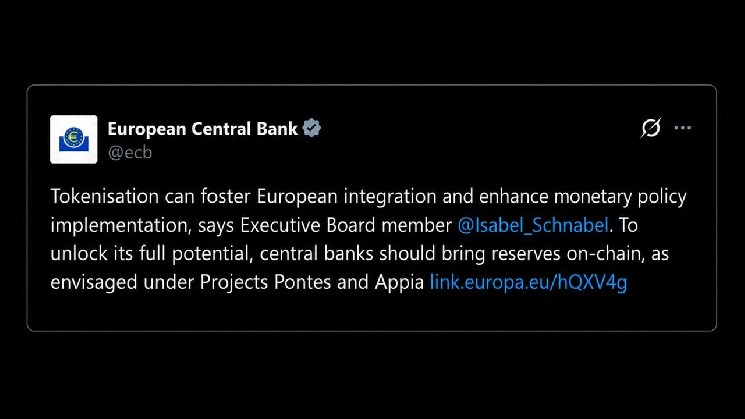
ECB Executive Board member Isabel Schnabel stated that central bank money "must move onto the blockchain." She argued that stablecoins lack the independent ability to scale liquidity during financial stress—a gap only a central bank can fill. Her proposed solution involves tokenization, which she says can make transactions faster, safer, and more programmable, but only if the safest asset (central bank money) is on the same "rails" as other tokenized assets. This marks a notable shift for the Eurosystem, which had previously viewed Distributed Ledger Technology (DLT) mainly as a tool for regulating stablecoins and crypto, not as infrastructure to adopt directly. The first step is Project Pontes, launching in September. It will initially synchronize the ECB’s existing TARGET services with private DLT platforms. Eventually, it aims to enable settlement finality on a Eurosystem-managed DLT platform with smart contract functionality and 24/7 operation. The long-term strategy is Project Appia, tasked with developing the architecture, standards, and legal framework for a genuine European tokenized asset market by 2028. Trials have already processed around €1.6 billion, and since March 2026, the ECB accepts DLT-based assets as collateral. While not directly impacting Bitcoin's price, these developments signal that a major G7 central bank is preparing to settle transactions on-chain, lending legitimacy to the underlying infrastructure of crypto markets. The ECB's move to avoid "disintermediation" by private tokenization shows that debates in central bank boardrooms are now aligning with discussions long followed in the crypto space.

cryptonews.ru2h ago

ECB's Schnabel says central bank money 'should move to blockchain'

cryptonews.ru2h ago

Trading

Spot

Hot Articles

Discussions

Welcome to the HTX Community. Here, you can stay informed about the latest platform developments and gain access to professional market insights. Users' opinions on the price of ETH (ETH) are presented below.

活动图片