Large-Scale Miners Cut 20% of Capacity for AI. The Situation is That Complex

cryptonews.ruPublished on 2026-08-14Last updated on 2026-08-14

Abstract

In the first half of the year, a group of major public Bitcoin miners reduced their Bitcoin mining output by 21%, according to Miner Weekly, amid a large-scale shift towards supporting artificial intelligence (AI) infrastructure. The global hashrate, reflecting mining activity, fell by 10% during this period. Despite expansion efforts by some large players like Bitdeer, MARA, Riot Platforms, and American Bitcoin, these increases were insufficient to offset the overall decline. Excluding Bitdeer, the hashrate of the other major miners fell by 21.2%, from 324.6 EH/s to 255.9 EH/s. Bitdeer's capacity grew 44% to 63 EH/s, aided by its own SEALMINER hardware production. The primary driver for the shift is that revenues from AI are higher, more stable, and predictable than from cryptocurrency mining. Early adopters like Core Scientific and TeraWulf already earn more from their AI segments than from mining. In Q2 2026, AI-related high-performance compute leasing accounted for 71% of TeraWulf's revenue and 83% for Core Scientific, while the rest of the sector is at an earlier stage of transition. The global hashrate has fallen over 10% since the start of 2026, from 1040 EH/s in January to below 900 EH/s in August, with a recent 24-hour average at 888 EH/s.

A group of major public miners reduced Bitcoin production by 21% in the first half of the year amid a mass transition to supporting artificial intelligence infrastructure, according to calculations by Miner Weekly. The global hash rate, reflecting miner activity, fell by 10% during this period.

Several major industry players increased their hash rate, but their efforts were insufficient to compensate for the overall decline in activity. Core Scientific, IREN, Cipher Digital, TeraWulf, and Keel Infrastructure (formerly Bitfarms) reduced Bitcoin mining, while Bitdeer, MARA, Riot Platforms, and American Bitcoin increased cryptocurrency mining.

However, excluding Bitdeer, the hash rate of the remaining companies in this group decreased by 21.2%, from 324.6 EH/s (exahashes per second) to 255.9 EH/s. Bitdeer's capacity, on the other hand, increased by 44% in the first half of 2026, reaching 63 EH/s. This was achieved through the production of its own SEALMINER equipment.

MARA and American Bitcoin also continued to expand, but their growth was not enough to offset the capacity reductions at Cango, Cipher, Keel, Core Scientific, TeraWulf, and IREN.

The shift to the AI field is driven by higher, more stable, and predictable revenues compared to cryptocurrency mining. Companies that transformed earlier, such as Core Scientific and TeraWulf, are already generating more revenue from the AI sector than from mining.

In the second quarter of 2026, TeraWulf's revenues from leasing high-performance computing platforms accounted for 71%. For Core Scientific, it was 83%. The rest of the sector is at an earlier stage of transition.

Since the beginning of 2026, the overall global hash rate has fallen by more than 10%, from 1040 EH/s in January to below 900 EH/s in August. According to BitinfoCharts, the average hash rate over the last 24 hours was 888 EH/s.

end-content

Trending Cryptos

Related Questions

QWhat was the overall reduction in Bitcoin mining hash rate among a group of large public miners in the first half of the year, and what was the main reason for this trend?

AThe group of large public miners reduced their Bitcoin mining hash rate by 21.2% (from 324.6 EH/s to 255.9 EH/s, excluding Bitdeer). The main reason for this was a massive shift towards supporting artificial intelligence (AI) infrastructure, as it offers higher, more stable, and more predictable revenues compared to cryptocurrency mining.

QWhich specific companies mentioned in the article increased their Bitcoin mining operations, and which ones decreased them?

AThe companies that increased their Bitcoin mining were Bitdeer, Marathon Digital (MARA), Riot Platforms, and American Bitcoin. The companies that decreased their mining operations were Core Scientific, IREN, Cipher Digital, TeraWulf, and Keel Infrastructure (formerly Bitfarms).

QHow much did the global Bitcoin hash rate decline from January to August 2026 according to the article?

AThe global Bitcoin hash rate fell from 1040 EH/s in January 2026 to below 900 EH/s in August 2026, representing a decline of over 10%.

QWhat percentage of their revenue did TeraWulf and Core Scientific generate from AI-related services in Q2 2026?

AIn the second quarter of 2026, TeraWulf generated 71% of its revenue from leasing high-performance computing platforms for AI, while Core Scientific generated 83% from AI-related services.

QWhat factor enabled Bitdeer to significantly increase its hash rate in the first half of 2026, and by what percentage did it grow?

ABitdeer was able to increase its hash rate by 44% in the first half of 2026, reaching 63 EH/s. This growth was enabled by the production of its own mining equipment called SEALMINER.

Related Reads

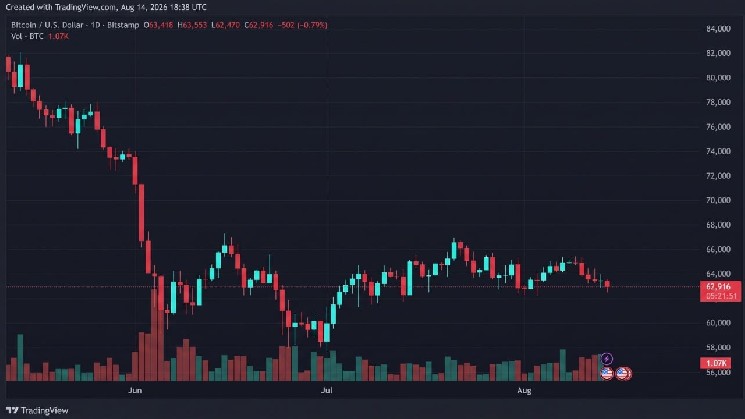
Bitcoin Price Drops to $62,470 as Sellers Retest $63,000 Support Level

Bitcoin's price fell below $63,000 for a second consecutive day on Friday, hitting an intraday low of $62,470. The cryptocurrency later recovered to trade just above $63,000, leaving it nearly flat for the past 24 hours and for August overall, with a weekly loss of 2.6%. The volatility triggered significant liquidations, with $26 million of leveraged long Bitcoin positions liquidated over 24 hours. Market sentiment was further dampened by data showing over $131 million in outflows from spot Bitcoin ETFs for a second straight day, signaling a potential pullback by institutional investors. Adding to the negative pressure, index provider MSCI has proposed new criteria for "non-operating companies" in its global indexes, which could lead to the exclusion of firms holding significant digital assets like Bitcoin on their balance sheets. Companies such as Strategy and Metaplanet could be affected, potentially forcing index-tracking funds to sell their shares. Strategy publicly criticized the proposal, arguing digital assets are legitimate assets and index providers should not dictate what companies can own. Public consultations on MSCI's proposal end September 30, with a final decision expected by October 16. If approved, exclusions could begin in November, potentially triggering sustained institutional selling and damaging a key bridge for Bitcoin adoption in the corporate sector.

cryptonews.ru1h ago

Bitcoin Price Drops to $62,470 as Sellers Retest $63,000 Support Level

cryptonews.ru1h ago

Trading

Spot

Hot Articles

Discussions

Welcome to the HTX Community. Here, you can stay informed about the latest platform developments and gain access to professional market insights. Users' opinions on the price of AI (AI) are presented below.

活动图片