Hyperliquid First Discloses HIP-4 Permissionless Deployment Specifications: Threshold Aligns with HIP-3, but Adds a Template Approval Layer

Foresight NewsPublished on 2026-07-20Last updated on 2026-07-20

Abstract

Hyperliquid founder Jeff Yan announced plans for permissionless deployment of HIP-4 outcome markets in a future network upgrade, moving from testnet to mainnet. This follows the initial, validator-voted deployment phase on mainnet that began in May. The announcement details key mechanisms for the permissionless phase. The staking requirement is set at 500,000 HYPE (locked for 6 months), matching HIP-3. A core new feature is a "template system": validators will vote on and store standardized market templates on-chain, and deployers can only create markets by instantiating these pre-approved templates. This aims to ensure market quality and clarity. Deployers will also have an initial quota of 100 outcomes (200 tokens), which refreshes after settlements. The reasoning for permissionless deployment is the vast potential universe of tradable events for prediction markets, which far exceeds the finite assets available for perpetual contracts. While HIP-4 has seen $370M in volume over 78 days, its market share remains small compared to established players. The model mirrors HIP-3's successful expansion of perpetual contracts after opening deployment. Rules include slashing stakes for unclear definitions or incorrect/delayed settlements. This incentivizes short-duration markets, as long-term settlements would lock capital and quota for extended periods. The template system addresses definition clarity but does not prevent potential liquidity fragmentation or market concentration,...


Author:angelilu, Foresight News


Hyperliquid founder Jeff Yan posted an announcement about HIP-4 on his Discord, stating that outcome markets will support permissionless deployment in an upcoming network upgrade, first on testnet and then on mainnet.


The wording of the announcement is that, just like the deployment of spot and perpetual contracts, this outcome markets technology needs to undergo sufficient real-world testing in an environment deployed by validators before it can be expanded to permissionless deployment.
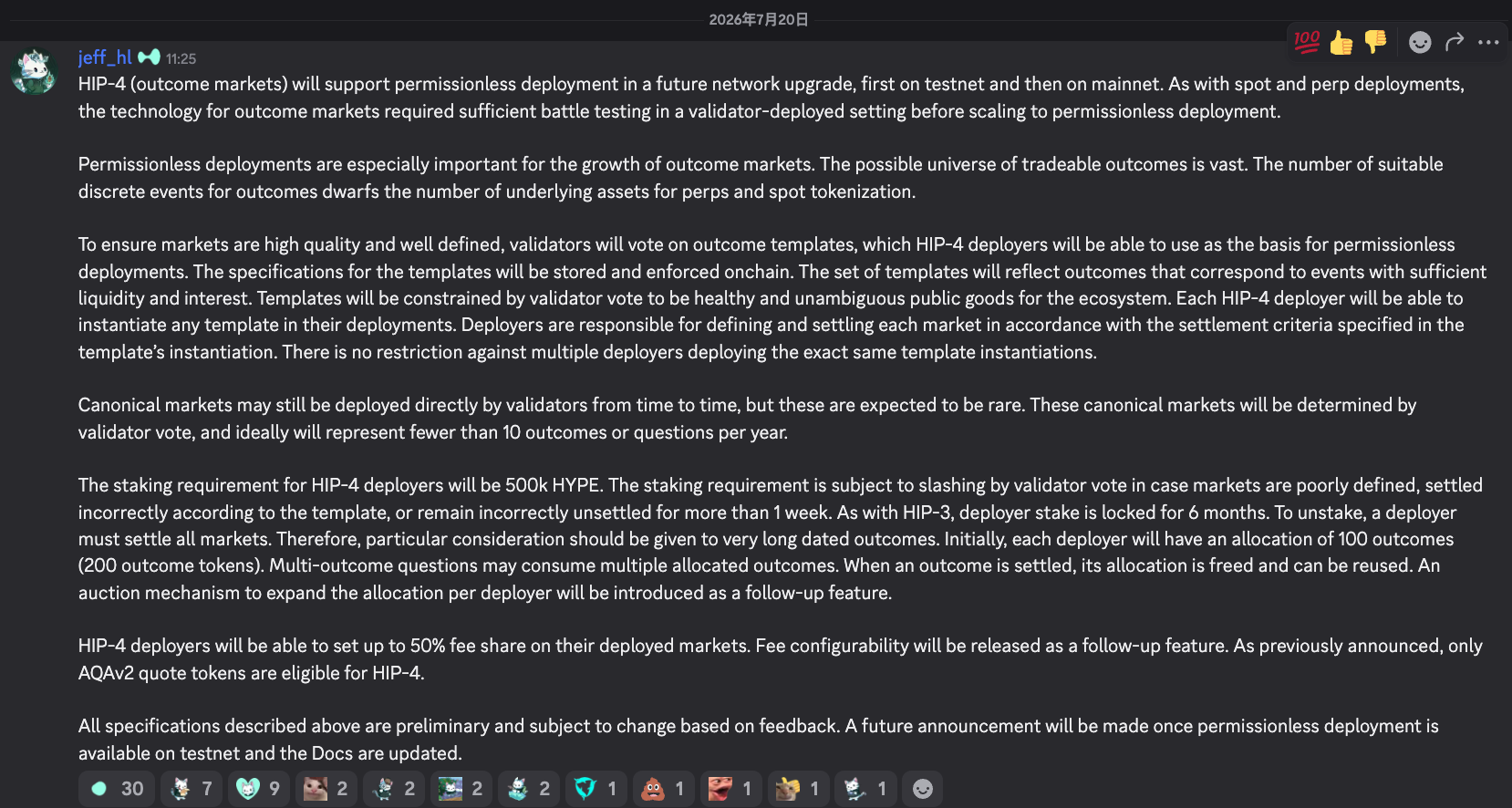


The announcement did not give a specific date and noted at the end that all specifications are preliminary and may be adjusted based on feedback. However, it disclosed a set of mechanism details that had not been made public in detail before.


What Stage Has HIP-4 Reached Now?


On February 2, 2026, the Hyperliquid team announced HIP-4, introducing a new primitive called "Outcome Trading." According to the official documentation definition, outcome contracts are fully collateralized, with settlement prices falling within a fixed range. They are suitable for prediction markets and bounded option-like instruments, introducing nonlinear characteristics and dated contracts, and involve no leverage or liquidation. Each outcome market has two directions, each corresponding to a token, typically labeled Yes and No, with their order books merged to share liquidity. A "question" is a collection of outcomes, where exactly one outcome will settle as Yes.


In the same month, HIP-4 went live on testnet. On May 2nd, it officially launched on mainnet, with the first market being a cyclic binary outcome market, settling daily at 06:00 UTC based on the BTC mark price on HyperCore, with zero fees for opening positions. Subsequently, Hyperliquid extended outcome markets to off-chain events, with the first off-chain market being "May CPI YoY."


However, this mainnet phase is "validator-deployed." Which markets to open are decided by validator votes, and external parties cannot launch markets themselves. Therefore, this new announcement is about the upcoming next phase.


Why Is Permissionless Deployment Necessary?


The reason given by Hyperliquid founder Jeff Yan in the announcement is straightforward: within outcome markets, the universe of tradable outcomes is extremely vast. The number of discrete events suitable for outcome contracts far exceeds the number of underlying assets for perpetual contracts and spot tokenization. The underlying assets for perpetual contracts are finite - coins, stocks, commodities, indices - they can be counted. However, real-world events that can be bet on are infinite. Relying on validators to vote on listing them one by one can never keep up with supply and demand.


To understand the urgency of permissionless deployment, one must first look at the actual performance of HIP-4 on mainnet over these two and a half months.


Over 78 days since HIP-4 launch, cumulative trading volume reached $370 million, with a cumulative number of trades reaching 7 million. The peak daily volume occurred on June 27th, at $12.96 million.

https://hl.eco/hip4
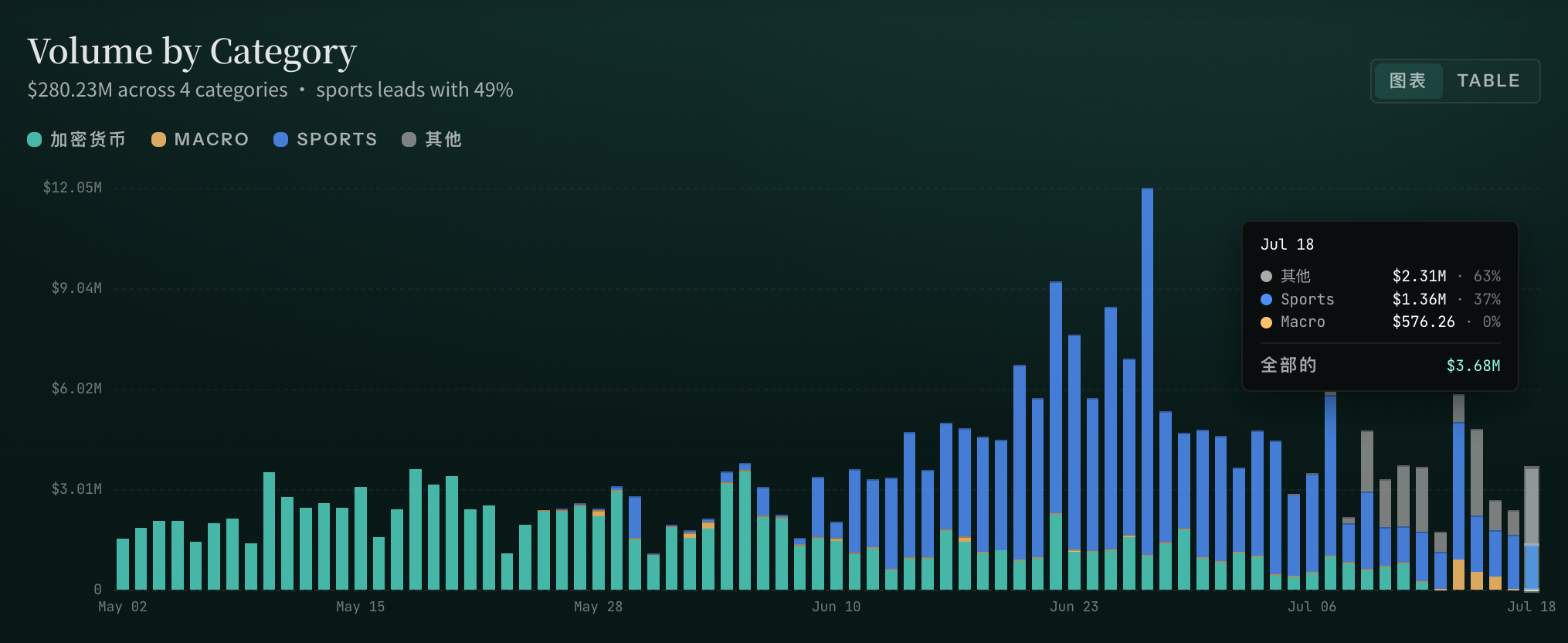

From May 2nd to early June, trading was almost entirely from cryptocurrency categories, with daily volume between $1 million and $3.5 million. When the World Cup started on June 11th, sports categories instantly took over, pushing volume to three to four times the previous baseline.
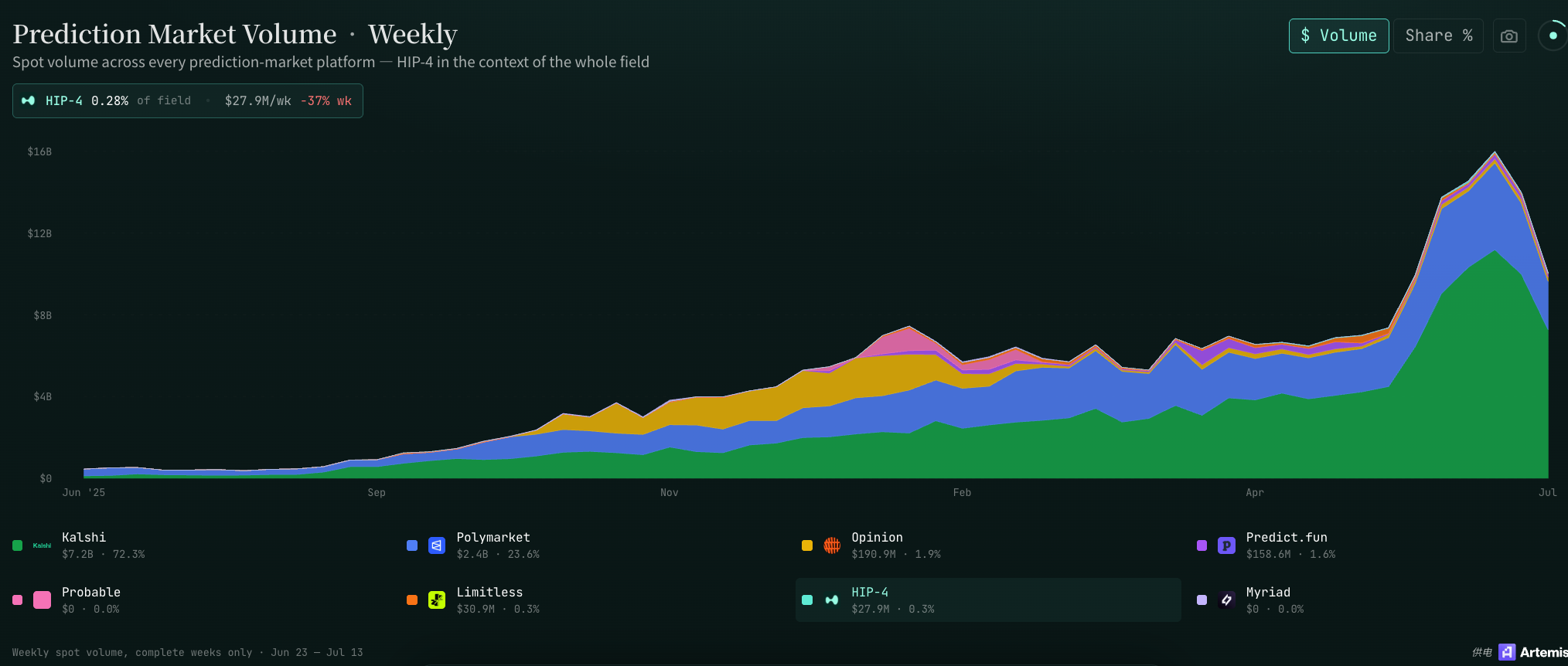


The figures from competitors during the same period are of another order of magnitude. Taking weekly data as an example, for the week of July 13th (during the World Cup), the weekly trading volumes for Kalshi and Polymarket were $7.2 billion and $2.4 billion respectively, while HIP-4's trading volume was $27.9 million. HIP-4's market share in prediction markets was only 0.3%.


But this logic has already been successfully validated once on Hyperliquid. HIP-3 allowed anyone to deploy perpetual contract markets after staking HYPE. It launched on October 13, 2025, and subsequently listed Nvidia, Tesla, gold, crude oil, S&P 500, and other underlying assets.


According to HIP-3 Ecosystem data, as of the time of writing, HIP-3's historical trading volume is $387.72 billion, and open interest has grown from about $790 million in January 2026 to $3.43 billion in July; HIP-3's share of Hyperliquid's trading volume reached 47.2% at the time of writing. Opening up the supply side indeed brought explosive growth.


Several New Mechanisms for HIP-4


Therefore, at the end of the World Cup, when all prediction markets are exploring new underlying assets, Hyperliquid announced several new mechanisms for HIP-4 at this time.
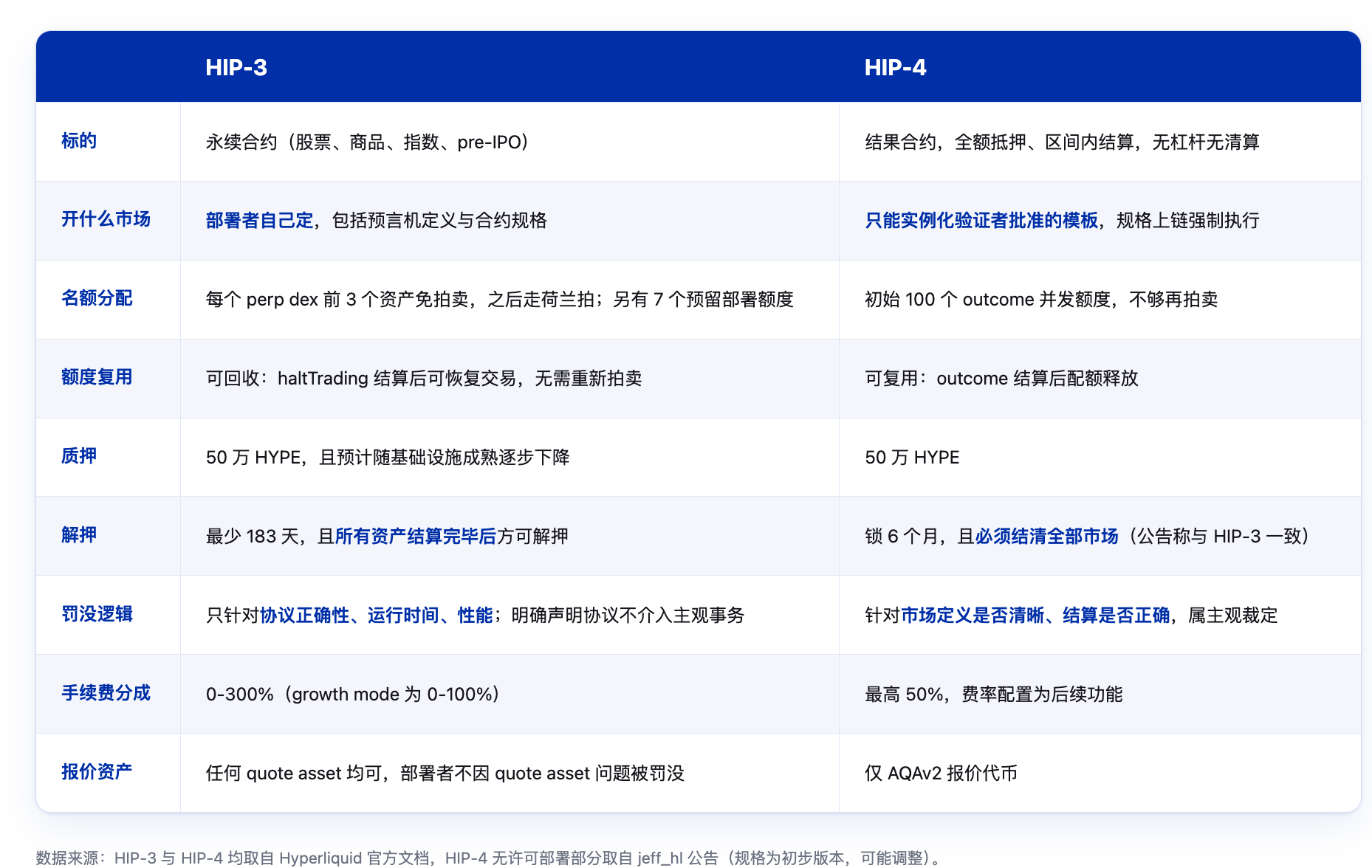


Staking Threshold is 500,000 HYPE Tokens


As for the staking threshold for HIP-4 deployers, this announcement is the first time Hyperliquid has publicly explained the staking requirements for HIP-4 permissionless deployment. Previously, community speculation placed the number at 1 million HYPE, twice that of HIP-3. This announcement states it's 500,000 HYPE, aligning with HIP-3. Staked tokens will be locked for 6 months and may be slashed if market definitions are unclear or settlements are delayed.


Template System


The template system is the core of this design. To ensure market quality and clear definitions, validators will vote on "outcome templates." Template specifications are stored on-chain and enforced. HIP-4 deployers can only perform permissionless deployment based on these templates, filling in parameters themselves to instantiate specific markets. The announcement requires that templates must be "healthy and unambiguous public goods for the ecosystem" and that corresponding events must have sufficient liquidity and attention. Deployers are responsible for defining and settling each market according to the settlement criteria specified when instantiating the template. The announcement explicitly does not restrict multiple deployers from deploying identical template instances.


Why add this layer? It's related to the product form. Perpetual contracts have continuous prices; if the market is off, it corrects itself. Outcome contracts settle at a definite value upon expiration; once the settlement is judged incorrectly, money is directly awarded to the wrong side.


Quota System


The quota system is another new element. Each deployer is initially allocated 100 outcomes (200 outcome tokens). One outcome corresponds to YES and NO two tokens. Multi-outcome questions consume multiple outcomes; for example, a five-choice question is split into five binary outcomes, occupying five. The quota is released and can be reused after an outcome settles; this is a concurrent upper limit, not a lifetime limit. The announcement states that an auction mechanism will be introduced later to expand an individual deployer's quota.


Slashing and Locking


Slashing and locking determine what this market will ultimately become. Stakes can be slashed by validator vote for three reasons: unclear market definition, failure to settle correctly according to the template, and failure to settle correctly for over a week. As with HIP-3, deployer stakes are locked for 6 months, and all markets must be settled before unstaking. The announcement itself warns that special caution is needed for very long-term outcomes.


The consequence of this rule is very practical. Launching a market that settles two years later means 500,000 HYPE is locked for two years, and the quota is also occupied the entire time. Rational deployers will only create markets with short cycles and frequent settlements. The difference in product form between HIP-4 and Polymarket is not entirely a strategic choice; it's also a result pushed by the mechanism.


Additionally, deployers can set up to 50% fee share for the markets they deploy; fee rate configuration will be released as a subsequent feature; only AQAv2 quote tokens can be used for HIP-4; validators may still occasionally deploy outcome markets directly, but it is expected to be very rare, aiming for fewer than 10 outcomes or questions per year.


Issues Not Addressed by the Template System


From the HIP-3 experience, there are aspects worth HIP-4 being cautious about.


hl.eco shows HIP-3 currently has 8 active deployers and 204 markets, but Trade.XYZ alone accounts for over 90% of all HIP-3 open interest. Some analyses indicate that this high concentration by a single deployer may constitute a structural/centralization risk for Hyperliquid.
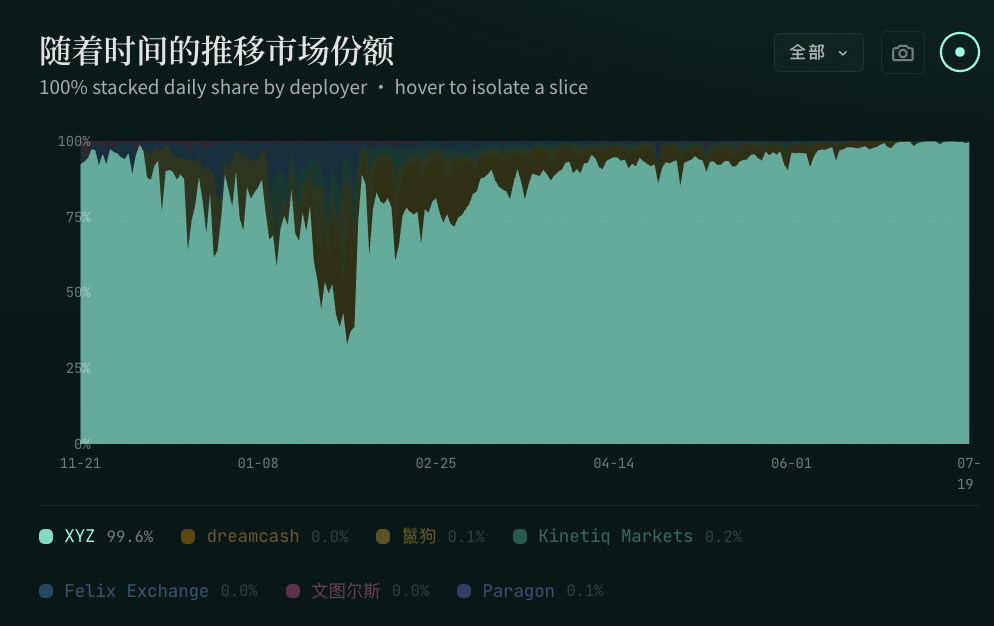


The template system in these new HIP-4 rules governs market quality, not market share. Where users trade depends on depth. HIP-4 explicitly allows multiple deployers to instantiate identical templates, which sounds like encouraging competition. However, if the same question is opened as five identical markets, liquidity will only be further fragmented, ultimately still converging towards the deepest pool.


Trending Cryptos

Related Questions

QWhat is the main announcement regarding HIP-4 made by Hyperliquid founder Jeff Yan?

AJeff Yan announced that Outcome Markets (HIP-4) will support permissionless deployment in an upcoming network upgrade, first on testnet and then on mainnet. This will allow external users to deploy their own markets.

QWhat are the two key reasons provided in the article for HIP-4 needing permissionless deployment?

AFirst, the universe of tradable outcomes for prediction markets is vast and practically infinite, far exceeding the finite number of underlying assets for perpetual contracts. Second, the success of HIP-3's permissionless deployment for perpetual contracts demonstrated that opening up the supply side leads to explosive growth.

QWhat is the staking requirement for a HIP-4 deployment, and how does it compare to HIP-3?

AThe staking requirement for HIP-4 permissionless deployment is 500,000 HYPE, which is the same as the requirement for HIP-3. The staked tokens will be locked for 6 months and are subject to slashing for issues like unclear market definitions or delayed settlements.

QWhat is the 'template system' for HIP-4, and what is its primary purpose?

AThe template system requires validators to vote on and approve 'outcome templates' which are stored on-chain. HIP-4 deployers can then use these approved templates to create specific markets by filling in parameters. Its purpose is to ensure market quality, definition clarity, and that events have sufficient liquidity and attention.

QAccording to the article, what is a potential issue that the new HIP-4 rules do not solve, based on experience with HIP-3?

AThe new rules, including the template system, focus on market quality but do not address the potential problem of market concentration. Similar to HIP-3 where a single deployer dominates the open interest, liquidity in HIP-4 might still consolidate into a few deep markets even if multiple identical markets are allowed, leading to fragmented liquidity.

Related Reads

The Most Difficult Thing to Predict on Polymarket Is... When the POLY Airdrop Will Happen

During the recent World Cup, Polymarket saw record-breaking activity, with its "World Cup winner" market reaching $4.32 billion in volume, making it the platform's highest-volume single prediction event ever. Over the six-week tournament, football markets amassed $85 billion in nominal trading volume, cementing sports as a major growth driver. Capitalizing on this surge in traffic, Polymarket quietly increased fees for its sports markets in early July. The taker fee multiplier was raised from 0.03 to 0.05, effectively raising maximum costs per trade by nearly 70% and moving sports out of its lowest fee tier. This follows a broader trend of the platform gradually expanding fee structures across various market categories since the start of the year to boost revenue. However, community focus is increasingly shifting from trading volumes to the long-awaited POLY token airdrop. Despite a senior executive confirming in late 2025 that a token and airdrop were planned for after U.S. market re-entry, no timeline has been provided. Recent actions, like an affiliated account deleting a potentially suggestive tweet and official help pages stating "no airdrop or token generation event has been announced," have fueled speculation and frustration. The community is divided on the reasons for the delay. Some believe Polymarket is waiting for a more favorable regulatory window in the U.S., while others speculate that the platform's strong organic growth and rising fee revenue have reduced the urgency to issue a token, potentially following a path similar to OpenSea. The prolonged uncertainty has led users to question not the *if*, but the *when*, of the POLY airdrop, turning it into one of the platform's most unpredictable events.

Odaily星球日报5m ago

The Most Difficult Thing to Predict on Polymarket Is... When the POLY Airdrop Will Happen

Odaily星球日报5m ago

After Investing in Changxin, Hefei State Capital Makes Another Move

Two events unfolded within the same week. On July 13th, the Hefei Industrial Investment Xinzhi Xinyu Equity Investment Partnership with a pledged scale of 5 billion RMB was established. Three days later, ChangXin Technology launched its online and offline public offering at a price of 8.66 RMB per share, aiming to raise approximately 57.9 billion RMB. The link between these events is the Hefei Industrial Investment Group (Hefei ChanTou). Hefei ChanTou directly holds shares in ChangXin Technology through its wholly-owned subsidiary, ChangXin Integration, and is also behind the newly established 5 billion RMB fund. This highlights a strategic move: as ChangXin approaches its IPO, Hefei ChanTou establishes a new fund to prepare for the next round of industrial investment. Founded in 2015, Hefei ChanTou is a state-owned capital investment platform focused on industrial financing and innovation. Beyond direct equity holdings in major projects like ChangXin's 12-inch memory wafer manufacturing base, it manages various provincial and municipal government-guided funds. Its self-managed fund scale exceeds 100 billion RMB. ChangXin Technology, now China's leading DRAM manufacturer, exemplifies the classic "Hefei model." A decade ago, when founder Zhu Yiming sought entry into the capital-intensive DRAM sector, Hefei's state capital provided the crucial long-term support. Pre-IPO, entities within the Hefei ChanTou system hold significant direct and indirect stakes, with a theoretical combined value of roughly 116.2 billion RMB based on the IPO price. However, this long-cycle, concentrated investment model brings financial pressure. Hefei ChanTou's financials show significant liabilities, net outflows from investing activities, and reliance on investment income. The focus is now shifting alongside Hefei's broader "654X" industrial system, which encompasses six dominant industries, five emerging industries (like AI and biopharma), and four future industries (including quantum tech and nuclear fusion). The narrative is one of transition. As the ChangXin project reaches a major milestone with its IPO, the new 5 billion RMB fund symbolizes the beginning of the next investment chapter—targeting a more diverse and early-stage array of sectors within Hefei's expanded industrial vision.

marsbit15m ago

After Investing in Changxin, Hefei State Capital Makes Another Move

marsbit15m ago

Should Developers Build on Corporate Blockchains Like Base and Robinhood?

Should developers build on enterprise-backed public chains like Base, Robinhood, or Stripe's Tempo? While these chains offer enticing benefits—primarily access to the platform's existing user base for accelerated growth—they come with significant, well-documented risks stemming from the inherent conflict of interest when a company controls both the underlying chain and major on-chain applications. The core promise is traffic distribution: projects gain exposure through platforms like the Coinbase wallet or app. However, this model creates five major risks: 1. **Direct Competition**: The platform can leverage its data and position to launch and prioritize its own competing products, similar to Amazon creating private-label goods or Microsoft bundling Internet Explorer. 2. **Wallet Agnosticism**: Companion wallets (e.g., Coinbase Wallet) must support multiple chains and integrate top applications across the ecosystem to remain competitive, diluting the promised exclusive traffic advantage for the enterprise chain. 3. **Competitor Exclusion**: Rival platforms (e.g., Coinbase vs. Robinhood) have no incentive to promote applications built on a competitor's chain. 4. **Profit Extraction**: The party controlling end-users holds disproportionate bargaining power and can capture most of the value, squeezing protocol profits down to marginal cost. 5. **Unfulfilled Promises**: Promised traffic support can be deprioritized or withdrawn based on shifting corporate strategies. In contrast, neutral chains like Ethereum or Solana avoid these platform risks entirely. For developers considering enterprise chains, risk mitigation strategies include: evaluating substantial onboarding grants, seeking (though often weak) contractual guarantees, and, most crucially, pursuing a multi-chain strategy while building independent user acquisition channels. Enterprise chains may be useful for initial cold-start growth, but the ultimate goal should be cultivating a dedicated user base rather than long-term dependence on a single, conflicted platform.

marsbit16m ago

Should Developers Build on Corporate Blockchains Like Base and Robinhood?

marsbit16m ago

Trading

Spot

Hot Articles

How to Buy 4

Welcome to HTX.com! We've made purchasing 4 (4) simple and convenient. Follow our step-by-step guide to embark on your crypto journey.Step 1: Create Your HTX AccountUse your email or phone number to sign up for a free account on HTX. Experience a hassle-free registration journey and unlock all features.Get My AccountStep 2: Go to Buy Crypto and Choose Your Payment MethodCredit/Debit Card: Use your Visa or Mastercard to buy 4 (4) instantly.Balance: Use funds from your HTX account balance to trade seamlessly.Third Parties: We've added popular payment methods such as Google Pay and Apple Pay to enhance convenience.P2P: Trade directly with other users on HTX.Over-the-Counter (OTC): We offer tailor-made services and competitive exchange rates for traders.Step 3: Store Your 4 (4)After purchasing your 4 (4), store it in your HTX account. Alternatively, you can send it elsewhere via blockchain transfer or use it to trade other cryptocurrencies.Step 4: Trade 4 (4)Easily trade 4 (4) on HTX's spot market. Simply access your account, select your trading pair, execute your trades, and monitor in real-time. We offer a user-friendly experience for both beginners and seasoned traders.

4.8k Total ViewsPublished 2025.10.20Updated 2026.06.02

How to Buy 4

Discussions

Welcome to the HTX Community. Here, you can stay informed about the latest platform developments and gain access to professional market insights. Users' opinions on the price of 4 (4) are presented below.

活动图片