The AI industry is still primarily driven by large-scale infrastructure build-out, funded largely by debt. This is a key difference from the Internet bubble era, which relied mainly on equity financing.
The bursting of the Internet bubble in 2000 triggered a stock market crisis. If a future AI bubble bursts, the initial shock would likely occur in the bond market. However, this doesn't mean the stock market would be immune, as the 2008 financial crisis was ignited by the subprime mortgage crisis.
The difference lies in the speed of the collapse.
The 2000 dot-com bust involved a valuation collapse—a linear process with massive daily trading volume, allowing investors to sell at any time. A bear market could last years. Equity is patient capital; investors can hold on, waiting for companies to recover.
In contrast, debt exhibits negative convexity. No matter how well a company performs, creditors only receive fixed interest payments. But if performance deteriorates, they face potentially unlimited losses. Therefore, debt covenants have binary, hard triggers—it's either 0 or 1, with no middle ground. Either a company can successfully refinance, appearing as if nothing is wrong, or it can quickly face asset seizures, with bond prices plummeting to zero in days.
A simple example: the accounting figure "Remaining Performance Obligations" (RPO). An equity investor might treat it as future revenue and assign some valuation. But a debt investor would scrutinize who will fulfill these future orders and how.
The current debt chain in AI infrastructure roughly follows this pattern:
Leading AI labs like OpenAI sign contracts with Microsoft, committing to pay hundreds of billions over several years for computing power. However, OpenAI lacks sufficient cash, so this is essentially a "financed order," similar to an airline's aircraft leasing financing.
The major cloud providers, data centers, and computing leasing companies then use these contracts as collateral to borrow from private institutions, raising funds for data center construction and GPU procurement.
Stripping away the AI hype, AI infrastructure is essentially a chain of credit leverage. Financial institutions advance capital for buildings full of chips, with data centers as collateral and AI lab contract payments as debt service. This structure functions only if the AI labs at the order's origin can continuously fund these payments.
But for an unprofitable company, where revenue (ARR) is less than expenditure (orders), it must rely on constant fundraising to survive.
If you were a bond analyst, seeing a company losing tens of billions annually, surviving only through continuous refinancing, these "remaining performance obligations" are essentially subprime commitments used to justify massive, not-yet-depreciated capital expenditures.
Naturally, this brings to mind the subprime mortgage crisis that triggered the 2008 financial crash.
In just a few years, OpenAI has committed to unprecedented computing costs, with total debt potentially reaching trillions—unprecedented in corporate history. Roughly half of the approximately $2.1 trillion in backlogged contracts held by the top five cloud platforms are commitments from OpenAI and Anthropic, an unprecedented level of concentration.
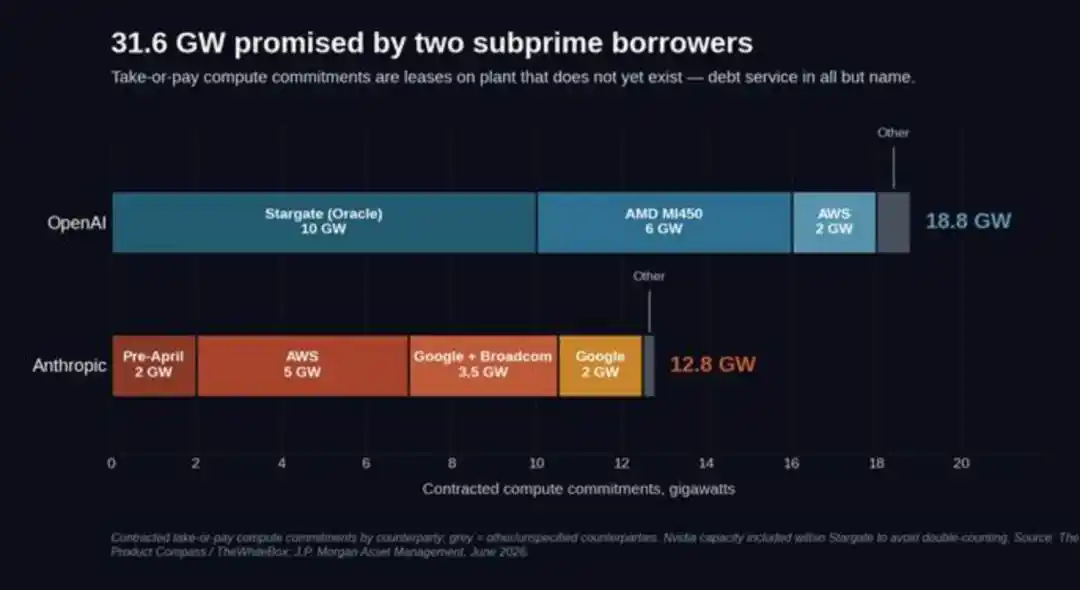
Corresponding to this debt is an operational business with unpredictable profitability. While its revenue is real, large, and growing rapidly, its only hope for success is continuously finding explosive growth avenues like coding. This is a century-spanning gamble dragging even tech giants into the fray.
Thus, the true root of this potential crisis is that AI, as a technological revolution, is being funded through a very traditional, credit-driven real estate finance model.
Yes, AI infrastructure is essentially real estate. That's why, after studying the 2000 dot-com bust in the previous piece "The Last 120 Days of the Tech Bubble," we now examine 2008.
2/4
The Real Estate Core of the AI Industry
Technological revolutions and real estate cycles should be worlds apart.
Tech revolutions are driven by innovation and adoption rates, high-risk with high potential rewards upon success, making them most suitable for equity financing like venture capital.
Real estate cycles are mechanical, value determined by land and space, with fixed profits. Future income can be locked in via commercial leases or pre-sales. Long investment horizons and massive capital requirements make them most suitable for debt financing.
But scrutinizing AI infrastructure reveals its every characteristic mirrors real estate development:
Building data centers on approved land requires massive upfront investment, necessitating debt financing from the start—akin to a development loan.
Then, signing "take-or-pay" contracts with large clients and using these contracts as collateral for more funding—akin to later-stage project financing.
"Take-or-pay" contracts: e.g., an AI company commits to buying $100 million in computing power annually for 5 years. Even if model training demand is lower or user growth lags, payment is mandatory. This is because data center investment is huge; builders need predictable future cash flow. It's similar to office towers or malls securing anchor tenants before applying for bank loans.

It doesn't end there. After purchasing and installing GPU racks, cloud providers mortgage them for GPU financing to support operations—akin to commercial real estate operational loans.
But the financing value isn't fully extracted. The final step for cloud providers and data centers is issuing "Asset-Backed Securities" (ABS), packaging future cash flows to sell to insurers, pension funds, and other conservative investors—somewhat similar to real estate REITs.
ABS-packaged assets were precisely what allowed subprime mortgage risks to spread from real estate to the entire financial system.
This is essentially the universal playbook for all capital-intensive industries: using layered collateral, packaging future cash flows, and completing construction with leveraged funds. It has nothing to do with being a tech company or a technological revolution.
But applying this to cutting-edge tech like AI creates problems.
Both real estate and tech experience bubbles, but their causes are entirely different.
Tech bubbles stem from new technologies being too far ahead of their time or lacking large-scale real demand, causing their value to plummet.
Real estate bubbles result from cyclical mismatches. Investment peaks typically occur during economic booms, with financing amounts based on linear extrapolations of boom-time cash flows. Long construction cycles mean projects often become operational when the market is already oversupplied, generating insufficient cash flow to service debt, triggering a crisis.
The associated risks are also completely different:
The primary risk in tech investment is product failure. High upfront R&D costs, but high barriers if successful.
The risk in real estate investment lies on the balance sheet—leverage risk. Land value depends on location, fluctuating but rarely disappearing entirely, with slow depreciation. The key is that leverage doesn't break before the next cycle arrives.
Therefore, "AI + infrastructure" is even more dangerous, combining the inherent technology risk of tech investment with the leverage risk of real estate. Its data centers are specialized assets with limited alternative uses. The mortgaged GPU clusters face rapid technological obsolescence, potentially losing significant value in just two years. ABS assets packaged from AI operating income are based on theoretical future revenue.
Moreover, amid the "arms race" of capital expenditure, the current financing pace mirrors real estate bubble dynamics. Assuming AI computing demand grows 50% annually, financing is also based on this cash flow projection.
This is similar to land auctions in recent years: with nearby二手房 (secondary housing) at 100,000 per square meter, developers dared bid 120,000 for land, believing prices would rise to 120,000 by project completion.
Cloud providers are increasingly becoming real estate companies in the computing business, at least in their financial structure, rather than traditional internet firms.
Of course, this risky financing game persists mainly because the top five cloud providers are among the world's highest-valued companies, each with a core business generating massive cash flow. Investors don't believe these tech giants could face a debt crisis.
But consider: why was China Vanke long considered a premium blue-chip stock in the A-share market? Because real estate's primary risk stems from debt, even off-balance-sheet debt. They rarely raise equity and compensate shareholders with high dividends (essentially a small compensation for high leverage). Their risk is non-linear: as long as debt doesn't blow up, they remain premium blue-chips; once debt implodes, they become worthless overnight.
We must understand that debt accumulation is a linearly increasing mathematical process. Greater strength only means a longer pre-crisis period. Technological revolution is a non-linear process, potentially accelerating suddenly or stalling abruptly. Expecting the latter to solve the former's problems is like assuming the hare, prone to naps, will always win the race against the tortoise.
Bond investors are the world's most pessimistic group. They become alert when the second derivative of growth declines, never waiting for the hare to fall asleep.
3/4
Why the Second Derivative Matters More
Conventionally, the 2008 subprime crisis is attributed to lax lending standards, falling home prices causing borrowers to become underwater, subsequent defaults, and the eventual blow-up of ABS securities based on these loans.
In reality, default rates began rising while home prices were still increasing, just at a slower pace. This is positive first-derivative growth, but a declining second derivative (rate of growth).
This relates to the mechanics of subprime mortgages. Borrowers enjoyed extremely low "teaser" rates for the first three years, making payments affordable. After three years, if home prices had risen, borrowers could refinance based on the increased equity, securing a new low teaser rate and restarting the cycle. Nearly four-fifths of subprime hybrid adjustable-rate mortgages issued in 2003 were refinanced by late 2006.
But this game required one premise: home prices must perpetually rise, ensuring loans never reached the interest rate reset point, or borrowers couldn't afford the payments.
By 2006, home prices were still rising, but the growth rate had slowed compared to previous years. This meant prices had stagnated in some areas. Some households couldn't refinance and couldn't afford the reset rates. Subprime loan delinquency rates began rising precisely then.
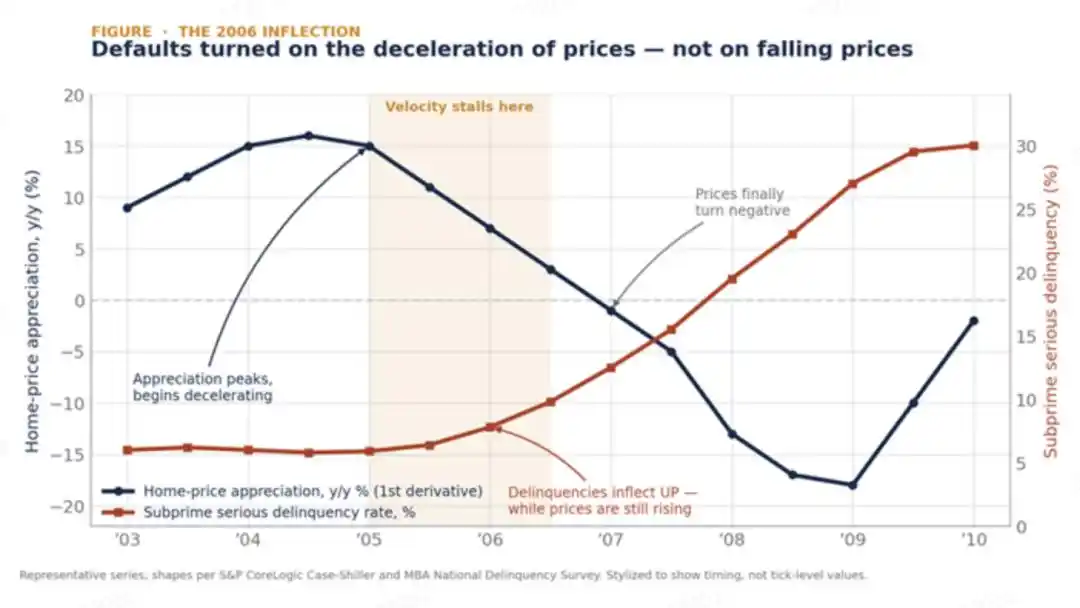
There exists a "borrowed time window" between the decline of the second derivative and the first derivative turning negative. During this window, everything appears rosy—revenue at record highs, growth still positive. Yet, a future crisis has already become inevitable.
Here, we can introduce Hyman Minsky's financial instability hypothesis. Minsky argued that "stability is destabilizing." Long periods of economic prosperity foster overly optimistic expectations, gradually shifting financing structures from robust to highly leveraged, refinance-dependent models, ultimately triggering a "Minsky Moment."
Based on a firm's debt-servicing ability, Minsky categorized financing into three regimes:
1. **Hedge financing:** Operating cash flow is sufficient to cover both principal and interest payments.
2. **Speculative financing:** Cash flow covers only interest, not principal. The firm must continuously roll over debt.
3. **Ponzi financing:** Operating cash flow is insufficient to cover even interest payments.
A decline in the second derivative of demand growth corresponds to a shift from Regime 1 to Regime 2. The first derivative turning negative signifies a full transition to Regime 2, making it difficult for the firm to return to Regime 1 through its own efforts.
Examining the top five cloud providers' Q2 reports reveals three categories:
Google and Amazon's free cash flow has turned negative, meaning AI capex growth has temporarily outpaced core business cash flow growth. They have just entered Regime 2 this quarter.
Microsoft and Meta remain in Regime 1, but risk entering Regime 2 soon if capex isn't controlled.
Oracle has long been a Regime 2 firm. Its debt service coverage ratio (present value of debt principal & interest / operating cash flow) is only 48%, resembling a capital-intensive real estate company more than a high-tech firm.
、
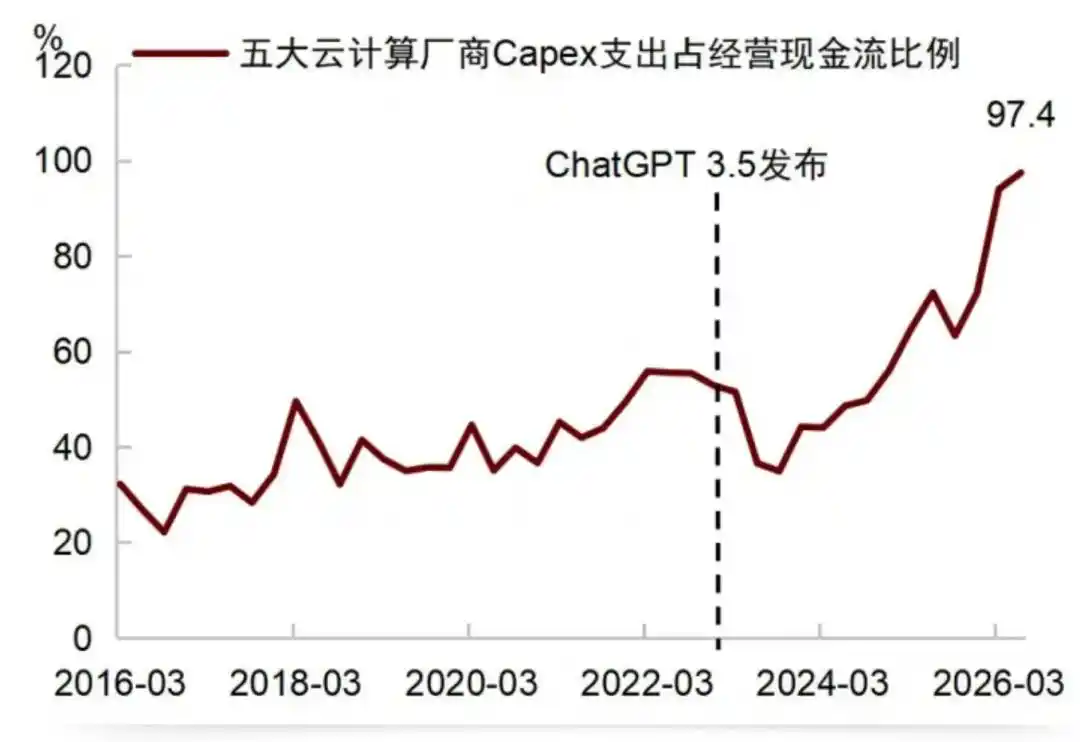
The conclusion is stark: when capital expenditure exceeds 100% of operating cash flow, further accelerated expansion means borrowing more money at an even faster pace each quarter. Over the next year, hyperscale cloud providers must dramatically increase debt issuance. The entire AI infrastructure build-out will become entirely dependent on the bond market for marginal funding.
The situation might be worse than these numbers suggest. AI infrastructure shares another trait with real estate: much of its debt is hidden off-balance-sheet as "shadow loans."
4/4
Shadow Loans
A report from the Bank for International Settlements notes that large cloud providers are rapidly increasing their use of "shadow loans" to finance AI data centers.
"Shadow lending" often occurs via private credit. For instance, a large cloud provider might first establish a Special Purpose Vehicle (SPV) or joint venture with a consortium to acquire or build data center assets, holding only a minority stake. The cloud provider commits to long-term operating leases or computing power purchase agreements and provides credit guarantees. Debt is serviced by lease cash flows.
This risk mirrors off-balance-sheet project financing by real estate companies. If, upon completion, AI computing demand is insufficient to cover long-term lease costs, the guaranteed contingent liabilities will surface, creating new debt.
Some institutions estimate this implicit debt at approximately $1.65 trillion. While these cloud providers emphasize that their cloud service backlogs remain ample and, if fulfilled as planned, should cover related lease liabilities, we have already analyzed what "unfulfilled orders" represent.
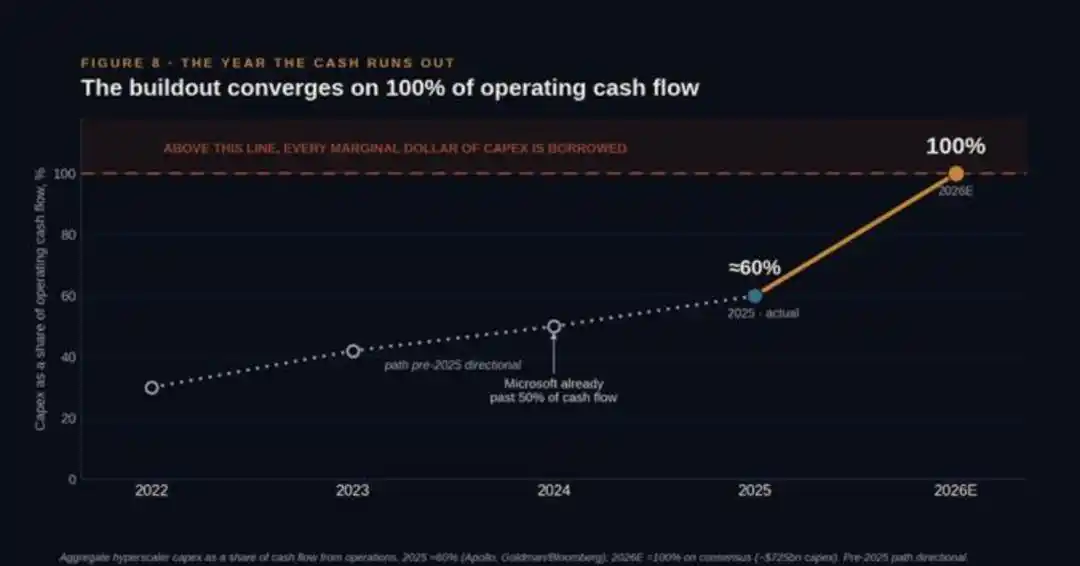
In summary, starting this year, with continued AI capex expansion, the financing structure of the top five cloud providers is shifting. Their financing mode is transitioning from internal to external funding, marking a metamorphosis from tech companies to real estate entities. They now possess "the capital intensity of real estate" and "the rapid depreciation of semiconductors," yet are still valued as tech stocks.
The Minsky Moment hasn't arrived, but a "financing migration" in the Minsky sense has begun. Most problems trace back to the two leading AI labs at the source. The next explosive demand will undoubtedly emerge, but the crucial factor is timing.
Finally, we return to the opening premise: don't conflate stock and bond risks.
Equity investors consider: Does AI have technological value? What future revenue and profits can it generate?
Creditors consider: Can the future cash flows from AI's massive fixed asset investments cover their capital costs?
AI's long-term risk is insufficient demand, but the mid-to-short-term accumulating risk is that the pace of capital expenditure is outstripping the pace of genuine cash flow generation.
In the next piece, I will analyze which of the two top AI labs is more vulnerable to crisis and identify the five most fragile moments when a debt crisis could emerge.
This article is from the WeChat public account "lig0624" (ID: sxgy9999), author: Thought Seal.