Progress in the field of artificial intelligence will give rise to a number of new use cases for public blockchains—from AI agent transactions to verifiable digital records. This opinion was shared by the head of Grayscale's research unit, Zach Pandl.
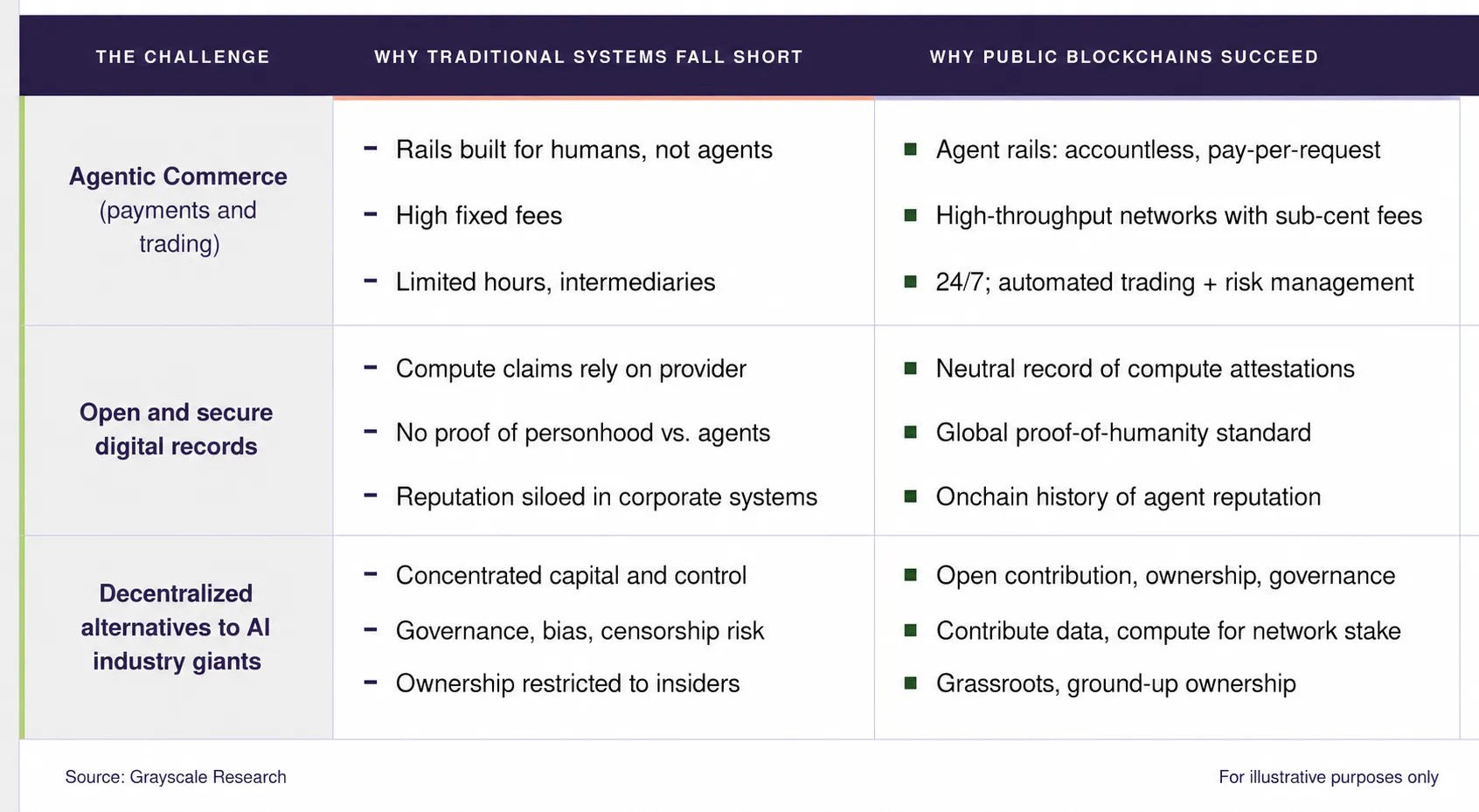
According to his assessment, the most obvious source of new demand is related to payments. Digital assistants that perform tasks on behalf of users need programmable wallets to independently store and spend funds.
The expert believes this will create a need for infrastructure for micropayments, cross-border settlements, automatic trading, and risk management. Pandl named Ethereum and Solana as suitable networks for this: open ledgers allow for programmable transactions 24/7.
Another direction is verifiable records of AI work. As more tasks are delegated to algorithms, companies will need to record which models, data, and rules were used in decision-making. According to the researcher, a public blockchain can serve as an independent ledger for such information.
A similar mechanism can also be applied to identifying people and digital agents and storing their reputation. Pandl named the project World as an example.
He named a third factor as the concentration of computational resources, capital, and control over AI in a small number of companies. An alternative could be decentralized networks where participants provide resources and participate in the ownership and governance of the infrastructure.
However, the practical utility of such a combination remains a subject of debate. In June, researchers from the IC3 consortium noted that many arguments about the benefits of blockchain for AI require additional proof. For example, an entry in a distributed ledger can confirm the existence of certain data at a specific moment, but it does not in itself prove the correctness of a model's operation.
Recall that in July, Franklin Templeton named AI agents as one of the potential drivers of crypto payments. The company noted that blockchain could be used for settlements between autonomous programs without constant human involvement.