Fields Medalist Hong Wang Has Also Published in NeurIPS

marsbitPublished on 2026-07-24Last updated on 2026-07-24

Abstract

A new recipient of the Fields Medal, mathematician Hong Wang, has also authored a NeurIPS paper. This research, presented at NeurIPS 2019, is a prime example of mathematics meeting machine learning. The work tackles the fundamental problem of low-rank matrix approximation, specifically analyzing the Column Subset Selection (CSS) algorithm. The key contribution was tightening the theoretical approximation bounds for CSS. The paper established new, sharper bounds dependent on the parameter *p* of the ℓ<sub>*p*</sub> norm: approximately *(k+1)<sup>1/p</sup>* for 1 ≤ *p* ≤ 2 and *(k+1)<sup>1-1/p</sup>* for *p* ≥ 2, improving upon the previous general *O(k+1)* bound. A crucial technical innovation was the application of the classical Riesz–Thorin interpolation theorem from harmonic analysis, a tool not commonly used in theoretical computer science at the time, to elegantly derive results across all *p*. Notably, this theoretical paper aligns with NeurIPS 2026's updated review guidelines, which explicitly value mathematical rigor and the introduction of tools from other disciplines. It demonstrates that NeurIPS contributions extend beyond novel neural architectures, encompassing deeper theoretical understanding. The paper underscores how foundational mathematical insights can provide elegant solutions to core problems in artificial intelligence.

Huh? The newly minted Fields Medalist, Hong Wang, once dabbled in AI?
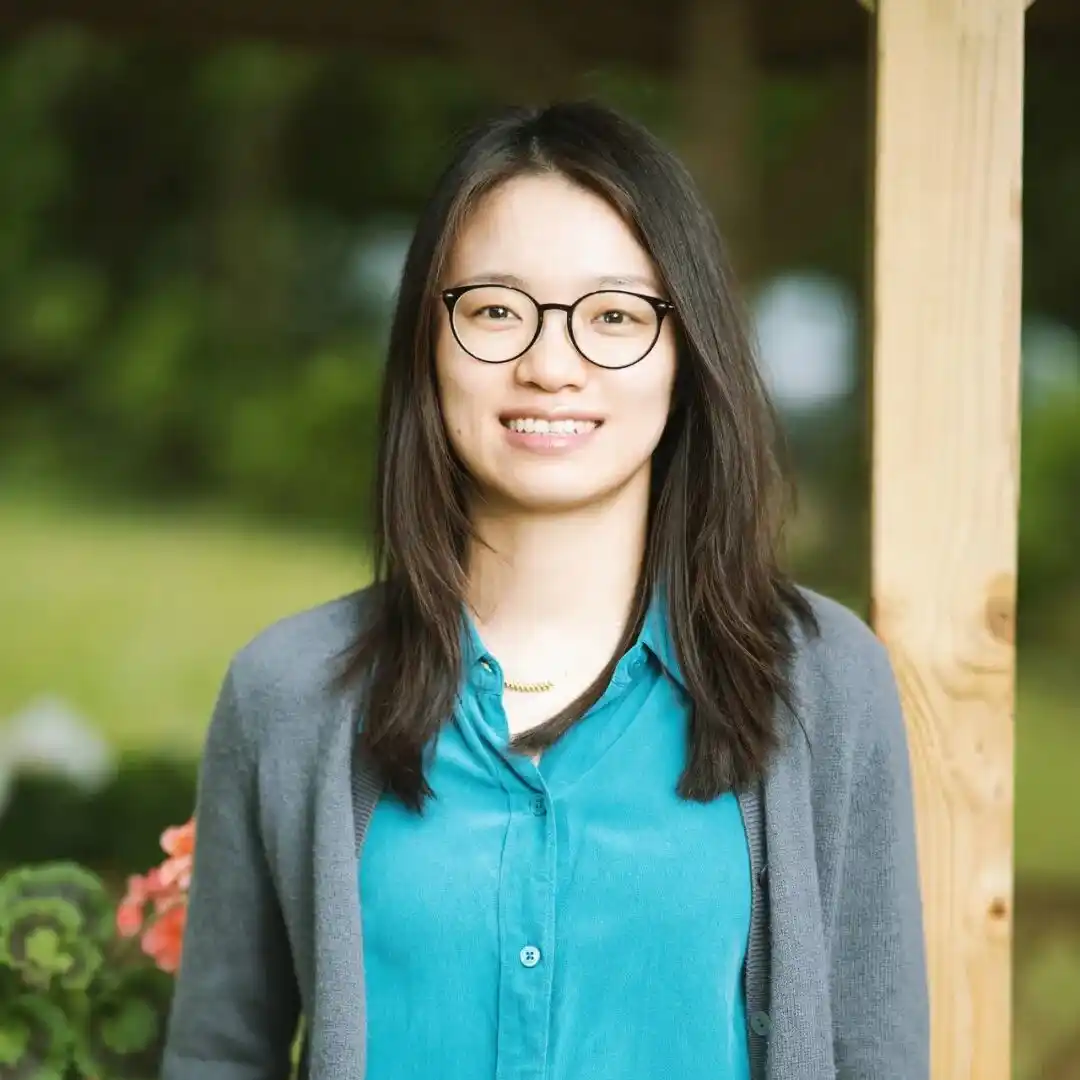
With NeurIPS 2026 reviews imminent, netizens dug up that Professor Hong Wang once co-authored a NeurIPS 2019 paper.

And it wasn't just a nominal credit; she was a veritable co-first author.
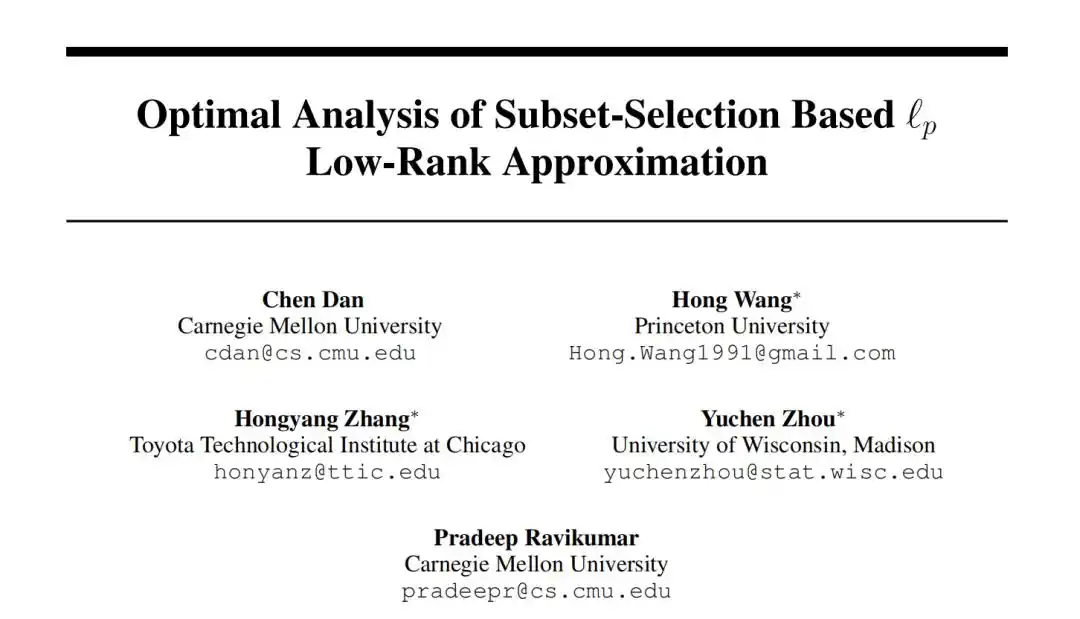
So here's the question: why would a top mathematician in pure mathematics publish a paper in an AI top-tier conference?

After reading through, our conclusion is that this is an excellent example of mathematical theory + machine learning.

Interestingly though, on Hong Wang's personal homepage, nearly all of the 40+ listed papers and preprints have complete links attached.

Except for this one, which is an exception.

Hong Wang's Crossover into AI

This paper studied a fundamental task in machine learning and data analysis: low-rank matrix approximation.

In simple terms, real-world data can often be organized into a matrix, but these matrices are usually very large, making direct storage and processing extremely costly.

Low-rank approximation aims to reconstruct the original matrix as accurately as possible using a simpler, lower-rank matrix.

A commonly used approximation algorithm recently is Column Subset Selection (CSS).
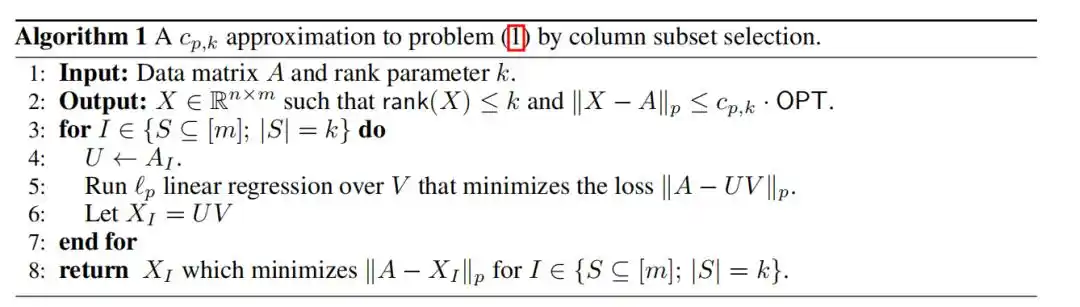
Its concept is actually quite intuitive.

When faced with a data matrix containing a large number of columns, instead of directly computing a brand-new low-rank matrix, it selects a few representative columns from the original matrix and uses the space they span to approximate the entire matrix.

Since the columns selected by CSS come directly from the original data, they are easier to interpret than the abstract vectors obtained from general matrix decomposition. At the same time, it can also reduce storage and computational costs, making it suitable for processing large-scale data.

Previous research proved that for general low-rank approximation, the upper bound of the CSS algorithm's approximation ratio is approximately O(k+1).

Here, k refers to the rank of the target matrix; the larger k is, the larger the theoretically permissible worst-case error.
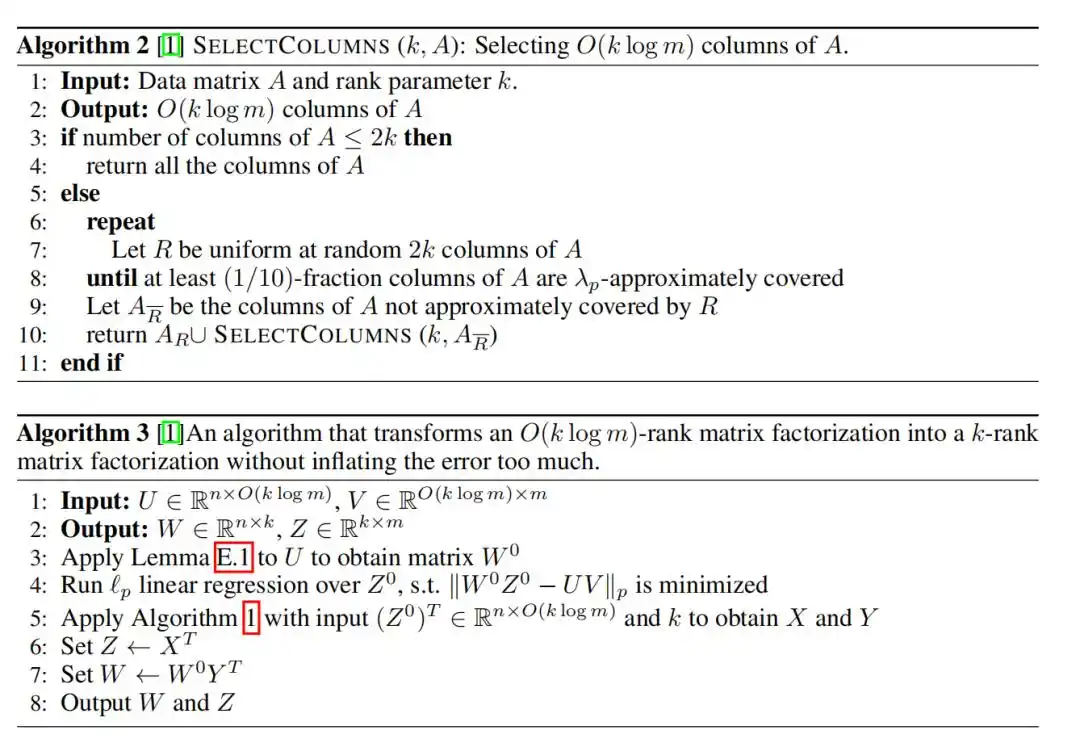
The work by Hong Wang and others further advanced this bound:

When 1≤p≤2, the approximation ratio is (k+1)^(1/p);

When p≥2, the approximation ratio is (k+1)^(1−1/p).

Compared to the previous unified O(k+1) result, this bound is significantly tighter. The algorithm can be strictly limited, and the worst outcome will only be slightly worse than the optimal solution.

Additionally, for the case p≥2, the paper also constructed a corresponding lower bound, proving the result is precise up to a constant of 1.

In other words, this paper provides a nearly definitive theoretical answer.

The most critical part of this paper, and the part that best reflects Hong Wang's mathematical background, is their use of the classic tool from harmonic analysis: the Riesz–Thorin interpolation theorem.

Typically, to prove that an algorithm holds for all p values, one needs to conduct complex analyses separately for different p values.

For certain endpoint cases, such as p=1, p=2, and p=∞, it is relatively easier to handle.

Then, the Riesz–Thorin interpolation theorem can "interpolate" the conclusion to all intermediate p values after mastering these endpoint results.

Specifically, the paper first proved the three special cases of p=1, 2, ∞, then derived the approximation bounds for the entire range through interpolation theory.

In fact, this tool is a classic method in harmonic analysis and operator theory, but it was not the most commonly used technique among theoretical computer science researchers at the time.

The NeurIPS reviewers of that year also noticed this point.

The reviewers ultimately recognized that the primary technical innovation of this paper was introducing the Riesz–Thorin theorem into the computer science field. The final Meta Review rated it as a paper with quite solid argumentation.

Looking at it today, this paper also provides a very typical interdisciplinary case: the difficult problems in machine learning might find breakthroughs in pure mathematics.

NeurIPS 2026 Reviews Are Imminent

Back to the present, NeurIPS' review mechanism is undergoing a noticeable adjustment.
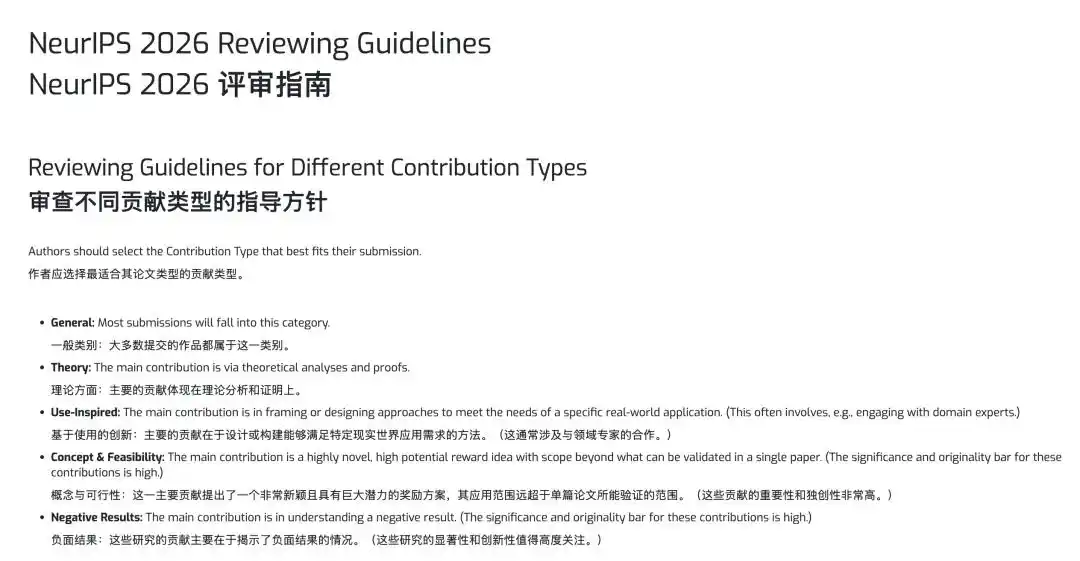
NeurIPS 2026 requires authors to select the most suitable contribution type from five categories at the time of submission: General, Theory, Use-Inspired, Concept & Feasibility, and Negative Results.

Undoubtedly, Hong Wang's 2019 paper belongs to the Theory category.

According to the latest NeurIPS 2026 review guidelines, theoretical papers are first evaluated on mathematical rigor and correctness. Proofs, lemmas, and overall logic must be sound, so theoretical papers should not be overlooked due to a lack of experiments.

At the same time, NeurIPS 2026 explicitly states that theoretical contributions can stand independently, and the purpose of designing new algorithms is not necessarily to beat the SOTA on the latest application models or largest datasets.
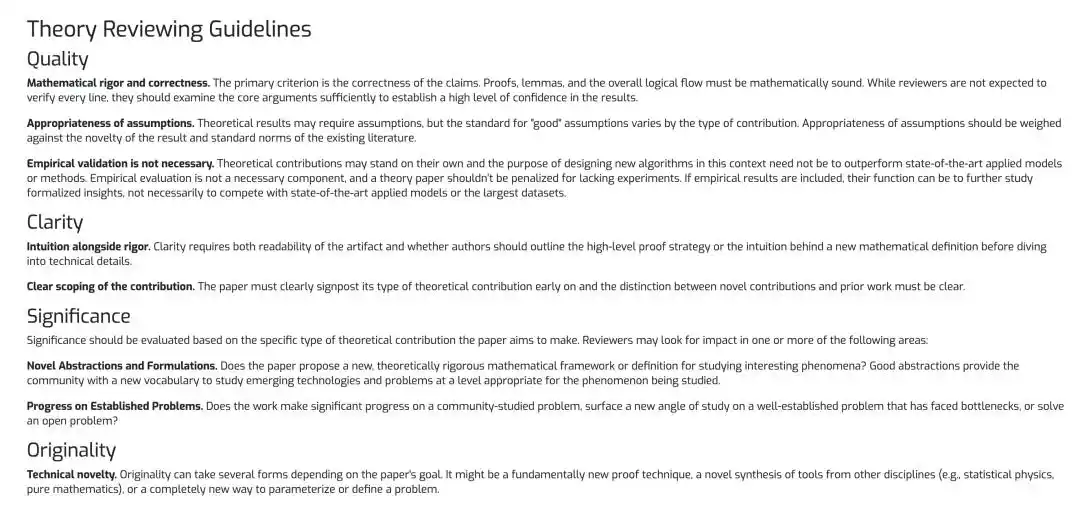
Regarding originality, it can also introduce new proof tools from other disciplines or innovatively synthesize existing tools.

And this is almost a precise description of Hong Wang's paper.

They did not propose a neural network architecture in today's sense, nor did they train models with enormous parameters. Instead, they introduced the interpolation theorem from harmonic analysis into low-rank approximation to solve the approximation algorithm bound problem.

Placed within the 2026 review framework, it remains a very standard NeurIPS theoretical paper.

It also illustrates in reverse that NeurIPS is not equivalent to a neural network model release conference. Providing new understanding of existing methods, discovering new properties, and establishing tighter theoretical bounds are also valuable original contributions.

As for the boundary between mathematics and AI, it has never been as clear as imagined.

A Fields Medalist can publish in NeurIPS, and mathematical language can also find its true general solution for AI.

Reference links:

[1]https://proceedings.neurips.cc/paper_files/paper/2019/file/80a8155eb153025ea1d513d0b2c4b675-Paper.pdf

[2]https://neurips.cc/Conferences/2026/ReviewerGuidelines

[3]https://sites.google.com/view/hongwang/home

[4]http://xhslink.cn/o/8oQ3gm7qaxu

This article is from the WeChat public account "QbitAI", author: Lu Yu

Trending Cryptos

Related Questions

QWhat is the main topic of the paper by Fields Medalist Hong Wang (王虹) published at NeurIPS 2019?

AThe paper studies low-rank matrix approximation in machine learning and data analysis, specifically focusing on the Column Subset Selection (CSS) algorithm and providing tighter approximation bounds using the Riesz–Thorin interpolation theorem.

QWhat classic mathematical tool did Hong Wang (王虹) and colleagues introduce to the computer science field in their NeurIPS 2019 paper?

AThey introduced the Riesz–Thorin interpolation theorem from harmonic analysis and operator theory to the field of computer science.

QHow does the Column Subset Selection (CSS) algorithm work for low-rank matrix approximation?

AThe CSS algorithm works by selecting a subset of representative columns from the original large data matrix and using the subspace spanned by these selected columns to approximate the entire matrix. This preserves interpretability and reduces storage and computational costs.

QAccording to the article, under which contribution category of NeurIPS 2026 would Hong Wang's 2019 paper likely be classified?

AIt would be classified under the 'Theory' contribution category, which emphasizes mathematical rigor, correctness, and the introduction of new proof tools from other disciplines.

QWhat does the article suggest about the boundary between mathematics and AI, based on Hong Wang's (王虹) example?

AThe article suggests that the boundary between mathematics and AI is not rigid, as evidenced by a Fields Medalist publishing in an AI conference. It highlights that mathematical language and tools can provide fundamental solutions and theoretical insights for AI problems.

Related Reads

The Verdict in Choi Tae-won's Divorce Case: Revealing the Inheritance Undercurrent Behind SK Hynix's Trillion-Won Empire

SK Group Chairman Chey Tae-won's high-profile divorce case, involving a record 1.38 trillion won settlement, has drawn attention to the succession plans for Korea's second-largest conglomerate, especially its crown jewel, SK hynix. Unlike traditional chaebol scripts centered on the eldest son, Chey's three children from his marriage to former President Roh Tae-woo's daughter, Roh Soh-yeong, are carving distinct, non-traditional paths. Eldest daughter Chey Yun-jung (b. 1989) is seen as the most evident successor. With a scientific and consulting background, she holds executive roles at SK bioscience and SK Inc.'s growth support department, focusing on future strategy and biopharma. Her marriage is to an AI infrastructure entrepreneur, not a traditional business alliance. Second daughter Chey Min-jung (b. 1991) took a unique route, voluntarily serving as a South Korean naval officer, including an anti-piracy deployment. She later worked on policy and strategy for SK hynix in Washington D.C. before co-founding an AI-driven healthcare startup. She married a former U.S. Marine Corps officer, connecting her to U.S. defense and policy circles—networks crucial for a global semiconductor giant. The only son, Chey In-geun (b. 1995), who studied physics like his father, worked briefly at SK E&S before joining McKinsey. Despite fitting the traditional "heir" profile as the eldest son, he remains silent and holds no public position or shares in SK, suggesting the old succession playbook is obsolete. As SK hynix's valuation soars, becoming a geopolitical asset in the AI era, the heirs' legitimacy is no longer automatic. They must prove themselves in fields like AI biotech, global policy, and strategic consulting. Their marriages also reflect new elite networks in tech and defense, not old political alliances. Their inheritance is the complex challenge of navigating a globalized, tech-driven world, not just a corporate throne.

marsbit1h ago

The Verdict in Choi Tae-won's Divorce Case: Revealing the Inheritance Undercurrent Behind SK Hynix's Trillion-Won Empire

marsbit1h ago

From OpenSea to OpenRouter: Is Alex Atallah Repeating His 'Exit at the Peak' Playbook?

From OpenSea to OpenRouter: Is Alex Atallah Repeating His "Exit at the Peak" Playbook? According to the Wall Street Journal, payments giant Stripe is in talks to acquire the AI model aggregation platform OpenRouter in a potential deal valuing the company near $100 billion. This would mark founder Alex Atallah's second creation of a company reaching a $100 billion valuation, following his co-founding of NFT marketplace OpenSea. OpenRouter, founded just over three years ago, has grown rapidly by acting as a unified gateway for developers to access over 400 AI models. It currently has about 10 million users and processes over 200 trillion tokens monthly. While the platform's annualized revenue is around $50 million, its valuation has skyrocketed from $1.3 billion in March 2026. The potential acquisition by Stripe, a company OpenRouter's founder once likened it to, represents a major expansion into AI infrastructure for the payments leader. This move echoes Atallah's previous timing with OpenSea, where he departed before the NFT market's significant downturn. For OpenRouter, selling now may be strategic. Despite its scale, its business model—charging a 5-5.5% fee on AI inference calls—faces pressure from competition, open-source models, and potential price wars among model providers, limiting its profitability narrative for an IPO. A key asset for potential acquirers like Stripe is OpenRouter's vast repository of real-world AI usage data, which offers unique insights into model performance and developer preferences that are difficult to replicate. Whether this potential deal signifies a new valuation benchmark for AI infrastructure or another market peak signal remains to be seen.

链捕手2h ago

From OpenSea to OpenRouter: Is Alex Atallah Repeating His 'Exit at the Peak' Playbook?

链捕手2h ago

Trading

Spot

Hot Articles

Discussions

Welcome to the HTX Community. Here, you can stay informed about the latest platform developments and gain access to professional market insights. Users' opinions on the price of AI (AI) are presented below.

活动图片