Long-running discussions in the Ethereum community regarding staking economics have taken a sharper turn: developers have proposed a new mechanism that will gradually stop validator issuance as the share of locked $ETH approaches the 50% mark.
The proposal draft, named "Tapered Issuance Burn," involves deducting and burning a portion of idealized validator rewards. The burn rate will increase as staking participation grows, until net issuance reaches zero when the share of locked $ETH nears half of the total supply.
According to the proposal's authors, in April, the share of $ETH engaged in staking exceeded one-third of the total supply. They argue that the current reward curve does not provide sufficient incentive to stop the growth of staking, as the yield will remain at around 1.5% even if practically all $ETH is staked.
Developer Jerome de Tychey wrote on X that by January 2028, over 70 million $ETH could be staked, representing more than 55% of the total supply, if no appropriate measures are taken.
Developers Aim to Address Dilution and Validator Concentration Issues
Proponents argue that excessive staking could ultimately make Ethereum less decentralized, not more secure.
They are concerned that small individual validators may become unprofitable first, leading to a concentration of most staking in the hands of custodians and large staking providers. Increased issuance also leads to dilution for $ETH holders who choose not to participate in staking.
Under the proposed reduction plan, issuance would peak at around 0.5% of the total supply per year when the staking share is about 20%, and then decline towards zero at a 50% share.
"The staking market will ultimately stabilize at a level where the yield equals the risk premium required by staking participants," de Tychey said. The change would be implemented gradually over 18 months, with developers noting that approximately six more months of preparation would be needed before a potential network upgrade.
Proponents also argue that reducing issuance, combined with existing Ethereum transaction fees and blob burns, could make $ETH supply more predictable and more frequently lead to deflation.
Kulechov Warns of Costs for Institutional Investors and DeFi
Aave founder Stani Kulechov strongly opposed the proposal, stating that it could make $ETH yield too uncertain for institutional investors and DeFi users.
"This caps Ethereum staking rewards at 0% when more than 50% of the supply [is] staked," Kulechov wrote. He argued that unpredictable yields could make $ETH less attractive compared to competing networks with clearer yield profiles.
He also warned that reducing staking rewards could undermine $ETH borrowing strategies in DeFi. Yield-seeking investors might instead switch to stablecoins or other yield-bearing assets.
"This simply reduces the appeal of $ETH as an asset and limits its potential," Kulechov said. "Ethereum should not be punished for its growth."
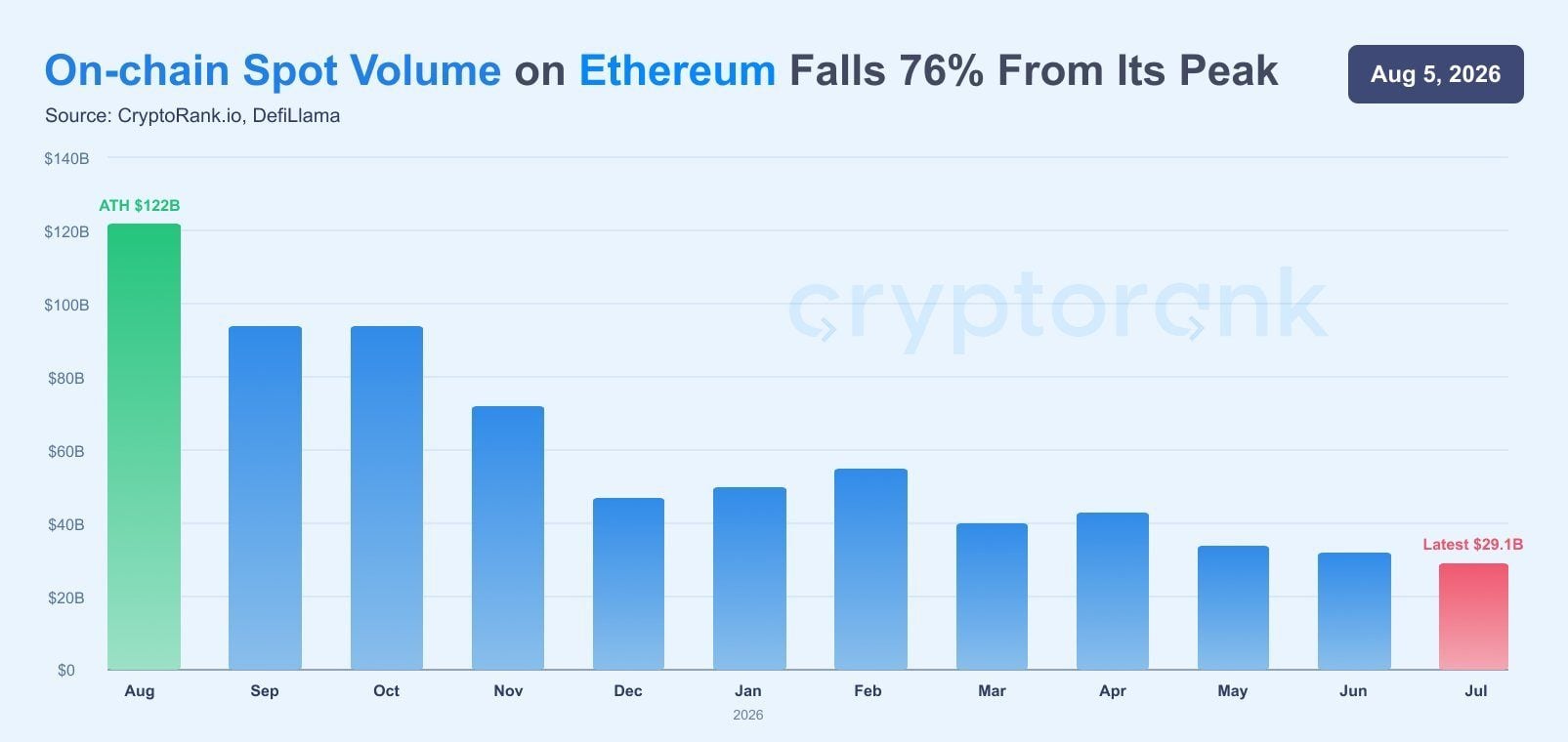
This debate unfolds against a backdrop of weakening trading activity on Ethereum. According to Cryptorank, the monthly spot trading volume on Ethereum decentralized exchanges fell to $29 billion in July, down 76% from the peak recorded in August 2025.
The proposal is currently preliminary. However, this dispute touches on a broader issue for Ethereum: how to limit dilution and concentration without diminishing the utility of $ETH as a yield-bearing asset.
end-content