Crypto service Coinsbuy hacked, loses $7.9 million

cryptonews.ruPublished on 2026-08-10Last updated on 2026-08-10

Abstract

Cryptocurrency service Coinsbuy suffered a hack, losing approximately $7.9 million. Security firm PeckShield suggested the breach may have been caused by compromised private keys or a critical infrastructure vulnerability. The stolen funds were drained simultaneously from hot wallets on the Ethereum and Tron networks. The attacker subsequently began splitting the assets and moving them through exchange services like FixedFloat, ChangeNOW, and BingX, converting a portion into the privacy-focused cryptocurrency Monero. The Coinsbuy team, in collaboration with ChangeNOW, managed to freeze some of the stolen assets before they could be fully withdrawn. Coinsbuy stated that gateway operations were temporarily suspended for several hours due to frozen deposits and withdrawals, but all services have now been restored and are functioning normally. This incident follows recent reports from PeckShield and blockchain researcher ZachXBT about a hack on the cross-chain exchange protocol THORChain, which resulted in an estimated loss of $10 million.

PeckShield suggested that the cause of the hack could have been a compromise of private keys or a critical vulnerability in the service's infrastructure. The funds stolen from Coinsbuy's hot wallets were withdrawn simultaneously from the Ethereum and Tron networks.

The attacker then began splitting the assets and transferring them through exchange services, including FixedFloat, ChangeNOW, and BingX, converting part of the funds into the anonymous cryptocurrency Monero.
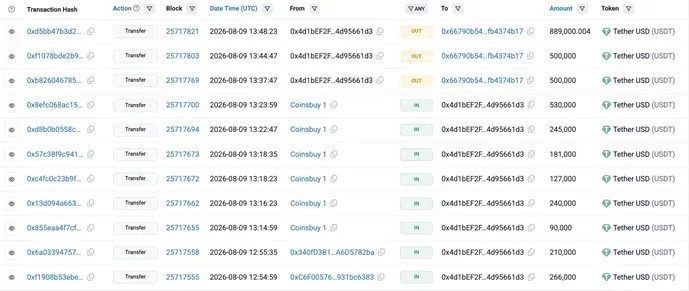
The Coinsbuy team, together with the crypto exchange platform ChangeNOW, managed to block part of the stolen assets before they could be fully withdrawn.

Coinsbuy stated that the gateway's operation was suspended for several hours due to the freezing of deposit and withdrawal operations, but currently all services have been restored and are operating normally.

Earlier, analysts from PeckShield and an anonymous blockchain researcher ZachXBT reported a hacker attack on the decentralized cross-chain exchange protocol THORChain. The damage from the hack was estimated at approximately $10 million.

end-content

Related Questions

QWhat is the estimated amount that Coinsbuy lost due to the hack?

ACoinsbuy lost an estimated $7.9 million.

QAccording to PeckShield, what were the two possible causes of the Coinsbuy hack?

APeckShield suggested the hack could have been due to a compromise of private keys or a critical vulnerability in the service's infrastructure.

QWhich cryptocurrency exchange services were used by the attacker to move the stolen funds from Coinsbuy?

AThe attacker used the exchange services FixedFloat, ChangeNOW, and BingX to move the stolen funds.

QWhat action did the Coinsbuy team take in collaboration with ChangeNOW regarding the stolen assets?

AThe Coinsbuy team, in collaboration with the ChangeNOW platform, managed to block a portion of the stolen assets before they could be fully withdrawn.

QBesides the Coinsbuy incident, which other crypto protocol was reported to be hacked according to the article, and what was the estimated damage?

AThe article also reports a hack on the cross-chain exchange protocol THORChain, with an estimated damage of around $10 million.

Related Reads

RIP: Atlas, Which Lived Only 292 Days

On August 9, 2026, OpenAI discontinued its standalone AI browser, Atlas, just 292 days after its launch on October 21, 2025. Initially positioned as a challenger to Chrome and the broader AI browser ecosystem, Atlas aimed to fundamentally redesign how users interact with browsers by deeply integrating ChatGPT. Its features included an AI-powered address bar, a sidebar for webpage analysis, Browser Memories for context retention, and an Agent Mode to automate multi-step tasks like shopping and research. Despite building on Chromium with a custom OWL (OpenAI Web Layer) framework, OpenAI struggled with the immense complexity of maintaining a full-fledged browser. The team spent significant time addressing basic functionalities—password managers, extensions, input methods—that mainstream browsers already handled seamlessly. Atlas's core AI agent capabilities also faced issues with reliability, speed, and security vulnerabilities like prompt injection. Furthermore, Atlas was limited to Apple Silicon Macs, failing to release promised Windows, iOS, and Android versions. This, coupled with the high switching cost for users entrenched in Chrome or Edge's ecosystems, hindered its adoption. By mid-2026, updates slowed, and OpenAI announced its shutdown, opting to integrate Atlas's AI explorations into the ChatGPT desktop app and browser extensions instead. The article contrasts two AI browser development paths: standalone products like Atlas, Perplexity's Comet, and Dia, which redesign the browser around AI but face user migration barriers; and the approach of incumbents like Chrome and Edge, which add AI features atop existing, widely-used platforms. The key question remains whether users need a completely new "AI browser" or simply AI capabilities within their current browser. While Atlas's experiment ended, the broader trend of AI integration into browsing continues.

marsbit45m ago

RIP: Atlas, Which Lived Only 292 Days

marsbit45m ago

Bitcoin's "Anti-Spam" Update Failed, Lasting Less Than a Day

A Bitcoin update proposal aimed at curbing spam by temporarily banning non-financial data from being stored on the network, BIP-110, has failed decisively. After months of debate, developers attempted to launch a separate blockchain, which collapsed within a day. The failure stemmed from a critical lack of miner support, with less than 1% signaling approval for the update. The vast majority of miners chose to continue mining the main Bitcoin blockchain without providing explanations. Despite this, the initiative's developers proceeded to launch an alternative blockchain—a hard fork of Bitcoin—on August 8. This meant a small subset of miners stopped mining Bitcoin to support the new chain with BIP-110 changes. However, the new network inherited Bitcoin's mining difficulty. With only a tiny fraction of the total computational power, block times stretched to roughly 7 hours instead of the standard 10 minutes, rendering the network practically non-functional. Michael Saylor, founder of major corporate Bitcoin holder MicroStrategy and a vocal opponent of BIP-110, commented: "Bitcoin worked exactly as designed. The BIP-110 fork occurred, and network participants were free to choose which chain to follow. As a result, about 99.85% of the network's hash power remained with Bitcoin." The event had no significant impact on Bitcoin's price, which traded in a narrow range between approximately $64.5k and $65.5k from August 7 through August 10.

cryptonews.ru51m ago

Bitcoin's "Anti-Spam" Update Failed, Lasting Less Than a Day

cryptonews.ru51m ago

Trading

Spot
活动图片