ERC-8004 Gathers Over 20,000 'Digital Immigrants', On-Chain Becomes Testing Ground for AI Agents

marsbitPublished on 2026-02-14Last updated on 2026-02-14

Abstract

ERC-8004, a new Ethereum protocol, has attracted over 21,000 AI Agents since its recent mainnet launch, positioning Ethereum and Base as primary testing grounds for AI Agent ecosystems. The protocol enables cross-platform interoperability and a portable reputation system, supporting decentralized AI service markets. While most Agents are deployed on Ethereum and Base, user engagement remains early-stage, with only around 15,000 total feedback entries recorded. Many Agents already support the x402 protocol for autonomous micro-payments, signaling the emergence of an on-chain agent economy. Vitalik Buterin supports Ethereum’s role as a foundational layer for AI—emphasizing decentralization, user sovereignty, and anti-censorship—rather than competing on raw AI compute. He outlined four key development directions: privacy-preserving AI tools, Ethereum as an economic layer for AI interactions, a self-verifying cyberpunk world powered by local AI, and improved AI-augmented governance mechanisms. The movement aligns with a broader trend of crypto-AI integration, as seen in projects like Chainlink, Filecoin, and initiatives from Coinbase and Farcaster.

Author: Nancy, PANews

Once, AI Agents were just supporting characters in science fiction; now, they are preparing to take over the real world. From simple chatbots to intelligent agents with autonomous decision-making capabilities, able to call tools across platforms and complete complex tasks, the AI Agent economy is on the verge of explosion.

Currently, Ethereum, in urgent need of fresh blood, is gathering a special group of "digital immigrants." With the launch of the ERC-8004 protocol, Ethereum is becoming one of the core testing grounds for AI Agents.

Over 20,000 Agents On-Chain, Ethereum and Base Become Main Testing Grounds

At the end of last month, ERC-8004 officially launched on the Ethereum mainnet and plans to be deployed as a singleton to all major L2 networks in the coming weeks.

This is an important step in the evolution of the Ethereum ecosystem toward AI-native infrastructure. ERC-8004 introduces a discovery mechanism and a portable reputation system, enabling AI agents to interact across organizations and carry reputation records across different platforms, providing an underlying protocol for a global interoperable AI services market without centralized gatekeepers.

According to 8004scan data, as of February 13, the number of Agents deployed based on ERC-8004 has reached nearly 21,000.

From the deployment map, ERC-8004 has covered 16 networks including Ethereum, Polygon, BNB Chain, Base, Monad, Arbitrum, Celo, and plans to launch on Plasma, Metis, and Soneium, among others.

Among them, Ethereum remains the core stronghold, with over 11,000 Agents, accounting for more than half of the total; the remaining Agents are mainly distributed on Base, Gnosis, and BNB Chain, each hosting several thousand.

However, looking at the deployment pace, Agents were initially concentrated on the Ethereum mainnet. As the scale expanded, new deployments gradually gathered on Base. Overall, ERC-8004 Agents are largely locked between the Ethereum and Base ecosystems. Mature development environments, liquidity depth, and user base are likely key factors attracting developers.
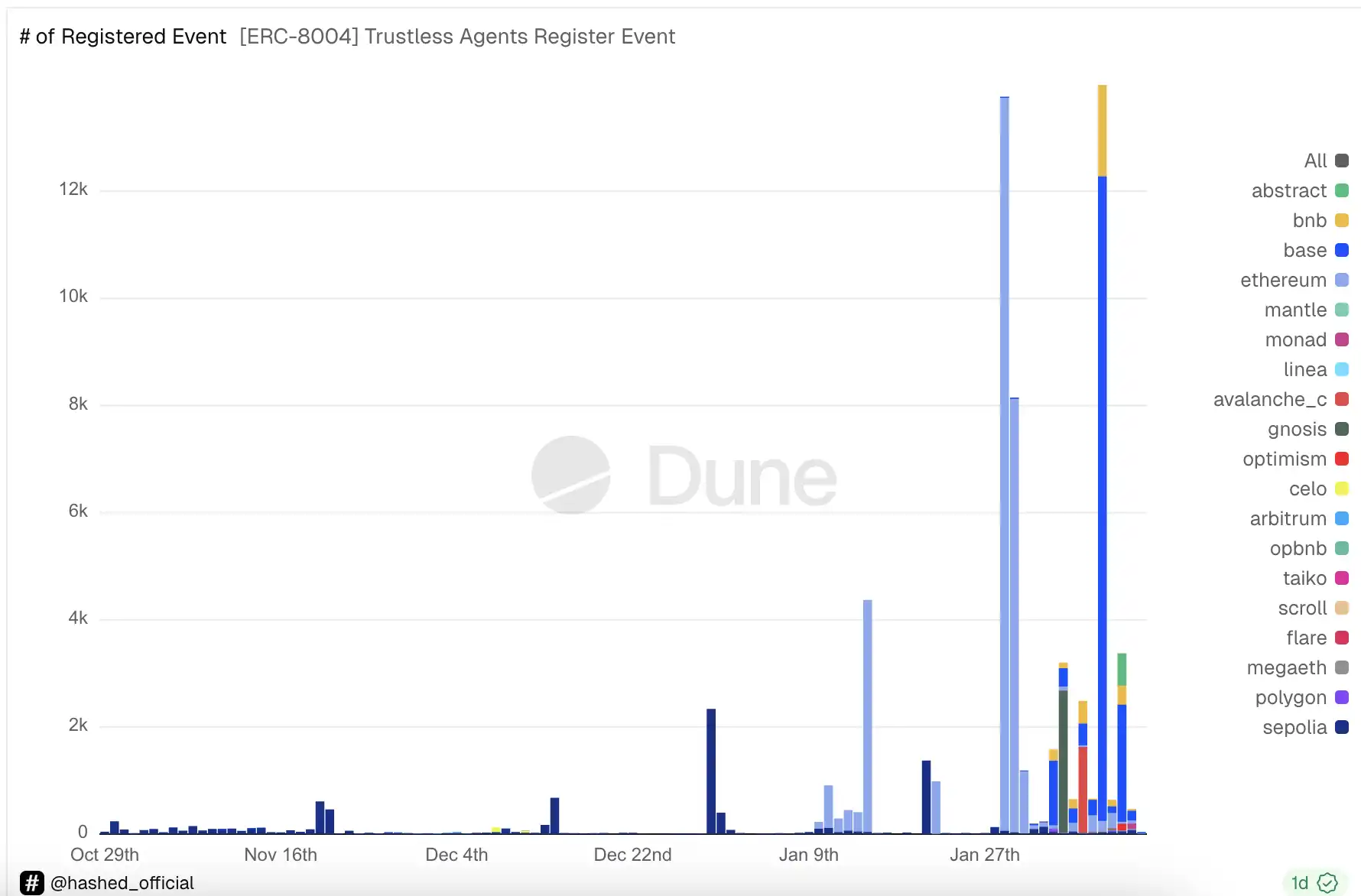
From the perspective of participants, prolific teams have begun to emerge, with the same address operating multiple Agents not being uncommon.

From the application direction, the current Agent players in the ERC-8004 ecosystem are quite diverse, including technical Agents focused on DeFi infrastructure and on-chain tools, market analysis and investment assistants, as well as content generation and creative applications. Some Agents have even issued tokens, exploring independent economic models.

However, in terms of real interaction, the ecosystem is still in its early stages. To date, the cumulative number of feedback entries is about 15,000, averaging less than one per Agent. This means most Agents are still in the cold start phase, with actual usage and user interaction being relatively limited. However, Base accounts for a high proportion of feedback received, at 73.6%, far exceeding Ethereum, BNB Chain, Avalanche, and other networks. This suggests that current actual interactions and active scenarios are concentrating on Base. This may be related to the recent hype around OpenClaw igniting the Agentic ecosystem on Base.
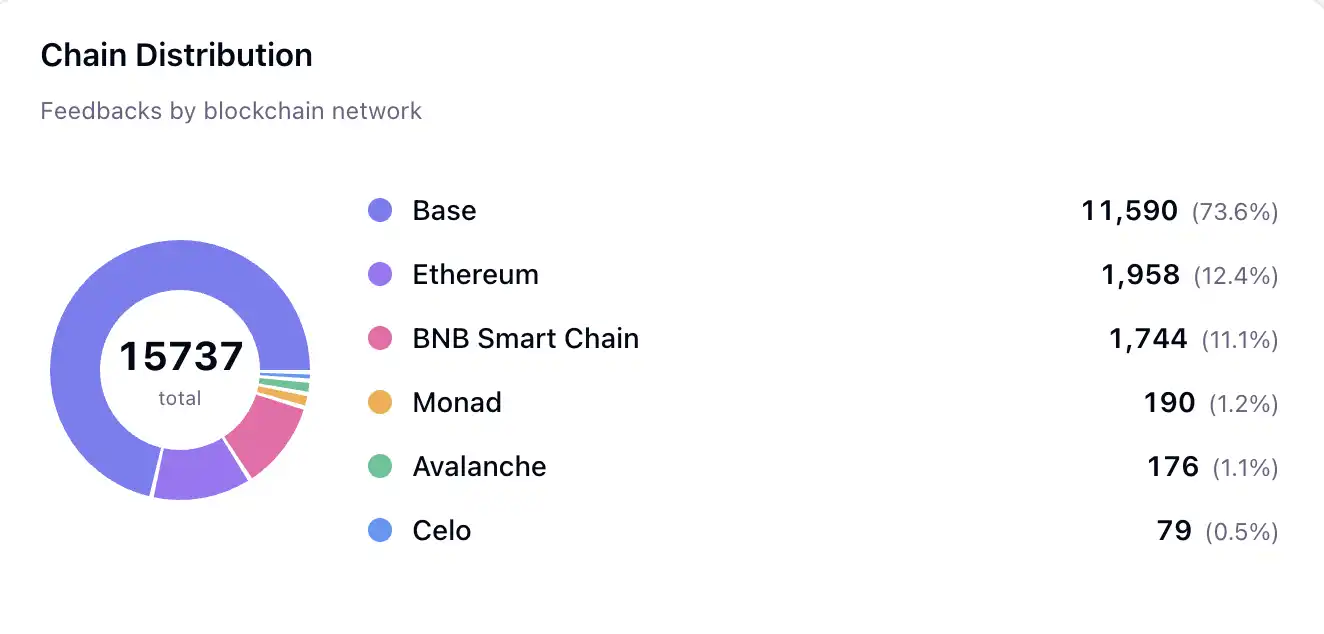
Approval rating data also highlights the head effect in the current ERC-8004 ecosystem. Only fewer than 10 Agents have received thousands of Stars, while most Agents are still awaiting market validation.

A noteworthy phenomenon is that most Agents already support the x402 protocol, enabling autonomous, real-time micro-payment capabilities, and are beginning to become true on-chain economic participants. This will further drive machine-to-machine collaboration and the explosion of the agent economy.

Overall, the ERC-8004 ecosystem is still in the early exploration stage, but an on-chain collaboration network for intelligent agents is beginning to take shape.

This wave of on-chain AI Agent hype has also drawn attention to many AI projects on various chains, including Chainlink, Filecoin, Render, Internet Computer, Bittensor, Virtuals, Bankr, Clawnch, and others. At the same time, some public chains, exchanges, and crypto projects are increasing their布局, such as Coinbase recently launching an AI agent wallet with built-in security protection, Farcaster supporting OpenClaw agents to autonomously create accounts, Virtuals推出 a monthly $1 million Agent incentive plan, and Crypto.com's高价 acquisition of ai.com to布局 AI agent business.

Making Ethereum the Home for AI, Proposing Four Short-Term Development Directions

AI is the next core narrative Ethereum is advancing. Last September, the Ethereum Foundation (EF) established a dedicated dAI team with the goal of building Ethereum into the infrastructure for AI development.

However, in the current era of rapid AI development, Ethereum, which promotes the "world computer" narrative, faces a reality check. The computing power of large GPU clusters far exceeds that of blockchains, and training and inferring large models seems difficult to accomplish quickly on Ethereum.

Thus, Ethereum has chosen a different strategic path. It has not chosen to compete with centralized giants in terms of computing power but has positioned itself as the trust and verification foundation for the AI ecosystem.
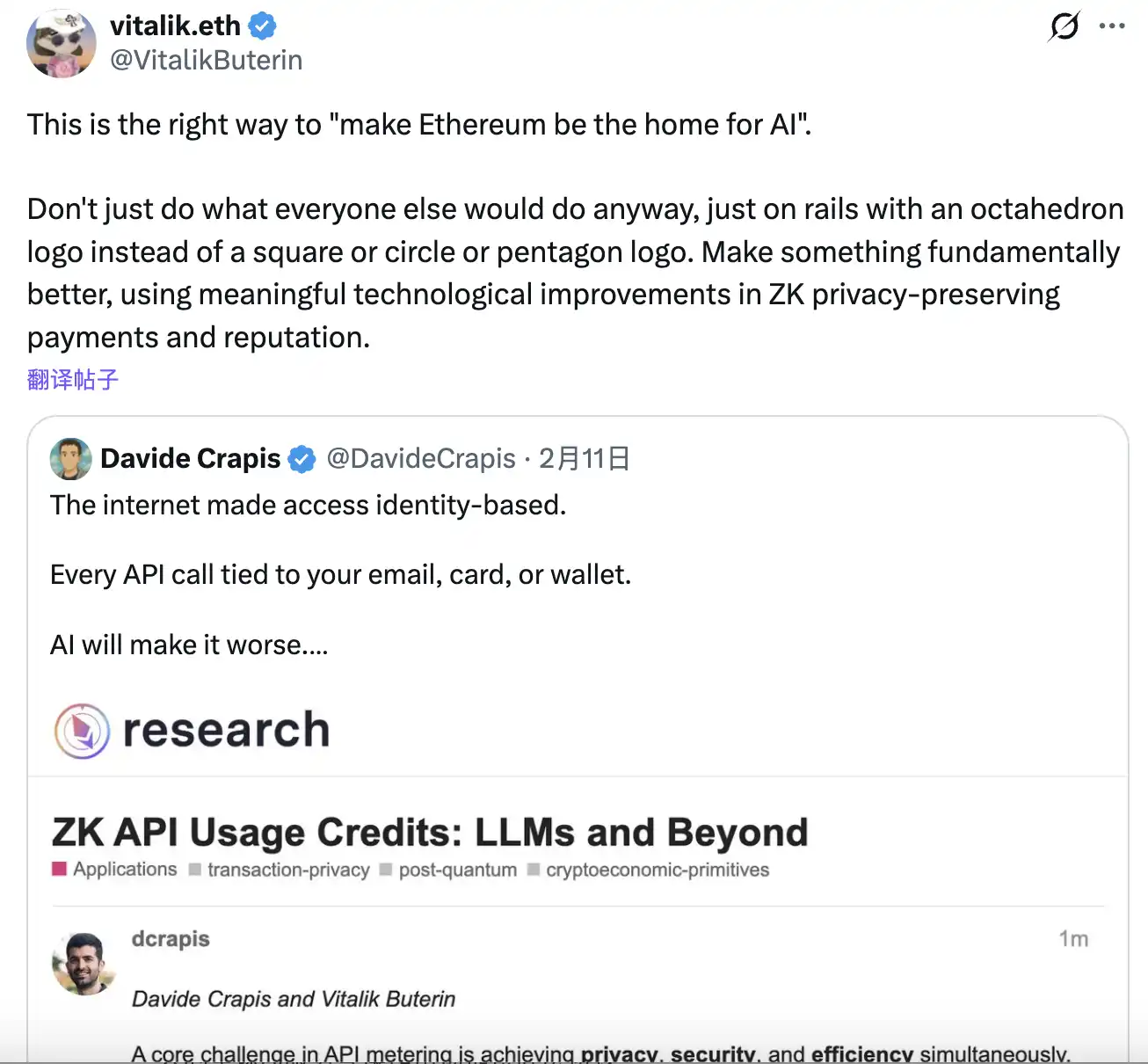
Ethereum founder Vitalik Buterin endorses the route of making Ethereum the home for AI and recently shared his latest thoughts on the relationship between Ethereum and AI. He believes that Ethereum's spirit is highly aligned with the ideal path for AI development, both emphasizing enhancing individual freedom, decentralizing power structures, and improving societal defense capabilities, rather than allowing centralized forces to expand infinitely.

But Vitalik also pointed out that Ethereum in the AI era cannot simply replicate existing solutions but should choose a differentiated innovation route, deeply integrating the values of encryption and AI to build a future conducive to human freedom, security, and decentralized collaboration.

In fact, the current AI agent war has already begun and has quickly moved from technical exploration into the deep waters of commercialization. Some accelerationists with huge funds pursue "the stronger the model, the better; the faster the progress, the safer," a trend that hides the risk of power concentration.

In Vitalik's view, the problem with AI development is not computing power or model scale, but direction choice. He opposes blind acceleration without constraints and calibration mechanisms, emphasizing that Ethereum's AI development should adhere to two bottom lines: protecting human freedom and initiative, avoiding being marginalized by AI or power structures, and preventing AI from getting out of control or causing systemic risks due to offense-defense imbalances.

The EF's key推进 ERC-8004 standard, recently落地, can provide on-chain identity, reputation, and behavior verification for AI agents, allowing AI to prove itself on-chain while giving users choice, avoiding centralized platform monopolies. This means that the past model, where platforms set the rules and AI was both executor and referee, will be replaced by a verifiable decentralized system, which also aligns with the core values of decentralization and anti-censorship that Vitalik emphasizes for Ethereum.
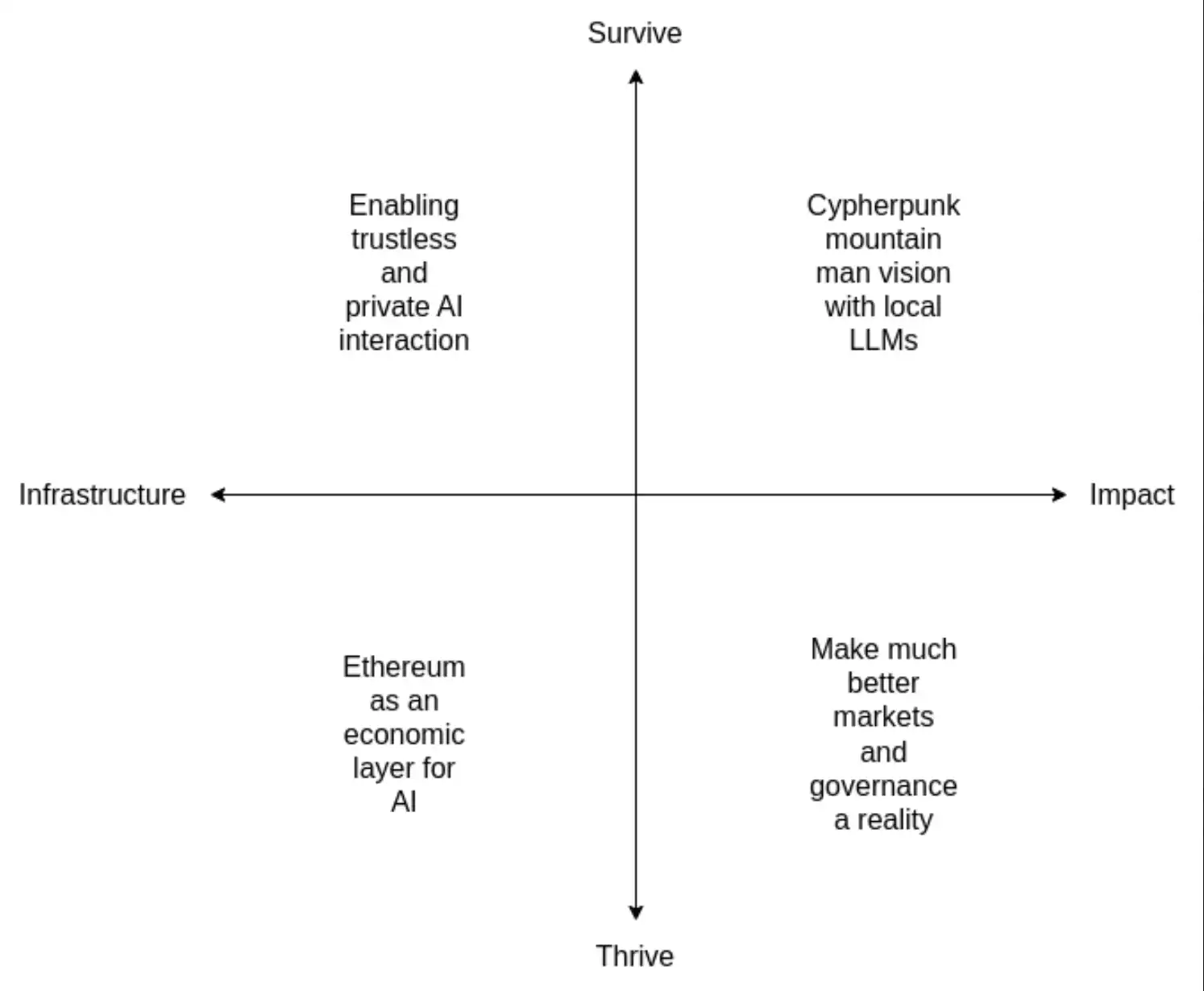
Note: Vitalik描绘 the role of Ethereum at the intersection with AI

Regarding the short-term infrastructure construction that can be落地 on Ethereum, Vitalik proposed four key directions:

First, building trustless, privacy-friendly AI interaction tools. This includes local LLM tools, ZK API payments supporting anonymity, cryptographic schemes to enhance AI privacy, and TEE and cryptographic proofs for client-side verification of server-side computations. He pointed out that this essentially extends Ethereum's privacy roadmap to LLM computing scenarios, allowing humans to maintain control in AI interactions.

Second, Ethereum as an AI economic interaction layer. This layer covers AI API calls, hiring between Bots,保证金 mechanisms, on-chain dispute resolution, and AI reputation systems like ERC-8004. In his view, implementing payment,抵押, arbitration, and reputation management through on-chain mechanisms can make decentralized AI architecture more feasible. This economic layer is not about financializing everything but about enabling multi-agent collaboration without relying on a single organization.

Third, realizing a cyberpunk-style self-verifying world. In the past, ordinary users could not audit code line by line, nor could they fully verify system security. But with local LLMs, people can use AI for various assists, including using Ethereum applications without third-party UIs, having local models generate and verify transactions, locally auditing smart contracts, understanding formal verification (FV) proofs, and verifying the trust models of applications and protocols. This makes the concept of "full self-sovereignty" move from idealism to practical feasibility.

Fourth, reshaping markets and governance mechanisms. Many decentralized governance and market design theories (such as prediction markets, quadratic voting, combinatorial auctions, etc.) have long been limited by human attention and cognitive abilities. The emergence of LLMs can greatly expand human judgment, making these institutional designs operationally possible in reality.

Simply put, Vitalik does not see AI as an isolated technological revolution but incorporates it into a larger framework of decentralized civilization building. In this framework, AI will expand human capabilities, while加密 technology will constrain power structures; the former brings intelligence, the latter provides defense and autonomy.

In the trillion-dollar new market of AI Agents, Ethereum's new AI story is about building an ecosystem that can promote human freedom, prevent super-intelligent agents from getting out of control, and simultaneously advance the development of a decentralized AI architecture.


Trending Cryptos

Related Questions

QWhat is the main purpose of the ERC-8004 protocol on Ethereum?

AERC-8004 introduces a discovery mechanism and a portable reputation system, enabling AI agents to interact across organizations and carry reputation records across different platforms. It provides the underlying protocol for a global, interoperable AI services market without centralized gatekeepers.

QHow many AI Agents have been deployed on the ERC-8004 network as of February 13th, and which blockchain is the primary deployment location?

AAs of February 13th, nearly 21,000 Agents have been deployed on the ERC-8004 network. The primary deployment location is Ethereum, with over 11,000 Agents, accounting for more than half of the total.

QAccording to Vitalik Buterin, what are the two core principles that should guide Ethereum's development in the AI era?

AVitalik Buterin stated that Ethereum's AI development should follow two core principles: 1) Protect human freedom and initiative, avoiding marginalization by AI or power structures, and 2) Prevent AI from becoming uncontrollable or causing systemic risks due to an imbalance in offensive and defensive capabilities.

QWhat are the four key short-term infrastructure development directions for Ethereum in relation to AI, as proposed by Vitalik Buterin?

AThe four key short-term directions are: 1) Building trustless, privacy-friendly AI interaction tools; 2) Establishing Ethereum as an AI economic interaction layer; 3) Realizing a cyberpunk-style self-verifying world; and 4) Reshaping market and governance mechanisms.

QWhich blockchain network currently has the highest proportion of user feedback interactions for Agents deployed on ERC-8004, and what is a potential reason for this?

AThe Base network has the highest proportion of user feedback interactions, accounting for 73.6% of the total. A potential reason for this is the recent hype around OpenClaw, which has ignited a wave of Agentic ecosystem activity on Base.

Related Reads

STAR 50 Soars 10.73%, Why Did A-Shares Stage a "V-Shaped Reversal"?

After a prolonged decline, the Chinese A-share market staged a strong rally on July 21. The STAR 50 index surged 10.73%, its largest single-day gain in nearly a year, leading a broad-based "V-shaped" reversal. The Shanghai Composite Index rose 1.79%, the Shenzhen Component Index gained 4.81%, and the ChiNext Index jumped 7.05%. Total market turnover reached 2.97 trillion yuan, an increase of 256.1 billion yuan from the previous session, with over 3,100 stocks advancing. The semiconductor sector spearheaded the rebound, with related ETFs posting significant gains. Analysts attribute the surge to three converging factors. First, coordinated capital inflows from "national team" institutions, insurance funds, listed company buybacks, and fund house self-purchases have bolstered market liquidity and confidence. Second, supportive policy signals, including commitments from regulators to ensure stable market operations, provided a favorable backdrop. Third, a stabilization and recovery in overseas markets, notably South Korea, created a positive external environment. Institutions suggest the most severe panic selling phase for the tech sector has likely passed, following a significant digestion of crowded positions and leveraged funds. While short-term volatility may persist, the medium to long-term outlook remains underpinned by enduring trends like AI computing demand expansion and semiconductor localization. The market's focus now shifts to the sustainability of supportive fund flows, earnings reports, and upcoming catalysts from the global AI industry chain.

marsbit24m ago

STAR 50 Soars 10.73%, Why Did A-Shares Stage a "V-Shaped Reversal"?

marsbit24m ago

U.S. Tech Momentum Stocks Post Largest Single-Day Gain Ever, But Is the Plunge Over?

US tech momentum stocks staged a sharp rebound on Tuesday (July 21st). Morgan Stanley's TMT Momentum Factor surged over 12%, marking its largest single-day gain on record, exceeding even peaks from the 2000 dot-com bubble. Key momentum indices from Goldman Sachs also posted their strongest daily performances in years. The rally was led by semiconductors, with the Philadelphia Semiconductor Index jumping 4.6%. This rebound followed three consecutive down days and a cumulative 33% plunge in momentum stocks, one of the steepest drawdowns since the dot-com era. Analysts attribute the surge largely to a short squeeze. Heavy selling had pushed high-beta momentum stocks into deeply oversold territory, forcing many short sellers, particularly in Asia, to cover their positions, creating a self-reinforcing buying spiral. However, the rebound's internals appear weak. Trading volume was notably low, and advancing stocks still lagged decliners on the S&P 500, indicating a narrow, concentrated rally rather than broad market participation. Diverging views emerge on the outlook. BTIG warns the bounce has hit key resistance and recommends selling into strength, citing extreme volatility and historical parallels to past market tops. Conversely, Goldman Sachs and UBS believe the momentum unwind is nearing its end, suggesting it may be time to gradually add exposure, as positioning has been significantly reduced. They caution, however, that high volatility warrants a measured approach, potentially using defined-risk strategies. The upcoming earnings season, particularly reports from major tech firms like Alphabet, is seen as a critical test for the rally's sustainability. Simultaneously, bond markets flashed a warning, with yields rising partly due to spiking oil prices. Analysts note that if long-term Treasury yields break decisively higher, it could pose a significant headwind for equities, especially growth stocks.

marsbit31m ago

U.S. Tech Momentum Stocks Post Largest Single-Day Gain Ever, But Is the Plunge Over?

marsbit31m ago

U.S. Tech Momentum Stocks Record Largest Single-Day Gain Ever, but Has the Rout Ended?

U.S. tech momentum stocks staged a dramatic rebound on Tuesday, July 21st. Key momentum indices like the Morgan Stanley TMT Momentum Factor and Goldman Sachs' High Beta Momentum Long Index posted historic or near-historic single-day gains, fueled largely by semiconductor stocks. This sharp rally followed a severe three-day sell-off that saw momentum stocks plunge 33%, marking one of the steepest pullbacks since the dot-com bubble. Analysts attribute the bounce primarily to a short squeeze, as forced covering from over-leveraged traders, particularly in Asia, created a buying spiral. However, the rally's health is questioned due to weak market breadth—overall trading volume was low, and decliners outnumbered advancers in the S&P 500 despite the index's gain—suggesting a narrow, concentrated surge rather than broad recovery. Opinions on the sustainability diverge. BTIG strategists warn the rebound has hit key resistance levels, citing extreme volatility and historic stock dispersion as signs of an ongoing broader correction, and recommend selling into strength. Conversely, Goldman Sachs and UBS view the aggressive momentum unwinding as nearing its end, noting reduced positioning and a lack of new fundamental catalysts. They suggest the sell-off presents a selective opportunity to add exposure, albeit cautiously and gradually using defined-risk strategies. The immediate trajectory hinges on the ongoing earnings season, with market focus on Alphabet's capital expenditure guidance for AI investment clarity. Meanwhile, bond markets present a risk, with rising Treasury yields—potentially heading toward 5.5%—and widening credit spreads for mega-cap tech companies posing a threat to equity valuations. The combination of technical factors, earnings results, and macro conditions leaves the durability of the rebound in doubt.

链捕手34m ago

U.S. Tech Momentum Stocks Record Largest Single-Day Gain Ever, but Has the Rout Ended?

链捕手34m ago

Long-Divided Must Unite, Long-United Must Divide: When L1 Becomes Its Own Rollup, What Is Ethereum's Endgame?

"The Inevitable Cycle: When L1 Becomes Its Own Rollup – What is Ethereum's Endgame?" For years, the Ethereum community grappled with concerns that L2s were fragmenting the ecosystem and eroding L1's value. While L2s provided cheaper execution, they also splintered liquidity and the unified user experience of a single chain. This has prompted a fundamental reassessment of the relationship between L1 and L2. Ethereum's roadmap is evolving. The "Scale" initiative merges L1 and L2 expansion into a holistic framework. L1 itself is advancing with higher gas limits, statelessness, and zkEVM verification, no longer content to be just a low-throughput settlement layer. Consequently, the primary value proposition of L2s is shifting from merely providing cheap blockspace to offering L1 cannot easily provide: application-specific optimizations, privacy features, and flexible governance models. L2s are becoming a spectrum of execution environments with varying degrees of security inheritance from Ethereum. A critical challenge in this multi-chain future is interoperability. The vision is to make Ethereum "feel like one chain again." This relies on advancements in native account abstraction (like EIP-7702) and intent-based architectures (Open Intents Framework), where users declare desired outcomes, and solvers handle the complex cross-chain execution. Furthermore, shortening Ethereum's finality time from minutes to seconds is crucial, as it underpins trust between chains for bridges, stablecoins, and cross-chain applications. Perhaps the most provocative idea is that Ethereum L1 itself could become a form of "its own Rollup." As zkEVM and proof systems mature, high-performance nodes could execute transactions and generate validity proofs. Regular validators would then verify these proofs instead of re-executing all transactions. This blurs the traditional L1/L2 hierarchy, making "Rollup" more of a general execution-verification architecture. Native Rollup aims to integrate L2 validation more directly into the Ethereum protocol, allowing L2s to inherit L1's security more fully and move away from reliance on security councils. In the end, L2s are not destined to replace L1 or be made obsolete by it. The likely future is a unified system where diverse execution environments—each optimized for specific use cases like DeFi, gaming, or privacy—coexist. They will share a common foundation of security, liquidity, and verifiable state, seamlessly connected to restore a cohesive user experience. The next phase for Ethereum is not just about scaling through separation, but about intelligently reintegrating what was separated back into a coherent whole.

链捕手50m ago

Long-Divided Must Unite, Long-United Must Divide: When L1 Becomes Its Own Rollup, What Is Ethereum's Endgame?

链捕手50m ago

Trading

Spot

Hot Articles

Discussions

Welcome to the HTX Community. Here, you can stay informed about the latest platform developments and gain access to professional market insights. Users' opinions on the price of AI (AI) are presented below.

活动图片














