Dwarkesh Patel: The Next Generation of AI May Be Built Through Actual Work

marsbitPublished on 2026-06-28Last updated on 2026-06-28

Abstract

In his latest podcast, Dwarkesh Patel explores the next paradigm for AI training. While current progress in fields like coding and math relies on Reinforcement Learning with Verifiable Rewards (RLVR), which requires tasks that are both verifiable and highly scalable ("grindable"), Patel questions whether this is sufficient for complex real-world objectives like starting a business, winning a legal case, or managing an organization. These tasks provide verifiable outcomes but lack the resetable, parallelizable environments needed for efficient RLVR training. Patel argues the key limitation of current models is their inability to convert valuable in-context learning from real deployment into permanent weight updates—a process he terms "learning back to the weights." He proposes two potential solutions: On-Policy Self-Distillation (OPSD), where a model distills knowledge from long, task-specific sessions back into its base weights, and "dreaming," where an AI constructs simulated environments from real-world observations to practice and refine strategies. Ultimately, Patel envisions a future training paradigm where AI advances not just through pre-training on static datasets but through continual, post-deployment learning from real-world experience. This shift would enable AI to move beyond "grindable" tasks and develop robust, generalizable agent capabilities for complex, real-world challenges.

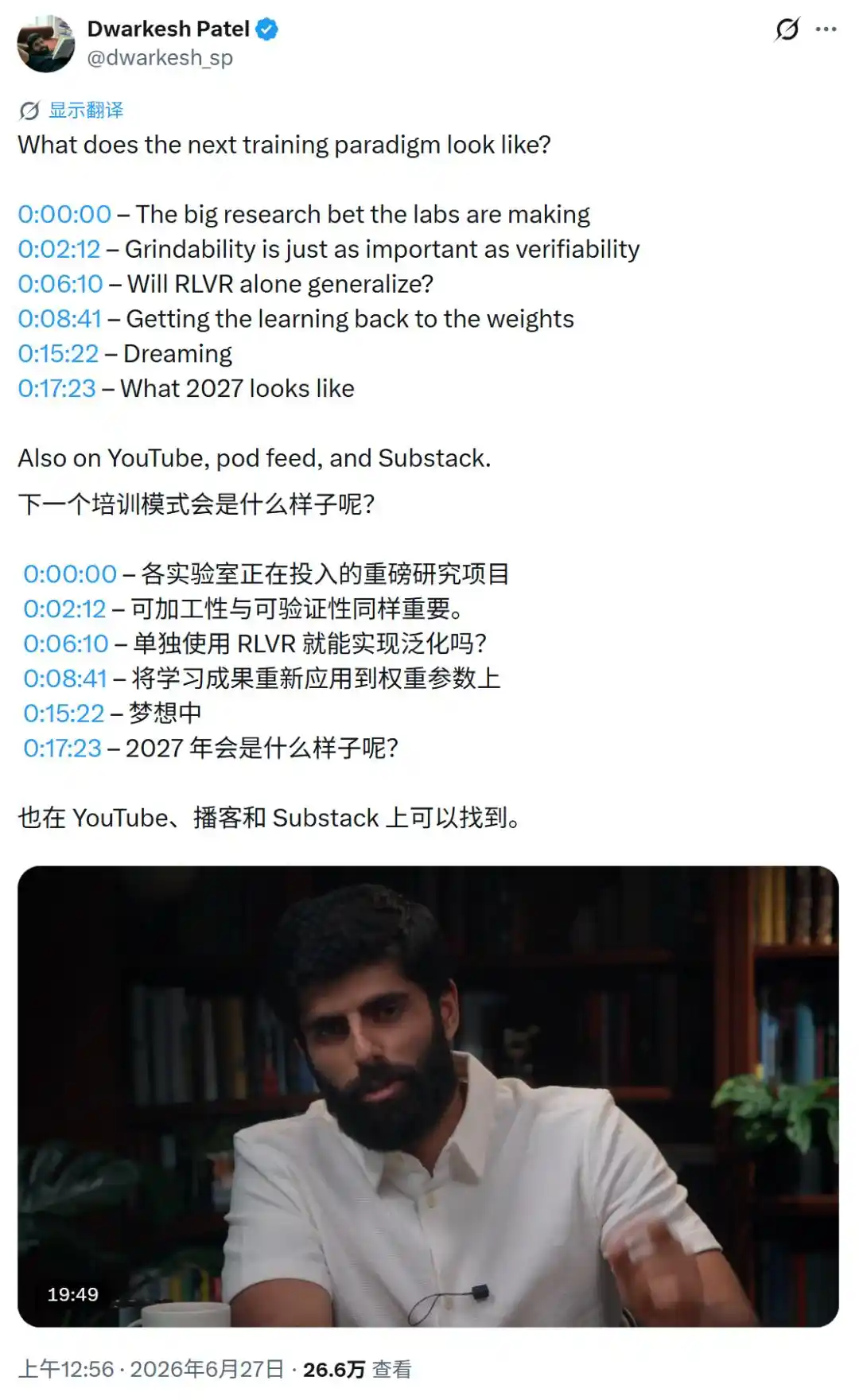
Dwarkesh Patel, a famous tech podcast host in Silicon Valley, recently posed a question: What will be the next paradigm for AI training?
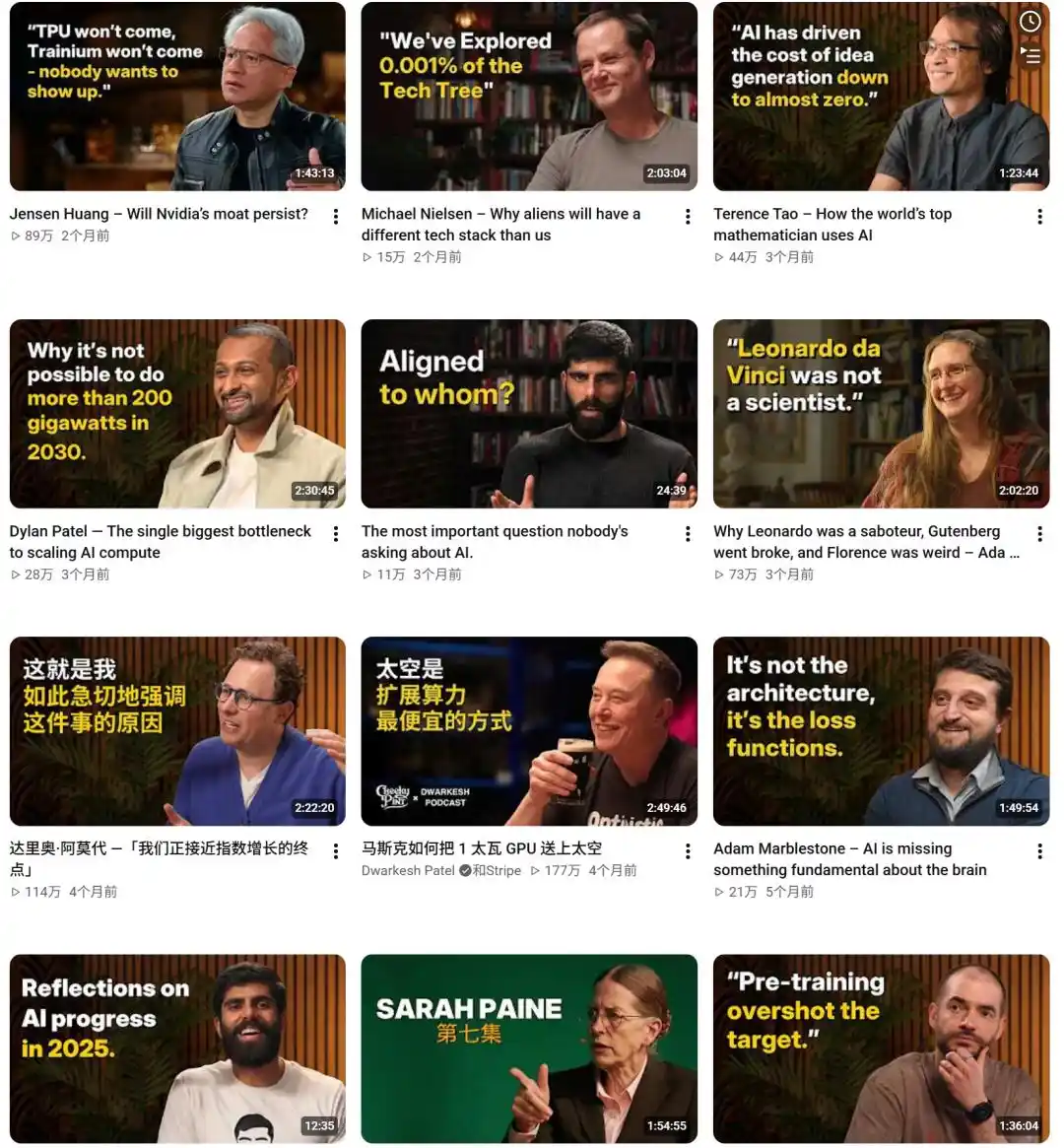
Dwarkesh Patel is a tech podcast host and writer who has rapidly gained popularity in Silicon Valley in recent years. At just 25 years old, he has already entered the core circles of AI discussion with the Dwarkesh Podcast. His interview subjects include AI and tech luminaries such as Ilya Sutskever, Andrej Karpathy, Dario Amodei, Demis Hassabis, and Mark Zuckerberg. TIME included him in the 2024 TIME100 AI list, stating that his podcast has become essential listening for many AI practitioners.
In his latest podcast episode, he summarized the direction leading AI labs are currently betting on with a single keyword: RLVR, or Reinforcement Learning with Verifiable Rewards.

Simply put, it involves letting models repeatedly trial and error on a large number of tasks where correctness can be automatically judged, training them to develop planning, error correction, iteration, and long-term execution capabilities. The rapid progress in fields like coding and mathematics today largely stems from this approach.

But what Dwarkesh really wants to explore is: If the next generation of AI relies solely on this kind of 'verifiable task training,' will it be enough?

His answer: Probably not.

Because a task being 'verifiable' is not sufficient; it must also be 'grindable.'

The key concept here is grindability. In the context of AI training, it refers to the ability to be practiced repeatedly or 'massively rolled out.'

Coding tasks are typical grindable tasks. You can prepare a software repository, a bug to fix, a test case, then replicate the same environment into thousands of copies, letting thousands of agents attempt it simultaneously. Whoever passes the test scores points. This process is parallelizable, reproducible, resettable, and particularly suitable for RLVR.

Math problems are similar. Answers can be verified, and the training environment is easy to replicate.

But Dwarkesh asks a very interesting question: Why is AI's progress slower in 'using computers' compared to coding and math?

Superficially, computer use is also verifiable. For example, whether an item was successfully purchased, an event venue was booked, or a tax form was submitted—these outcomes can be judged. The problem, however, is that it's difficult to replicate and replay these tasks at scale. You cannot have a thousand agents simultaneously run the same checkout process repeatedly on Amazon, because real websites detect bots, ban accounts, and change states. You could, of course, clone applications like Slack, Gmail, or Amazon to create simulators, but at this stage, that remains high-cost, low-scalability engineering.

Dwarkesh points out: AI progresses quickly in a particular domain not just because answers are verifiable there, but because the domain can be packaged into a replicable, replayable, parallelizable training environment.

This also explains why code, math, and game-like tasks are natural breeding grounds for RLVR, while many real-world tasks struggle to fit directly into this training paradigm.

Next, he pushes the question into the more complex real world.

  • What if we want to train an AI to start a company from scratch?
  • What if we want to train it to win a lawsuit?
  • What if we want to train it to make steady profits in the market, or help a candidate win an election?

These tasks, of course, also have outcomes. Whether a company succeeds, a lawsuit is won, a trade is profitable, or an election is secured—all can be judged in the end.

But their problems are: feedback is too slow, variables are too many, the world is not resettable, and it cannot be replicated a thousand times in a data center.

A startup may last for years. A political campaign depends on specific districts, candidates, voter sentiment, media environment, and chance events. A legal case also cannot be copied from the same starting point into a thousand parallel universes for different agents to experiment with.

Such environments in reinforcement learning resemble so-called reset-free, non-stationary environments: they cannot be easily reset, and the environment itself is constantly changing.

Dwarkesh therefore asks: Can agents trained by RLVR in verifiable, grindable environments truly generalize to these real-world tasks?

This is not a question that can be answered with slogans; it's an empirical question.

Optimists would say that if RLVR environments are sufficiently numerous and complex, models will eventually learn general agent capabilities. The planning and trial-and-error abilities honed in code, math, web navigation, and tool use will ultimately transfer to domains like entrepreneurship, organizational management, politics, law, and scientific research.

But Dwarkesh remains skeptical of this.

Because in the real world, the most valuable knowledge often does not appear in clear, verifiable, repeatable forms. It may come from vague customer feedback, a failed meeting, an implicit organizational process, a failure mode that only emerges during real tasks. For models to learn these things, they cannot rely solely on 'grinding problems'; they must possess true sample efficiency.

This leads the discussion to the most crucial point of the entire article: learning back to the weights.

Today's large models are already very good at in-context learning. They can read a lot of material in a long context, understand a project background, and temporarily adapt to a user's or organization's needs. The problem is, this learning mostly stays within the context window. After a session ends, the model doesn't necessarily truly 'remember.'

Dwarkesh believes this is a huge waste.

Because the most valuable training signals for a model actually appear after deployment. When the model is used by real users, enters real organizations, participates in real tasks, and exposes real mistakes. It will see how companies actually operate, what people actually do with it, where failures often occur, and which suggestions simply don't work in reality.

But if these experiences cannot be condensed back into the model's weights, then it's just a temporary adaptation within one session, not long-term growth in capability.

He uses human learning as an analogy: People don't become capable by memorizing verbatim everything that happens every day. An employee becomes useful after six months on the job not because they remember every email and meeting note, but because they compress those experiences into judgment, intuition, process understanding, and problem patterns.

Models should be the same.

True continual learning is not infinitely expanding the KV cache, nor stuffing all historical records into the context, but distilling a small amount of truly useful knowledge from real experiences and compressing it into the weights.

This is precisely the problem Dwarkesh believes the next training paradigm must solve.

So, how to do it specifically?

He mentions a direction being discussed: on-policy self-distillation, or OPSD.

Roughly understood: Let a model that has already accumulated extensive experience in long sessions act as a 'senior employee' or teacher; then train the base model so that even without this full context, it can make judgments similar to the teacher's.

In other words, distill what the model learned through context during a real task back into the model's own weights.

This is different from ordinary SFT (Supervised Fine-Tuning). The most naive SFT might simply have the model predict tokens that appeared in the session, equivalent to making it recite the entire work log. But that's not effective learning. What's truly important isn't remembering all the details, but extracting the key insights that help the model perform better next time.

The advantage of OPSD is that it doesn't necessarily require an externally verifiable reward. As long as the model can learn useful things within the context, the 'post-learning model' can be used as a teacher, moving the base model closer to it.

Furthermore, compared to ordinary RL which only has a final reward, OPSD can provide denser supervision signals. It can compare the probability distribution differences between teacher and student at the token level, thus compressing the sparse experience from a real task into smaller, more precise weight updates.

Besides OPSD, Dwarkesh proposes another direction: dreaming.

Here, 'dreaming' refers to the AI constructing its own simulation environment based on real-world observations, then repeatedly practicing, trying strategies, and reinforcing effective behaviors within it.

This sounds a lot like model-based RL in the reinforcement learning tradition, or like what Sutton has long emphasized: agents accumulating experience through environmental interaction. The difference is that Dwarkesh places it in the context of large models and real deployment.

For example, after an AI observes a certain business process in a real company, it doesn't just write a summary. Instead, it spends significant computation constructing a 'game-like simulation environment' of that process. Then it tests different communication strategies, execution paths, and project approaches inside, seeing what is more likely to succeed. Finally, it compresses the experience gained from these simulated practices back into the model.

If this approach proves viable, it might become a new scaling axis.

In the past, AI scaling primarily came from three axes: pretraining, RL, and inference-time compute. Dwarkesh envisions that in the future, a fourth axis might emerge: test-time training, or dreaming. Models wouldn't just reason, but during reasoning and task execution, construct simulation environments for specific users, organizations, or projects, and train themselves within them.

This is also why someone in the comments mentioned David Silver and Richard Sutton's 'Welcome to the Era of Experience': that article similarly emphasizes that AI cannot rely forever on human data, and the next phase's key will be agents gaining experience from their own interactions with the environment.

Dwarkesh concretizes this macro judgment for today's large model training problem: RLVR is an important transitional phase, letting models develop agent capabilities in verifiable tasks; but to enter the more complex real world, models must learn to continually learn from real deployment and write that experience back into the weights.

In Dwarkesh's envisioned 2027 or 2028, the training process might look like this:

  • First, RLVR trains a basically competent agent. This agent is thrown into an unfamiliar problem and can at least figure out the situation, try different strategies, and continue iterating after encountering obstacles.
  • Then, this agent is deployed into the real world to start doing real work. It might work continuously with a user for a week on a project outside the original training distribution.
  • At the end of the week, the user gives it a thumbs up or thumbs down, or even writes a work evaluation. If the result is positive, the model distills what it learned during this task back into the base model. This process might use OPSD, dreaming, or some new technology not yet invented.

Once this path is established, AI's capability boundaries are no longer limited by those initial 'verifiable tasks.'

It can first learn coding, math, web tasks, and tool use through RLVR; then learn organizational management, business processes, and complex collaboration through real deployment; then, starting from these experiences, continue expanding into adjacent domains.

This also implies that the main source of AI progress may change.

In the past, a model was trained before release, and users simply used it. The next generation of models might be: train a basic agent before release, then continue learning through massive real tasks after release. Every interaction with a user, every real project execution, every failure and correction could become material for the next round of capability improvement.

Therefore, what Dwarkesh calls the 'next generation training paradigm' is not simply saying models need to be bigger, data needs to be more, RL needs to be stronger.

It truly points to: AI moving from pre-deployment training to post-deployment learning; from human data to environmental experience; from temporary adaptation in context to long-term capability in weights.

The most important AI training data in the future may no longer be just the text already on the internet, nor just well-constructed verifiable tasks in labs, but the experience that AI accumulates itself while completing real tasks in the real world.

References:

https://x.com/dwarkesh_sp/status/2070551894674555081

This article is from the WeChat public account 'Almost Human' (ID: almosthuman2014), author: Focus on AI Training


Trending Cryptos

Related Questions

QAccording to Dwarkesh Patel, what is RLVR and what are its limitations for training the next generation of AI?

ARLVR stands for Reinforcement Learning with Verifiable Rewards. It involves training models on tasks where the outcome can be automatically judged as right or wrong, allowing for repeated trial and error to develop planning and execution skills. Its main limitation is that tasks must be 'grindable'—meaning easily replicated, parallelized, and replayed at scale. Real-world tasks like starting a business or running a political campaign are not grindable because they are slow, have too many variables, and cannot be reset or copied thousands of times in a data center.

QWhat does the concept of 'learning back to the weights' refer to, and why is it considered crucial?

A'Learning back to the weights' refers to the ability for a model to compress and permanently integrate the valuable knowledge it gains during real-world deployment into its own weights (parameters), rather than just temporarily adapting within a context window. This is crucial because the most valuable learning signals come from real tasks, user feedback, and failure modes encountered after deployment. Without this, model improvement relies only on pre-training data, and each real-world interaction remains a one-off adaptation, wasting the potential for continuous, long-term capability growth.

QWhat is On-Policy Self-Distillation (OPSD) and how could it contribute to continual AI learning?

AOn-Policy Self-Distillation (OPSD) is a proposed method where a model that has accumulated extensive experience in a long deployment context acts as a 'teacher'. A base 'student' model is then trained to make judgments similar to the teacher's, even without the full original context. This process distills the insights gained from real tasks back into the model's weights. It differs from standard supervised fine-tuning by focusing on distilling key insights, not memorizing logs. OPSD provides dense, token-level supervision signals, allowing the model to efficiently compress scarce real-world experience into precise weight updates, enabling true continual learning.

QHow does Dwarkesh define 'dreaming' in the context of AI training, and what role could it play?

AIn this context, 'dreaming' refers to an AI constructing its own simulated environment based on observations from the real world and then practicing strategies and testing actions within that simulation. After this internal practice, it compresses the learned experience back into its model weights. This approach, similar to model-based reinforcement learning, could allow an AI to safely and extensively practice complex real-world scenarios (like a business process) without direct, costly interaction. Dwarkesh suggests this could become a new scaling axis called 'test-time training' or 'dreaming', complementing pre-training, RL, and inference-time compute.

QWhat is the core shift in AI training paradigm that Dwarkesh Patel envisions for the future?

AThe core shift is moving from AI that is trained only before release to AI that learns continuously after deployment. This involves transitioning from relying solely on human-curated data and lab-constructed tasks to learning from the environment and experience gained by completing real-world tasks. The goal is to evolve from temporary in-context adaptation to permanent, long-term capability growth encoded in the model's weights. In this future, the most important training data might not be pre-existing internet text, but the experience the AI accumulates by doing real work for real users.

Related Reads

Shanghai's $10 Billion Unicorn Is About to Go Public

Shanghai-based automotive-grade millimeter-wave radar chip unicorn Calterah Microelectronics Technology (Shanghai) Co., Ltd. has filed for an IPO on Shanghai's STAR Market, aiming to raise 3.49 billion yuan. Founded in 2014 by Chen Jiashu, a UC Berkeley PhD graduate, and his professor Ali Niknejad, Calterah pioneered CMOS technology for 77GHz radar chips, breaking the decades-long monopoly of international giants like Texas Instruments. Its low-cost, highly integrated solutions enabled millimeter-wave radar to move from luxury to mass-market vehicles. By 2025, Calterah captured a 31.1% share in China's automotive millimeter-wave radar chip market (second domestically, fourth globally), with cumulative shipments exceeding 30 million units. Its client list includes BYD, Geely, Nio, and Volvo. The company has undergone 11 funding rounds, attracting high-profile investors such as the National Integrated Circuit Industry Investment Fund Phase II, China Capital Management, and GD Capital. Its valuation has reached tens of billions of yuan, with a projected post-IPO valuation of approximately 14 billion yuan. Despite rapid revenue growth—increasing from 206 million yuan in 2023 to 632 million yuan in 2025 with a 75.28% CAGR—Calterah remains unprofitable. It reported net losses of 323 million yuan, 334 million yuan, and 193 million yuan from 2023 to 2025, accumulating over 900 million yuan in losses over three and a half years. These losses are primarily attributed to heavy R&D investment, which totaled over 1.039 billion yuan in the reporting period, often exceeding annual revenue. The company faces significant risks, including high customer concentration (its top five customers accounted for over 99% of revenue from 2023-2025, with BYD alone representing over 50% in 2025) and supply chain concentration. Revenue pressure from key customers and dependencies on overseas suppliers for EDA tools and IP pose challenges to sustainable growth. The IPO is seen as crucial for securing capital to expand production, diversify its customer base, and reduce supply chain dependencies.

marsbit30m ago

Shanghai's $10 Billion Unicorn Is About to Go Public

marsbit30m ago

Ray Dalio's Latest Macro Analysis Full Text: Buy More Gold, Add Some Bitcoin

In his latest macro analysis, Ray Dalio applies his framework from "How Countries Go Broke: The Big Cycle" to the current global debt environment. He highlights recent events like Japan selling U.S. Treasuries and rising U.S. long-term yields as signs of an unsustainable debt dynamic. Dalio explains that excessive government debt leads to either unacceptably high interest rates, severe economic downturns, or significant currency debasement through central bank money printing. He summarizes the U.S. fiscal situation: with $5.5 trillion in revenue, $7.5 trillion in spending, a $2 trillion deficit, and total debt at six times annual revenue, debt servicing costs are immense. Without correction, U.S. debt could reach $55-$60 trillion in a decade. Dalio proposes a "3% Three-Way" solution: reducing the budget deficit to 3% of GDP through balanced spending cuts, tax increases, and interest rate reductions to avoid a traumatic adjustment. In response to FAQs, he argues that the risk of a U.S. debt crisis is high and could materialize within a few years if the current path continues. He dismisses the notion that the dollar's reserve status makes the U.S. immune, citing historical precedents of reserve currency declines. He is also unconvinced by Japan's high-debt stability, noting poor returns for yen-denominated assets. For investors, Dalio recommends diversifying globally, underweighting bonds, and overweighting assets like gold and a small allocation to Bitcoin (around 10-15% to gold) to hedge against currency debasement and poor debt returns.

marsbit1h ago

Ray Dalio's Latest Macro Analysis Full Text: Buy More Gold, Add Some Bitcoin

marsbit1h ago

Stripe’s 16-Year Chronicle: From 7 Lines of Code to a $100 Billion Valuation

Stripe's 16-year journey began with a simple promise: "7 lines of code to accept payments." Founded by Patrick and John Collison, the company started by hiding the complexity of bank integrations and merchant accounts behind a clean API, initially targeting developers at startups. This early focus on user experience and technical simplicity fueled rapid adoption. A key early milestone was establishing vital bank partnerships, a challenge overcome by hiring Billy Alvarado, who brought crucial institutional relationship skills. From this foundation, Stripe systematically expanded its product boundaries. It launched Connect for platform payments, Atlas for company formation, Radar for fraud prevention, and Billing for subscriptions. This transformed Stripe from a payment processor into a broader financial infrastructure suite for internet businesses. The COVID-19 pandemic accelerated growth but also led to over-hiring. A 14% layoff in 2022 marked a period of organizational correction. Subsequently, Stripe shifted its growth strategy towards strategic acquisitions to enter new domains quickly. It acquired Bridge (stablecoin infrastructure), Privy (wallet infrastructure), Metronome (usage-based billing), and agreed to buy OpenRouter (AI model routing). These moves signal Stripe's ambition to build a "programmable money system" for the emerging AI and agent-based economy, managing not just currency flows but also the measurement and pricing of computational resources like AI tokens. Internally, Stripe leverages AI agents (like "Minions") to boost engineering productivity. Despite scaling to nearly 8,000 employees and processing $1.9 trillion in payment volume annually, the company remains private. A recent employee tender offer valued it at $159 billion. The core question for Stripe's future is whether it can successfully integrate its expanding product matrix—spanning payments, crypto, and AI infrastructure—into a cohesive platform, positioning itself as the foundational economic layer for autonomous software agents.

marsbit1h ago

Stripe’s 16-Year Chronicle: From 7 Lines of Code to a $100 Billion Valuation

marsbit1h ago

Treasury Secretary's Move to Suppress Treasury Yields Ignites 'Currency Debasement Trade'! Gold Hits Three-Month High, Bitcoin Surges Over 25% in a Single Week

US Treasury Secretary Besant's efforts to lower long-term Treasury yields by announcing expanded buybacks had only a brief market impact. However, this move fueled a "currency devaluation trade," weakening the US dollar while boosting both gold (to a three-month high) and Bitcoin (up over 25% for the week). Analysts attribute this reaction to deepening market concerns over the massive US fiscal deficit and structural pressures keeping long-term rates elevated, including fierce competition for capital from global government borrowing and massive AI sector financing. Despite the Treasury's actions, fundamental forces like growth, inflation, and capital demand are seen as limiting its ability to sustainably suppress yields. Bitcoin's strong positive correlation with gold has reinforced its narrative as a hedge against devaluation. While equity markets have shown resilience, some strategists warn that Treasury yields nearing 5% increase pressure on the dollar and high-leverage assets. Figures like Ray Dalio have advised reducing bond exposure in favor of gold and some Bitcoin, citing US debt risks. Market opinions are divided on the sustainability of the devaluation trade, with some noting the lack of a near-term catalyst for its next leg higher. The underlying tension between the Treasury's desire for lower borrowing costs and the Federal Reserve's focus on inflation and reducing market intervention remains a key theme. Upcoming events like Nvidia's earnings and the Jackson Hole symposium will test whether AI profits can continue supporting stocks and if the Fed aligns more with Washington's preference for easier financial conditions.

华尔街日报4h ago

Treasury Secretary's Move to Suppress Treasury Yields Ignites 'Currency Debasement Trade'! Gold Hits Three-Month High, Bitcoin Surges Over 25% in a Single Week

华尔街日报4h ago

Trading

Spot

Hot Articles

Discussions

Welcome to the HTX Community. Here, you can stay informed about the latest platform developments and gain access to professional market insights. Users' opinions on the price of AI (AI) are presented below.

活动图片