By | Chaoyang Capital Review, Author | Sha Hua
The competition in the AI industry has evolved from a battle over model technology to a full-scale war encompassing computing power, talent, products, and ecosystems.
In the face of this war, any attempt to remain aloof in a "technological utopia" has found itself trapped within walls of its own making.
In April 2026, domestic AI star company DeepSeek was revealed to have initiated its first external funding round, planning to raise at least $300 million at a valuation of no less than $10 billion.
The news sent shockwaves through the market.
DeepSeek, which "lacks no money," is asking for funds.
This move shattered the idealistic narrative previously maintained by founder Liang Wenfeng of "rejecting funding to maintain independence."
But intriguingly, a $10 billion valuation seems "absurdly cheap" compared to the market capitalizations of Zhipu AI and MiniMax, which soared to hundreds of billions of Hong Kong dollars after their listings in Hong Kong.
Even the $300 million fundraising target is less than a fraction of a single funding round by peers in today's large model arena.
Moreover, DeepSeek's accounts are not short of cash. With quantitative trading firm幻方量化 (Huanfang Quant) continuously injecting hundreds of millions of USD in annual profits, and Liang Wenfeng having publicly stated that "VC money is a burden," why suddenly embrace capital markets at this juncture, with such an amount and valuation?
The Dilemma of the Technological Ideal
During the 2025 Spring Festival, DeepSeek stunned the AI circles in China and the US with its R1 model, which was trained at a cost of $5.6 million, shattering conventional wisdom about large model development. American venture capitalist Marc Andreessen called it a "Sputnik moment" for AI.
Even more memorable than the technological breakthrough was Liang Wenfeng's rejection of capital.
Investment offers from Tencent and Alibaba were turned down one by one; almost every top venture capital firm was on his list of rejected suitors. His reason was blunt: VCs all manage money for LPs and need to make profits, so they just can't see eye to eye.
In Liang Wenfeng's ideal, DeepSeek should not be held hostage by anyone's commercialization timeline; it should pursue AGI, embrace open source, and let the technology speak for itself.
This confidence stemmed from its parent company, Huanfang Quant.
According to data from Simuwang.com, Huanfang Quant's average return rate in 2025 was as high as 56.6%, with assets under management exceeding RMB 70 billion. Industry insiders estimate that Huanfang brought in over $700 million in revenue for Liang Wenfeng in 2025 alone. This was DeepSeek's "infinite ammunition."
DeepSeek did not need to bow to any external capital, nor did it need to present a stellar commercialization report any quarter.
But by the spring of 2026, this story could no longer continue. The change first appeared on the product front.
DeepSeek had gone 15 months without a major version update, suddenly hitting the brakes. The flagship model V4, originally planned for release around the Spring Festival in February 2026, was delayed from January to April, repeatedly keeping developers on edge. Meanwhile, OpenAI and Anthropic entered a "monthly update mode."
More致命 (fatal) than the slowed product pace was the loss of talent.
According to public information, from the second half of 2025 to now, at least five core R&D members have confirmed their departure from DeepSeek. Wang Bingxuan, a core author of the first-generation large language model, went to Tencent; Luo Fuli, a core contributor to V3, was poached by Lei Jun with an annual salary of tens of millions to Xiaomi; Guo Daya, a core researcher on the R1 project, joined ByteDance's Seed team with a reported total package nearing RMB 100 million; and core OCR series author Wei Haoran and multimodal achievements core contributor Ruan Chong also left successively.
DeepSeek has fewer than 200 employees in total, with a core research team of just over 100 people, and a base model architecture team of only a few dozen. In this small team极度依赖 (heavily reliant on) individual capability, the loss of every core researcher means the halt of an entire technical line.
DeepSeek's internal difficulties were magnified by external pressure.
The company, once placed on a pedestal, was being gradually pulled back to earth by time.
Zhipu and MiniMax have already listed in Hong Kong, with market capitalizations reaching HKD 400 billion and HKD 270 billion respectively. Overseas, Anthropic, with its agent products, achieved an annualized revenue exceeding $30 billion, overtaking OpenAI in one fell swoop.
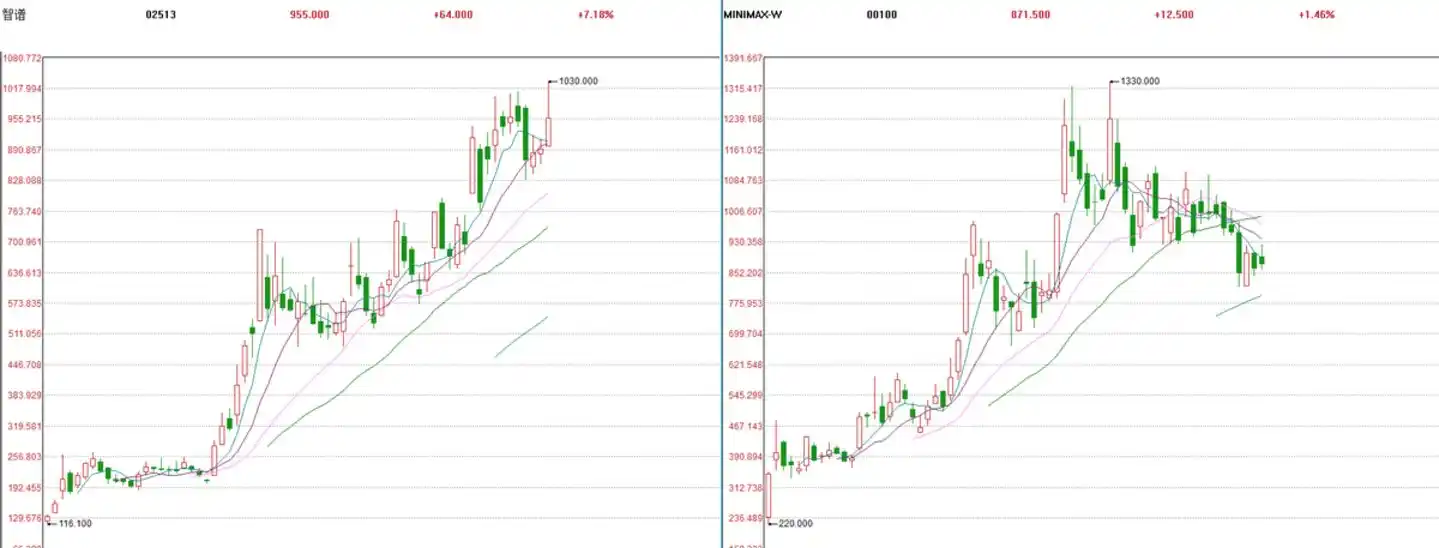
The soaring ARR of Anthropic, Zhipu, and MiniMax reveals that industry competition has entered a stage of commercialization race centered around computing power, talent, products, and ecosystems.
Pure technological idealism is no longer sufficient to support an AI company's continuous leadership in the industrialization process, nor can it solidify the confidence of top talent to stay.
DeepSeek Needs an Anchor to Price the "Ideal"
Why is talent leave?
The numbers on compensation are the most straightforward account.
DeepSeek's absolute salaries are not low within the industry, but competitors offer conditions that are "no problem to double or triple," with some even providing eight-figure total packages. For instance, behind Luo Fuli's departure was Lei Jun personally stepping in to recruit with a tens-of-millions salary.
Behind this lies a profound talent inflation happening in the AI industry. A 2025 report from Liepin indicated that China's AI talent gap has exceeded 5 million. McKinsey predicted that China's demand for AI professionals would increase sixfold by 2030 compared to 2022.
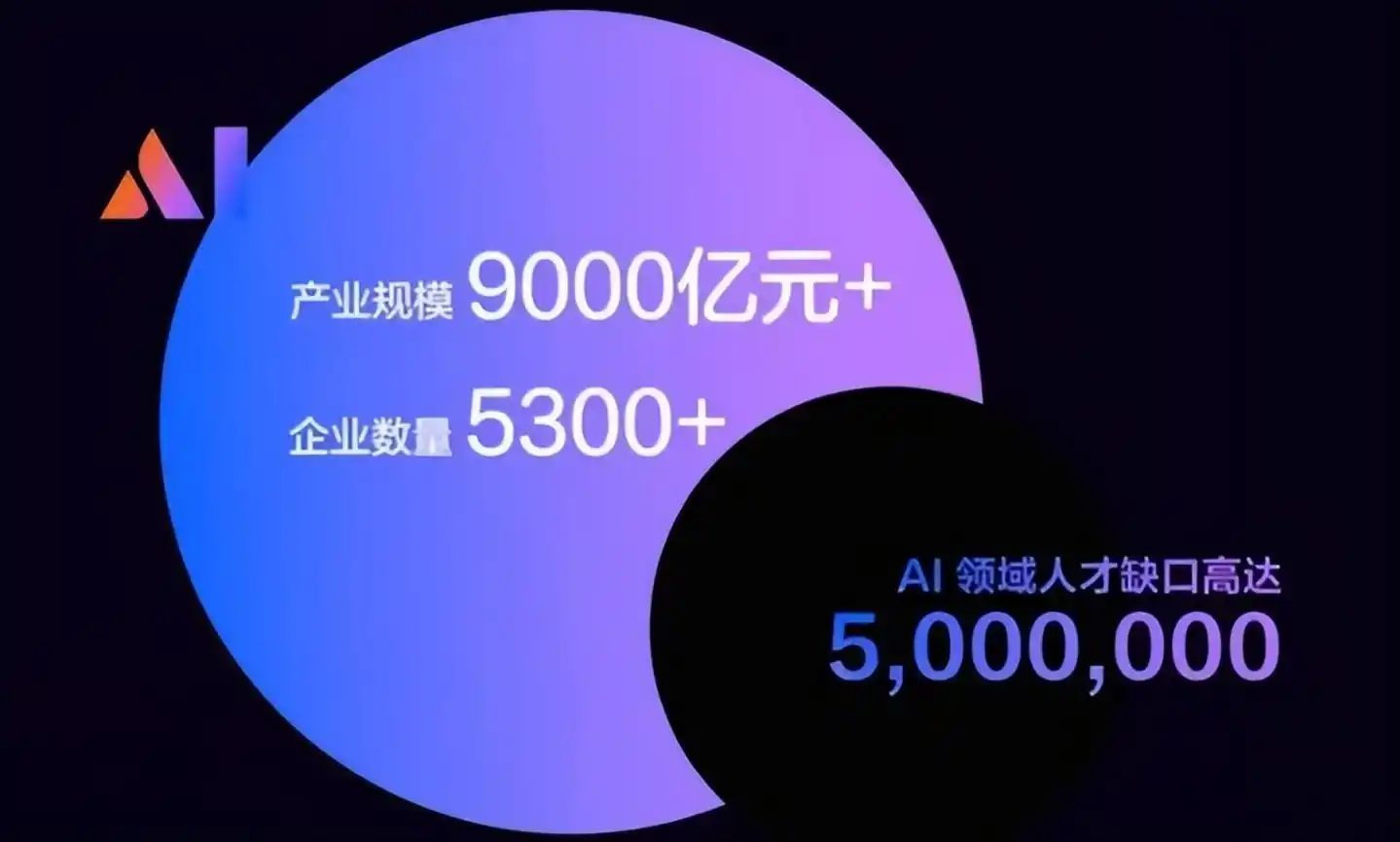
Image Source: Liepin 2025 Annual Talent Supply and Demand Trends Report
Capital giants are pricing top brains at an almost frantic pace, using proven talent to hedge against their own R&D uncertainties.
But the high salaries offered by giants are only the first reason; more致命 (fatal) than the salary figures is the uncertainty caused by the stock options themselves being "unpriced."
The challenge DeepSeek faces is not just a gap in base amount, but more critically, its options lack a market-based price benchmark for comparison.
DeepSeek has never accepted any external funding since its inception, so the options held by employees rely entirely on internal valuation. Before external institutions confirm the price with real money, this paper wealth lacks sufficient liquidity and a premium anchor in the eyes of top AI talent. Without IPO expectations, no equity变现 (liquidation) channel, and no comparable valuation anchor, this option is merely an un-cashable promissory note.
Liang Wenfeng might not need VC money to keep the company running, but he lacks a market-validated "price anchor."
With this anchor, DeepSeek's options transform from an elusive concept into a financial asset with fair value, and the organizational incentive mechanism shifts from idealism to market logic.
$300 million is not a large figure in today's AI赛道 (arena). For DeepSeek, it means giving up only 3% equity to gain market value recognition and reconstruct DeepSeek's talent incentive mechanism. Under the iron law of "talent is everything" in the AI industry, this might be a more pragmatic step than any technological breakthrough.
Beyond this, where Liang Wenfeng spends this money speaks louder than the fundraising itself.
From Research Institution to Ecosystem Player: The V4 Bet on Domestic Computing Power
The real reason for V4's delay was never a technical bottleneck.
Previously, a Reuters report disclosed a detail: After the release of DeepSeek R1, relevant authorities encouraged the company to adopt Huawei's Ascend processors.
An informed source told the press that over the past few months, DeepSeek's engineers have been engaged in a thankless task: migrating the entire V4 from Nvidia's CUDA ecosystem to Huawei Ascend's CANN architecture.
To do this, DeepSeek had to rewrite underlying code, adjust communication libraries and training frameworks, and perform precision alignment of the model's outputs on different hardware. But it was a strategic shift that had to be made.
Why was it absolutely necessary?
From an industry chain logic perspective, under the US export controls on high-end chips, this is a guarantee for long-term secure and stable development.
Nvidia CEO Jensen Huang stated bluntly in a recent interview: "New models based on domestic hardware platforms could be a bad outcome for the US." He worries that once top AI models are optimized to perform better on domestic chips, the ecosystem moat Nvidia has built over years will no longer be secure.
Escalating US export controls caused Nvidia's share of China's high-end AI chip market to drop from a former 95% directly to zero.
If V4 succeeds, it will become the world's first cutting-edge large model not reliant on Nvidia.
It's worth mentioning that having a cutting-edge model alone is not enough; today's AI competition is no longer a single-point game of "whoever has the most parameters wins."
An industry insider summarized the current landscape in one sentence: Whoever can build a complete ecological closed loop at the application layer can truly survive.
In this regard, ByteDance's strategy is to decompose AI capabilities into reusable "building blocks" embedded into product lines like Douyin, Jiemeng, Feishu, etc., forming a "product matrix + AI mid-platform" building block layout. Tencent directly reached into WeChat, which boasts 1.2 billion users, launching the ClawBot plugin allowing users to call AI agents without jumping apps. Even Zhipu AI achieved scaled revenue on the coding track; after the release of GLM-5.1, the配套 (supporting) Coding Plan subscription一度 (once) "sold out instantly."
In comparison, DeepSeek's shortcomings are clear.
DeepSeek lacks a super app entry point like Douyin or WeChat, and also lacks a commercially proven closed loop. Its powerful models and open-source community reputation are its moat, but it明显滞后 (lags noticeably) in end products, multimodal capabilities, and Agent ecosystem.
In other words, DeepSeek is still fighting the war of the ecosystem era with a model-era mindset, which is not just being half a step slow, but running on the wrong track.
Considering long-term competition, the deeper strategic intent behind the fundraising is to announce DeepSeek's formal entry into the "second half" of AI ecosystem competition.
Introducing external capital means DeepSeek's corporate governance structure will become more standardized, transforming into a commercial entity that must face market tests and answer to investors.
This step is DeepSeek's entry ticket to transform from a research institution into an industry-level player.
Whether V4 can prove itself on domestic computing power, and whether the funding can leverage it to补齐 (fill) the shortcomings at the application layer, will determine its possibility of metamorphosing (蜕变为) from a "dark horse in technology" to an "ecosystem player." And this transformation requires far more than $300 million.
A new storm has just appeared.




















