Crypto May Be Loud Online, But Only 4% Of Voters Care: Poll

bitcoinistPublished on 2026-05-14Last updated on 2026-05-14

Abstract

A Politico survey reveals a stark disconnect between crypto industry lobbying and U.S. voter priorities. While crypto groups have spent over $130 million on the 2024 elections, only 4% of voters say a candidate's position on crypto would influence their vote. Affordable housing, consumer fraud protection, and lower bank fees rank as far more important issues for voters. The poll also shows public ambivalence toward digital assets. Only 27% support government efforts to make crypto mainstream, while 31% oppose it. Over half of respondents have never traded crypto and don't plan to. Among those who have traded, 7% say a candidate's stance would sway their vote. Furthermore, 45% view crypto investing as a risk not worth taking. Despite low voter interest, Congress is advancing crypto regulation. The Senate Banking Committee is set to vote on a regulatory framework bill, a version of which already passed the House in June.

A separate poll released Friday by HarrisX found that 47% of registered voters said they would consider crossing party lines to support a candidate who backed crypto regulation legislation — a figure that stands in sharp contrast to new data showing crypto barely moves the needle for most Americans when they head to the polls.

The Lobbying Machine Behind The Legislation

The Politico survey, conducted by polling firm Public First and covering 2,035 US adults, found that only 4% of respondents would factor a candidate’s position on crypto into their voting decision.

Source: Politico

Affordable housing topped the list of issues voters want Congress to address, followed by consumer fraud protection and lower bank fees. Crypto regulation came in last.

That gap between voter priorities and industry muscle is hard to ignore. Crypto lobbies spent more than $130 million during the 2024 elections — more than any other industry — and have already committed $320 million to shape the upcoming November midterms, according to data compiled by researcher Molly White.
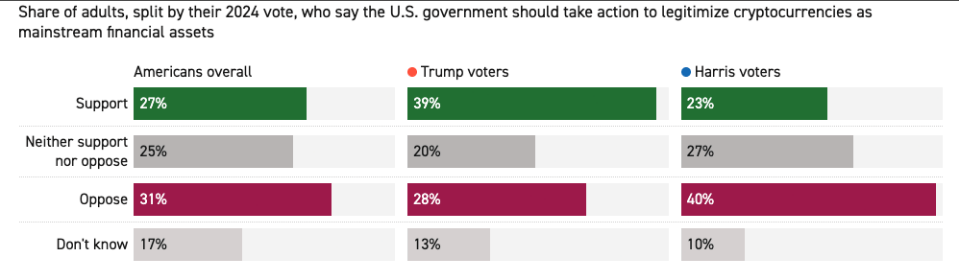
Survey results on public opinion regarding whether the US government should formally adopt crypto as a mainstream financial asset. Source: Politico.

In Illinois alone, crypto-aligned PACs have spent over $5.5 million opposing specific congressional candidates this year.

BTCUSD currently trading at $79,593. Chart: TradingView

Republican Representative Dusty Johnson acknowledged the disconnect. Most voters don’t think about digital assets, he told Politico, but those who do feel strongly about it. He described it as a high-intensity issue that is slowly growing in public awareness, even if the numbers remain small.

A Public Still Divided On Digital Assets

The survey also captured a broader wariness toward crypto among ordinary Americans. Only 27% said they support or strongly support the US government taking steps to make crypto a mainstream financial asset.

A slightly larger share — 31% — said they oppose or strongly oppose such a move. More than half of respondents said they had never traded crypto and had no plans to do so.

Image: Pexels

Among the 19% who had actually traded crypto, 7% said a candidate’s stance on the issue would influence their vote. The poll also found that 45% of respondents considered crypto investing a risk not worth taking, even with the promise of high returns. Only 25% disagreed.

Senate Moving On Crypto Regulation This Week

Meanwhile, Congress is pushing ahead. The Senate Banking Committee is set to vote on whether to advance a long-awaited bill that would establish a regulatory framework for the crypto industry.

A version of the bill — known as the Clarity Act — already cleared the House in June. Reports indicate the White House has been involved in negotiations between crypto interests and banking lobbies to shape the final version.

Featured image from Unsplash, chart from TradingView

Trending Cryptos

Related Questions

QAccording to the poll, what percentage of voters would factor a candidate's position on crypto into their voting decision?

AAccording to the Politico survey, only 4% of respondents would factor a candidate's position on crypto into their voting decision.

QWhat issue topped the list of voter priorities that they want Congress to address, as revealed in the article?

AAffordable housing topped the list of issues voters want Congress to address, according to the survey.

QHow much money did crypto lobbies spend during the 2024 elections, and how does this compare to other industries according to the data cited?

ACrypto lobbies spent more than $130 million during the 2024 elections, which was more than any other industry.

QWhat percentage of survey respondents support the US government taking steps to make crypto a mainstream financial asset?

AOnly 27% of survey respondents said they support or strongly support the US government taking steps to make crypto a mainstream financial asset.

QWhat legislative action is the Senate Banking Committee set to take regarding crypto, as mentioned in the article?

AThe Senate Banking Committee is set to vote on whether to advance a long-awaited bill, known as the Clarity Act, which would establish a regulatory framework for the crypto industry.

Related Reads

From South Korea to the United States: Blue-Collar Jobs Are Becoming Increasingly Popular, Thanks to AI

AI is reshaping the labor market's value proposition. The traditional four-year college degree is losing its appeal as a guaranteed career path, while skilled blue-collar trades like electricians, welders, and plumbers are experiencing historic demand and wage premiums. This shift is driven by dual pressures: AI's displacement of certain white-collar roles and a booming need for physical infrastructure and data center construction. Data confirms the trend. In the U.S., vocational school revenue surged, and a significant portion of recent layoffs are AI-related. Surveys show a majority of Gen Z adults plan to pursue blue-collar work, citing better job security against AI automation. Vocational education interest has exploded recently. Experts cite a psychological shift as younger generations seek tangible, AI-resistant careers and avoid high student debt. In many cases, salaries for skilled trades now match or exceed those requiring a bachelor's degree. In South Korea, semiconductor vocational high schools boast near-total employment, with graduates securing high-paying roles at companies like Samsung. The shortage is structural, exacerbated by a retiring baby boomer workforce and massive infrastructure projects. Companies like JPMorgan Chase, Meta, and Lowe's are investing heavily in training programs. However, overcoming historical stigma and a "perception gap" around trade careers remains a key challenge to closing the talent gap.

marsbit51m ago

From South Korea to the United States: Blue-Collar Jobs Are Becoming Increasingly Popular, Thanks to AI

marsbit51m ago

Qualcomm: AI Hype Subsides, When Will Smartphones Emerge from the Gloom?

Qualcomm reported its Q3 FY2026 results (ending June 2026), with revenue of $9.95B, down 4% YoY but above expectations. Gross margin declined to 53.1%, pressured by rising costs across manufacturing and memory. Key business segments showed mixed performance: Handset revenue fell 19.6% YoY to $5.09B, dragged by an 11% decline in non-Apple Android shipments and weaker high-end mix. Conversely, Automotive revenue surged 61% to $1.59B, and IoT grew 9% to $1.83B. Core operating profit dropped 41% YoY due to margin compression and higher expenses. Management's Q4 FY2026 guidance projects revenue of $9.7B-$10.5B, in line with consensus, but Non-GAAP EPS guidance of $2.05-$2.25 fell short of expectations. Amidst persistent weakness in its core handset market, Qualcomm is pursuing growth in AI, focusing on Edge AI (smartphones, PCs, automotive) and Data Center AI. Its data center strategy includes four pillars: AI accelerators (e.g., AI200), commercial CPUs (Dragonfly C1000), custom silicon, and connectivity solutions. While these initiatives initially boosted its stock, concerns over AI capital expenditure sustainability have since erased those gains. The company targets $5B in data center revenue for FY2027 and $15B for FY2029. The report concludes that with the traditional handset business still under pressure, the data center opportunity is currently viewed as a longer-term option, and a more conservative valuation based on core operations may be warranted until AI contributions materialize.

marsbit55m ago

Qualcomm: AI Hype Subsides, When Will Smartphones Emerge from the Gloom?

marsbit55m ago

From TPU to Self-Evolving Agents: How Jeff Dean Predicts the Next Step in AI

At the 2026 YC Startup School, Jeff Dean outlined his vision for AI's next phase, shifting focus from simply scaling models to building intelligent, autonomous systems. He believes AI's progress is no longer just about creating smarter models, but about integrating them into systems capable of long-term, iterative work, automated experimentation, and continuous learning. This evolution moves the competition from "who has the bigger model" to "who can best organize intelligence." Dean suggests AI capabilities are now comparable to a junior engineer, enabling the automation of complex workflows. However, the true challenge and opportunity lie in managing these AI "workers" at scale. He emphasizes the importance of **context engineering**—structuring tools, memory, and feedback loops—over raw model power. For startups, this means building deep expertise in niche domains where general models currently fail (near 0-1% success rates), leveraging proprietary data, specialized tools, and domain-specific evaluators. A recurring theme is re-examining fundamental constraints. Dean's past work, like moving Google's search index to memory or creating the TPU, stemmed from questioning outdated assumptions about hardware and cost. He sees similar inflection points today, particularly in **specialized inference hardware** to drastically reduce latency and energy consumption for real-time Agent operation. Notably, he points out that in modern AI systems, the dominant cost is often not computation but **data movement**. Reliable, long-running Agents require robust system design, borrowing concepts from distributed computing like checkpointing, state management, and parallel exploration to handle failures and maintain progress over days or weeks. As AI automates execution, the scarcest human skills will shift to **defining clear specifications**, **judging what problems are worth solving** (taste), and designing effective feedback loops. Ultimately, Dean's framework prioritizes understanding the problem deeply, identifying the true bottlenecks, and systematically building closed-loop systems where AI can not only perform tasks but also improve AI itself.

marsbit55m ago

From TPU to Self-Evolving Agents: How Jeff Dean Predicts the Next Step in AI

marsbit55m ago

Trading

Spot

Hot Articles

How to Buy 4

Welcome to HTX.com! We've made purchasing 4 (4) simple and convenient. Follow our step-by-step guide to embark on your crypto journey.Step 1: Create Your HTX AccountUse your email or phone number to sign up for a free account on HTX. Experience a hassle-free registration journey and unlock all features.Get My AccountStep 2: Go to Buy Crypto and Choose Your Payment MethodCredit/Debit Card: Use your Visa or Mastercard to buy 4 (4) instantly.Balance: Use funds from your HTX account balance to trade seamlessly.Third Parties: We've added popular payment methods such as Google Pay and Apple Pay to enhance convenience.P2P: Trade directly with other users on HTX.Over-the-Counter (OTC): We offer tailor-made services and competitive exchange rates for traders.Step 3: Store Your 4 (4)After purchasing your 4 (4), store it in your HTX account. Alternatively, you can send it elsewhere via blockchain transfer or use it to trade other cryptocurrencies.Step 4: Trade 4 (4)Easily trade 4 (4) on HTX's spot market. Simply access your account, select your trading pair, execute your trades, and monitor in real-time. We offer a user-friendly experience for both beginners and seasoned traders.

5.0k Total ViewsPublished 2025.10.20Updated 2026.06.02

How to Buy 4

Discussions

Welcome to the HTX Community. Here, you can stay informed about the latest platform developments and gain access to professional market insights. Users' opinions on the price of 4 (4) are presented below.

活动图片