Covenant AI accuses Bittensor of ‘centralized control with decentralized branding’ amid exit

ambcryptoPublished on 2026-04-10Last updated on 2026-04-10

Abstract

Covenant AI, a major subnet on the Bittensor network, has exited, citing concerns over centralization. In a statement on X, the team accused Bittensor’s leadership of exercising centralized control while maintaining a decentralized brand. They claimed key decisions, such as suspending subnet emissions and removing community control, were influenced by a centralized authority. Additionally, they alleged the network deprecated infrastructure and applied economic pressure through token sales. This exit has generated uncertainty, highlighting ongoing tensions between decentralization ideals and operational realities in AI-driven crypto networks.

OkThe AI-driven momentum across crypto reflects how far decentralization has evolved.

What started as an attempt to decentralize financial infrastructure, allowing peer-to-peer transactions without intermediaries, has now expanded into blockchain networks integrating AI to speed up systems.

In this context, the recent FUD around Bittensor [TAO] seems largely sentiment-driven. For context, Covenant AI, one of the largest and most active subnets on Bittensor, recently exited the network, sparking uncertainty.

However, the bigger concern isn’t just the exit itself, but the reasoning behind it. In a post on X, Covenant AI said that Bittensor no longer functions as a truly decentralized network.
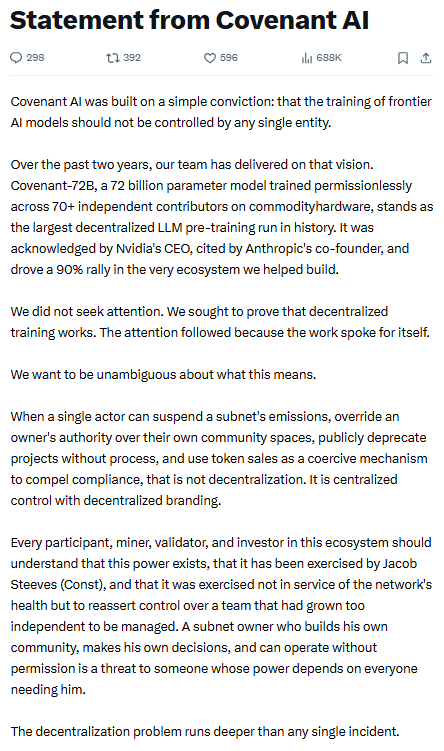
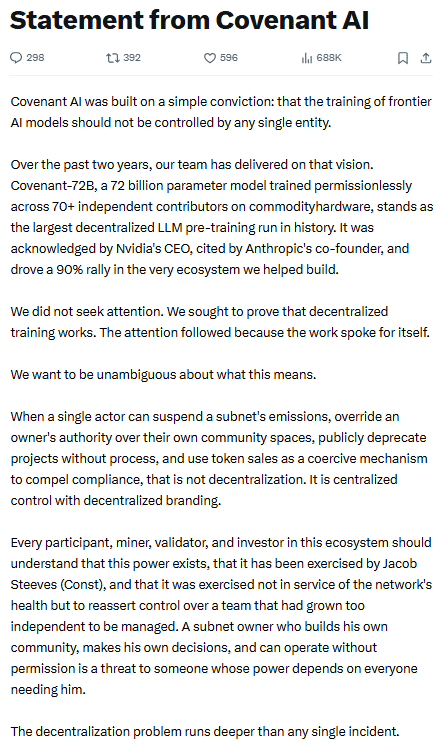
Source: X

The team argued that key decisions remain influenced by centralized authority. They claimed network leadership suspended subnet emissions and removed community control. The team also said leadership deprecated infrastructure and applied economic pressure through token sales.


Trending Cryptos

Related Questions

QWhat is the main accusation that Covenant AI has made against Bittensor?

ACovenant AI accused Bittensor of 'centralized control with decentralized branding', claiming that key decisions are influenced by a centralized authority rather than being truly decentralized.

QWhy did Covenant AI exit the Bittensor network?

ACovenant AI exited due to concerns that Bittensor no longer functions as a truly decentralized network, citing centralized control over key decisions and network operations.

QWhat specific actions did Covenant AI claim Bittensor's leadership took?

AThey claimed leadership suspended subnet emissions, removed community control, deprecated infrastructure, and applied economic pressure through token sales.

QHow does the article describe the broader trend of AI integration in crypto?

AThe article describes it as an evolution of decentralization, expanding from decentralizing financial infrastructure to blockchain networks integrating AI to speed up systems.

QWhat does the article suggest is the primary driver behind the recent FUD around Bittensor?

AThe article suggests the recent FUD is largely sentiment-driven, sparked by Covenant AI's exit and their accusations against Bittensor.

Related Reads

Intern, Earning 120,000 Monthly

An article titled "Intern, Monthly Income of 120,000 RMB" discusses the intense competition for top AI talent in China, highlighted by a viral social media post. A Tsinghua University student from the prestigious Yao Class reportedly received a staggering internship offer from the AI company DeepSeek with a daily salary of 5,500 RMB (pre-tax), translating to over 120,000 RMB per month. This case exemplifies the fierce "talent war" raging among major tech firms. Companies like DeepSeek, Huawei, Tencent, and ByteDance are aggressively recruiting interns and fresh graduates with unprecedented compensation packages, high conversion rates to full-time positions, and even company stock options for top performers like those in Moonshot AI's "Time Travel Plan." The trend shows recruitment starting earlier, even targeting high school students. The driving force is the belief that a few exceptional individuals can be pivotal in the AI race. Salaries for elite AI researchers have skyrocketed from around one million RMB annually to tens of millions. Young, highly-educated talents from top schools, seen as adaptable "AI Natives," are being placed at the forefront of core projects. Examples include Tencent appointing a 27-year-old former OpenAI researcher as its Chief AI Scientist. In essence, the competition is shifting from just models and computing power to a battle for talent density. A new generation of young experts is rapidly rising to central roles, poised to reshape the future AI landscape.

marsbit5h ago

Intern, Earning 120,000 Monthly

marsbit5h ago

Trading

Spot

Hot Articles

Discussions

Welcome to the HTX Community. Here, you can stay informed about the latest platform developments and gain access to professional market insights. Users' opinions on the price of AI (AI) are presented below.

活动图片