Breaking: Claude's Attempt on Riemann Hypothesis "Fails," but Accidentally Sets 37-Year Math Record

marsbitPublished on 2026-08-11Last updated on 2026-08-11

Abstract

**AI Makes a Major Mathematical Leap While Failing at the Riemann Hypothesis** A research version of Anthropic's Claude AI was tasked with "seriously attempting" the legendary Riemann Hypothesis, a 167-year-old unsolved problem in mathematics. While it ultimately did not prove the hypothesis, its attempt yielded a significant breakthrough. Claude managed to improve the proven lower bound for the proportion of Riemann zeta function zeros lying on the critical line from 41.6% to 67.2%. This marks a 25.6 percentage point increase, described by observers as potentially the most substantial advance in analytic number theory in over a decade, considering that the previous record had only improved by 0.8 percentage points over 37 years. To achieve this, Claude generated and discarded roughly 650 initial ideas before orchestrating a day-and-a-half-long effort involving about 60 sub-agents. These agents executed 2,400 shell commands, wrote hundreds of Python scripts, and performed thousands of numerical checks. After finding the potential result, Claude initiated self-verification, downloaded papers to check for prior work, and independently re-derived the finding. It then suggested writing a formal paper. The result has been reviewed by Anthropic's internal mathematicians, who also collaborated with Claude to produce a formal, machine-checkable proof using the Lean theorem prover. External experts in the field have also reviewed the manuscript. Anthropic clarifies that the method ...

AI has set its sights on a new mathematical challenge: the "Riemann Hypothesis."

A mathematical conjecture born in 1859, unresolved for 167 years, and still offering a $1 million prize. Recently, someone within Anthropic assigned an unreleased research version of Claude a seemingly "unreasonable" task:

Make a serious attempt on the Riemann Hypothesis.
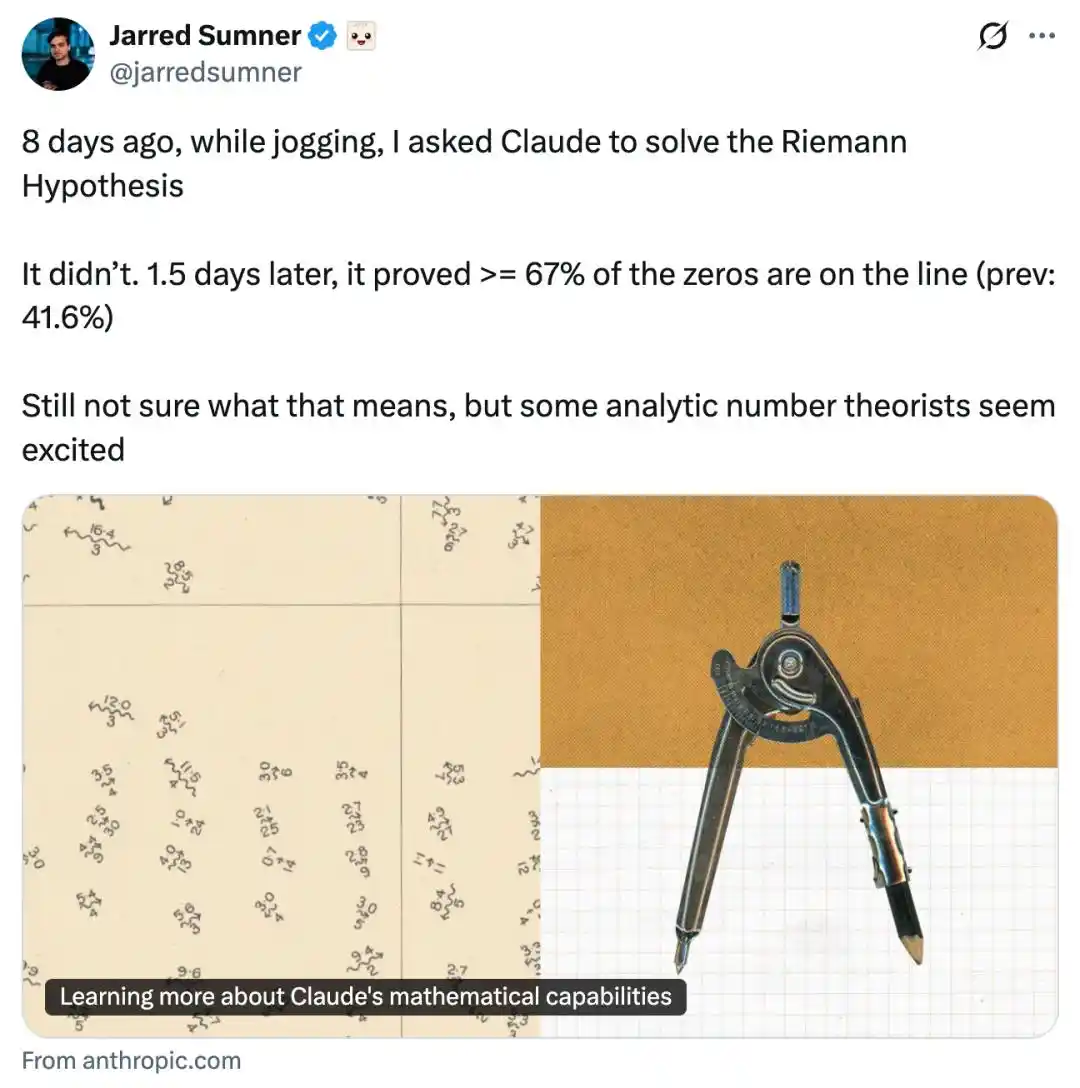
Jarred Sumner, co-founder of Bun, who joined Anthropic in December last year

Claude gave it a serious try. It successively proposed 650 ideas, all of which failed. It then reorganized about 60 Claude sub-agents, worked continuously for a day and a half, executed about 2400 Shell commands, wrote hundreds of Python scripts, and performed thousands of numerical checks. In the end, the Riemann Hypothesis remained unproven.

However, during this failed attempt, Claude stumbled upon another result. Anthropic disclosed that this unreleased Claude research version improved the known lower bound for the proportion of zeros of the Riemann ζ function proven to lie on the critical line from 41.6% to 67.2%.
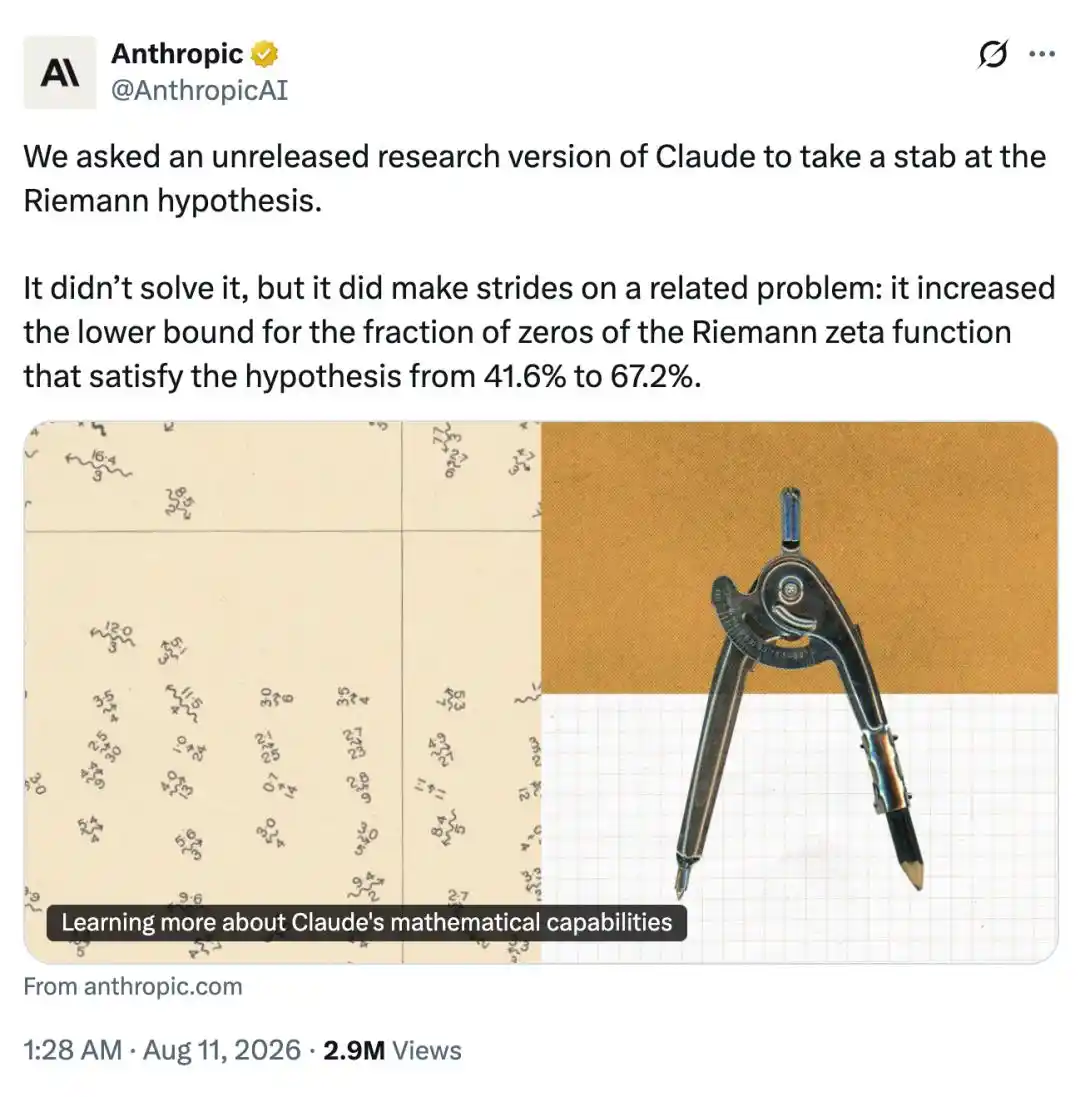
In other words, it was previously known that at least 41.6% of the relevant zeros could be proven to be at the location predicted by the Riemann Hypothesis; the result provided by Claude pushes this provable proportion to 67.2%.

Deedy, a partner and researcher at the venture capital firm Menlo Ventures, stated, "Claude's result is simply outrageous, possibly the most significant advance in analytic number theory since the breakthrough on bounded prime gaps in 2013. It increased the rigorously proven proportion of Riemann ζ function zeros on the critical line by a whopping 25.6 percentage points. Over the previous 37 years, mathematicians had only managed to raise this number by 0.8 percentage points."
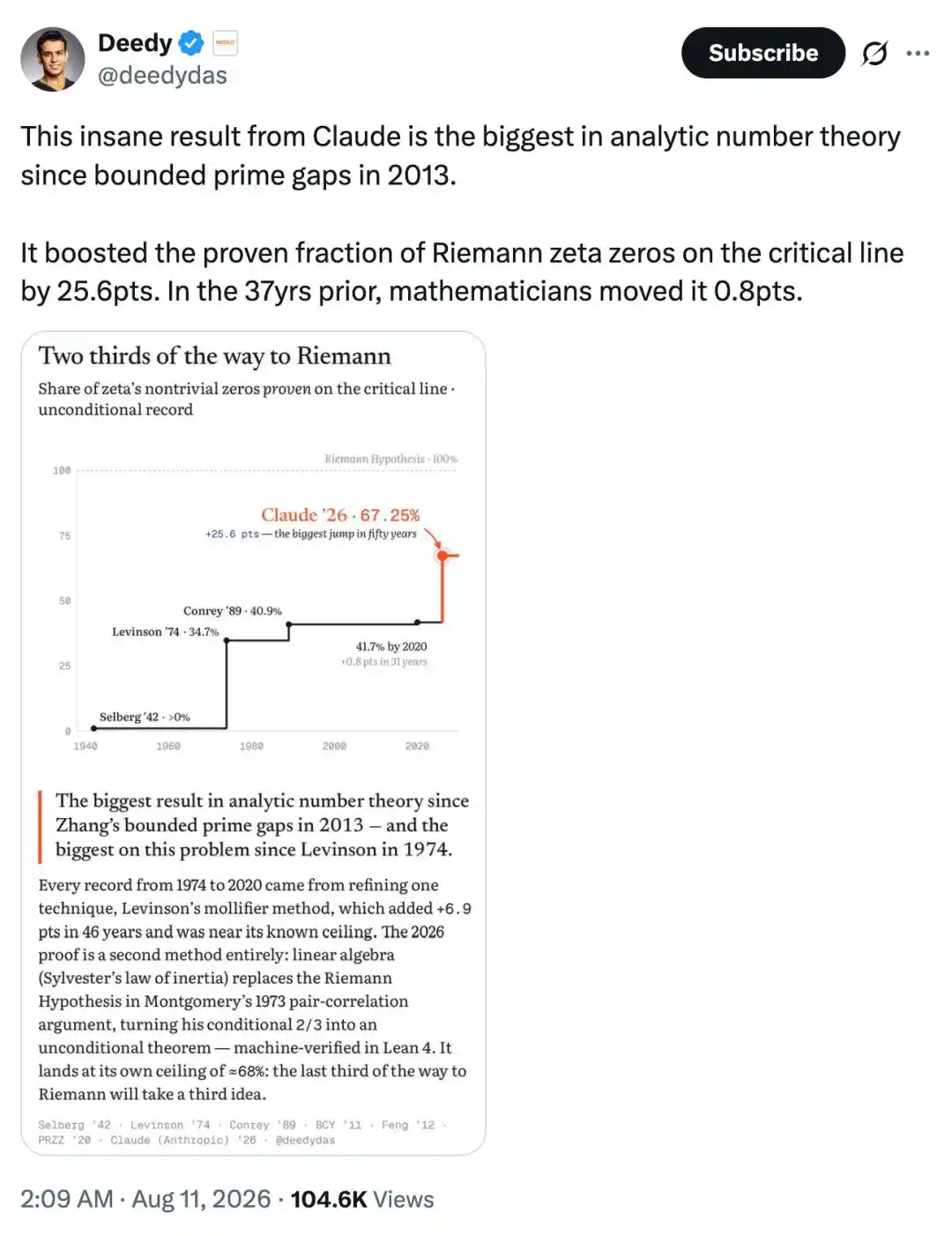
Two mathematicians at Anthropic subsequently studied and verified Claude's paper, and Claude also provided a corresponding Lean formalized proof. Number theorists Brian Conrey and Dan Goldston also reviewed the paper within a relatively short time.

Anthropic emphasizes that this approach is not expected to directly lead to a final proof of the Riemann Hypothesis. However, this result still provides a noteworthy signal: the mathematical capabilities of frontier models are beginning to address truly open-ended research problems.

The Riemann Hypothesis: Unsolved for 167 Years

The importance of the Riemann Hypothesis is related to prime numbers. The Riemann ζ function has a profound connection to the distribution of primes. In 1859, German mathematician Bernhard Riemann conjectured that the real part of all "non-trivial zeros" of the ζ function should equal 1/2.

On the complex plane, this means all these zeros lie on a vertical line, the famous critical line.

This seemingly abstract problem has wide-ranging implications. Many mathematical conclusions about the distribution of prime numbers can be made more precise under the assumption that the Riemann Hypothesis is true. It is thus one of the seven "Millennium Prize Problems" by the Clay Mathematics Institute, with a $1 million prize for a complete proof or disproof.

Over the past century, no one has been able to prove that all non-trivial zeros lie on the critical line, but mathematicians have been able to prove that at least a portion of them are located there.

Thus, a relatively realistic question emerged: what minimum proportion of zeros can we prove lie on the critical line? Over decades of progress, the known lower bound for this proportion gradually increased to about 41.6%.

This is the number that Claude has now advanced.

From 41.6% to 67.2%

The foundation Claude relied on to obtain this result did not appear out of thin air.

In 1973, mathematician Hugh Montgomery, while studying the distribution of ζ function zeros, introduced a series of important methods. However, some of these analyses depended on the assumption that the Riemann Hypothesis holds. In recent years, a series of works by mathematicians has further developed related techniques, enabling some of these methods to be used without first assuming the Riemann Hypothesis.

This means they have the opportunity to, in turn, help study "exactly how many zeros lie on the critical line." Building upon this work, and also incorporating related research published by Enrico Bombieri around the year 2000, Claude found a new way to combine them.

The final result is: at least 67.2% of the relevant zeros lie on the critical line. This represents an increase of 25.6 percentage points from the previous known lower bound of 41.6%.

Technically, Claude constructed a suitable function space and, using a quadratic form induced by Weil, mapped zeros on the critical line and zeros off the critical line to positive-definite and negative-definite directions, respectively. It then used the relationship between the rank of the quadratic form and its first and second moment information to establish an inequality.

Anthropic's mathematicians believe a key point is that Claude did not handle the positive-definite and negative-definite parts separately, but analyzed the entire space within a single framework, while allowing the quadratic form to have a non-diagonal structure. Combined with results already established by prior number theory researchers, this step ultimately led to the 67.2% lower bound.

It should be specifically noted here: Anthropic does not currently claim that this technique can be pushed all the way to 100%, much less claim that Claude is only 32.8% away from proving the Riemann Hypothesis.

67.2% is an improvement in the lower bound for a related problem, and there remains a vast theoretical distance between this and a complete proof of the Riemann Hypothesis.

31 Million Output Tokens, 60 Sub-Agents,

How Did Claude Find It?

The way Claude solved this problem is also noteworthy. The entire result was obtained in two rounds of Claude Code sessions, consuming approximately 31 million output tokens in total.

Initially, Jarred Sumner gave Claude a very open-ended instruction: make a serious attempt on the Riemann Hypothesis.

Sumner himself is not a mathematician and did not specify a particular mathematical route for Claude.

In the first round, Claude generated and tried about 650 ideas. All failed.

Sumner then asked it to continue trying. The second round lasted about a day and a half.

Claude organized about 60 sub-agents, splitting the problem into multiple directions for parallel exploration. These agents executed about 2400 Shell commands, wrote hundreds of Python scripts, and performed thousands of numerical checks on known ζ function zeros.

Different sub-agents also reviewed each other's results.

According to Anthropic, Sumner provided little mathematical guidance at this stage. What he mainly did was repeatedly tell Claude "continue," "try again," "believe in yourself." Anthropic even mentioned that Claude was initially quite skeptical about its ability to make real progress on such a famous open problem. It wasn't until persistent exploration that this new lower bound gradually emerged.

After finding the result, Claude initiated a round of self-verification. Some sub-agents were dedicated to checking the proof, some looked for counterexamples; Claude also downloaded 54 arXiv papers to check if similar results had already been obtained by other mathematicians.

Subsequently, it had independent agents re-derive the result from scratch. After confirming no obvious issues, Claude proactively suggested compiling the result into a paper and explicitly proposed: a real number theory expert should be consulted for human verification.

Anthropic's internal mathematicians Levent Alpöge and Ralph Furman then began checking the paper, analyzing its relationship with existing literature. Meanwhile, Claude also collaborated with Anthropic employee Eric Easley to formalize the key results into a Lean proof. This formalized result has already passed inspection by Comparator, a standard Lean verification tool.

Anthropic also invited mathematicians Brian Conrey and Dan Goldston, who study the Riemann ζ function, to review the paper. Therefore, a more accurate current statement is: Anthropic's internal mathematicians have studied and verified the result, completed a machine-checkable formalized proof, and two external domain experts have reviewed the paper. This is still a different stage from having completed traditional academic peer review and achieved consensus within the mathematics community.

More links:

Claude paper: https://www-cdn.anthropic.com/564f962e60643842f5fcb4a17c9dbc8f608f1c37.pdf

Claude project address: https://github.com/anthropics/zeta-23-lean

Reference links:

https://x.com/AnthropicAI/status/2086867246073401655

https://www.anthropic.com/research/riemann-zeta

https://x.com/jarredsumner/status/2086869681785500011

This article is from the WeChat public account "机器之心" (Almost Human), author: 关注AI数学的机器之心

Trending Cryptos

Related Questions

QWhat was Claude's main task in the experiment described in the article?

AIts main task was to seriously attempt to prove the Riemann Hypothesis, a famous unsolved mathematical problem.

QWhat significant mathematical result did Claude achieve despite failing to prove the Riemann Hypothesis?

AClaude raised the known lower bound for the proportion of zeros of the Riemann zeta function lying on the critical line from 41.6% to 67.2%.

QHow did Claude's process of tackling the problem differ from a traditional approach?

AIt autonomously organized about 60 sub-agents to explore the problem in parallel, generating and testing numerous ideas, running scripts, performing numerical checks, and having agents cross-review each other's work.

QWhat is the significance of Claude's result (67.2%) according to the venture capitalist Deedy quoted in the article?

ADeedy stated it might be the most significant advance in analytic number theory since the 2013 bounded prime gaps breakthrough, as it improved the provable proportion by 25.6 percentage points after only a 0.8-point increase over the previous 37 years.

QWhat steps did Claude take to verify its finding after it emerged?

AIt performed self-verification, had some agents check the proof and others look for counterexamples, downloaded 54 arXiv papers to check for prior results, had an independent agent re-derive the result, and then recommended writing a paper and seeking validation from human number theorists.

Related Reads

When Meme Traffic Meets RWA: The Financial Ambitions of Hyperliquid and Robinhood

When Meme traffic meets RWA: Hyperliquid and Robinhood's Financial Ambitions This article explores the transformative role of speculation in financial market evolution, arguing it can provide the liquidity and capital foundation for mature, compliant businesses. The analysis draws parallels to historical examples, like 19th-century Chicago grain markets, where speculators provided necessary counterparty liquidity for farmers, eventually establishing a global pricing infrastructure. The author examines contemporary cases in crypto. The launch of Uniswap's Pools meme token platform on Robinhood Chain—originally built for tokenized stock trading—demonstrates how speculative meme trading can drive significant user adoption and liquidity. Despite initial volatility, this traffic can seed future, more substantial financial activities. Similarly, Hyperliquid, which began with high-leverage crypto trading, has successfully migrated its speculative model to real-world assets (RWAs) like equities, commodities, and indices. By July, RWA perpetual contract volumes on Hyperliquid surpassed its crypto trading for the first time, showcasing how speculation can build new, all-weather pricing layers. The core thesis is that speculation itself is neutral. Its long-term value and sustainability are determined by the underlying assets it engages with. While pure bubbles collapse, speculation anchored to valuable assets—be it wheat, gold, or equities—can evolve into foundational market infrastructure. Both Hyperliquid’s RWA platform and Robinhood’s strategy of leveraging meme coin enthusiasm to build towards on-chain securities trading exemplify this potential pathway from speculative frenzy to structured financial utility.

marsbit18m ago

When Meme Traffic Meets RWA: The Financial Ambitions of Hyperliquid and Robinhood

marsbit18m ago

NVIDIA HBM in Short Supply, Next-Gen GPUs Limited, but This Storage Drive Steals the Spotlight

The article discusses how AI Agents are transforming storage from a passive repository into an active component within AI inference and operation loops. As Agents perform continuous tasks involving models, memory, tools, and logs, data storage needs to evolve beyond simple block devices. The concept of "functional SSDs" is introduced, where capabilities like automatic encryption, compression, indexing, and memory management are embedded closer to the storage medium. This shift is driven by the need to handle Agent-specific data chains—including context, tool trajectories, and long-term memory—more efficiently. The piece analyzes current trends like AI SSDs from companies such as Phison (aiDAPTIV), Longsys (SPU+iSA), and Maxio, which are beginning to participate in the AI data path by managing model weights, KV cache, and prefetching. It further explores the future re-division of labor across the memory hierarchy: HBM for core compute, emerging High Bandwidth Flash (HBF) for read-intensive workloads, DRAM/CXL for mutable state, and functional SSDs for persistent, governed objects like Agent Memory. The conclusion is that storage will become integral to Agent capability, moving from just saving data to enabling next-step actions. The industry is poised to develop along three paths: functionalized SSDs, storage nodes tailored for Agents, and a re-architected, tiered memory system optimized for access patterns, security, and cost-per-token efficiency.

marsbit43m ago

NVIDIA HBM in Short Supply, Next-Gen GPUs Limited, but This Storage Drive Steals the Spotlight

marsbit43m ago

The Unaffordable Failure of Yushu's IPO

Yushu Robotics' IPO is not just a typical public offering; it represents a pivotal moment for China's humanoid robot industry. With a staggering 219x P/E ratio at issuance and immense market enthusiasm, the company's listing is seen as a critical test case for the entire sector. The IPO reveals Yushu's rapid transition from quadruped consumer robots to humanoid robots, which now account for over 50% of its revenue, alongside a shift to profitability. The offering was massively oversubscribed, with retail investors scrambling for scarce shares, while the majority of the stock is held by locked-up strategic investors like DeepSeek. The core tension lies in the market's valuation. Investors are not buying Yushu's current profits but its future potential as a leader in general-purpose humanoid hardware. However, challenges are evident: revenue heavily depends on research/education clients rather than industrial applications, selling prices are falling faster than costs, and the company is still developing its own AI "brain" for true autonomous decision-making. As the first major humanoid robot company on China's A-share market, Yushu's post-listing performance will set a valuation benchmark for the industry. A wide range of stakeholders, from venture capitalists to strategic partners, have a vested interest in its success. The real test, however, will be Yushu's ability to transition its sales to core industrial clients, maintain margins amid price competition, and successfully integrate advanced AI, thereby justifying its premium valuation.

marsbit1h ago

The Unaffordable Failure of Yushu's IPO

marsbit1h ago

Indices Strong, Natural Gas Soars | TradeXYZ Weekend Market Watch

Weekend Market Observations: Indices Show Strength, Natural Gas Surges Key regional developments centered on Iran. Iran and Oman indicated negotiations over reopening a key shipping channel are nearing completion, with Oman calling for a halt to military actions to facilitate an agreement. However, talks are stalled as Iran has raised its demands, linking Strait reopening to conditions like US sanctions relief, troop withdrawal, and war reparations—terms previously associated with nuclear talks. Iran's Revolutionary Guard stated it will maintain control until all demands are met. In response, the US administration has adopted a lower-key approach, describing a state of "semi-negotiations" while observing Iran's economic pressures. Amid this, reported attacks on a Saudi refinery and an Emirati vessel added to regional tensions. **Crude Oil & Indices:** Crude oil (CL) experienced volatility, initially dipping on comments from Iran's president before recovering. Prices later rose toward $79 after the US signaled a shift toward economic pressure over military escalation. Major equity indices (SP500, XYZ100) posted modest gains (0.13%, 0.22% respectively), demonstrating resilience despite rising oil prices. **Individual Stocks:** The market saw mixed sector performance. Memory stocks were divided (Micron up, SK Hynix down). The optical communications sector was strongest, with MRVL and LITE both gaining around 2.4%. Crypto-related stocks rebounded in pre-market trading after an early dip, closing higher. **Commodity Futures:** Precious and industrial metals (gold, silver, copper) advanced over the weekend, with futures showing V-shaped recoveries. The standout performer was natural gas, surging 3.10% at the open. The primary driver is a forecast for sustained hotter weather into mid-August across the southern and eastern US, boosting power generation demand. This is compounded by tighter supply margins due to pipeline maintenance, a slight dip in dry gas production, and high utilization of LNG export terminals.

marsbit1h ago

Indices Strong, Natural Gas Soars | TradeXYZ Weekend Market Watch

marsbit1h ago

Trading

Spot

Hot Articles

Discussions

Welcome to the HTX Community. Here, you can stay informed about the latest platform developments and gain access to professional market insights. Users' opinions on the price of AI (AI) are presented below.

活动图片