Behind the $TAO Crash: The Bittensor Internal Strife and the 'Impossible Trinity' of DeAI

marsbitPublished on 2026-04-15Last updated on 2026-04-15

Abstract

The decentralized AI (DeAI) sector is facing a major crisis following a public conflict within Bittensor ($TAO), a leading DeAI project. Covenant AI, one of its top development teams, which recently successfully trained a 72-billion-parameter large language model, announced its exit from the Bittensor network. The team accused founder Jacob Steeves of having "absolute and dictatorial" control over the network, alleging he arbitrarily cut off token rewards to their subnet without transparent governance. This triggered a panic sell-off, causing $TAO’s price to drop 15-25% in a single day and wiping out hundreds of millions in market value. The incident has raised serious questions about the viability of decentralized AI, highlighting a fundamental tension—referred to as DeAI’s "impossible trilemma"—between model quality and scale, credible neutrality of decentralization, and Sybil-resistant incentive alignment. Covenant’s departure exposed the centralized reality beneath Bittensor’s decentralized facade: although the network relies on a Yuma consensus mechanism for reward distribution, key validator nodes are controlled by early investors and the founder, allowing unilateral intervention. The event underscores systemic governance risks that may deter high-quality developers and institutional participants, threatening the entire DeAI narrative centered around trustless, incentive-driven AI development.

Author: Max.S

Capital markets' faith in 'Decentralized AI' (DeAI) is facing an unprecedented stress test.

Recently, Bittensor ($TAO), the absolute leading project in the decentralized AI sector, experienced a highly destructive internal earthquake. Covenant AI, one of the top development teams within the Bittensor ecosystem, which had just successfully trained a 72B large language model, suddenly announced via social media its complete withdrawal from the Bittensor network. In its exit statement, Covenant AI directly targeted Bittensor founder Jacob Steeves, vehemently criticizing his "absolute and dictatorial" control over the network, accusing him of arbitrarily cutting off token rewards for subnets, and bluntly stating that the so-called decentralized AI is nothing more than an elaborately staged "charade."

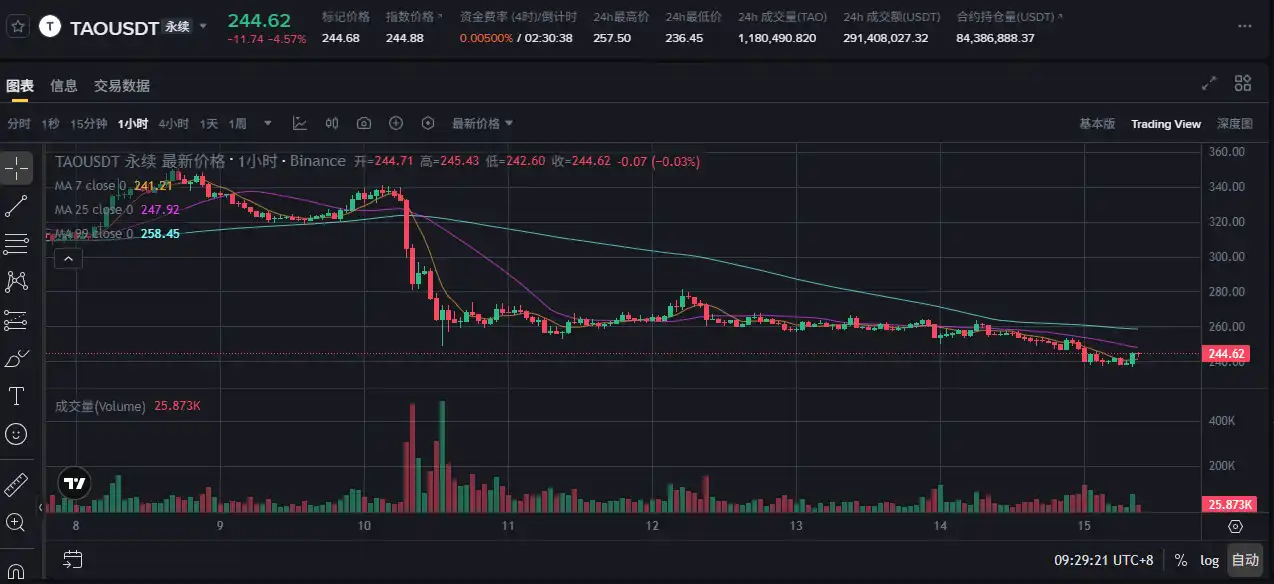
Affected by this black swan event, the $TAO token price faced panic sell-off in the secondary market, plummeting 15% to 25% in a single day, with its market capitalization evaporating by hundreds of millions of dollars instantly. While the crypto community was "enjoying the drama" of the public fallout between a top team and the founder, it also began to seriously examine a deeper industry proposition: In the AI field, which heavily relies on computational power capital and complex engineering, is the token-economics-driven "decentralization" a utopia that reshapes production relations, or a华丽的 facade masking centralized power?
To understand the destructive power of this event, one must first recognize Covenant AI's weight within the Bittensor ecosystem.

In Bittensor's multi-subnet architecture, most subnets are still in the low-level stages of API calls, model fine-tuning, or simple task routing. Teams truly capable of training models from scratch or handling large-scale parameter models are extremely rare. Covenant AI was a "hardcore" representative in this ecosystem. Just before announcing their exit, the team had delivered a milestone achievement to the community: successfully training a 72-billion parameter (72B) open-source large model in a decentralized network environment.

Given current computing power costs, training a 72B model means mobilizing a massive GPU cluster (typically equivalent to thousands of H100s running for weeks) and incurring extremely high hardware and electricity costs. The core logic behind Covenant AI's willingness to bear such huge upfront sunk costs lay in Bittensor's "Emissions" mechanism—as long as the models and computing power they provided scored high in subnet evaluations, they would continuously receive $TAO token emissions as substantial rewards. This is precisely the most attractive flywheel effect in the DeAI narrative.

However, the flywheel stopped abruptly at its peak. According to Covenant AI's disclosure, after they spent huge sums to complete the 72B model training and deployment, founder Jacob Steeves and his stakeholders, by controlling validator nodes, cut off the token rewards flowing to Covenant AI's subnet without any warning or transparent governance process.

For miners and developers, cutting off Emissions is tantamount to "pulling the plug." The ROI on massive computing power expenditure instantly dropped to zero. This highly unpredictable systemic risk directly triggered Covenant AI's angry departure.

The word "Charade" used by Covenant AI in its exit statement precisely hit Bittensor's most vulnerable nerve: network control.

Bittensor's underlying design relies on the Yuma consensus, whose core is that "validators" evaluate the contributions of "miners" and decide how the system's newly issued $TAO tokens are distributed. Theoretically, this is a decentralized game theory system based on staking amounts and algorithms. But Covenant AI's accusations reveal a harsh reality: computing power is decentralized, but power and capital are highly concentrated.

In the current Bittensor root network, the leading validator nodes that dominate the flow of token distribution have their staking chips highly concentrated among early investors, the foundation, and addresses associated with founder Jacob Steeves. This means the founder is not only the rule-maker but also the biggest referee.

Covenant AI pointed out that when a subnet's output did not align with Jacob's personal wishes, or potentially threatened the interests of other "favored" subnets, Jacob could easily use his substantial staking weight to alter the distribution outcome of the Yuma consensus. This "one-person rule" type of intervention renders the decentralization at the smart contract level meaningless. Developers spending millions of dollars on computing power ultimately found their fate dependent on the subjective will or behind-the-scenes manipulation of a single founder.

Objectively, Jacob and his supporters might defend their actions by citing reasons like "maintaining overall network quality" or "preventing specific subnets from exploiting rule loopholes to farm tokens." However, in the absence of a transparent DAO governance mechanism and on-chain hearing and appeal channels, this kind of centralized intervention, done in the name of "carrying out justice," severely undermines the network's core value as a "credibly neutral infrastructure."

$TAO's single-day plunge of 15-25% is not merely a panic-induced stampede by retail investors; it is also institutional funds repricing the "governance risk discount" for Bittensor.

The reason Bittensor could support its huge market capitalization and enjoy extremely high valuation premiums was that the market viewed it as the only realistic candidate for a "decentralized OpenAI." The foundation of this grand narrative is that the system must possess极强的 predictability: as long as you contribute computing power and quality models, the protocol will automatically guarantee your收益 through code.

The Covenant AI event shattered this expectation. Top financial professionals and institutional investors most despise "unpredictable single points of failure," and here, that point of failure is Jacob Steeves's power.

If even the absolute top-tier team capable of training a 72B model could instantly receive nothing due to the founder's intervention, then for other computing power providers and AI research institutions holding tokens and观望, deploying heavy assets on Bittensor is undoubtedly playing a game of Russian roulette where the table can be flipped at any moment. When the high-quality supply side (miners and developers) refuses to enter out of fear of centralized tyranny, the application scenarios and intrinsic value of the $TAO token become a river without a source. The frantic capital flight is a提前 vote on this fundamental weakness.

Covenant AI's departure is not just a PR crisis for Bittensor alone; it is also the inevitable growing pain for the entire decentralized AI sector as it moves into deeper waters. It残酷ly reveals the "Impossible Trinity" of the DeAI field: Model Quality & Scale, Decentralized Credible Neutrality, and Anti-Malice Incentive Alignment.

Centralization of Scale vs. Decentralization of Mechanism: Cutting-edge AI (like 72B+ large models) training is a typical heavy-capital, centralized engineering effort requiring highly coordinated GPU clusters. This has a natural physical chasm with the permissionless,分散式 nodes advocated by Web3.

Anti-Sybil (Preventing Fake Volume) vs. Credible Neutrality: To prevent low-quality nodes from farming tokens through mutual traffic brushing (Sybil attacks), the network must introduce subjective "quality assessment." But today, with AI evaluation standards not yet fully objective and mathematical, this assessment power, once handed to a few validators, can easily evolve into centralized power rent-seeking.

Bittensor attempted to use token economics to build a bridge connecting the two, but the Covenant event proves that the bridge's load-bearing pillars (governance mechanisms) remain incredibly fragile.

Covenant AI's exit popped the romanticized bubble of Bittensor's "absolute decentralization." For $TAO, this might be a painful moment of disenchantment, but for the entire DeAI industry, it is a necessary wake-up call.


Related Questions

QWhat was the immediate impact on the $TAO token following Covenant AI's exit from the Bittensor network?

AThe $TAO token experienced a panic sell-off in the secondary market, with a single-day drop of 15% to 25%, wiping out billions of dollars in market value instantly.

QWhy did Covenant AI decide to leave the Bittensor ecosystem?

ACovenant AI exited because Bittensor founder Jacob Steeves, through his control of validator nodes, abruptly cut off token rewards to their subnet without warning or a transparent governance process, rendering their massive computational investment non-viable.

QWhat major achievement had Covenant AI recently delivered before their departure?

ACovenant AI had successfully trained a 72-billion parameter (72B) large language model in a decentralized network environment, a significant milestone that required substantial GPU resources and costs.

QWhat core issue in Bittensor's governance did the Covenant AI incident expose?

AThe incident exposed that power and capital are highly centralized despite the decentralized design, with the founder and early investors controlling validator nodes that dictate token distribution, undermining the network's credibility as a neutral infrastructure.

QWhat is the 'impossible Triangle' of DeAI highlighted in the article?

AThe 'Impossible Triangle' refers to the trade-offs between model quality and scale, decentralized trust and neutrality, and anti-malice incentive alignment, which are challenging to achieve simultaneously in decentralized AI systems.

Related Reads

When Doing Cryptocurrency Payment, the First Thing is Licenses, What is the Second?

When launching a crypto payment business, obtaining the necessary licenses is the crucial first step. However, the second, and arguably more critical, step is designing a comprehensive operational framework that forms a coherent business loop. This loop must be clearly understood and executable by all stakeholders: banks, payment partners, exchanges, on-chain analytics providers, regulators, and your internal team. Many projects mistakenly believe a single license permits all operations. Licenses merely grant entry; they don't define how the specific business functions. The real challenge lies in detailing every aspect of the workflow. This involves clarifying the customer base, the flow of fiat and crypto assets, the settlement process, and establishing clear lines of responsibility for risks like AML compliance, sanctions screening, chargebacks, and regulatory inquiries. A robust framework must answer seven core questions: Who are the clients and merchants? Who collects fiat and crypto? Who handles conversion and custody? And who is ultimately accountable for compliance and risk management? Projects often fail not from a lack of licensing, but during due diligence when they cannot convincingly explain these operational details. Therefore, beyond securing licenses, the priority must be constructing a closed-loop system. This system ensures the business model is transparent, risks are managed, responsibilities are delineated, contracts are aligned, and the entire process is comprehensible to partners and regulators. The true competitive edge in crypto payments lies not in acquiring a license quickly, but in integrating licensing, banking, compliance, and operations into a sustainable and executable whole.

marsbit33m ago

When Doing Cryptocurrency Payment, the First Thing is Licenses, What is the Second?

marsbit33m ago

Arthur Hayes Analysis: AI Bubble Nears Burst, Crypto Market Faces Short-Term Pressure

Arthur Hayes argues that the current AI market is a bubble poised to burst, which will exert downward pressure on the crypto market in the near term. The core trigger is rising oil prices due to the US-Iran conflict and a blockade of the Strait of Hormuz. Higher energy costs directly increase the operational expenses of AI data centers, squeezing profit margins for companies like Google, Anthropic, and OpenAI. Hayes predicts that persistent inflation from high oil prices will force Trump, in a bid to win the November election, to turn public sentiment against the AI industry. He may propose regulations and taxes on data centers and AI companies to appeal to voters concerned about costs and job displacement. Such political rhetoric could shatter market confidence. Furthermore, the market is unlikely to healthily absorb the massive concurrent IPOs of SpaceX, Anthropic, and OpenAI, which together seek valuations in the trillions. The combination of soaring energy costs, overwhelming equity supply, and negative political pressure will puncture the AI bubble. Hayes notes that nearly all new USD liquidity since 2022 has flowed into AI, leaving crypto like Bitcoin behind. When the AI bubble bursts, liquidity will contract sharply, pulling down all risk assets, including cryptocurrencies. In response, Hayes's fund, Maelstrom, has sold all AI-related stocks and non-core cryptocurrencies. It maintains core positions in Bitcoin and Ethereum while increasing exposure to energy sector equities, betting on rising oil and gas prices. He expects Bitcoin to bottom after the AI-led market decline, before rallying again with future monetary easing.

Foresight News47m ago

Arthur Hayes Analysis: AI Bubble Nears Burst, Crypto Market Faces Short-Term Pressure

Foresight News47m ago

To C, To B, and the Next Big Thing Called To A

After To C and To B, the Next Wave is To A: Serving AI Agents In a recent quarterly earnings call, Meituan's Wang Xing introduced a new concept: To A (To Agent), signifying that future business services will increasingly target AI Agents as primary clients, not just consumers or merchants. This shift implies that internet giants must now consider how to make their services more appealing for AI Agents to recommend, fundamentally altering traditional distribution logic. This "To A era" is prompting an unusual trend of alliances among major tech companies. Unlike previous competitive battles, firms like Meituan, Tencent, JD.com, Huawei, OPPO, and OpenAI are rapidly forming partnerships. The reason is strategic: as AI Agents become the primary user interface, handling tasks from a single command (e.g., "Book a Japanese restaurant for tomorrow"), the risk for platforms is being bypassed entirely. Companies are positioning themselves within this new value chain. Three primary strategies are emerging: 1. **Super-Entry Points + Service Providers:** Platforms like Tencent's Yuanbao, WeChat, and ChatGPT aim to be the first-stop Agent, integrating various services (food delivery, shopping, travel) from partners like Meituan and JD.com. 2. **Apps as Callable Services:** Companies like Meituan, JD.com, and Uber are ensuring their core services remain accessible and callable by external Agents, shifting from front-end apps to back-end capabilities. 3. **System-Level Agent Entry Points:** Smartphone makers (Huawei, Honor, OPPO) are leveraging their OS-level AI assistants to control the initial user command, redistributing it to relevant service apps. While alliances offer mutual benefit—entry points gain service capabilities, and service providers gain traffic—inherent conflicts of interest exist. A dominant Agent platform could eventually attempt to connect directly with suppliers (restaurants, hotels), bypassing current aggregators like Meituan or Ctrip. Other unresolved challenges include the potential for Agent recommendations to become a new form of paid ranking and unclear accountability for faulty recommendations. The current rush to form alliances is a defensive move by service providers to secure their position before the landscape solidifies. In this To A-driven restructuring, the greatest risk is not losing the race but failing to hear the starting gun.

marsbit56m ago

To C, To B, and the Next Big Thing Called To A

marsbit56m ago

The More Lifelike the Robot, the More Terrifying? Unveiling the 'Uncanny Valley Effect' in the Era of Humanoid Robots

As humanoid robots become increasingly lifelike, they confront a significant psychological barrier known as the "Uncanny Valley Effect," a concept proposed by Japanese roboticist Masahiro Mori in 1970. This phenomenon describes a dip in human comfort and acceptance when robots appear almost, but not perfectly, human. Minor imperfections in facial expressions, eye movements, or skin texture trigger a subconscious sense of unease, as the brain detects something trying, yet failing, to mimic a person. Examples range from the controversial human-like robot Sophia to animated characters in films like *The Polar Express*. The effect poses a key design challenge for robotics companies. Some, like Boston Dynamics, avoid it entirely by creating highly capable but visibly mechanical robots. Others, like Hanson Robotics, push for greater human likeness despite the risk. For consumer robots, especially in homes, most manufacturers opt for stylized or clearly mechanical designs to ensure broader acceptance. While the Uncanny Valley remains a powerful force, its impact may diminish over time through technological advancements that achieve near-perfect realism or through generational familiarity as people grow accustomed to interacting with humanoid machines. Ultimately, navigating this psychological frontier requires as much understanding of human perception as of robotics technology itself.

marsbit57m ago

The More Lifelike the Robot, the More Terrifying? Unveiling the 'Uncanny Valley Effect' in the Era of Humanoid Robots

marsbit57m ago

Trading

Spot
Futures

Hot Articles

Discussions

Welcome to the HTX Community. Here, you can stay informed about the latest platform developments and gain access to professional market insights. Users' opinions on the price of AI (AI) are presented below.

活动图片














