Before the AI Bubble Bursts, the 'Big Short' Makes $100 Million First from Subscription Fees

marsbitPublished on 2026-08-14Last updated on 2026-08-14

Abstract

Michael Burry, known as "The Big Short," is generating significant revenue from his Substack investment newsletter "Cassandra Unchained," which reached over 300,000 subscribers within 231 days. At an annual fee of $379, this could translate to theoretical revenue of approximately $113.7 million. While this figure represents a theoretical maximum before Substack's cut and includes free subscribers, it highlights a potentially lucrative venture. In contrast, Burry's well-publicized short positions in AI and semiconductor stocks like Nvidia, Micron, and Applied Materials have faced substantial pressure. These stocks have surged dramatically in 2024, with Micron rising 697% year-to-date, leading to significant unrealized losses on his short bets. Through his newsletter, Burry discloses his investment moves. His long portfolio includes value-oriented stocks like PayPal, Lululemon, and Chinese equities such as Alibaba and JD.com. He argues that fear surrounding AI has created undervalued opportunities in software and that capital will eventually rotate into Chinese markets. Despite the mounting losses from his short trades against the AI rally, which he compares to the dot-com bubble, the success of his paid subscription service may emerge as his most profitable endeavor this year.

Michael Burry's paid newsletter, 'Cassandra Unchained,' surpassed 300,000 subscribers in just 231 days. At an annual fee of $379, this translates to a theoretical yearly revenue of approximately $113.7 million. Meanwhile, his short positions in AI and semiconductor stocks like NVIDIA, Micron, and AMAT have faced significant pressure this year, with Micron's stock price surging as much as 697% year-to-date.

Shorting AI stocks is losing big, but selling subscriptions could be a jackpot—Michael Burry's most profitable venture this year might not be stock trading, but blogging.

'Big Short' investor Michael Burry's investment newsletter on Substack, 'Cassandra Unchained,' surpassed 300,000 subscribers in just 231 days. At an annual fee of $379, this translates to a theoretical yearly revenue of approximately $113.7 million.

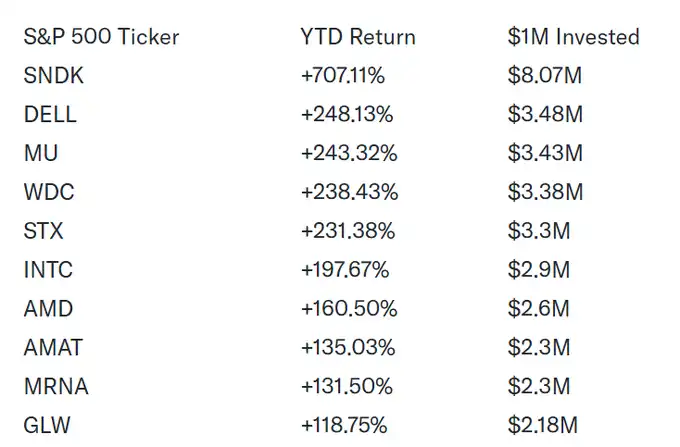
How staggering is this number? According to a report from Stocktwits, if $1 million were invested in each of the year's top 10 performing stocks in the S&P 500, the total return would be around $34 million—less than one-third of Burry's theoretical newsletter revenue.
300,000 Subscribers in 231 Days

In a post titled 'Short & Thankful: 300,' Burry disclosed that 'Cassandra Unchained' has reached 300,044 subscribers and 346,680 followers. Subscribers come from all 50 U.S. states and 212 countries, with 52% located outside the United States.

Data shows that the 'Cassandra Unchained' newsletter had about 218,000 followers in January of this year, growing to nearly 347,000 by July, indicating a consistently upward growth trajectory.
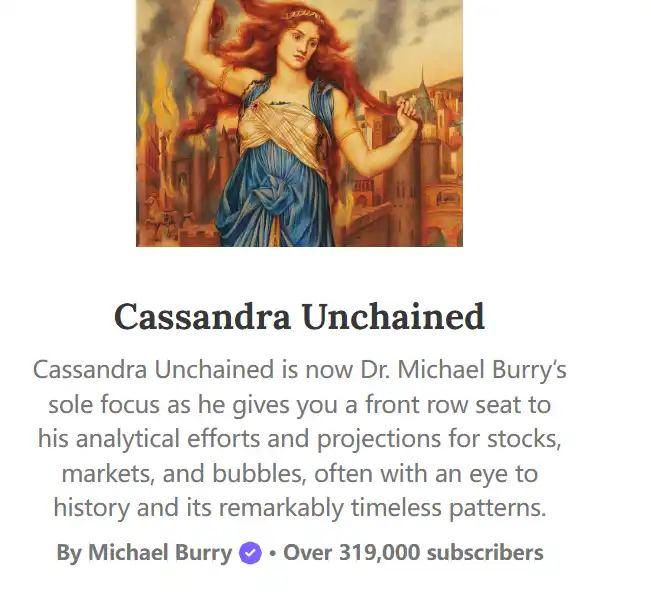
The newsletter is priced at $39 per month or $379 per year, with a free tier also available. Burry has not disclosed the specific proportion of paid subscribers. Substack's subscriber count includes both free and paid readers, and the aforementioned calculation does not deduct Substack's platform fees. Therefore, the $113.7 million figure represents a theoretical maximum, not actual net income.

Burry launched the newsletter in November 2025, shortly after deregistering his hedge fund with the SEC, returning to social media, and resuming his criticism of the AI frenzy. The newsletter attracted over 60,000 subscribers at launch and has gradually evolved into his primary platform for publishing real-time portfolio updates, valuation analyses, and detailed trading records.

Long Value Stocks: PayPal, Lululemon, Alibaba

In the newsletter, Burry continuously discloses specific trades.

In April, he made his first large-scale public disclosure of holdings, initiating a position in PayPal Holdings (PYPL) at around $49, making it 3.5% of his portfolio and naming it his top pick in the software and payments sector, ahead of Fiserv (FI) and Adobe (ADBE). He subsequently added to his PayPal position around $45 and simultaneously bought Fiserv. That same month, he also initiated positions in Adobe, Autodesk (ADSK), and Veeva Systems (VEEV), citing that 'AI disruption fears have compressed software valuations below intrinsic value.'

In April, he also reaffirmed his confidence in Molina Healthcare (MOH), stating that market expectations had 'bottomed out' and that he would continue adding to the position, as the investment thesis is based on normalized earnings over the coming years.

In June, Burry turned his attention to Lululemon Athletica (LULU), adding to the position multiple times. He stated bluntly: 'Terrible management is a value investor's best friend.' He believes Wall Street is overly focused on management missteps, tariffs, and slowing growth, while neglecting its long-term value.

Regarding Chinese assets, Burry disclosed in April that he held over 6% of Alibaba's stock and continued adding to his position in JD.com (JD). Last week, he stated that JD.com is one of his top three holdings and predicted that 'as the enthusiasm for AI and memory chips wanes, capital will rotate toward Hong Kong and Chinese stocks.'

Shorting AI Stocks: NVIDIA, Micron, Palantir

Simultaneously, Burry has been consistently expanding his short positions in AI and semiconductor stocks.

In April, he disclosed holding additional put options on NVIDIA (NVDA), including contracts expiring in January 2027 with a strike price of $115, while maintaining his previous $100 puts. On June 30th, he escalated the trade to directly shorting NVIDIA, entering at a price of $198.09. The same update also disclosed new short positions in Applied Materials (AMAT), the iShares Semiconductor ETF (SOXX), Tesla (TSLA), and Caterpillar (CAT). He compared the current semiconductor frenzy to the dot-com bubble.

'The immediate trigger for today's rally is Korea's announced massive spending. I think this is the beginning of the end,' Burry said.

Earlier this month, he disclosed directly shorting Micron Technology (MU), stating that the memory chipmaker's deviation from its 200-day moving average exceeded any point since 1984.

Regarding Palantir Technologies (PLTR), Burry has maintained one of Wall Street's most closely watched bearish stances since first disclosing the short last November. Although he partially covered the position, in June he reiterated that 'there's still no sign of seller capitulation or exhaustion.'

The Cost of Being Short: Getting 'Slapped' by the Market

However, reality has not been on Burry's side.

This year, many of the stocks he has shorted have significantly outperformed the broader market. The S&P 500 ETF (SPY) is up 22% year-to-date, the Nasdaq 100 ETF (QQQ) is up 31%, while NVIDIA has gained 29%, AMAT has skyrocketed 206%, and Micron has surged a staggering 697%.

Shorting these stocks means Burry has incurred substantial paper losses on these positions.

This is precisely why his newsletter revenue appears particularly striking—while under pressure on the trading front, the 'Big Short's' other business venture may quietly be becoming his biggest source of profit this year.


Trending Cryptos

Related Questions

QHow many subscribers did Michael Burry's paid newsletter 'Cassandra Unchained' gain in 231 days, and what is its theoretical annual revenue based on its annual fee?

AMichael Burry's paid newsletter 'Cassandra Unchained' gained over 300,000 subscribers in 231 days. With an annual fee of $379, the theoretical annual revenue is approximately $113.7 million.

QWhich major AI and semiconductor stocks did Michael Burry short in 2025, and what was their performance?

AMichael Burry shorted NVIDIA, Micron, Applied Materials (AMAT), and the iShares Semiconductor ETF (SOXX) in 2025. These stocks performed strongly: NVIDIA rose 29%, AMAT surged 206%, and Micron skyrocketed 697% year-to-date.

QWhat were some of the value stocks Michael Burry invested in and disclosed in his newsletter?

AIn his newsletter, Michael Burry disclosed investments in several value stocks, including PayPal Holdings (PYPL), Fiserv (FI), Adobe (ADBE), Autodesk (ADSK), Veeva Systems (VEEV), Molina Healthcare (MOH), Lululemon Athletica (LULU), and Chinese companies like Alibaba and JD.com.

QWhy is the revenue from Michael Burry's newsletter highlighted as significant in the context of his investment performance?

AThe revenue from Michael Burry's newsletter is highlighted as significant because, while his short positions in AI and semiconductor stocks are experiencing substantial paper losses due to the stocks' massive rallies, his newsletter business is generating a large theoretical income, potentially making it his most profitable venture this year.

QWhat did Michael Burry compare the current semiconductor boom to, and what was his reasoning for his short positions?

AMichael Burry compared the current semiconductor boom to the dot-com bubble. His reasoning for the short positions was his belief that the massive rally, partly triggered by announcements of large-scale spending (like from South Korea), signaled 'the beginning of the end' for the boom, indicating an impending market correction.

Related Reads

Podcast Notes | U.S. Stocks Hit Another Record High: Senior Fund Manager Nancy Tengler's Portfolio Picks for the Second Half of the Year

Podcast Summary: Veteran fund manager Nancy Tengler (CEO/CIO of Laffer Tengler Investments) discusses her investment outlook for the second half of the year, amidst the S&P 500 reaching new highs. She is bullish on the market, citing strong, productivity-driven earnings growth and the current economic transformation. Tengler emphasizes that this rally differs from the 1990s bubble, as fundamentals (earnings) and price appreciation have been aligned. She outlines four key investment themes: 1. **AI Infrastructure:** Companies like Quanta Services (PWR), GE Vernova (GEV), Williams (WMB), and Deere (DE) to benefit from massive capital expenditures ($7.5 trillion over five years) in data centers and electrification. 2. **Growth Stocks at Value Prices:** Names like Nvidia (NVDA) and Amazon (AMZN), which she views as undervalued based on forward earnings and growth rates (e.g., NVDA's PEG ratio of 0.25). 3. **Cybersecurity:** Prefers CrowdStrike (CRWD) over Palo Alto Networks (PANW) while acknowledging growing competition. 4. **Financials & Consumer Discretionary:** Sees catch-up potential in Goldman Sachs (GS), JPMorgan (JPM), Brookfield Asset Management (BAM), Starbucks (SBUX), and Home Depot (HD). She avoids sectors like consumer staples, utilities, and most REITs in this strong growth environment. Key risks are a potential credit market breakdown or a resurgence of inflation. Tengler believes market leadership will broaden beyond mega-cap tech and advises long-term investors to stay invested.

marsbit43m ago

Podcast Notes | U.S. Stocks Hit Another Record High: Senior Fund Manager Nancy Tengler's Portfolio Picks for the Second Half of the Year

marsbit43m ago

Selling Block Space Is No Longer Profitable, Arbitrum and MegaETH Venture into Applications

Selling block space is no longer a sustainable core business for blockchains, as it is easily commoditized and generates insufficient revenue to support their valuations, especially when compared to the high fees generated by applications built on them. This report, following up on the "Verticalization" thesis, examines how chains like Arbitrum, Polygon, MegaETH, and Sophon are adapting. It categorizes their strategies into two main paths: **Ecosystem Expansion** and **Product Expansion**. **Ecosystem Expansion** involves chains extending their reach by offering their technology stack to others. Examples include Arbitrum, which earns revenue from chains like Robinhood's L2 built on Arbitrum Stack, and Polygon, which is positioning itself as a payment chain for fintech. However, this model faces challenges, as seen with Optimism's revenue drop after Base left its Superchain, and often fails to translate chain success into sustained token value due to ongoing emissions. **Product Expansion** sees chains vertically integrating by building their own applications to capture more value internally. MegaETH shifted focus to developing first-party consumer apps and launched a native stablecoin, USDm, to capture yield. Similarly, Sophon pivoted from being an independent chain to becoming an application builder on Base. The goal is to directly own the lucrative application fee streams that typically don't flow back to the underlying chain. The conclusion is that with hundreds of chains offering similar block space, differentiation through liquidity alone is not enough. To justify high valuations and ensure sustainability, chains are moving beyond their foundational role. They are evolving into broader ecosystems or application builders themselves, actively working to internalize the value generated within their networks. This represents a pragmatic shift towards utility, where chains are becoming more than just infrastructure providers in a highly competitive landscape.

marsbit1h ago

Selling Block Space Is No Longer Profitable, Arbitrum and MegaETH Venture into Applications

marsbit1h ago

Trading

Spot

Hot Articles

Discussions

Welcome to the HTX Community. Here, you can stay informed about the latest platform developments and gain access to professional market insights. Users' opinions on the price of AI (AI) are presented below.

活动图片