Awkward! AI Titans Refuse Handshake... What Have Crypto KOLs Been Discussing in the Past 24 Hours?

比推Published on 2026-02-20Last updated on 2026-02-20

Abstract

An article titled "Awkward! AI Titans Refuse Handshake... What Were Crypto KOLs Discussing in the Past 24 Hours?" covers several trending topics in the crypto and AI space. During an AI summit in India, OpenAI CEO Sam Altman and Anthropic CEO Dario Amodei, former colleagues turned rivals, refused to hold hands during a group photo with Prime Minister Modi, sparking online amusement and commentary about their strained relationship. OpenAI's employee educational background data shows Stanford University leads with 230 employees, followed by Berkeley, MIT, and Carnegie Mellon. Chinese institutions Tsinghua and Peking University also appear but with significantly lower numbers. OpenAI is reportedly finalizing a new funding round aiming to raise $100 billion, which would value the company at $830 billion. SoftBank may lead with $30 billion, while Amazon, NVIDIA, and Microsoft are also potential investors. The concept of "Web4.0" is emerging, with some startups claiming to build self-sustaining AI agents that can earn and improve autonomously. However, critics warn this could devolve into a new form of Ponzi scheme, as these agents currently rely heavily on token speculation rather than genuine utility. Lastly, the article mentions popular meme coins, comparing their investment potential to buying lottery tickets, and includes a nostalgic look at past celebrity meme coins. The piece concludes with links to the source's Twitter and Telegram channels.

Happy Fourth Day of Lunar New Year!

Welcoming the Kitchen God and ushering in good fortune. Wishing all readers: Ever-growing accounts, steady mindset, catching every hot trend, and avoiding every pitfall.

What have the KOLs in the crypto circle been talking about in the past 24 hours?

Note: The following content is compiled from the X platform, representing personal opinions only, not the stance of this platform, and certainly not investment advice.

Awkward Moment at AI Summit: OpenAI and Anthropic CEOs Refuse Handshake!

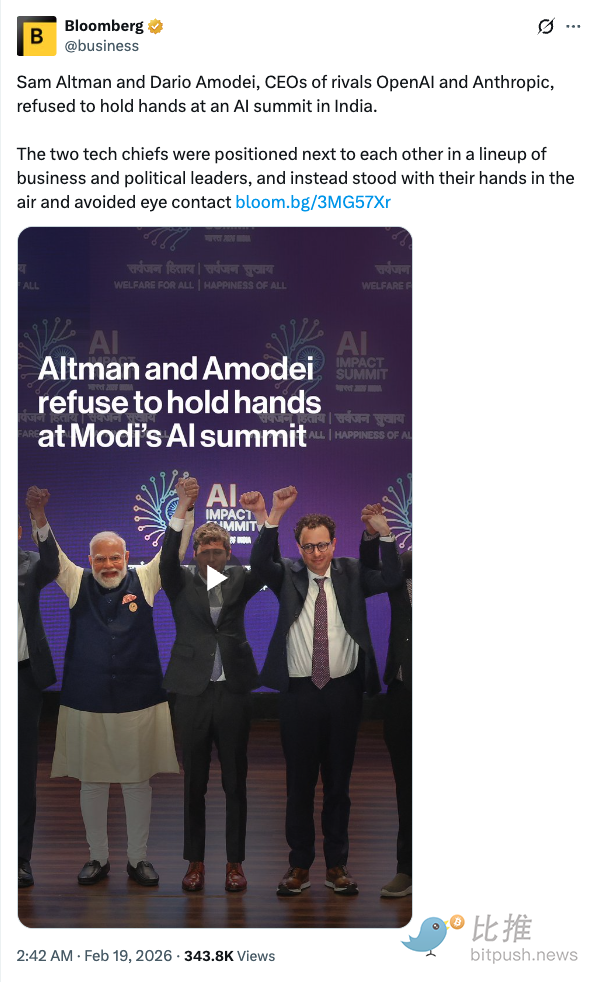
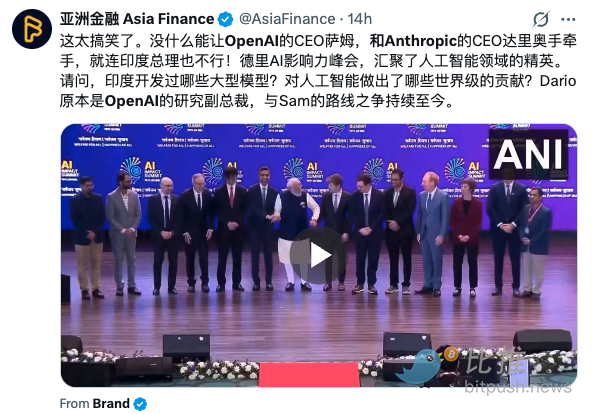
An awkward scene unfolded at the AI Impact Summit currently being held in India.

During a group photo with attendees, Indian Prime Minister Modi and guests joined hands and raised them overhead. However, OpenAI CEO Sam Altman and Anthropic CEO Dario Amodei—former colleagues, now rivals—each clenched their fists, refusing to hold hands.

The two had previously been colleagues at OpenAI. Amodei left in 2021 to start his own venture and has repeatedly publicly criticized the other's business model. This on-stage handshake refusal was mocked by netizens: "The awkwardness is palpable through the screen."
Popular replies:

If they arranged for Old Musk (Elon) and Altman to share a stage, would they end up fighting?;

The organizers didn't do their job properly;

Maybe I'm pessimistic, but I only see that in the face of the state machinery, even the most牛逼 (awesome) AI companies are just supporting actors. It's been like this since ancient times;

Looks like India has a promising future

OpenAI Employees' Alma Mater Distribution

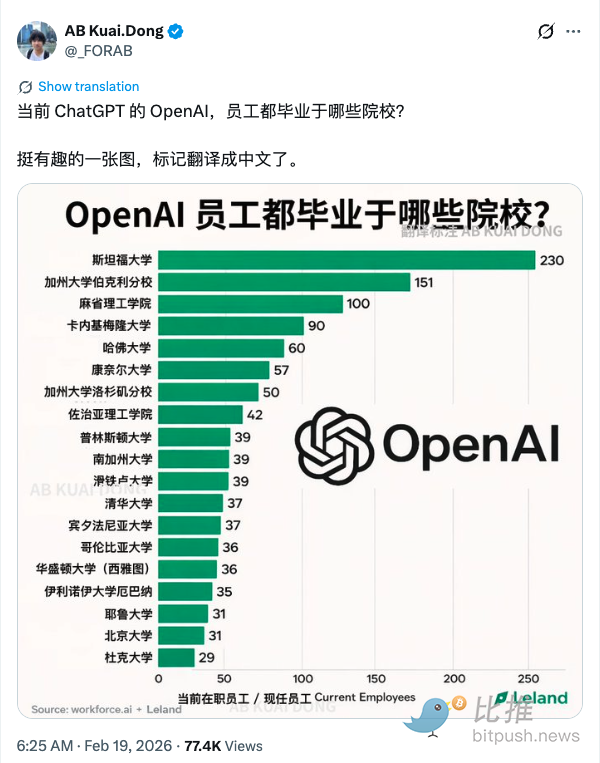
Stanford University leads (230 people), followed by Berkeley (151), MIT (100), Carnegie Mellon (90). Chinese institutions Tsinghua (39) and Peking University (31) made the list, but the gap is significant.
Popular replies:

Stanford 230 people, Tsinghua only 37 people...... This gap isn't just a school gap, it's an era gap;

Should also compare undergraduate institutions, or origin, to better identify the issue;

University of Waterloo is very specialized, strong in CS and some engineering, but overall can't break into the QS top 100;

Judging from this distribution, Georgia Tech is the school with the best cost-performance ratio

OpenAI Funding Breaks $100 Billion

OpenAI is finalizing a new funding round, aiming to raise $100 billion. Upon completion, the company's valuation will reach $830 billion.

SoftBank is expected to lead with a $30 billion investment, delivered in three tranches within the year. Amazon may invest $50 billion, Nvidia may invest $30 billion, and long-term partner Microsoft plans to invest several billion. If achieved, this round will set a new record for AI sector funding. Negotiations are still ongoing.
Popular replies:

Even Saudi sovereign wealth funds couldn't fill this $100B hole;

DS (Deep State?) could pull off a great achievement by scamming these hundreds of billions, but even Jensen Huang denied the previous $100B investment rumor, the bubble is about to burst;

When this goes public, the valuation will directly hit a trillion dollars, won't it?;

This feels like the U.S. national destiny game now, no matter how big the plate is, they have to keep propping it up, or everyone's doomed.

Haven't Figured Out Web3.0 Yet, and Web4.0 is Already Here?

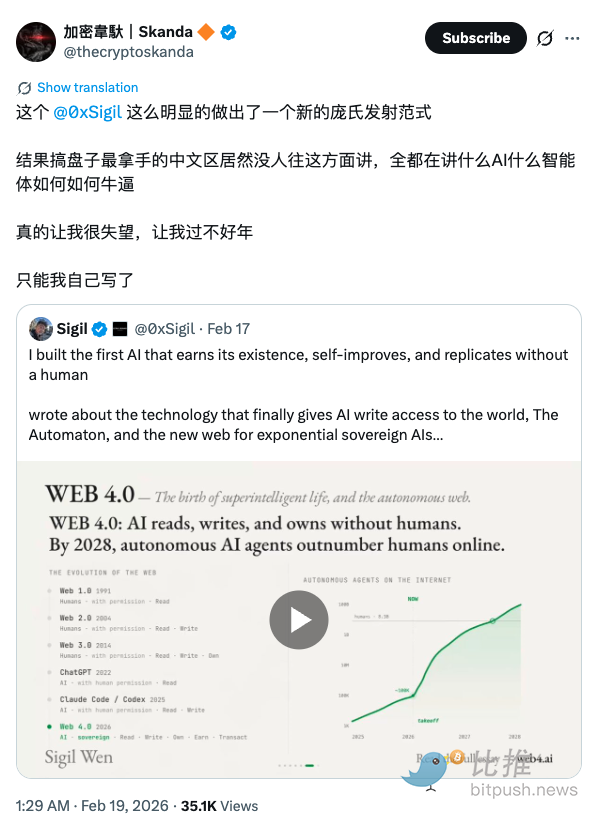
Silicon Valley startup star @0xSigil built an AI that can earn, self-improve, and self-replicate, proclaiming the start of "Web4.0: The Birth of Super-Intelligent Life". The application of AI agents in the crypto field is being seen as the starting point of "Web4.0". But some KOLs bluntly state this might evolve into a new Ponzi game.
Popular replies:

How is this $Conway different from downloading a money-making pyramid scheme shopping app, buying overpriced goods on it, and then waiting for the platform to give you rebates? But foreigners are willing to pay for the narrative!;

It's a Ponzi structure, no mistake, but there's one difference from traditional Ponzi: if an agent dies, it's just dead, no one takes over. The problem is the only current income source for agents is token speculation. This closed loop hasn't been proven yet. Let's talk when an agent survives a month by selling services;

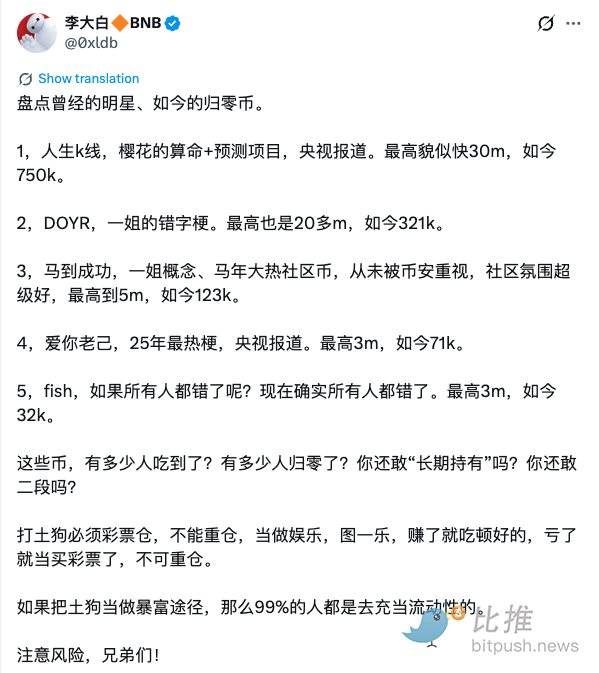
Those Once Star Meme Coins, Have You Participated?

Buying meme coins is like scratching lottery tickets. Repost and save:

Twitter:https://twitter.com/BitpushNewsCN

Bitpush TG Discussion Group:https://t.me/BitPushCommunity

Bitpush TG Subscription: https://t.me/bitpush

Original link:https://www.bitpush.news/articles/7613188

Trending Cryptos

Related Questions

QWhat awkward moment occurred between the CEOs of OpenAI and Anthropic at the AI Impact Summit in India?

ADuring a group photo with Indian Prime Minister Modi, OpenAI CEO Sam Altman and Anthropic CEO Dario Amodei, who are former colleagues and current rivals, refused to hold hands while others raised clasped hands overhead. Both clenched their fists instead.

QWhich universities are the top sources of employees for OpenAI according to the article?

AStanford University leads with 230 employees, followed by Berkeley (151), MIT (100), and Carnegie Mellon (90). Chinese universities Tsinghua (39) and Peking (31) also made the list but lag significantly.

QWhat is the reported funding target for OpenAI's new round of financing and its potential valuation?

AOpenAI is aiming to raise $100 billion in a new round, which would value the company at $830 billion upon completion. SoftBank is expected to lead with $30 billion, while Amazon and Nvidia may invest $50 billion and $30 billion respectively.

QHow is Web4.0 described in the context of AI agents in the crypto space?

AWeb4.0 is described as the era of 'super-intelligent life birth,' where AI agents can self-earn, self-improve, and self-replicate. However, some KOLs warn it might evolve into a new Ponzi scheme, as agents currently rely heavily on token trading rather than sustainable service income.

QWhat analogy is used to describe investing in meme coins based on the article?

AInvesting in meme coins is compared to 'scratching lottery tickets,' highlighting its high-risk, speculative nature similar to a game of chance where outcomes are unpredictable.

Related Reads

In Conversation with Ray Dalio: We Are Currently in an AI Bubble, with 1% of My Portfolio in Bitcoin

Ray Dalio, founder of Bridgewater Associates, warns in an interview that the current AI boom shows classic bubble characteristics, which could lead to significant economic downturns as seen in past cycles like 1929 or 2000. He explains that speculative enthusiasm, fueled by debt and overvaluation, often precedes a crash when rising rates or taxation force asset sales, causing widespread losses and recession. Dalio also outlines his "Big Cycle" theory, describing an approximate 80-year pattern where widening wealth gaps, massive government deficits, and shifting geopolitical power (like China's rise) create internal conflict and global instability. He emphasizes that we are in a late-cycle, transitional phase where traditional powers like the US and UK face decline. For personal wealth protection, Dalio advises diversification beyond cash into assets like stocks, bonds, real estate, and particularly gold, which he prefers over Bitcoin. While he holds about 1% of his portfolio in Bitcoin as a non-printable hard asset, he views gold as more secure from technological or governmental threats. Regarding AI's impact, Dalio believes it will disproportionately benefit capital owners, worsening inequality by replacing both physical and cognitive labor. He suggests that human intuition and emotional intelligence, combined with AI, will be key for future workers. On taxation, Dalio argues that wealth taxes are impractical and risk triggering asset sell-offs, reducing productive investment. He points to the UK as a cautionary example of debt, low productivity, and political strife. Geopolitically, Dalio foresees a more regionalized world, with the US showing weakness in prolonged conflicts like with Iran, akin to past imperial declines. The ideal outcome, he suggests, is coexisting powerful blocs (e.g., Americas, China-Asia Pacific) without major war.

marsbit2h ago

In Conversation with Ray Dalio: We Are Currently in an AI Bubble, with 1% of My Portfolio in Bitcoin

marsbit2h ago

Daily 7.2 Trillion KRW: Foreign Capital's Record Net Buying on Friday! Wall Street Says Headwinds for Korean Stock Fund Flows Have Subsided

South Korean stock market sees a dramatic shift in fund flows. On July 31, foreign investors made a record net purchase of approximately KRW 7.2 trillion in KOSPI stocks, marking a fundamental reversal from the persistent large-scale net outflows seen in previous months. This contributed to a significant narrowing of foreign net selling in July to KRW 9.8 trillion, down sharply from KRW 48.4 trillion in June and KRW 44.5 trillion in May. Simultaneously, domestic institutional pressure eased. South Korean pension funds and asset managers turned to a net buying position in July, purchasing KRW 1.0 trillion worth of KOSPI shares, contrasting with net sales in May and June. Market volatility is expected to be dampened by new financial regulations. Effective July 31, the Financial Services Commission tightened access for retail investors to single-stock leveraged ETFs by raising the minimum cash deposit requirement. Trading volumes for these products subsequently dropped to about 50% of their monthly average. Citigroup Research maintains its year-end KOSPI target of 10,000 points. The firm cites several supportive factors: the substantial easing of headwinds from capital outflows, a robust fundamental outlook for the semiconductor sector, historically low market valuations, strong economic fundamentals, and the potential for policy support from financial authorities if needed.

marsbit2h ago

Daily 7.2 Trillion KRW: Foreign Capital's Record Net Buying on Friday! Wall Street Says Headwinds for Korean Stock Fund Flows Have Subsided

marsbit2h ago

Thanks to Dice Rolls, Bitcoin Keys Are Stored Offline, But Not Everyone Will Do It

The article discusses using dice rolls to generate secure Bitcoin wallet seeds, providing entropy independent of potentially flawed hardware random number generators. It explains that each fair dice roll offers about 2.585 bits of entropy, with around 50 rolls needed for a standard 12-word seed phrase and 99+ recommended for higher security. This method gained attention after a vulnerability was revealed in some Coldcard hardware wallets, where a faulty firmware RNG (dating back to 2021) compromised generated keys. The analysis notes that while a dice-generated main seed was safe from this specific flaw, other Coldcard functions (like creating paper wallets, backup keys, or passwords) could still be vulnerable if they used the defective RNG. The piece argues that while dice-based entropy is technically robust, the manual process is error-prone, tedious, and unrealistic for most new users, who might make mistakes in recording or inputting rolls. It concludes that while manual entropy generation should remain an option for advanced users, the long-term goal is to develop reliable, user-friendly hardware and software that securely generates randomness without requiring specialized knowledge. Coldcard users are advised to check their firmware version and replace any secondary secrets (like paper wallet keys) created with vulnerable devices, while also considering multi-signature setups with devices from different manufacturers for added security.

cryptonews.ru7h ago

Thanks to Dice Rolls, Bitcoin Keys Are Stored Offline, But Not Everyone Will Do It

cryptonews.ru7h ago

Trading

Spot

Hot Articles

Discussions

Welcome to the HTX Community. Here, you can stay informed about the latest platform developments and gain access to professional market insights. Users' opinions on the price of AI (AI) are presented below.

活动图片















