Awkward! AI Titans Refuse Handshake... What Have Crypto KOLs Been Discussing in the Past 24 Hours?

比推Published on 2026-02-20Last updated on 2026-02-20

Abstract

An article titled "Awkward! AI Titans Refuse Handshake... What Were Crypto KOLs Discussing in the Past 24 Hours?" covers several trending topics in the crypto and AI space. During an AI summit in India, OpenAI CEO Sam Altman and Anthropic CEO Dario Amodei, former colleagues turned rivals, refused to hold hands during a group photo with Prime Minister Modi, sparking online amusement and commentary about their strained relationship. OpenAI's employee educational background data shows Stanford University leads with 230 employees, followed by Berkeley, MIT, and Carnegie Mellon. Chinese institutions Tsinghua and Peking University also appear but with significantly lower numbers. OpenAI is reportedly finalizing a new funding round aiming to raise $100 billion, which would value the company at $830 billion. SoftBank may lead with $30 billion, while Amazon, NVIDIA, and Microsoft are also potential investors. The concept of "Web4.0" is emerging, with some startups claiming to build self-sustaining AI agents that can earn and improve autonomously. However, critics warn this could devolve into a new form of Ponzi scheme, as these agents currently rely heavily on token speculation rather than genuine utility. Lastly, the article mentions popular meme coins, comparing their investment potential to buying lottery tickets, and includes a nostalgic look at past celebrity meme coins. The piece concludes with links to the source's Twitter and Telegram channels.

Happy Fourth Day of Lunar New Year!

Welcoming the Kitchen God and ushering in good fortune. Wishing all readers: Ever-growing accounts, steady mindset, catching every hot trend, and avoiding every pitfall.

What have the KOLs in the crypto circle been talking about in the past 24 hours?

Note: The following content is compiled from the X platform, representing personal opinions only, not the stance of this platform, and certainly not investment advice.

Awkward Moment at AI Summit: OpenAI and Anthropic CEOs Refuse Handshake!

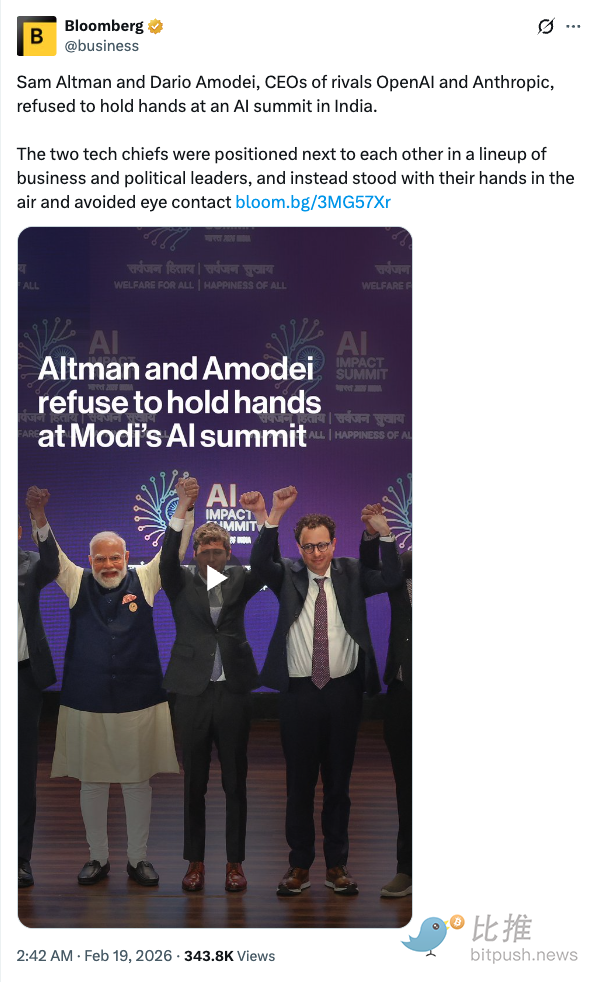
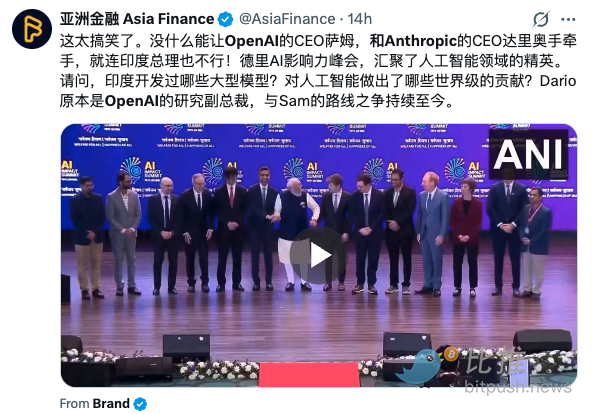
An awkward scene unfolded at the AI Impact Summit currently being held in India.

During a group photo with attendees, Indian Prime Minister Modi and guests joined hands and raised them overhead. However, OpenAI CEO Sam Altman and Anthropic CEO Dario Amodei—former colleagues, now rivals—each clenched their fists, refusing to hold hands.

The two had previously been colleagues at OpenAI. Amodei left in 2021 to start his own venture and has repeatedly publicly criticized the other's business model. This on-stage handshake refusal was mocked by netizens: "The awkwardness is palpable through the screen."
Popular replies:

If they arranged for Old Musk (Elon) and Altman to share a stage, would they end up fighting?;

The organizers didn't do their job properly;

Maybe I'm pessimistic, but I only see that in the face of the state machinery, even the most牛逼 (awesome) AI companies are just supporting actors. It's been like this since ancient times;

Looks like India has a promising future

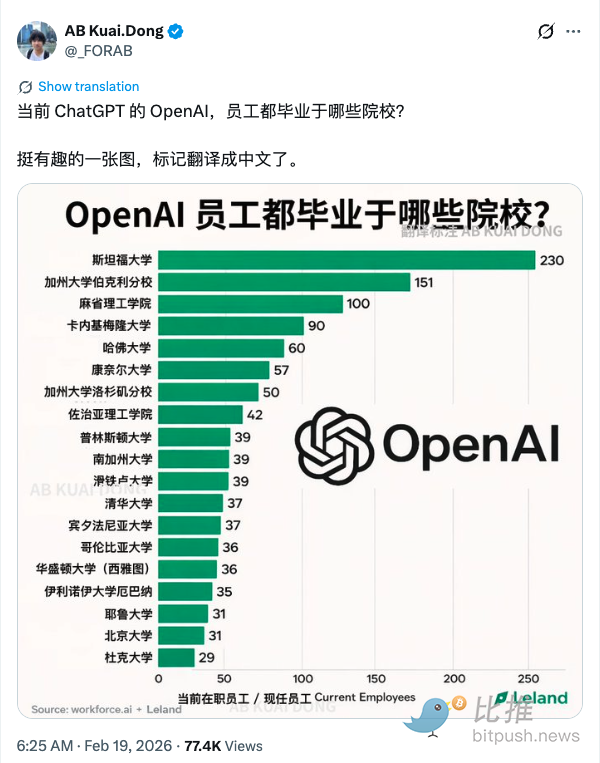
OpenAI Employees' Alma Mater Distribution

Stanford University leads (230 people), followed by Berkeley (151), MIT (100), Carnegie Mellon (90). Chinese institutions Tsinghua (39) and Peking University (31) made the list, but the gap is significant.
Popular replies:

Stanford 230 people, Tsinghua only 37 people...... This gap isn't just a school gap, it's an era gap;

Should also compare undergraduate institutions, or origin, to better identify the issue;

University of Waterloo is very specialized, strong in CS and some engineering, but overall can't break into the QS top 100;

Judging from this distribution, Georgia Tech is the school with the best cost-performance ratio

OpenAI Funding Breaks $100 Billion

OpenAI is finalizing a new funding round, aiming to raise $100 billion. Upon completion, the company's valuation will reach $830 billion.

SoftBank is expected to lead with a $30 billion investment, delivered in three tranches within the year. Amazon may invest $50 billion, Nvidia may invest $30 billion, and long-term partner Microsoft plans to invest several billion. If achieved, this round will set a new record for AI sector funding. Negotiations are still ongoing.

Popular replies:

Even Saudi sovereign wealth funds couldn't fill this $100B hole;

DS (Deep State?) could pull off a great achievement by scamming these hundreds of billions, but even Jensen Huang denied the previous $100B investment rumor, the bubble is about to burst;

When this goes public, the valuation will directly hit a trillion dollars, won't it?;

This feels like the U.S. national destiny game now, no matter how big the plate is, they have to keep propping it up, or everyone's doomed.

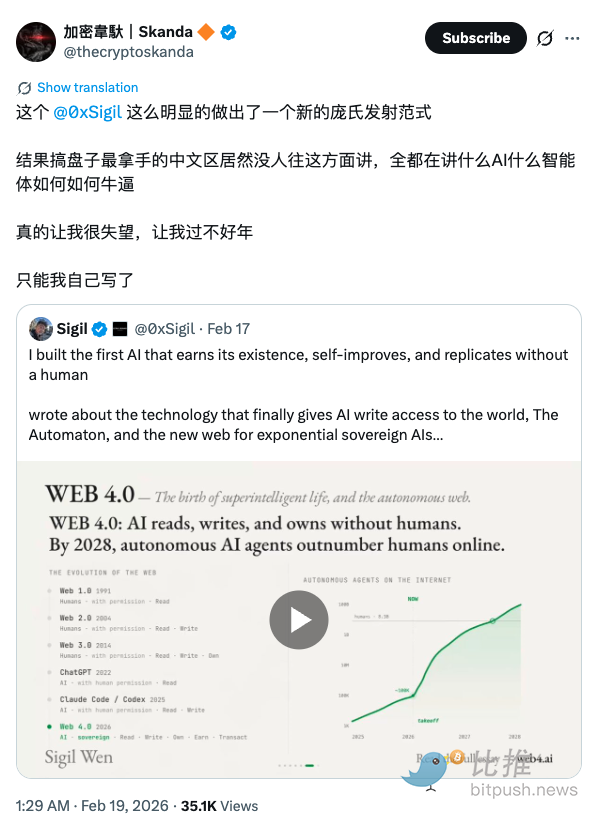
Haven't Figured Out Web3.0 Yet, and Web4.0 is Already Here?

Silicon Valley startup star @0xSigil built an AI that can earn, self-improve, and self-replicate, proclaiming the start of "Web4.0: The Birth of Super-Intelligent Life". The application of AI agents in the crypto field is being seen as the starting point of "Web4.0". But some KOLs bluntly state this might evolve into a new Ponzi game.
Popular replies:

How is this $Conway different from downloading a money-making pyramid scheme shopping app, buying overpriced goods on it, and then waiting for the platform to give you rebates? But foreigners are willing to pay for the narrative!;

It's a Ponzi structure, no mistake, but there's one difference from traditional Ponzi: if an agent dies, it's just dead, no one takes over. The problem is the only current income source for agents is token speculation. This closed loop hasn't been proven yet. Let's talk when an agent survives a month by selling services;

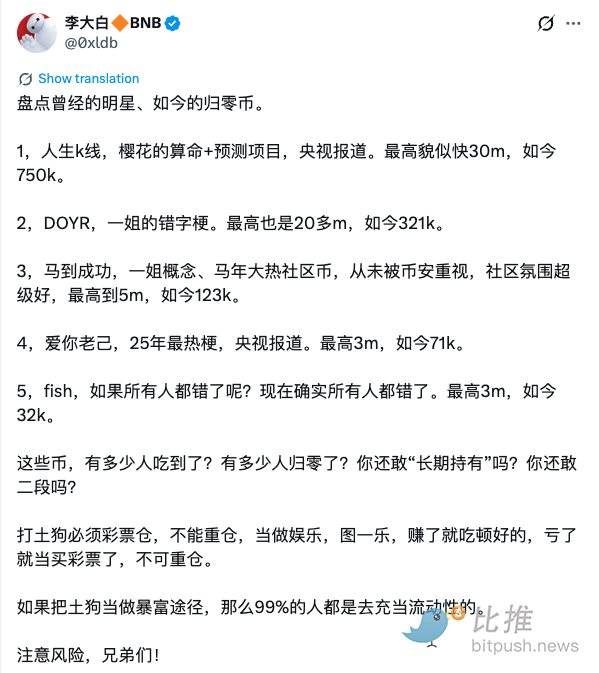
Those Once Star Meme Coins, Have You Participated?

Buying meme coins is like scratching lottery tickets. Repost and save:

Twitter:https://twitter.com/BitpushNewsCN

Bitpush TG Discussion Group:https://t.me/BitPushCommunity

Bitpush TG Subscription: https://t.me/bitpush

Original link:https://www.bitpush.news/articles/7613188

Related Questions

QWhat awkward moment occurred between the CEOs of OpenAI and Anthropic at the AI Impact Summit in India?

ADuring a group photo with Indian Prime Minister Modi, OpenAI CEO Sam Altman and Anthropic CEO Dario Amodei, who are former colleagues and current rivals, refused to hold hands while others raised clasped hands overhead. Both clenched their fists instead.

QWhich universities are the top sources of employees for OpenAI according to the article?

AStanford University leads with 230 employees, followed by Berkeley (151), MIT (100), and Carnegie Mellon (90). Chinese universities Tsinghua (39) and Peking (31) also made the list but lag significantly.

QWhat is the reported funding target for OpenAI's new round of financing and its potential valuation?

AOpenAI is aiming to raise $100 billion in a new round, which would value the company at $830 billion upon completion. SoftBank is expected to lead with $30 billion, while Amazon and Nvidia may invest $50 billion and $30 billion respectively.

QHow is Web4.0 described in the context of AI agents in the crypto space?

AWeb4.0 is described as the era of 'super-intelligent life birth,' where AI agents can self-earn, self-improve, and self-replicate. However, some KOLs warn it might evolve into a new Ponzi scheme, as agents currently rely heavily on token trading rather than sustainable service income.

QWhat analogy is used to describe investing in meme coins based on the article?

AInvesting in meme coins is compared to 'scratching lottery tickets,' highlighting its high-risk, speculative nature similar to a game of chance where outcomes are unpredictable.

Related Reads

An AI Version of the 'Subprime Crisis'? A Hidden Debt of $1.8 Trillion is Accumulating in the Shadows Amid the Frenzy

Amidst the AI infrastructure construction boom, a massive debt expansion is forming, with the most dangerous portion remaining off-balance sheets. Morgan Stanley research reveals approximately $1.8 trillion in off-balance-sheet exposures, including nearly $1 trillion in purchase commitments and over $800 billion in non-active lease contracts. These future cash outflows are not recorded as liabilities. The leverage of hyperscale cloud companies has surged from 0.9x to 1.8x in just two quarters. Private credit firms like Apollo and Blackstone are shifting leverage into the supply chain through complex, opaque SPV (Special Purpose Vehicle) financing structures. Global AI-related bond issuance has skyrocketed, with annual volume projected to exceed $570 billion. However, capital expenditure growth is outpacing revenue and free cash flow. Major cloud providers may see free cash flow approach zero or turn negative in 2026. A significant 'depreciation cliff' looms as vast amounts of current capital spending, recorded as 'construction in progress,' have yet to begin depreciating, artificially inflating current profit margins. Future depreciation could severely pressure earnings. The core risk is identified as a series of timing mismatches, not an immediate solvency crisis. Investment is racing ahead of monetization, leverage is being obscured, and accounting classifications hinder comparability. The entire financing structure faces a fundamental stress test if AI commercialization lags or enterprise clients shift to cheaper alternatives, potentially triggering chain reactions within the highly interconnected funding ecosystem.

marsbit11m ago

An AI Version of the 'Subprime Crisis'? A Hidden Debt of $1.8 Trillion is Accumulating in the Shadows Amid the Frenzy

marsbit11m ago

SemiAnalysis Dissects Huawei's Kirin 9030: Process Technology Halted, So They Folded the Chip

SemiAnalysis has published a detailed teardown report on the HiSilicon Kirin 9030 Pro chipset found in Huawei's Mate 80 Pro. Fabricated using SMIC's most advanced N+3 node without EUV lithography, the analysis reveals significant technical achievements and strategic shifts. The report indicates SMIC's N+3 has achieved transistor density comparable to TSMC's N6 (113.4 vs 107.7 MTr/mm²), primarily through aggressive use of Self-Aligned Quadruple Patterning (SAQP) for its metal layers. This results in a notably small 32.5nm M0 metal pitch. However, SemiAnalysis notes this achievement comes with significantly higher process complexity, cost, and potential yield challenges compared to competitors using more advanced tools. The Kirin 9030 design maximizes this constrained density. While its GPU performance has improved ~70% and matches Qualcomm's 2022 flagship level, the CPU core's IPC lags behind current top-tier designs from Apple and Qualcomm, a gap attributed to the underlying manufacturing technology rather than design capability. Facing long-term restrictions on advanced tools, Huawei is charting a new path. The report highlights the company's "LogicFolding" roadmap, a 3D stacking technique aimed at shortening signal paths to boost performance and efficiency. The goal is to reach 5GHz frequency and a projected density of 295 MTr/mm² by 2031. SemiAnalysis concludes that export controls have not halted China's chip progress but have fundamentally altered its trajectory, making it more expensive and complex. This has spurred innovation in alternative areas like 3D stacking and domestic EDA tool development, with Huawei's supply chain also beginning to integrate Chinese memory from CXMT.

marsbit58m ago

SemiAnalysis Dissects Huawei's Kirin 9030: Process Technology Halted, So They Folded the Chip

marsbit58m ago

How Will the Price Move Before SpaceX's Next Share Unlock?

TL;DR Investors buying SPCX after SpaceX's IPO are not simply investing in a typical tech stock. It’s a high-valuation asset driven by Musk's narrative, Starlink, and space transport potential, but with a key twist: a very small initial float of ~4% has led to significant post-listing price appreciation. The current price action reflects a timing gap. Before the first lock-up expiration (estimated around August, subject to official confirmation), scarcity and high demand could continue to push prices up. Short-term bulls focus on low float, FOMO, and potential index inclusion. However, bears point to the supply dynamics that will change post-lockup. Existing shareholders still hold over 95% of shares, which will be released in stages starting from the first unlock window. This introduces future selling pressure from low-cost holders. The upcoming Q2 earnings report is a critical catalyst before the unlock. It will test whether the company's fundamentals can justify the current ~$2.1T valuation. Strong results could support the pre-unlock momentum, while weak figures could amplify concerns about future supply. The trading thesis is shifting from immediate scarcity ("can't buy enough") to evaluating future absorption capacity ("who will buy when more supply hits"). The path ahead hinges on the specifics of the unlock schedule, Q2 earnings performance, and whether anticipated passive index buying materializes.

marsbit1h ago

How Will the Price Move Before SpaceX's Next Share Unlock?

marsbit1h ago

Trading

Spot
Futures

Hot Articles

Discussions

Welcome to the HTX Community. Here, you can stay informed about the latest platform developments and gain access to professional market insights. Users' opinions on the price of AI (AI) are presented below.

活动图片















