An AI-Generated 'Whistleblower Post': How Did It Make Two CEOs Write Self-Defense Essays at Midnight?

比推Published on 2026-01-07Last updated on 2026-01-07

Abstract

An anonymous post on Reddit, allegedly written by a drunken backend engineer from a major food delivery platform, went viral with 87,000 upvotes and 36 million views on X. The post accused the company of using algorithms to exploit drivers—assigning “desperation scores” to prioritize orders for more financially vulnerable drivers, delaying regular orders despite promised priority delivery, and misusing driver welfare funds for lobbying against unions. The viral allegations prompted immediate public denials from the CEOs of DoorDash and Uber, who issued statements and social media posts in the middle of the night to refute the claims. DoorDash published a detailed rebuttal on its website. The post was later exposed as an AI-generated hoax by a Platformer reporter. The “whistleblower” provided a fake 18-page technical document and an AI-generated employee ID, which was detected using Google’s SynthID watermarking tool. The account was deleted when further verification was requested. The incident highlights how AI can cheaply and convincingly fabricate content that aligns with public skepticism toward tech platforms. Past real controversies, such as DoorDash’s tip policy and Uber’s Greyball tool, made the false narrative feel plausible. The case underscores growing public anxiety over the difficulty of distinguishing real from AI-generated content and the power of emotionally resonant misinformation—even when debunked—to shape perception.

Written by: Curry, Deep Tide TechFlow

Original Title: The People Need a Bad Capitalist, AI Created a Food Delivery Rumor


Last week, something quite surreal happened.

The CEOs of two major American food delivery giants, one worth $2.7 billion and the other running the world's largest ride-hailing platform, were both awake at midnight on Saturday, writing self-defense essays online.

The cause was an anonymous post on Reddit.

The poster claimed to be a backend engineer at a major food delivery platform, who got drunk and went to a library to use public WiFi to leak information.

The content roughly was:

The company analyzes ride-hailing drivers' situations and assigns them a "desperation score." The more financially strained the driver, the fewer good orders they receive; the so-called priority delivery for food orders is fake, as regular orders are deliberately delayed; various "driver welfare fees" are not given to drivers at all but are used to lobby Congress against unions...

The post ended in a very convincing manner: I'm drunk, I'm angry, so I'm leaking this.

It perfectly portrayed itself as a whistleblower role of "big companies using algorithms to exploit drivers."
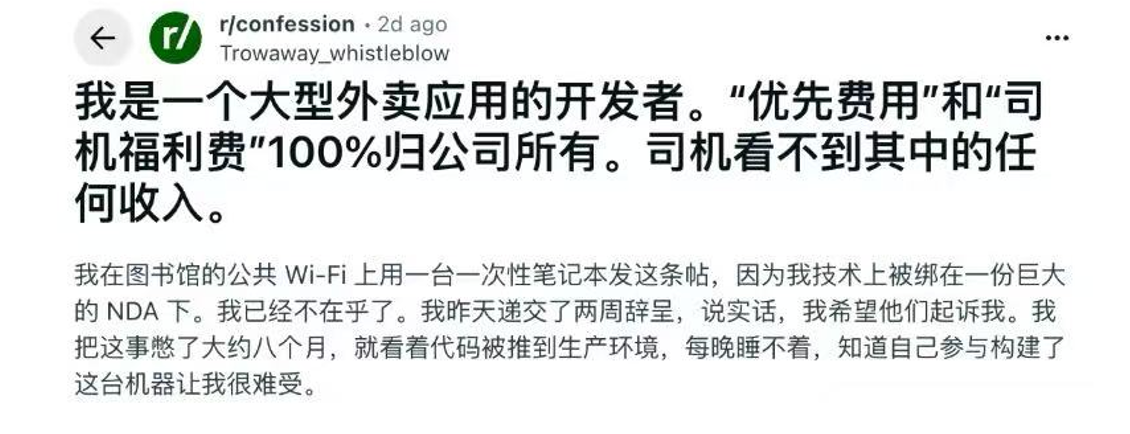
The post received 87,000 upvotes in three days, reaching the front page of Reddit. Some also screenshotted and posted it on X, where it gained 36 million exposures.

Keep in mind, the American food delivery market has only a few major players. The post didn’t name names, but everyone was guessing who it was.

DoorDash's CEO Tony Xu was the first to react, tweeting that this wasn’t them and that he would fire anyone who did such a thing. Uber’s COO also jumped in to respond, "Don’t believe everything you see online."
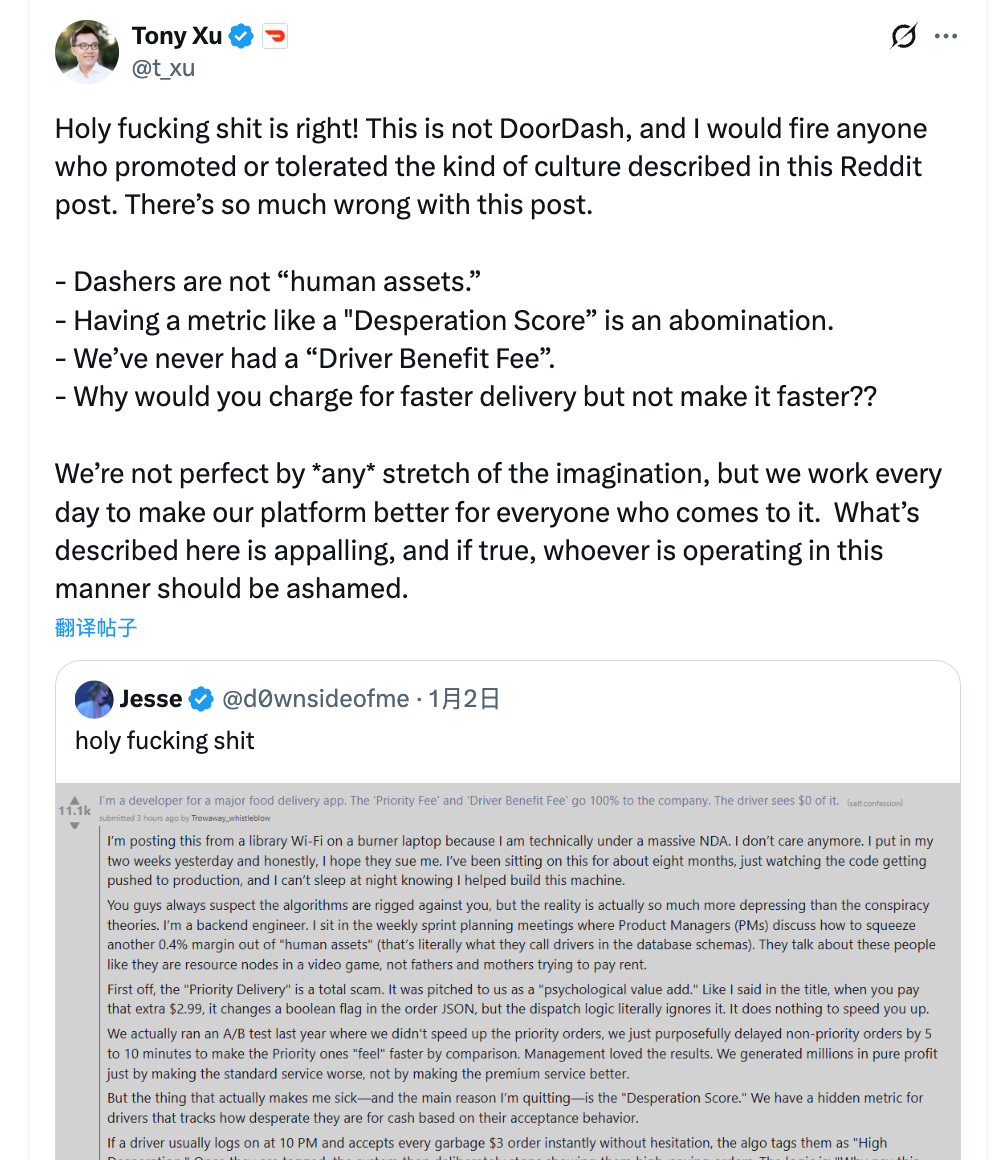
DoorDash even published a five-point statement on its official website, refuting each point in the leak. These two companies, with a combined market cap of over $80 billion, were forced into overnight PR clarifications by an anonymous post.

Then, the post was proven to be fabricated.

It was debunked by Platformer reporter Casey Newton.

He contacted the poster, who immediately sent over an 18-page "internal technical document" titled "AllocNet-T: High-Dimensional Temporal Supply State Modeling."

Every page was watermarked "Confidential," attributed to Uber’s "Market Dynamics Group · Behavioral Economics Department."

The content explained the model mentioned in the Reddit post that calculates the "desperation score" for drivers. It included architecture diagrams, mathematical formulas, data flow charts...
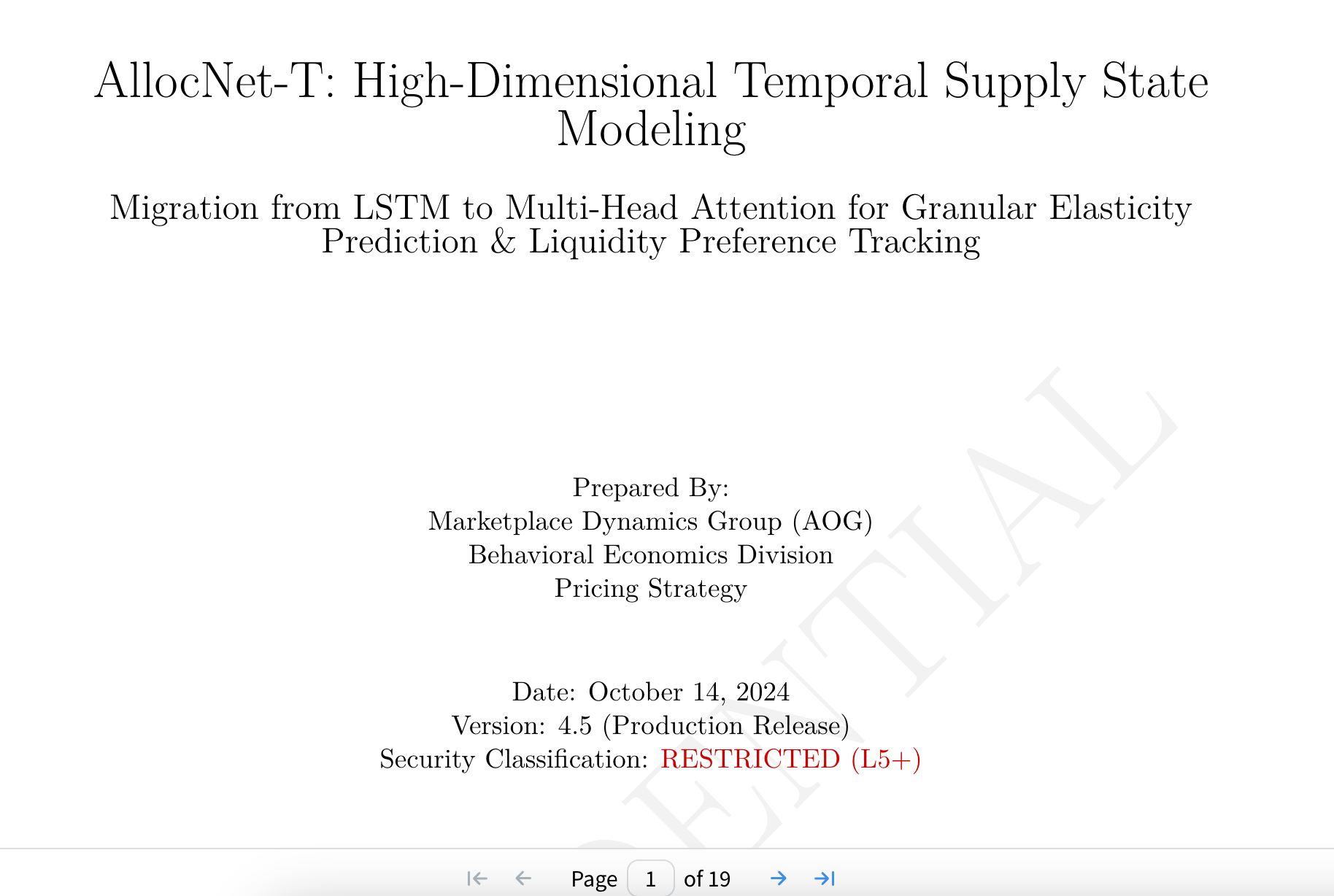
(Fake paper screenshot, at first glance, it looked very real)

Newton said the document initially fooled him. Who would go to the trouble of forging an 18-page technical document to bait a journalist?

But now it’s different.

An 18-page document like this can be generated by AI in minutes.

Additionally, the leaker sent the reporter a blurred photo of their Uber employee ID to prove they worked there.

Out of curiosity, Newton ran the ID photo through Google Gemini for verification. Gemini said the image was AI-generated.

It could be identified because Google embeds an invisible watermark called SynthID in its AI-generated content, undetectable to the human eye but recognizable by machines.

Even more absurdly, the employee ID featured the "Uber Eats" logo.

An Uber spokesperson confirmed: They do not have Uber Eats-branded employee IDs; all badges only say Uber.
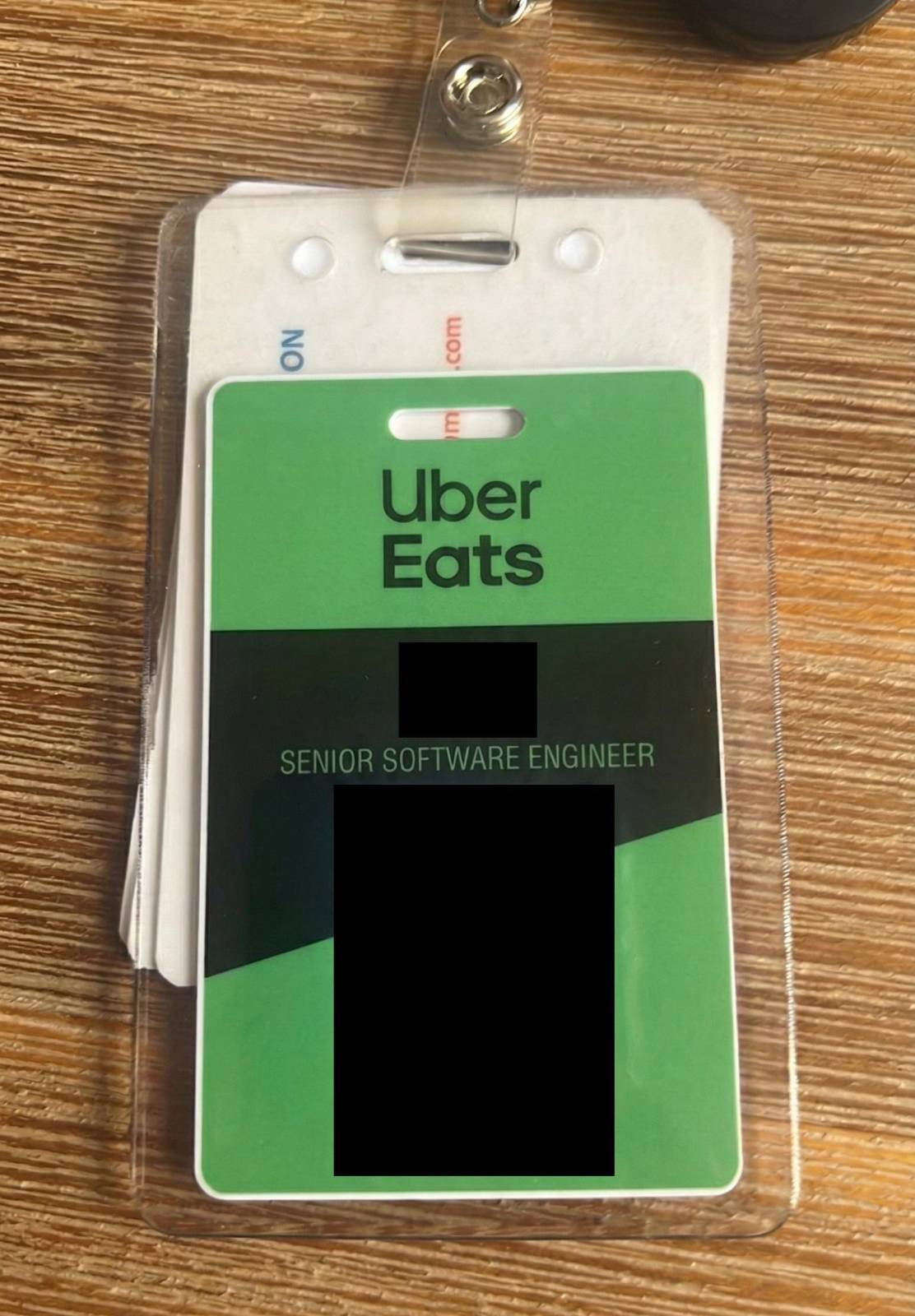
Clearly, this fake "whistleblower" didn’t even know who they were trying to target. When the reporter requested LinkedIn or other social media accounts for further verification,

The leaker deleted their account and vanished.

Actually, we don’t want to talk about AI’s ability to fake things; that’s not new.

We’d rather discuss: Why were tens of millions of people willing to believe an anonymous leak post?

In 2020, DoorDash was sued for using tips to offset drivers' base pay and settled for $16.75 million. Uber had a tool called Greyball to evade regulators. These are real events.

It’s easy to find a subconscious agreement: Platforms are not good guys, and this judgment is definitely correct.

So when someone says "food delivery platforms use algorithms to exploit drivers," the first reaction isn’t "Is this true?" but "I knew it."

Fake news spreads because it resembles what people already believe in their hearts.

What AI does is reduce the cost of creating this "resemblance" to almost zero.

There’s another detail in this story.

The deception was uncovered using Google’s watermark detection. Google develops AI, and Google also creates AI detection tools.

But SynthID can only detect Google’s own AI. This time, they caught it because the forger happened to use Gemini. With another model, they might not have been so lucky.

So solving this case was less a technical victory and more about:

The other party made a rookie mistake.

Previously, a Reuters survey found that 59% of people worry they can’t distinguish truth from falsehood online.

The food delivery CEOs’ clarification tweets were seen by hundreds of thousands, but how many firmly believe it’s just PR, just lies? Even though the fake leak post has been deleted, people are still criticizing the platforms in the comments.

The lie has run halfway around the world while the truth is still tying its shoes.

Now think, what if this post wasn’t about Uber but Meituan or Ele.me?

Things like "desperation score," "using algorithms to exploit riders," "welfare fees not given to riders at all." When you see these accusations, is your first reaction emotional agreement?

"Delivery Riders, Trapped in the System"—do you remember that article?

So the issue isn’t whether AI can fake things. The issue is, when a lie looks like what everyone already believes, does truth even matter?

What that account-deleting fugitive wanted, we don’t know.

We only know they found an emotional outlet and poured a bucket of AI-generated fuel into it.

The fire started. As for whether it’s real or fake firewood, who cares?

In fairy tales, Pinocchio’s nose grows when he lies.

AI has no nose.

Original link:https://www.bitpush.news/articles/7600729

Related Questions

QWhat was the main reason the anonymous Reddit post about food delivery platforms gained so much traction and led to CEOs responding?

AThe post gained traction because it tapped into pre-existing public skepticism and negative sentiment towards large food delivery platforms, with many people already believing that such companies exploit drivers through algorithms. The allegations, though fabricated, aligned with common perceptions, making them easily believable.

QHow was the anonymous Reddit post eventually exposed as being AI-generated?

AThe post was exposed as AI-generated when a journalist, Casey Newton, investigated and found that the 'internal technical document' provided by the whistleblower was likely created by AI in minutes. Additionally, a fake employee ID photo included in the evidence was identified as AI-generated by Google's SynthID watermark detection tool, and Uber confirmed they do not issue Uber Eats-branded employee cards.

QWhat specific allegations did the AI-generated Reddit post make against the food delivery companies?

AThe post alleged that the company analyzed ride-hailing drivers' situations and assigned them a 'desperation score,' where drivers in greater financial need received worse orders; that priority delivery for food orders was fake and regular orders were delayed; and that various 'driver welfare fees' were not given to drivers but used to lobby Congress against unions.

QWhy did the CEOs of DoorDash and Uber feel compelled to respond to the anonymous post?

AThe CEOs felt compelled to respond because the post went viral with 87,000 likes on Reddit and 36 million views on X, creating significant public pressure and potential damage to their reputations. They issued denials and clarifications to protect their companies' images and reassure the public and stakeholders.

QWhat broader concern does this incident raise about AI and misinformation?

AThe incident highlights how AI can easily generate convincing misinformation that aligns with existing public biases, making it difficult to distinguish truth from falsehood. It underscores the challenge of combating AI-generated content, especially when it reinforces preconceived notions, and raises concerns about the potential for widespread deception in the digital age.

Related Reads

Apple Also Has to Pay Rent Now

Apple Pays Rent Too: The Two-Way Flow of "Traffic Tax" and "AI Capability Rent" Between Tech Giants For over two decades, Google has paid Apple an estimated $20 billion annually to remain the default search engine on Safari, a "traffic tax" for a critical user entry point. However, in 2026, the direction of this cash flow partially reversed. Apple agreed to pay Google roughly $1 billion per year to license its Gemini AI models, as Apple's own models reportedly struggled with complex tasks. This creates a unique dynamic: Apple acts as the "landlord" in the established search ecosystem, collecting rent from Google for access. Simultaneously, in the emerging AI arena, Apple becomes the "tenant," paying Google for access to cutting-edge AI capabilities it cannot currently match internally. While Apple claims its new models are "distilled" from Gemini outputs and contain "not a drop" of Google's original code, core dependencies remain. Its knowledge base is refined using Gemini's outputs, and its most powerful cloud model runs on Google's infrastructure. Apple has structured the deal as non-exclusive, allowing it to theoretically switch AI suppliers—a hedge against over-reliance. The future hinges on whether advanced AI models become a commodity (cheap and abundant) or remain a concentrated, scarce resource (expensive and controlled by few). Apple is betting on the former, leveraging its massive device ecosystem to be a powerful, choosy customer. If the latter proves true, its bargaining power could erode. This power dynamic is extending to developers. Apple, Google, and WeChat are all pushing for apps to expose their core functions as standardized "actions" or "intents" that their respective AI assistants (Siri, Gemini, WeChat AI) can directly call. The new scarce resource is no longer just app store visibility, but "being selected by the AI." The currency of "rent" has changed from a 30% revenue share to ceding control over how users interact with an app's functions.

marsbit43m ago

Apple Also Has to Pay Rent Now

marsbit43m ago

Missed the SpaceX IPO? WEEX's "First Trade Protection" Lets You Experience US Stock Trading Risk-Free.

With the excitement around SpaceX's recent public listing reigniting interest in the US stock market, Chinese investors face significant challenges accessing compliant and convenient trading channels following regulatory actions against major online brokers. This article explores the available options, highlighting their risks and limitations. Traditional paths for US stock investments remain problematic. Qualified Domestic Institutional Investor (QDII) and Listed Open-Ended Fund (LOF) products, while compliant, suffer from high fees, significant purchase premiums, and a very limited selection of assets. Small, unregulated offshore brokers pose substantial risks, including potential insolvency. While secure, VIP accounts at banks in Hong Kong or Singapore require high minimum deposits (often 1-2 million RMB) and in-person visits, placing them out of reach for most retail investors. The article positions cryptocurrency exchanges, specifically their TradFi (traditional finance on-chain) offerings, as a compelling alternative. Platforms like WEEX are noted for providing access to a wide range of US stocks and ETFs, including SpaceX (SPCXON), through tokenized assets. This method offers advantages such as a single account for both crypto and traditional assets, USDT-based settlement avoiding fiat complexities, flexible leverage, and robust risk management. To attract users, WEEX is promoting a "First Trade Guarantee" campaign. Running from June 15 to July 8 (UTC+8), it features a $30,000 prize pool. Users who trade $500 worth of US stock contracts can qualify for a guarantee on their first eligible trade: 100% loss coverage up to $30 or a 20% bonus on profits up to $30. The campaign is presented as a low-risk opportunity for both crypto natives and traditional investors to experience US stock trading.

marsbit44m ago

Missed the SpaceX IPO? WEEX's "First Trade Protection" Lets You Experience US Stock Trading Risk-Free.

marsbit44m ago

How Difficult is Chip Making? A Division Error Costs 475 Million Dollars

How Hard Is It to Make a Chip? A Division Error Cost $475 Million Chip expert Shi Kan, a researcher at the Chinese Academy of Sciences and a popular tech creator, explains the immense challenges of chip development. Chips are foundational to modern technology, but their creation is extraordinarily difficult. The journey from sand to a functional chip involves complex design and manufacturing, but a critical bottleneck is verification—ensuring the design works flawlessly before costly production. A single, undetected bug can have catastrophic consequences, as illustrated by the infamous 1994 Intel Pentium FDIV bug. A flaw in the floating-point division unit forced a recall costing $475 million. Unlike software, chips cannot be easily patched after manufacture, making "first-time success" paramount. However, industry surveys show only 24% of chip projects achieve this; over three-quarters require at least one costly re-spin due to design flaws. Verification has thus become the dominant phase, consuming up to 70% of the design cycle. The core challenge is a "verification impossible triangle" between high performance, good debuggability, and low cost. Exhaustively verifying a modern CPU core could take 15,000 years with software simulation, or 30 years with advanced hardware emulation—timeframes utterly impractical for development. Despite being essential, verification is often seen as unglamorous "dirty work," receiving less academic attention than fields like AI. Shi and his team are tackling this by developing an agile verification research framework called ENCORE, based on FPGA technology, to improve verification efficiency and debug capability. Beyond research, Shi engages in public science communication through long-form video content, aiming to demystify chip technology, AI, and computer science. He argues for the value of pursuing "hard and long-term" endeavors, whether in the meticulous world of chip verification or in creating substantive educational content, believing such sustained effort is likely the right path forward.

marsbit54m ago

How Difficult is Chip Making? A Division Error Costs 475 Million Dollars

marsbit54m ago

Trading

Spot
Futures

Hot Articles

Discussions

Welcome to the HTX Community. Here, you can stay informed about the latest platform developments and gain access to professional market insights. Users' opinions on the price of AI (AI) are presented below.

活动图片















