Amid the AI Layoff Wave, OpenAI Opens "Iron Rice Bowl" for Salespeople

比推Published on 2026-03-24Last updated on 2026-03-24

Abstract

Amid widespread AI-driven layoffs across the tech industry—with companies like Block, Pinterest, and Dow Chemical cutting thousands of jobs—OpenAI is expanding its workforce by hiring 3,500 new employees, primarily in sales, partnership management, and technical ambassador roles. While AI is replacing standardized, task-based jobs (e.g., coding, customer service), OpenAI’s recruitment focuses on roles that require human interaction: convincing enterprise clients to adopt AI, integrating systems, and providing tailored solutions. Despite ChatGPT’s massive user base, monetization remains challenging, with significant losses per user. Enterprise clients, crucial for profitability, are increasingly choosing competitors like Anthropic’s Claude. OpenAI’s shift reflects a broader trend: AI excels at clearly defined tasks but struggles with ambiguous, relationship-driven work like sales and customization. The company is even exploring partnerships with private equity firms to support AI implementation. The key differentiator between replaced and valued roles is whether the job can be easily described—if so, it’s vulnerable to AI automation. Roles requiring nuanced, human-driven problem-solving remain in demand.

Author: Curry

Original Title: AI Leads to Layoffs, But OpenAI Is Hiring Salespeople


Companies building AI are massively recruiting "field promoters"—the shovels are made, but someone still needs to teach others how to dig.

Recently, a wave of AI-induced unemployment anxiety has swept across the internet in both the East and the West.

Block laid off 4,000 people, with the CEO saying AI can do your job; Pinterest cut 15% of its employees, redirecting funds to AI initiatives; Dow Chemical laid off 4,500 people, citing a shift toward automation...

Domestically, things aren’t quiet either: NetEase was rumored to be replacing outsourced workers with AI, iFlytek denied rumors of large-scale layoffs, and ByteDance was reported to be optimizing 20% of non-AI departments every six months...

According to statistics, in the first three months of 2026, the global tech industry has already seen over 45,000 layoffs, with nearly 10,000 explicitly attributed to AI.

Against this backdrop, last Friday, the Financial Times reported that OpenAI plans to expand its workforce from 4,500 to 8,000 by the end of the year.

3,500 new positions. The company building AI actually says it doesn’t have enough people?
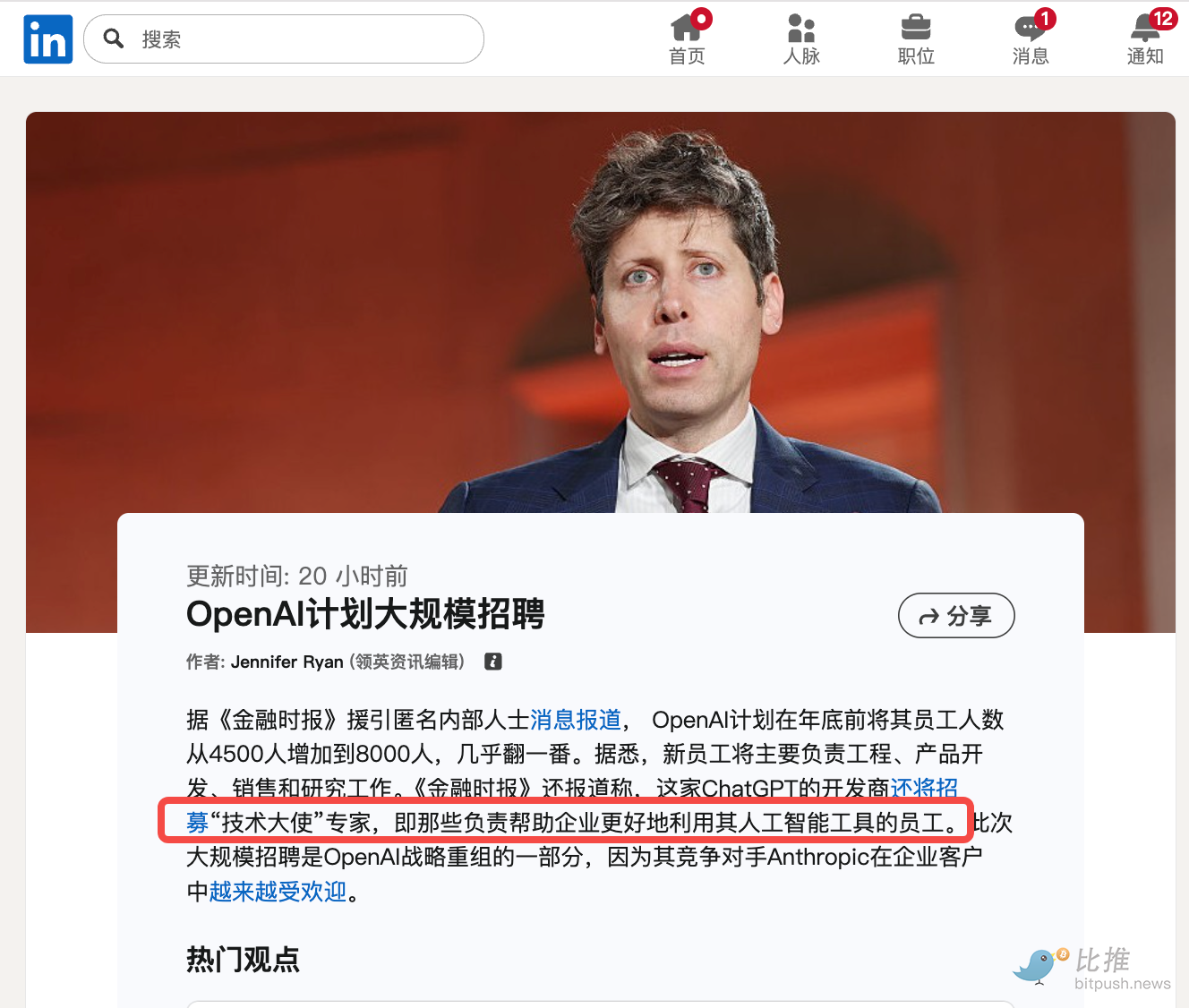
Take a look at OpenAI’s recruitment page: engineers and researchers are, of course, being hired, but equally prominent are another category of roles: partnership managers, enterprise sales, GTM (go-to-market strategy) teams, and a new role mentioned in the report called "technical ambassadorship," which translates to:

Technical Ambassador, specifically tasked with helping enterprise clients learn how to use AI.

So, OpenAI isn’t hiring people to make AI stronger; it’s hiring people to make others willing to pay for AI.

Winning Clients Trumps Winning Models

ChatGPT has 900 million weekly active users, but most don’t pay.

Even paying consumers are being served at a loss for OpenAI: the computing cost per heavy user exceeds the $20 monthly fee. Projected revenue for this year is $25 billion, with an expected loss of $14 billion.

Consumers support traffic; enterprise clients support profits. And enterprise clients are running toward Anthropic’s Claude.

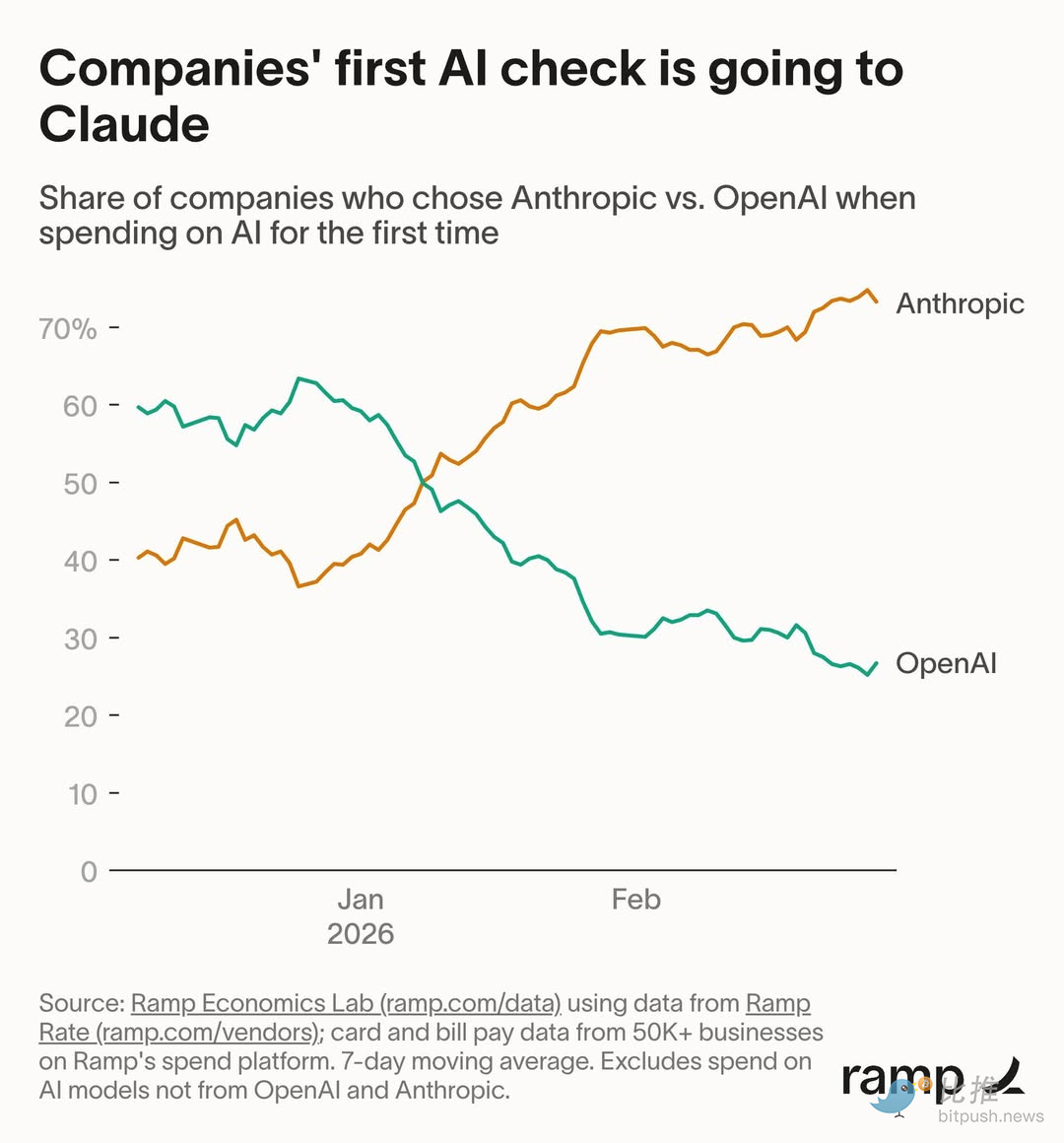
Data from Ramp shows that among enterprises making their first AI tool purchase, Anthropic captured 73% of the share. Ten weeks ago, this data was split evenly between the two.
In December of last year, Altman sent a "code red" memo to all staff, pausing all non-core projects like advertising and shopping assistants, and concentrating all company resources on the ChatGPT experience.

The immediate trigger was Google’s Gemini 3 outperforming ChatGPT in multiple tests, but the underlying anxiety lies on the enterprise side: Anthropic is embedding Claude into customers’ codebases and workflows. Once set up, migration costs begin to snowball.

Models can be iterated, but customers who leave won’t come back on their own. Chasing customers can’t rely on AI suggestions; it requires real people to knock on doors.

The Shovel Can’t Sell Itself

AI can write code, handle customer service, and perform data analysis, but there’s one thing it can’t do:

Persuade a company’s technical lead to sign an annual contract to buy me.

For individuals using AI, downloading an app is enough; dissatisfaction leads to uninstalling. Enterprise use of AI is another matter. Data security reviews, internal process changes, compatibility with existing systems, employee training—any single hurdle can stall a project.

This isn’t a problem solvable by model benchmarks; it requires someone to sit in the client’s conference room to push things forward.

OpenAI clearly gets it. It’s not just hiring salespeople; the FT reported it’s in talks with private equity firms like TPG and Brookfield about joint ventures specifically to help enterprises implement AI. The essence of this business is still about sending people on-site.

Block’s story tells the same tale.

Less than three weeks after laying off 4,000 people, the company started calling people back. A design engineer was told it was a "mistaken layoff"; a technical lead found that after his entire team was cut, no one could handle critical business, threatening to quit, prompting the company to rehire some people.

Dorsey himself preemptively noted in the layoff letter: We might have cut the wrong some people...

AI is indeed causing layoff anxiety, but cutting the lifeblood arteries of a company due to AI is clearly an overcorrection. Even in a company where the CEO publicly states AI can replace most employees, there are still links in the chain that AI can’t handle.

AI is best at replacing tasks that can be clearly defined, but "convincing an organization it needs AI, then helping it use it" is something that precisely cannot be clearly defined.

Every technological revolution has someone saying "the shovel sellers make the most money." This round of AI is no different, with consensus being that infrastructure companies are safe bets, regardless of who wins or loses.

But OpenAI’s current situation shows that once the shovels are made, someone still needs to teach others how to use them. And this "teaching" process恰恰 cannot be accomplished by the shovel itself.

Field Promotion: The Iron Rice Bowl in AI Anxiety

Looking at the people laid off and those hired in this wave, a dividing line emerges.

A large portion of the 4,000 people cut from Block were engineering and operations roles expanded during the pandemic, doing work that could be standardly described. The bulk of OpenAI’s new 3,500 hires are in sales, customer success, partnership management—work that can’t be written into process documentation.

What OpenAI is doing now has a very old name: field promotion (地推).

Sending people to client offices, sitting down, listening to needs, integrating systems, overseeing implementation. Whether it’s called a Technical Ambassador or a Partnership Manager, stripped of the English, it’s essentially no different from Meituan sending people door-to-door a decade ago to convince restaurant owners to install POS machines during the O2O wars.

This line doesn’t just appear in these two companies.

Shopify’s CEO told employees this year that future requests for more staff must first prove AI can’t do the job. Klarna laid off 700 customer service reps two years ago saying AI was sufficient, then quietly hired people back last year, with the CEO admitting they "moved too fast" on AI.

What’s the difference between those laid off and those hired back?

Layoff-prone roles share a common trait: the work content can be broken down into clear inputs and outputs. Writing a piece of code, replying to a support ticket, generating a report—clear boundaries, something AI excels at.

The characteristics of field promotion are the exact opposite. Helping a financial client integrate AI into a compliance system versus helping a gaming company use AI for content generation—no two projects are the same. The person sitting across the table differs, so the solution differs. This cannot be written into a prompt.

AI isn’t eliminating all jobs; it’s repricing work. What can be explained in one sentence is getting cheaper; what can’t is getting more expensive.

The company that could change the world with one research paper three years ago now needs to hire thousands of people to knock on doors one by one.

If you’re anxious about whether AI will replace you, the answer might not depend on your industry, but on whether your job can be explained in one sentence.

The part that can be explained clearly is already not very safe.


Twitter:https://twitter.com/BitpushNewsCN

Bitpush TG Discussion Group:https://t.me/BitPushCommunity

Bitpush TG Subscription: https://t.me/bitpush

Original link:https://www.bitpush.news/articles/7622926

Trending Cryptos

Related Questions

QWhat is the main reason OpenAI is hiring 3500 new employees, according to the article?

AOpenAI is hiring 3500 new employees, primarily in roles like sales, customer success, and partnership management, to help sell and implement its AI technology with enterprise clients, rather than just focusing on making the models stronger.

QWhy is OpenAI focusing on enterprise clients instead of individual consumers for profitability?

AWhile ChatGPT has 900 million weekly active users, most do not pay, and even paying consumers are served at a loss due to high computational costs. Enterprise clients are crucial for profitability, as they provide sustainable revenue through contracts and integration into business workflows.

QWhat does the term 'technical ambassadorship' refer to in the context of OpenAI's hiring?

A'Technical ambassadorship' refers to a role at OpenAI where employees help enterprise clients learn how to use and implement AI technology effectively, acting as intermediaries to teach and support customers in adopting AI solutions.

QHow does the article contrast the jobs being cut at companies like Block with those being hired at OpenAI?

ACompanies like Block are cutting jobs that involve standardized, clearly defined tasks (e.g., engineering and operations), which AI can handle, while OpenAI is hiring for roles like sales and customer success that require human interaction, customization, and persuasion—tasks that cannot be easily automated or clearly defined.

QWhat is the key takeaway regarding AI's impact on job security, as stated in the article?

AAI is not eliminating all jobs but is repricing them: jobs with clear, definable tasks are becoming cheaper and less secure, while roles that require human nuance, such as sales and client management, are becoming more valuable and secure because they cannot be easily replaced by AI.

Related Reads

Why Zhang Yiming Spends 50% of His Time on Seed?

Why does Zhang Yiming devote 50% of his time to Seed, ByteDance's core AI research team, while the company’s high-profile AI products like Doubao appear less dominant in the current market? An analysis reveals that ByteDance, historically a leader in defining trends (e.g., TikTok, Toutiao), has not set major AI industry agendas in the first half of the year, instead following competitors in areas like Agent and productivity tools. ByteDance’s strategy diverges from peers like Tencent and Alibaba, who are integrating AI into holistic productivity systems. While Doubao is highly successful—with 382 million MAU and leading revenue—its very success may create inertia, focusing iterations on improving the AI assistant rather than pioneering disruptive new entry points like Agent-native desktops. Zhang Yiming’s deep investment in Seed, a team of 300+ top researchers from firms like Google DeepMind, signals a long-term bet on foundational model capabilities as the ultimate competitive moat, reminiscent of ByteDance's past wins through superior underlying tech (e.g., recommendation algorithms). However, in the fast-evolving AI era, superior foundational models risk being outpaced by rapid shifts in product-level interaction paradigms and user habits. Zhang is essentially applying his principle of "delayed gratification" to corporate strategy, gambling that Seed’s breakthroughs will eventually make it the indispensable infrastructure for all AI applications, regardless of which product leads the user interface. The core question remains: is the AI era a race for the best product or the most powerful underlying infrastructure? The answer will define ByteDance’s future position.

marsbit24m ago

Why Zhang Yiming Spends 50% of His Time on Seed?

marsbit24m ago

From 'Speculative Asset' to 'The Next Generation Financial Infrastructure', Crypto is Growing a New TradFi World

From "Speculative Asset" to "Next-Generation Financial Infrastructure": Crypto Is Evolving into a New TradFi World Looking back, the crypto industry has long focused on identifying the "next asset to pump." However, starting around 2026, several developments across different sectors began converging. Stablecoin market cap approached $300 billion, entering a global payments adoption phase. DTCC initiated its first live tokenized asset conversions, while prediction markets expanded into regulated exchanges and brokerages. Simultaneously, AI Agents began using stablecoins autonomously for payments. These seemingly disparate trends share a common thread: the issuance, custody, trading, payment, and settlement capabilities built by the crypto industry over the past decade are now opening to broader financial activities and machine-driven economies. This suggests crypto is maturing beyond a purely speculative market, building a foundational infrastructure layer beneath it. This simultaneous progress occurs because the core components of a new financial system—stablecoins as programmable money APIs, RWA tokenization for traditional assets, prediction markets for price discovery on future events, and AI Agents as new economic actors—have developed independently and are now beginning to interconnect. These elements form the building blocks of a next-generation financial infrastructure. This emerging infrastructure features multi-layered capabilities: 1) Asset issuance and tokenization for a wider range of assets. 2) 24/7 programmable payments and settlement, simplifying global transfers. 3) Continuous trading and price discovery, providing real-time market signals for both humans and software. 4) Advanced identity, permissions, and authorization systems suitable for institutions and AI. 5) Growing connections to real-world legal and regulatory frameworks, providing greater clarity for traditional participants. This shift is reflected in changing funding sources, with more revenue now coming from real-world business flows, an expanding set of participants (including corporate systems and autonomous agents), and more nuanced regulatory discussions focused on rules and boundaries rather than outright prohibition. However, significant challenges remain. Technical confirmation is not legal finality; liability and governance for AI-driven payments are unclear; fragmentation across networks persists; privacy solutions for institutions are needed; and the system currently lacks mature frameworks for credit, insurance, and complex risk management found in traditional finance. In conclusion, 2026 marks a pivotal point where several previously independent pieces of the crypto puzzle started to connect. While far from complete, it signifies crypto's crucial step towards becoming a low-friction, global execution layer for real assets, traditional institutions, and intelligent software, built beneath its vibrant speculative markets.

marsbit1h ago

From 'Speculative Asset' to 'The Next Generation Financial Infrastructure', Crypto is Growing a New TradFi World

marsbit1h ago

Supporters of Bitcoin BIP-110 Update Have Prepared a 'Last Resort' Plan If the Proposal Is Not Adopted: It Could Radically Change BTC's Value

Supporters of the BIP-110 update for Bitcoin have prepared a contingency plan in case the proposal is not adopted, a move that could radically alter BTC's value. Developer Chris Guida has adapted a proof-of-work code originally created by Luke Dashjr in 2017 for the current version of Bitcoin Knots. This adaptation is described as a last-resort measure to be activated if miners do not signal readiness for BIP-110. The proposal itself is a soft fork aimed at temporarily limiting the storage of arbitrary data in Bitcoin transactions. It introduces stricter limits on new transaction outputs, OP_RETURN fields, and witness data, with rules designed to expire after approximately one year. Guida stated this option needs to remain open if miners were to "conspire to betray Bitcoin." Should the contingency code be used, it could change Bitcoin's current mining algorithm. This change would likely prevent existing ASIC miners from generating blocks on the new chain, leading to a large-scale reorganization of the Bitcoin mining network. Luke Dashjr, another Bitcoin Knots developer, contributed to the code and expressed hope it would not be needed, but sees its existence as useful for a potential crisis. A supporter known as Mechanic argued that the mere possibility of a proof-of-work change could act as a deterrent, emphasizing that Bitcoin's rules should be set by participants and node operators, not miners. While miner signals are tracked for BIP-110 activation, data from the proposal's official tracking page indicates support remains limited.

cryptonews.ru4h ago

Supporters of Bitcoin BIP-110 Update Have Prepared a 'Last Resort' Plan If the Proposal Is Not Adopted: It Could Radically Change BTC's Value

cryptonews.ru4h ago

Trading

Spot

Hot Articles

Discussions

Welcome to the HTX Community. Here, you can stay informed about the latest platform developments and gain access to professional market insights. Users' opinions on the price of AI (AI) are presented below.

活动图片