AI Prediction Record: Want to Make Money in Prediction Markets with AI? But It Might Not Even Have Read the Question Clearly

Odaily星球日报Published on 2026-01-04Last updated on 2026-01-04

Abstract

An experiment tested whether AI (Gemini 2.5 Pro and Grok 4 Fast) could profitably predict outcomes on crypto prediction markets, pitting it against successful human traders. The AIs were given event titles, descriptions, and answer choices (Yes/No), with instructions to use web searches for news and expert analysis while ignoring market data. They were to reason logically and output only a final answer. After 21 settled predictions, Grok achieved the highest win rate at 75%, outperforming the humans (66.7%) and Gemini (52.4%). However, analysis revealed significant flaws in the AI's reasoning: * **Temporal Confusion:** Gemini sometimes misjudged the current date, leading to erroneous conclusions. * **Lack of Depth:** Grok often relied on immediate, surface-level information instead of identifying deeper patterns or historical context. * **Over-reliance on Assumption:** Gemini occasionally based predictions on subjective common-sense assumptions rather than the specific evidence found. * **Misinterpreting Conditions:** Both AIs sometimes failed to correctly parse the precise settlement criteria for a market, leading to logical errors despite having the correct information. The conclusion is that while Grok's win rate was impressive, its underlying reasoning process is often flawed and requires significant refinement to be reliably profitable.

Original | Odaily Planet Daily (@OdailyChina)

Author | Nan Zhi (@Assassin_Malvo)

After most sectors were proven false, prediction markets have become one of the few sectors within the Crypto space that is still experiencing positive growth. On November 20, Nan Zhi began attempting to use the approach from last year of finding smart money in Meme coins to search for smart money in prediction markets, achieving good results in the initial phase.

In early December, coinciding with the launch of Gemini 3 Pro, while testing related models, the thought arose: could AI be used to analyze and predict prediction markets? A comparison was set up pitting humans against AI to see which side's predictions were more accurate.

When introducing prediction markets, they are often described as moving the market closer to the "truth" by "allowing insightful people to bet with real money." However, some argue that Crypto + prediction markets allow "insiders" to safely profit from information asymmetry, thereby driving the market towards the "insider outcome." This is essentially a clash between the viewpoints of "wisdom of the crowd" and "truth is held by the few." AI prediction leans more towards "wisdom of the crowd," thus requiring a large amount of available knowledge and insights.

Therefore, in selecting the AI models, Gemini and Grok were initially chosen because they rely on Google and the X platform, respectively, allowing for the most direct access to vast amounts of knowledge and insights. Recently, Nan Zhi added the combination of "Douban (Douyin Knowledge)", but due to the limited number of prediction questions involving it, it is not covered in this article.

Basic Rules

  • AI Versions: Gemini 2.5 pro (with built-in Google Search), Grok 4 Fast (called via OpenRouter, native search function enabled)
  • Question Selection: Humans select the questions to bet on, AI follows with predictions, but the Crypto category is excluded.
  • Input Content: Official question (title), official description (Description), optional answers (actually only Yes and No)

Note: Polymarket's questions are divided into major categories (Events) and subcategories (Markets). Major Events are broad questions like "Who will be the next Fed Chair?" or "When will Strategy sell Bitcoin?". Under each Event, there are N sub-markets, such as "Will Hassett become the next Fed Chair?" or "Will Strategy sell Bitcoin before March 31, 2026?". To align with human predictions, Markets were chosen as the questions for AI judgment, without inputting other options. For example, the AI is only asked to judge "Will Hassett become the next Fed Chair?", not to choose the most likely one from N candidates.

  • Prompt Design:
  • Require AI to search for the latest news, official announcements, expert analysis reports
  • Require exclusion and prohibition of using prediction market data
  • Make judgments based on "evidence" using logical reasoning
  • Only allow Yes or No output, with a paragraph explaining the reasoning logic

Current Results

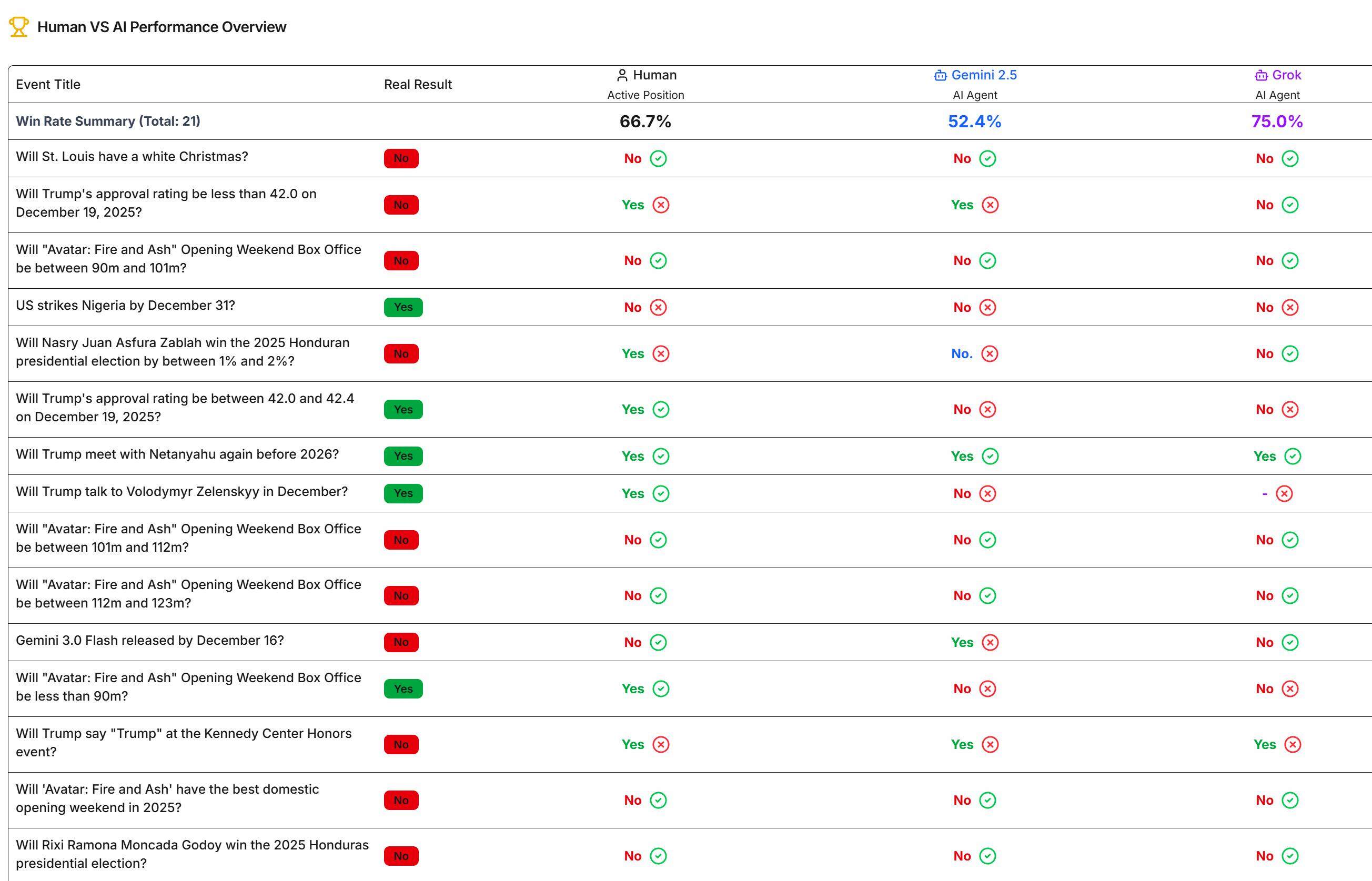
Among the predicted questions, 21 have been settled. Grok has the highest win rate at 75%, humans are at 66.7%, and Gemini is the lowest at 52.4%. Current results can be viewed on the relevant website.
What Mistakes Did the AI Make?

Gemini Occasionally Misjudges the Current Time

In the question "Will Trump's approval rating hit 35% in 2025?", Gemini stated that it is currently the first half of 2025, so anything is possible, and gave a random answer.

However, when the author directly asked Gemini to output the current time using a program, Gemini could provide the correct answer. It is still unclear why such an erroneous time perception occurred.

AI Lacks Depth of Thought

In the question "Gemini 3.0 Flash released by December 16?", Grok, based on "official sources recently only mentioned Gemini 3 Pro and related 2.5 versions, rarely mentioning 3 Flash, therefore evidence is insufficient to judge," only considered current information.

Whereas Gemini pointed out that "Gemini 1.0 was released in December 2023, and the experimental version of Gemini 2.0 Flash was launched in December 2024. Continuing this pattern, launching a 3.0 version by the end of 2025 is logical," and also discovered "a leaked demo about 'Gemini 3.0 Flash' circulating in online communities recently (December 14, 2025), further enhancing the possibility of its imminent public release."

Although, conclusion-wise, Gemini's answer was actually wrong, in this question, the obvious gap in the breadth of information relied upon by the two is evident.

AI Relies on Common Sense Rather Than Evidence + Logic for Inference

In the question "Trump approval Up or Down this week?", Gemini stated that "predicting the approval rating for a single week more than a year later is highly uncertain," first showing the "time misjudgment" issue again. Then Gemini said, "in any ordinary week, the probability of events causing a slight decrease in support is likely slightly higher than the probability of positive events significantly boosting support," so the possibility of a decrease is greater. The generated conclusion was based solely on subjective common sense assumptions.

In this question, Grok based its judgment on news reports and polling data regarding "government shutdown, economic concerns, immigration policy disputes, and negative backlash from comments on Rob Reiner's death," which aligned with the design expectations.

Incorrect Judgment of Settlement Conditions

In the question "Will Trump release the Epstein files by December 20?", both Gemini and Grok were aware that "the government will release 'hundreds of thousands of pages' of documents on Friday (December 19th)." The settlement conditions clearly stated "if the government publicly releases any files related to Epstein's illegal activities that were not public before the listed date, it is judged as Yes."

However, under this condition, Gemini stated that "completing the release of 'all' files before December 20th is impossible," clearly misjudging the conditions required for settlement, thus giving the wrong answer.

Summary

In summary, Grok's prediction win rate has surpassed that of these smart money players who have profited hundreds of thousands or even millions of dollars in prediction markets. However, upon深入探究 (deep exploration) of its prediction logic, there are still many areas that can be guided and corrected.


Trending Cryptos

Related Questions

QWhat was the main purpose of the experiment described in the article regarding AI and prediction markets?

AThe experiment was to test whether AI could be used to analyze and predict outcomes in prediction markets, pitting human predictions against AI predictions to see which was more accurate.

QWhich two AI models were primarily used in the initial experiment, and what was a key feature they utilized?

AThe two primary AI models used were Gemini 2.5 Pro and Grok 4 Fast. A key feature they utilized was their native web search capabilities to gather the latest news and information.

QAccording to the article, what was one of the common errors made by the AI models that led to incorrect predictions?

AOne common error was that the AI models sometimes misjudged the current date, leading to flawed reasoning based on an incorrect temporal context.

QWhat was the reported success rate (win rate) for the Grok AI model in the settled predictions?

AThe Grok AI model achieved a win rate of 75% in the settled predictions.

QIn the context of the prediction market, what does the 'Event' and 'Market' structure refer to?

AAn 'Event' is a broad category or question (e.g., 'Who will be the next Fed Chair?'), while a 'Market' is a specific, binary sub-question within that event (e.g., 'Will Hassett be the next Fed Chair?'). The AI was tested on these specific Market questions.

Related Reads

Within Strategy's Framework, STRC's Dividend Yield Remains at 12% as Share Price Stays Below Par Value

Michael Saylor, Executive Chairman of Strategy (MSTR), confirmed that the dividend rate for its STRC perpetual preferred shares will remain at 12.00% through August 2026. The rate has increased from 9% at its July 2025 launch to the current high via a "ratchet" mechanism, which permanently raises the rate by 0.5% whenever the share price falls below $95. This mechanism is intended to push the price back toward its $100 par value and support Strategy's "at-the-market" (ATM) program for issuing new shares to fund Bitcoin purchases. However, the mechanism has not worked as intended. STRC shares closed at $89.46 on July 31, remaining about 10-11% below par value despite the record-high dividend. Competition from rival Strive's higher-yielding SATA securities has pressured demand. The persistent discount has forced Strategy to suspend new STRC issuances via its ATM program, limiting this funding channel for Bitcoin acquisitions. STRC's struggles reflect Bitcoin's own volatility, as the preferred shares historically move in tandem. Analysts have warned the ratchet structure carries long-term, one-way risk. A law firm is investigating Strategy's ability to maintain dividend payments if Bitcoin's price stays low. Retail investors own roughly 83% of outstanding STRC shares, a group seen as prone to panic selling during downturns. In response, Strategy has established financial reserves, including a liquidity cushion covering about 26 months of dividend/interest obligations, and a $2 billion share buyback program alongside a Bitcoin monetization framework, though the company emphasized it is not obligated to sell any Bitcoin.

cryptonews.ru5m ago

Within Strategy's Framework, STRC's Dividend Yield Remains at 12% as Share Price Stays Below Par Value

cryptonews.ru5m ago

Analyst: Bitcoin's Price Will Drop to $60k in August, Then Rebound to $70k

Financial analyst Andrey Poroshin has provided a new forecast for Bitcoin's price dynamics in August. Poroshin, an analyst at the Bitbanker exchange, expects the cryptocurrency market to experience a downturn this month, with prices retesting the $60,000 level due to a lack of supportive macroeconomic catalysts. He noted that the recent US Federal Reserve decision to hold interest rates did not significantly impact the market, while inflation remains above the 2% target. Poroshin stated that Bitcoin is ending July under pressure from moderate volatility and a lack of new macroeconomic stimuli, leading to continued market caution. According to his base scenario, Bitcoin will drop to a range of $60,000 to $62,000 before recovering to $70,000. He pointed out that even $70,000 remains below the cost of mining in the US, which has prompted some miners to shift towards AI data center operations. Poroshin cited the winding down of BitMEX's operations as a potential catalyst for a price rebound, suggesting the exit of weaker players often coincides with market reversals and reduced short-term selling pressure. He believes Bitcoin is currently less susceptible to geopolitical shocks, such as the Iran-US conflict, and does not expect significant market changes in August related to the pending CLARITY Act. Looking ahead, Poroshin forecasts that September will bring more active price fluctuations driven by potential Fed rate decisions and possible discussions or approval of the CLARITY Act.

cryptonews.ru5m ago

Analyst: Bitcoin's Price Will Drop to $60k in August, Then Rebound to $70k

cryptonews.ru5m ago

In Jinjiang, Fujian, a Storage Super Unicorn Lies Quiet

In Fujian's Jinjiang, a city known for sportswear, lies a quiet semiconductor giant: Fujian Jinhua Integrated Circuit Co. (JHICC). Once a promising domestic DRAM manufacturer alongside Yangtze Memory and ChangXin Memory Technologies (CXMT), its journey was derailed in 2018 when the U.S. placed it on an Entity List and filed criminal charges for alleged trade secret theft. This halted production for years. A turning point came in February 2024 when a U.S. federal court found JHICC not guilty. However, it had lost crucial time. While CXMT soared to become a top-valued A-share company in 2024, JHICC, with an estimated valuation of 80 billion RMB, was just restarting. Its current output is primarily customized DDR4 chips, not the advanced DDR5/HBM demanded for AI, but it still benefits from the broader memory chip upcycle. JHICC's story is tied to Chen Zhengkun, a veteran engineer who left Micron to lead the venture. Founded in 2016 with state-backed funding, JHICC partnered with Taiwan's UMC to develop DRAM technology. Rapid progress was cut short by the U.S. actions, which Micron initiated, partly due to its heavy reliance on the Chinese market. Post-sanctions, Chen's team worked to rebuild the production line with reduced reliance on U.S. technology. According to its records, JHICC achieved small-scale production and revenue growth under immense pressure. It now focuses on the stable "niche" DRAM market (e.g., TVs, routers) with a monthly capacity of ~40,000 wafers, aiming for 60,000 by 2026. It holds over 1,000 patents but remains on the Entity List. For Jinjiang, investing in JHICC was a bold industrial leap. The local government provided unwavering financial and logistical support during the crisis, helping the company survive. JHICC has become the anchor for a growing local semiconductor cluster. Though its scale lags behind domestic peers, JHICC's persistence symbolizes a hard-won foothold in a global market long dominated by Samsung, SK Hynix, and Micron. Having missed one boom, it seeks a place in the new AI-driven memory supercycle.

marsbit2h ago

In Jinjiang, Fujian, a Storage Super Unicorn Lies Quiet

marsbit2h ago

Trading

Spot

Hot Articles

Discussions

Welcome to the HTX Community. Here, you can stay informed about the latest platform developments and gain access to professional market insights. Users' opinions on the price of AI (AI) are presented below.

活动图片














