AI is Revaluing the Real World: Why Gold, Silver, and Copper are Becoming Important Again

链捕手Published on 2026-05-13Last updated on 2026-05-13

Abstract

AI is reassessing the value of the real world: why gold, silver, and copper are regaining importance. For over a decade, financial innovation centered on digitalization, from internet platforms to RWA tokenization. However, AI's rapid development highlights a deeper dependency: the physical infrastructure underpinning the AI era, not just code. Contrary to being "dematerialized," AI strengthens reliance on the real world. Every model training and deployment requires vast resources—data centers, energy grids, cooling systems, and critical industrial materials like copper, silver, and gold, which provide irreplaceable conductivity and durability. This shift is redefining the asset layer structure. A new "Asset Stack" is emerging: - Physical Layer: Metals, energy, and raw materials. - Financial Layer: Government bonds, ETFs, structured products. - Digital Layer: Tokenization infrastructure and programmable assets. The digital layer relies on the financial layer, which ultimately depends on the physical layer. While markets previously rewarded upper-layer assets like stocks and digital platforms, AI is redirecting attention to foundational real-world resources. S&P Global forecasts data center copper demand will surge from 1.1 million tons in 2025 to 2.5 million tons by 2040, amid a growing global supply deficit. This signals a long-term structural shift where energy, metals, and infrastructure form a critical "Physical Layer" that could limit AI's expansion. Tokenization alo...

Over the past decade, global financial innovation has revolved almost entirely around "digitization": internet platforms, ETFs, stablecoins, and today's RWA (Real World Asset) tokenization. However, with the rapid development of AI, a deeper question is beginning to emerge: what will truly underpin the AI era?

The answer may not be the code itself, but the real world behind the code.
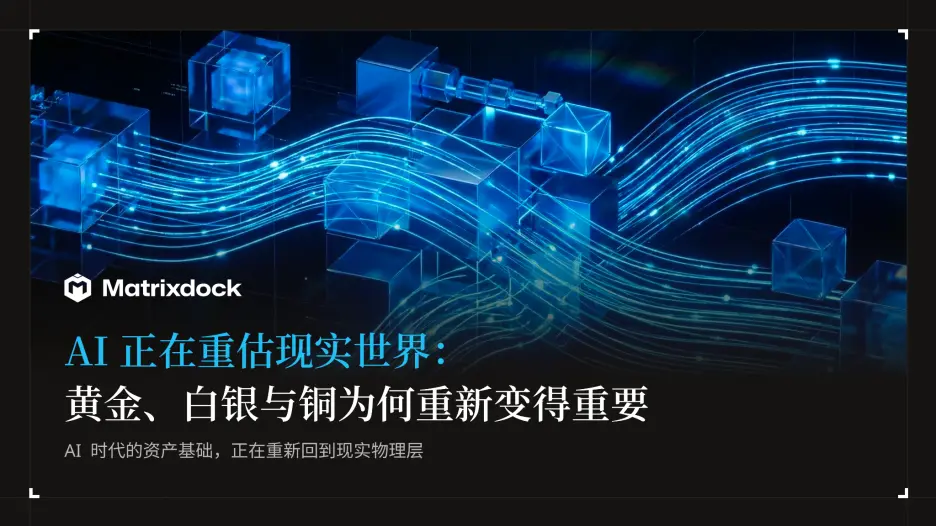
AI is Redefining the Asset Layer Structure

For a long time, AI was often imagined as a "dematerializing" technological revolution, but the reality is precisely the opposite. AI has not weakened dependence on the real world; instead, it is strengthening that dependence. Every model training, inference, and deployment requires vast real-world infrastructure support, including data centers, power grids, cooling facilities, advanced hardware, and industrial resources. In other words, what appears to be a digital system is essentially an industrial system.

In this system, the truly irreplaceable elements are metals and real-world resources. Materials like copper, silver, and gold collectively determine conductivity, durability, and infrastructure performance—capabilities that software cannot replace.

S&P Global expects that copper demand from data centers alone will grow from 1.1 million metric tons in 2025 to 2.5 million metric tons by 2040. Concurrently, the market expects the global refined copper deficit to reach 304,000 metric tons in 2025 and could expand to 6 million metric tons by 2035. As AI infrastructure continues to expand, demand for these real-world resources is growing rapidly, while supply remains constrained by structural factors.

A growing number of industry observers are beginning to see this not as a short-term cyclical issue, but as a long-term structural change. What may truly limit AI expansion is no longer just computing power itself, but the "Physical Layer" constituted by energy, metals, and real-world infrastructure. This layer is also developing its own logic of scarcity, pricing, and asset system.

A New "Asset Stack" Structure is Forming

In this context, the market is beginning to re-understand the relationship between the physical layer, the financial layer, and the digital layer:

  • Physical Layer: Metals, energy, real-world resources

  • Financial Layer: Government bonds, ETFs, structured products

Digital Layer: Tokenization infrastructure, programmable assets

The digital layer is built upon the financial layer, which ultimately depends on the real-world physical layer. Over the past few decades, the market has long highly rewarded "upper-layer assets," including stocks, ETFs, internet platforms, and digital financial infrastructure. But now, AI is pulling market attention back to the foundational real-world resources themselves.

Tokenization Does Not Create Value Out of Thin Air

This also explains why most RWA projects haven't truly succeeded. The problem isn't entirely in the technology itself, but in asset selection.

Tokenization does not create value out of thin air; it merely reconnects assets the market already trusts. For an asset to be genuinely tokenized, it typically needs mature demand, deep liquidity, and institutional consensus. Otherwise, tokenization often brings complexity, not value.

From this perspective, the current development path of tokenization is quite logical. The first to be tokenized was sovereign debt because it has the world's most mature liquidity and credit system. Next came gold, which has centuries of global consensus. After that came silver, possessing both reserve attributes and industrial demand. And the direction for future expansion is likely the industrial materials that the real economy truly relies on.

Notably, the order of tokenization does not entirely depend on these assets' importance to AI infrastructure. The importance of copper and industrial metals is no less than that of gold. What truly determines the order is where market consensus is first established, with each step inheriting the credibility accumulated by the previous one.

This is also the core logic behind the RWA tokenization platform Matrixdock: start with assets where the market has established long-term trust, including sovereign debt, gold, and silver. Currently, Matrixdock manages over $200 million in on-chain assets and serves institutional clients who need both the stability of real-world assets and the programmability of on-chain infrastructure.

Gold ETFs and Gold Tokens are Heading in Different Directions

In the gold sector, a new change is also emerging.

Gold ETFs were one of the most successful financial innovations of the past two decades. They solved the issues of physical gold being difficult to trade, lacking liquidity, and having high holding costs, allowing gold to be easily bought and sold by ordinary investors like stocks for the first time.

But the core logic of ETFs is essentially to give investors "exposure to gold," not to truly bring gold into the financial system. The gold in ETFs essentially remains within the traditional financial holding system, difficult to achieve programmable settlement, native collateral, or cross-system interaction like on-chain assets.

With the development of programmable finance and on-chain finance, the market is beginning to ask a new question: besides "holding," can gold truly participate in financial activities? For example, can it achieve instant settlement, cross-border collateral, and flow without requiring a custodial intermediary?

In a sense, this is the fundamental difference between gold tokens and gold ETFs. Gold ETFs solve the problem of making gold "investable"; gold tokens, however, are exploring broader functions for gold within the digital financial system.

Matrixdock's gold token, XAUm, operates precisely on this logic. Currently, XAUm has approximately $74 million in assets under management (AUM) and cumulative trading volume exceeding $100 million. Its goal is not to simply replicate an ETF but to begin bringing gold into the on-chain financial system.

From "Store of Value" to "Functional Asset"

And gold may just be the starting point.

As AI infrastructure continues to expand, more and more industrial materials are shifting from "commodities" to "strategic resources." Silver is used for conductivity, copper underpins energy and connectivity infrastructure, and industrial metals are becoming the real-world physical substrate behind AI infrastructure.

Silver, in particular, has already begun to see changes in its supply-demand structure. It has faced a structural supply deficit for five consecutive years, and the deficit is projected to widen to 46.3 million ounces by 2026. Industrial demand from solar power, electric vehicles, and AI infrastructure is continuously pushing up consumption, while growth in mining supply struggles to keep pace.

If gold represents a "Store of Value," then industrial metals are more like a "Store of Function." However, the tokenization of industrial metals will not completely replicate the path of gold. This is because industrial metals are consumed; their focus is not solely on reserve attributes but on how to establish operational and circulatory connections between the real commodity system and digital infrastructure.

Matrixdock's silver token, XAGm, is the first step in this direction. Its positioning is to connect the reserve logic of precious metals with the functional demand of industrial metals. As the roadmap delves further into the "Physical Layer," the direction is becoming increasingly clear: those industrial metals upon which AI infrastructure heavily relies may become an important component of the next stage of the on-chain asset system.

In a sense, the asset layer is evolving towards a direction that is more firmly grounded in the real, physical world, more strategic, and simultaneously more programmable. And the assets truly worth tokenizing in the future may not just be those "easiest to digitize," but those important assets upon which the real economy has long depended.


Related Questions

QAccording to the article, why are physical resources like copper, silver, and gold becoming increasingly important in the AI era?

AAI is not a 'dematerialized' revolution but actually strengthens reliance on the physical world. AI infrastructure (data centers, grids, hardware) is fundamentally an industrial system requiring vast amounts of physical materials. Metals like copper, silver, and gold provide irreplaceable properties (conductivity, durability) and underpin the 'Physical Layer' essential for AI's expansion, creating structural scarcity and new asset valuation logic.

QWhat are the three layers of the new 'Asset Stack' structure described in the article, and how are they related?

AThe three layers are: 1) Physical Layer: metals, energy, real-world resources. 2) Financial Layer: government bonds, ETFs, structured products. 3) Digital Layer: tokenization infrastructure, programmable assets. The digital layer is built on the financial layer, which ultimately depends on the physical layer. AI is shifting market attention back to these foundational real-world resources.

QWhy does the article argue that many RWA projects haven't succeeded, and what determines the logical order for tokenizing assets?

AThe article argues the problem isn't primarily technology but asset selection. Tokenization doesn't create value; it connects markets to assets that already have trust. To succeed, an asset needs mature demand, deep liquidity, and institutional consensus. The logical order for tokenization is determined by where market consensus is already strongest: starting with sovereign debt, then gold, then silver (assets with global trust), progressively building credibility for each subsequent step.

QWhat fundamental difference does the article highlight between a Gold ETF and a tokenized gold asset (like XAUm)?

AA Gold ETF solves the 'investability' problem, allowing investors to gain exposure to gold price movements without the hassles of physical ownership. Tokenized gold (like XAUm) aims to make gold a functional part of the digital financial system, enabling programmable uses like instant settlement, cross-border collateralization, and interaction within DeFi protocols without traditional custodial intermediaries.

QHow does the article characterize the evolution of industrial metals like silver in the context of AI, and what term does it introduce for this new role?

AIndustrial metals like silver are evolving from being mere 'commodities' to becoming 'strategic resources' critical for AI infrastructure (e.g., silver for conductivity). They are shifting from being a 'Store of Value' (like gold) to becoming a 'Store of Function'—a functional asset whose value is tied to its essential role in enabling technology. Tokenization for such metals focuses on connecting the physical commodity system to digital infrastructure for operation and circulation.

Related Reads

Microsoft is Afraid of Being Marginalized by AI Giants

Microsoft, once the defining force of the PC era, now faces a familiar challenge in the AI age: the risk of being relegated to a profitable but invisible infrastructure provider. This anxiety was laid bare at Build 2026, where CEO Satya Nadella unveiled a major strategic pivot. The catalyst was a quiet April agreement that dissolved Microsoft's exclusive licensing and cloud-hosting deal with OpenAI, its once-vital partner. This erased Microsoft's key AI moat. With OpenAI and Anthropic defining AI applications and gaining enterprise traction—even within Microsoft's own ranks—Nadella had to answer: without exclusivity, what is Microsoft's role? The answer was a suite of seven in-house AI models, a developer-focused AI workstation (Surface RTX Spark Dev Box), and, most crucially, the Agent 365 platform for enterprise AI governance. The models, notably targeting Anthropic's strengths in coding and enterprise, signal a defensive move. However, the broader strategy is to make the models themselves less decisive. Financially, Microsoft's AI revenue is strong, driven largely by Azure running others' models. Yet its user-facing products like Copilot show weak penetration and engagement. Microsoft earns infrastructure money but lacks direct user mindshare. Nadella's core fear is being "hollowed out." As OpenAI and Anthropic prepare for IPOs and gain financial independence, they may build their own infrastructure, threatening Azure's lucrative AI revenue stream. Microsoft's window is to entrench itself deeper: not as the model creator, but as the indispensable platform for securely deploying, managing, and governing all AI models within the enterprise through Agent 365. Build 2026 revealed Microsoft's bet: in the AI era, the ultimate power lies not in any single model, but in the enterprise "operating system" that controls them. Nadella is determined to ensure Microsoft is the driver of this new era, not just a passenger.

marsbit4m ago

Microsoft is Afraid of Being Marginalized by AI Giants

marsbit4m ago

CPU, Quietly Returning to the Center of the AI Computing Power Stage

Over the past three years, AI computing power narratives have been dominated by GPUs. However, starting in 2026, this story began to shift. While training large models remains GPU-intensive, the rapid growth of inference and AI agent workloads, which require high levels of task orchestration, concurrency, and data flow management, has highlighted a renewed critical role for CPUs. These are tasks GPUs are not designed to handle. Intel's recent launch of the Xeon 6+ processor, built on its Intel 18A process and featuring up to 288 efficiency cores (E-cores), exemplifies this strategic pivot. It is positioned not as a mere companion to GPUs but as the essential "control plane" for AI infrastructure, optimized for high-density, energy-efficient, and high-throughput workloads characteristic of AI agents and inference. This "CPU resurgence" is not about CPUs outperforming GPUs in raw computation. It reflects a systemic bottleneck: as AI scales from training single models to deploying countless intelligent agents, the demand for coordination and data handling surges. Major cloud providers are also developing their own high-density ARM-based server CPUs for similar workloads. However, Intel's success with this strategy faces significant challenges. Competition includes NVIDIA's integrated CPU-GPU solutions, the expanding adoption of cloud vendors' in-house ARM CPUs, and the crucial market test of Intel's 18A manufacturing process against rivals like TSMC's N2. In conclusion, CPUs are indeed reclaiming a central, though redefined, role in AI compute—managing the complex orchestration that enables massive-scale AI deployment. While the trend is clear, which company will ultimately lead this CPU resurgence remains an open question to be decided in the data centers of 2027 and beyond.

marsbit25m ago

CPU, Quietly Returning to the Center of the AI Computing Power Stage

marsbit25m ago

Trading

Spot
Futures

Hot Articles

Discussions

Welcome to the HTX Community. Here, you can stay informed about the latest platform developments and gain access to professional market insights. Users' opinions on the price of AI (AI) are presented below.

活动图片














