AGI is Not the End, DeepMind's New Paper: Moving Towards ASI, the Real AI Progress Has Just Begun

marsbitPublished on 2026-06-16Last updated on 2026-06-16

Abstract

In a new report, Google DeepMind researchers argue that achieving Artificial General Intelligence (AGI) is not the end goal, but rather a step toward Artificial Superintelligence (ASI). They outline four potential pathways for this transition: 1) continued scaling of compute, models, and data; 2) algorithmic evolution and potential paradigm shifts; 3) recursive self-improvement; and 4) multi-agent coordination and collective intelligence. The report also identifies six key bottlenecks that could hinder progress: data limitations (the "data wall"), economic and resource pressures, limitations of current neural network paradigms, increasing research difficulty, "abstraction barriers" in forming new concepts, and regulatory and societal pushback. Looking ahead, the authors emphasize the need for new evaluation methods once AI surpasses human benchmarks. They call for a large-scale, interdisciplinary effort to prepare for a future where AI-driven advancements could trigger transformative changes across multiple fields. The path and speed of progress remain uncertain, constrained by physical laws, computational complexity, and real-world feedback loops.

If artificial general intelligence (AGI) were achieved tomorrow, what would the next phase of AI look like?

Google DeepMind's team and its collaborators propose in a latest research report that AGI is likely not the endpoint. In their view, AI will not plateau at a level close to humans but will continue to become more powerful, surpassing the most top-tier teams of human experts and ultimately moving towards artificial superintelligence (ASI).

As Alan Turing wrote in 1950: “We can only see a short distance ahead, but we can see plenty there that needs to be done.”

In this report, the research team outlines four potential pathways for AI's transition from AGI to ASI, possible key bottlenecks, and the most pressing research questions to advance.
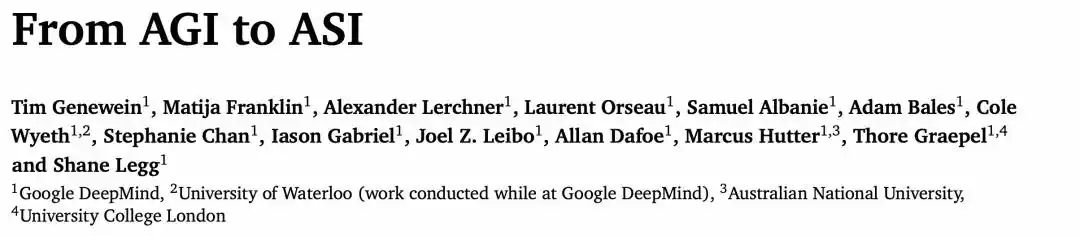
Paper Link: https://arxiv.org/abs/2606.12683

The research team stated that due to the considerable uncertainty in predicting ASI progress, the possibility of AI continuing to accelerate its development in the coming years cannot be ruled out. This may mean that the notion of a “single transformative leap” triggered by introducing human-level AGI into society might be inaccurate.

A more fitting prospect might be that AI-driven progress and breakthroughs will emerge successively across numerous fields of science and technology, thereby triggering a series of transformative societal changes.

To address this prospect, a large-scale, interdisciplinary project with a global vision and broad concern is needed.

After AGI, Comes ASI

Before discussing how AI might continue to become stronger, the research team first distinguishes three easily confused concepts: AGI, ASI, and UAI.

AGI (Artificial General Intelligence): A general intelligent system that reaches the median human level in most cognitive tasks. This corresponds to the general cognitive ability of an average person, not the level of top experts. The research team also notes that the first generation of AGI might already surpass humans in some tasks, just not yet possessing sufficiently broad generality.

ASI (Artificial Super Intelligence): It does not surpass humans in only a few tasks but overall exceeds humans in nearly all fields of human concern; the reference is not a single expert but large-scale, well-coordinated collectives of human experts.

UAI (Universal Artificial Intelligence): The theoretical upper bound of machine intelligence, formally described by the AIXI framework. AIXI corresponds to a theoretically optimal universal agent. Real-world AI can only gradually approach this upper bound, not directly achieve it.

Simultaneously, the research team points out that the transition from AGI to ASI might not have only one path. They propose four potentially parallel advancing pathways, detailed as follows:

Path One: Continue Scaling Computation, Models, and Data

This path continues the basic logic of AI progress over the past decade, including more powerful hardware, larger training runs, higher algorithmic efficiency, larger models, and more data. The research team notes that recent “effective compute” has roughly grown tenfold annually. Following this path, AI's improvement comes not only from individual models becoming stronger but also potentially from collective capability expansion due to more instances, faster inference, and larger-scale collaboration.

Path Two: Continued Algorithmic Evolution, Even New Paradigm Shifts

The research team states that longer context, continual learning, retrieval augmentation, tool use, robust decision-making in interactive environments, world models, etc., all belong to extensions of existing paradigms; whereas new architectures, training objectives, or learning mechanisms are closer to genuine paradigm shifts. The team does not specifically predict what the next paradigm shift might be but believes it could still be a crucial source of continued AI progress post-AGI.

Path Three: Recursive Self-Improvement

A stronger AI can help develop the next generation of even stronger AI, forming a positive feedback loop. The research team mentions this mechanism could manifest in algorithm and code improvement, hardware design, data generation and filtering, and efficiency gains in division of labor. For example, AlphaZero's approach of first using search to improve outputs, then distilling results back into the model, is a relevant case. More importantly is the question of how far this positive feedback can develop in reality.

Path Four: Multi-Agent Coordination and Collective Intelligence

This path focuses not on how strong a single model becomes, but on numerous AGI systems forming collective intelligence exceeding individual limits through division of labor and collaboration. The research team views automated companies, research organizations, and virtual economic systems as possible manifestations of this path. According to this path, ASI might not necessarily be an extremely powerful individual model but could be a highly coordinated AI collective.

The research team also cautions that the move from AGI to ASI may not simply be about more compute being better. Compute expansion is certainly important but will soon hit resource ceilings, requiring new algorithmic ideas, even new paradigms. More notably, even if a single AGI is only near human-level, once many AGIs can efficiently divide labor and collaborate, their collective capability might exceed humanity's.

Where Do the Real Challenges Lie?

After discussing the four potential paths, the research team also summarizes six categories of key bottlenecks that could affect AI's continued strengthening. Details as follows:

1. Data Wall

The research team points out that high-quality human-generated data is finite; human text data suitable for large-scale pre-training may approach its limit within this decade. Whether synthetic data, simulated environment data, and data generated from AI interacting with the real world can fill this gap fast enough is not concluded by the team but listed as a core uncertainty.

2. Economic and Natural Resource Pressures

If AI progress continues to rely primarily on scaling, then energy, chips, data centers, supply chains, and capital investments must grow in sync. The research team sees this as a real-world constraint but also notes that AI itself might increase economic output and improve algorithmic and hardware efficiency, thereby alleviating these pressures.

3. Current Neural Network Paradigms Might Be Inadequate

The research team does not rule out the possibility of the current path leading to ASI but also cautions that this path may still have fundamental limitations in areas like continual learning, stable reasoning, interactive decision-making, uncertainty representation, as well as issues like hallucinations and prompt injection.

4. Research Itself Will Become Increasingly Difficult

The research team notes that as a field matures, further progress often requires greater investment; whether AI can offset this trend through automated research remains to be studied.

5. Abstraction Barrier

The research team believes that if today's AI primarily learns from concepts and symbolic systems humans have already formed, it might excel at recombining existing concepts but not necessarily at autonomously extracting new conceptual primitives from the raw world. For example, if a modern large model were trained solely on pre-Newtonian knowledge, it would be almost impossible for it to derive general relativity or quantum mechanics from that material alone.

6. Regulation, Governance, and Societal Backlash

The research team argues that regulatory thresholds, licensing regimes, incident reporting requirements, and societal reactions to accidents will all influence the pace of AI capability expansion. This involves not just technical issues but also policy, institutions, markets, and public risk perception.

Shortcomings and Future Developments

Finally, the research team raises a very practical question: If AI already surpasses humans, how should we continue to assess its capabilities?

Today, many benchmarks use human-level as a reference. Once AI approaches or surpasses top humans in exams, programming, mathematics, Q&A, and professional knowledge tests, the original evaluation metrics may lose meaning. Therefore, future needs include establishing new evaluation and forecasting systems for the post-AGI era, encompassing tasks like multi-agent competition and cooperation, automated test generation, universal compression tasks, economic productivity and other indirect indicators, along with assessment mechanisms that can be continuously updated and do not saturate prematurely.

However, in terms of content, this is not an experimental paper but more like a technical report centered on the post-AGI era. The research team points out that future directions worthy of attention include: continuing to scale existing AGI systems, exploring new AI paradigms, achieving recursive self-improvement of systems, and forming stronger overall capabilities through large-scale multi-agent collaboration.

Finally, the research team notes that ASI is also not an omniscient, omnipotent “magic system”; it remains constrained by physical laws, computational complexity, data, resources, experimentation time, and the speed of real-world feedback. Which path AI will advance along and at what speed remains highly uncertain. In the future, there is still a need to establish continuously updated benchmarks, predictions, and research mechanisms to reduce uncertainty in judgment.

This article is from the WeChat public account "Academic Headlines" (ID: SciTouTiao), author: Academic Headlines


Related Questions

QWhat are the four potential pathways for AI to progress from AGI to ASI according to the DeepMind paper?

AThe four potential pathways are: 1. Continued scaling of compute, models, and data. 2. Algorithmic evolution, including possible paradigm shifts. 3. Recursive self-improvement. 4. Multi-agent coordination and collective intelligence.

QWhat is the key difference between AGI and ASI as defined in the research?

AAGI (Artificial General Intelligence) refers to a system performing at the median human level across most cognitive tasks. ASI (Artificial Super Intelligence) refers to a system that surpasses human capability not just in a few tasks, but across virtually all domains of human concern, exceeding the collective performance of large, well-coordinated teams of human experts.

QWhat are some of the major bottlenecks that could hinder AI's progress from AGI to ASI?

AThe major bottlenecks include: 1. The data wall (limited high-quality human-generated data). 2. Economic and natural resource pressures. 3. Potential fundamental limitations of current neural network paradigms. 4. Increasing difficulty of research itself. 5. The abstraction barrier (AI may struggle to autonomously derive new primitive concepts). 6. Regulation, governance, and societal backlash.

QWhy might traditional AI benchmarks become inadequate in the post-AGI era?

ATraditional benchmarks, which are often anchored to human-level performance, may lose their meaning once AI approaches or exceeds top human performance in tests like exams, coding, and expert knowledge. New evaluation systems are needed, focusing on multi-agent competition/cooperation, automatically generated tests, universal compression tasks, and indirect metrics like economic productivity.

QWhat is the purpose of the 'large-scale interdisciplinary project' mentioned in the report?

AThe purpose is to proactively address the prospective scenario where AI-driven advancements and breakthroughs emerge successively across many fields of science and technology, leading to a series of transformative social changes. This project requires a global perspective and broad concern to manage this transition.

Related Reads

Has the Crypto Market Bottomed? Here's What Institutions Think

The crypto market is in a period of significant debate, with leading institutions offering differing views on whether a bottom has been reached. Three prominent firms have published detailed analyses: * **Galaxy Digital** argues Bitcoin has **not yet bottomed**. Their analysis of 13 historical indicators across six dimensions (valuation, profit-taking, miner pressure, etc.) shows only four are fully met. They project a potential bottom range between $30k and $54k. * **NYDIG** states a bottom is **possible but not likely**. While metrics are close to historic bear market extremes, they note the absence of a classic panic-selling event. They also suggest increased institutional adoption may have structurally altered the market cycle, potentially leading to a shallower downturn. * **Standard Chartered Bank** asserts the **bottom has already occurred** at around $59k. They cite two key factors: potential US-Iran diplomatic progress and the anticipated SpaceX IPO, which they believe absorbed capital and caused ETF selling pressure that is now subsiding. They forecast a year-end price target of $100k. Despite the surface-level disagreement, the reports share critical common ground more valuable for long-term investors: 1. All three believe the market bottom will form **within this year**. 2. All agree the current price is **closer to the bottom than to previous highs**. 3. All maintain a **bullish long-term outlook** for Bitcoin and a new cycle. The core takeaway is that while the exact bottom price ($40k, $50k, or $60k) is debated, the consensus is that a bottom is imminent. For long-term holders, the primary focus should not be pinpointing the absolute low, but on the future potential for prices to reach $100k, $200k, or higher. The fundamental thesis for Bitcoin—sovereign debt accumulation, inflation, declining trust in centralized institutions, global digitization, and improved accessibility—remains intact and is arguably strengthening. The overall landscape is viewed as more favorable than in previous crypto winters.

marsbit8m ago

Has the Crypto Market Bottomed? Here's What Institutions Think

marsbit8m ago

The 'Chip' Challenge and Breakthroughs in China's Optical Industry Chain

China's Photonics Industry: Bottlenecks and Breakthroughs In the global AI race, computing chips dominate the narrative, but the underlying bottleneck increasingly defining the scale of AI clusters is light—or more specifically, optical connectivity. Optical modules, which translate electrical signals to light and vice versa, are crucial for connecting thousands of GPUs in AI data centers, preventing data congestion and ensuring efficient model training. High-speed modules (800G, 1.6T) are now standard, with performance hinging on advanced DSP (Digital Signal Processor) chips. This is where a critical dependency lies. Two US giants—Marvell and Broadcom—collectively dominate over 90% of the high-end DSP chip market. Chinese optical module leaders like Zhongji Innolight and Eoptolink rely on these chips to manufacture modules for overseas AI customers, primarily in North America. While this creates a supply chain vulnerability, complete decoupling is difficult. Marvell derives over half its revenue from Greater China, and the US firms depend on Chinese partners for chip packaging and optical components. The risk from laser chips (e.g., from Lumentum), another key component, is considered more manageable due to multiple global suppliers and faster progress in domestic alternatives from companies like YOFC and Accelink. To mitigate risks, China's industry is pursuing a multi-pronged strategy: diversifying supply chains and locking in long-term orders; fostering a domestic market ecosystem to adopt homegrown DSPs from firms like Huawei HiSilicon and CETC; accelerating R&D in high-speed DSPs and advanced packaging; and investing in next-gen technologies like silicon photonics and Co-Packaged Optics (CPO) to reduce reliance on discrete DSPs. The ultimate solution lies not in short-term博弈 but in persistent advancement of domestic high-end chip R&D and manufacturing. While challenges remain in performance, certification, and ecosystem building, China's vast domestic market and manufacturing base provide a crucial buffer, buying time for the industry to achieve greater technological independence.

marsbit22m ago

The 'Chip' Challenge and Breakthroughs in China's Optical Industry Chain

marsbit22m ago

Behind SpaceX's $2 Trillion Market Cap: Why Does Musk Always Have the Next Move Planned?

On June 12th, SpaceX debuted on the Nasdaq, reaching a valuation that briefly touched $2 trillion. This marked the culmination of a 24-year journey from its founding in 2002, driven by Elon Musk's frustration at the high cost of buying rockets. The company's path was defined by early failures, with its first three Falcon 1 launches ending in explosions before a successful 2008 flight opened the era of commercial spaceflight. Key to its model was a fixed-price NASA contract, incentivizing cost reduction. SpaceX mastered rocket reusability, first achieving a Falcon 9 landing in 2015, which drastically cut launch costs. This enabled its profitable Starlink satellite internet constellation, envisioned years before reusability was proven, to create an internal market for frequent launches. Similarly, the next-generation Starship rocket was in development long before its first flight, with its business case evolving from Mars colonization to supporting the emerging concept of in-orbit data centers for AI—a story now central to its valuation. The company's recent IPO, a reversal of its long-standing "no IPO" stance, is funding this ambitious "space-based compute" vision. While major tech players like Google, Blue Origin, and others are investing heavily, significant technical and cost hurdles remain. Ultimately, SpaceX's history is one of creating its own demand: first with Starlink and now with space-based AI compute, betting that its next rocket will enable its next giant market.

marsbit25m ago

Behind SpaceX's $2 Trillion Market Cap: Why Does Musk Always Have the Next Move Planned?

marsbit25m ago

When Crypto Meets the World Cup: CoinW and Modrić's Art of "Navigating Cycles"

When Encryption Meets the World Cup: CoinW and Modrić's "Transcending Cycles" Philosophy In the context of the 2026 FIFA World Cup and its massive global audience, the crypto exchange CoinW announced football legend Luka Modrić as its global brand ambassador. This move is framed not merely as a marketing tactic, but as a strategic experiment in user profile migration. It targets mature, financially stable football fans—particularly in Europe, Southeast Asia, and Latin America—who traditionally have low crypto awareness but value trusted, time-tested authority figures like Modrić. The article draws parallels between Modrić's enduring, disciplined career—marked by consistency and success at the highest level over two decades—and CoinW's own development path. Founded in 2017 during a volatile industry period, CoinW focused on building robust infrastructure and risk management. It weathered the 2022 industry crisis without major security incidents, subsequently earning recognition like "Europe's Most Trusted Exchange" and growing to over 20 million registered users. This "long-termism" is translated into user-centric products. CoinW Academy lowers the initial knowledge barrier. Its integrated ecosystem (CoinW, GemW, DeriW, PropW) and the recent launch of a TradFi section—offering perpetual contracts on traditional assets like stocks, gold, and oil—aim to create a unified platform for diverse assets. For the World Cup, CoinW launched the "We Are The Game" campaign, collaborating with Alchemy Pay to offer zero-fee deposits and local payment options, aiming to transform spectators into participants and lower entry barriers. Ultimately, CoinW's sports partnerships and product strategy are presented as a concerted effort to build trust and accessibility for the "silent majority" still outside crypto—shifting the industry narrative toward inclusivity and long-term value.

Foresight News31m ago

When Crypto Meets the World Cup: CoinW and Modrić's Art of "Navigating Cycles"

Foresight News31m ago

Trading

Spot
Futures

Hot Articles

Discussions

Welcome to the HTX Community. Here, you can stay informed about the latest platform developments and gain access to professional market insights. Users' opinions on the price of AI (AI) are presented below.

活动图片














