After 10 Years, Altman Finally Has the Person He Wanted

marsbitPublished on 2026-06-18Last updated on 2026-06-18

Abstract

After a decade of waiting, OpenAI CEO Sam Altman has finally secured his desired collaborator: Noam Shazeer, a legendary AI researcher and co-author of the seminal "Attention Is All You Need" paper that introduced the Transformer architecture. Shazeer has announced his departure from Google to join OpenAI as Head of Architectural Research. Shazeer, a crucial early Google employee who returned to Google DeepMind in a high-profile $2.7 billion deal two years ago, confirmed his move on social media platform X. Altman expressed his long-standing desire to work with Shazeer, stating the 10-year wait would be worth it. OpenAI's research lead, Mark Chen, welcomed Shazeer, highlighting his foundational work on Transformer, Mixture-of-Experts (MoE) models, and efficient decoding, which have profoundly shaped modern AI. His departure is seen as a significant blow to Google's Gemini project, where he served as a technical co-lead. Industry observers note this move represents a major win for OpenAI in the ongoing AI talent war, with some quipping that OpenAI acquired his expertise "for free" after Google's massive investment.

Noam Shazeer, the legendary AI figure whom Google brought back two years ago with a $2.7 billion deal, announced his departure from Google to join OpenAI.

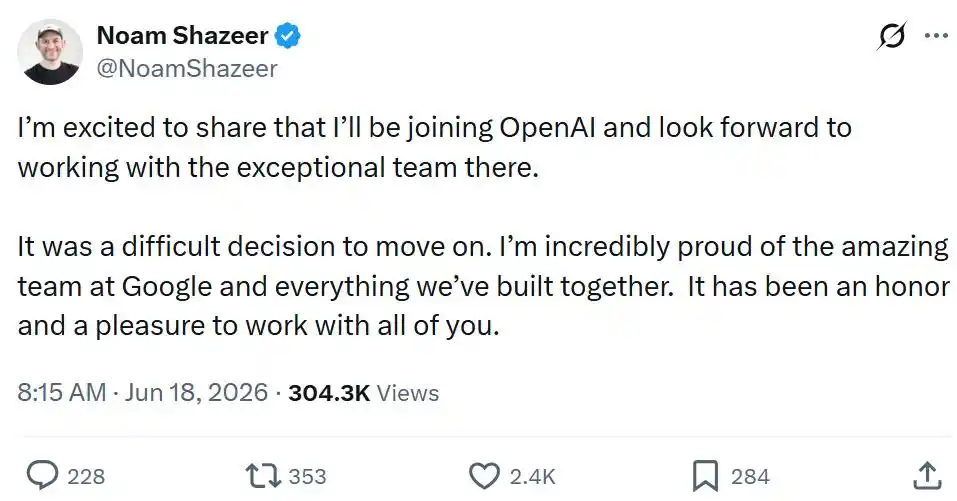
Just now, Noam Shazeer confirmed this news on X. He stated that he is joining OpenAI and looks forward to working with the excellent team there. He also expressed that leaving Google was not an easy decision; he is immensely proud of the Google team and everything they have built together, and it has been an honor and a pleasure to work alongside these colleagues.
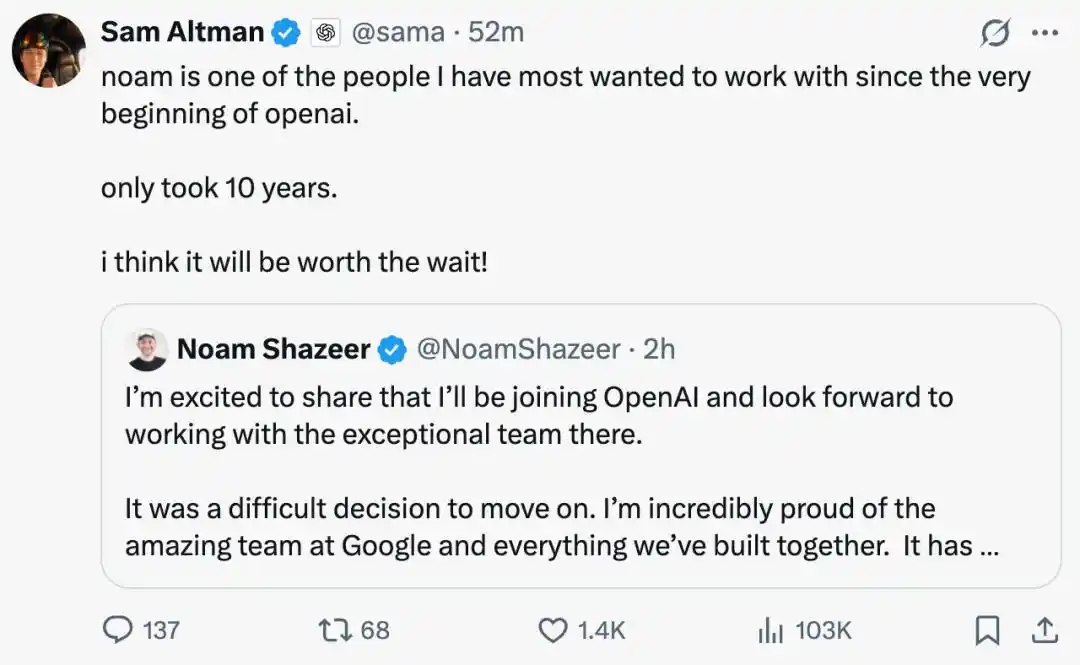
Subsequently, Sam Altman said, "From the very beginning of OpenAI's founding, Noam has been one of the people I most wanted to work with. It just took 10 years to finally get the chance. I believe the wait will be worth it!"
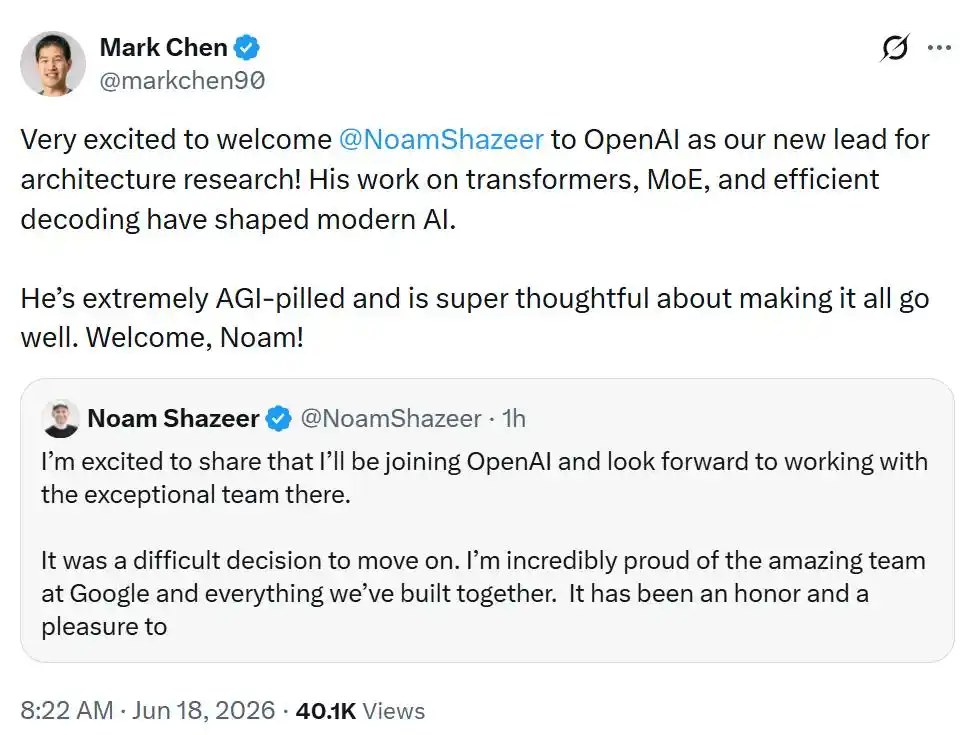
OpenAI research lead Mark Chen and others also responded on X: "A huge welcome to Noam Shazeer joining OpenAI as Head of Architecture Research! His research contributions in Transformer, MoE (Mixture of Experts), and efficient decoding have profoundly shaped the development of modern AI.

He not only holds a strong belief in achieving AGI but also has deeply considered insights on how to ensure its smooth development. Welcome, Noam!"
Noam Shazeer

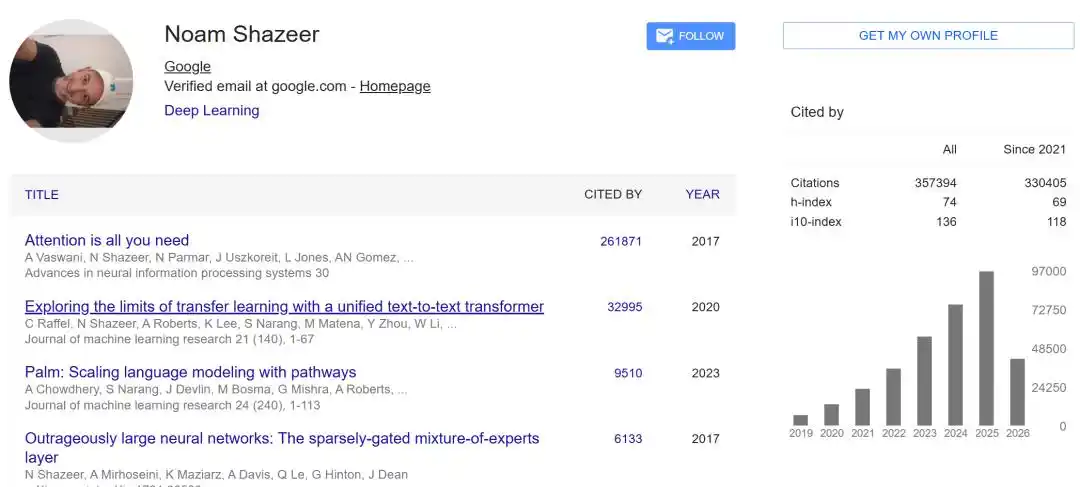
Noam Shazeer is one of Google's most important early employees. He joined Google at the end of 2000, serving as a Principal Software Engineer responsible for early advertising systems.

Noam Shazeer is no ordinary researcher. He is one of the co-authors of the seminal 2017 paper "Attention Is All You Need." The Transformer architecture proposed in this paper later became the most crucial technical foundation of the large language model era. From GPT and Gemini to Claude, and nearly all mainstream large models today, they all rely on the Transformer technical lineage.

More importantly, Shazeer's contributions extend beyond Transformer itself.

Long before large models truly entered the phase of scale competition, he had been focused on model scaling, sparse computation, and training of massive models. He co-proposed Sparsely-Gated Mixture-of-Experts, an important early foundation for the later MoE approach; Switch Transformer further pushed sparse expert models to the trillion-parameter scale. Today, MoE has become one of the key approaches for frontier models to increase parameter scale while controlling inference costs.
In 2021, Noam Shazeer left Google, disappointed by the bureaucracy at the search giant, and co-founded Character.AI with Daniel De Freitas. That company once became one of the most watched AI startups.

In 2024, Google reached a technology licensing deal with Character.AI and brought Shazeer and others back to Google DeepMind. Subsequently, he was appointed as co-head of Gemini technology, involved in Google's core large model project.
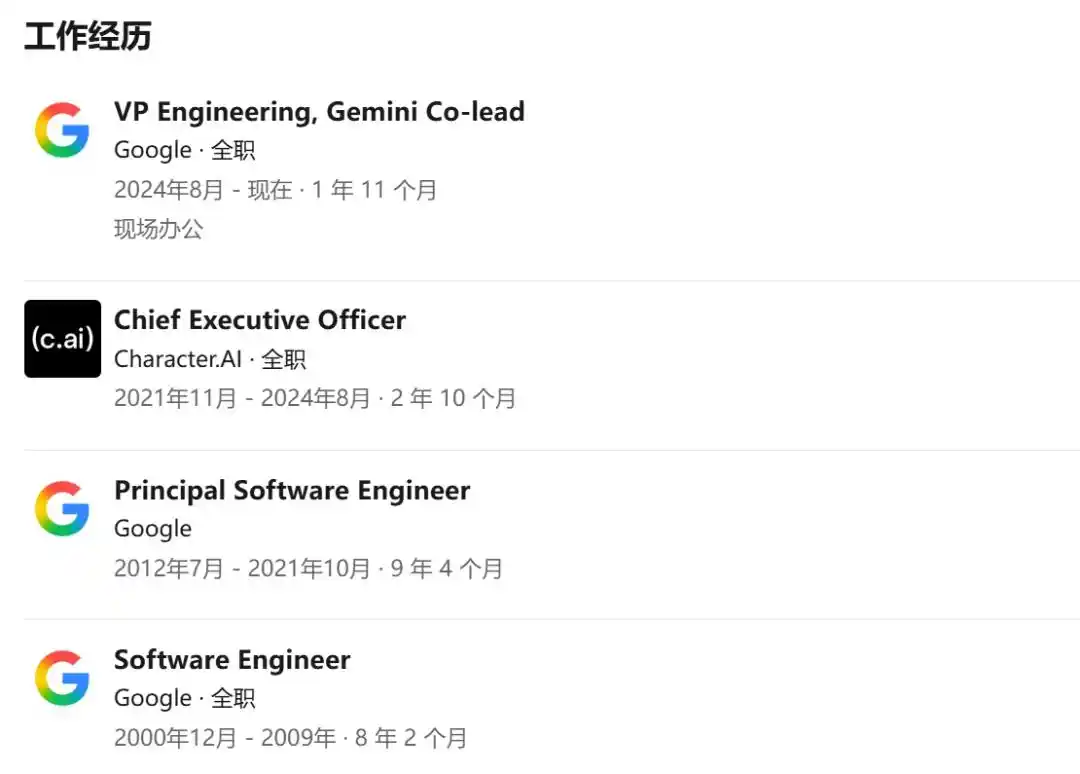
Now, in less than two years, he has turned to join OpenAI. This is truly harsh news for Gemini's development.

Many netizens believe that during the critical stage where Gemini still needs to continuously strengthen model capabilities and engineering systems, losing a figure like Shazeer will be a significant talent drain.

Others were more blunt in their jokes: Gemini wasn't that great to begin with; now with a core figure leaving, it's completely finished.
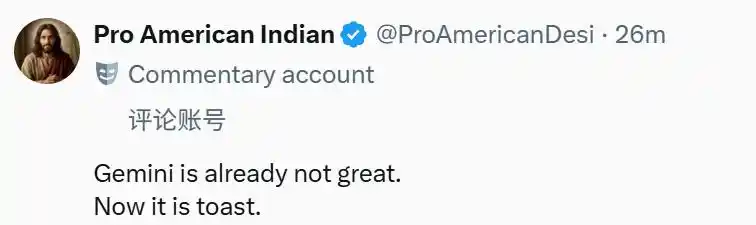
Another netizen joked: Google paid $2.7 billion for Shazeer's intellectual property. And OpenAI got these patents for free. This is the most favorable acquisition price in tech history.

In this AI talent war, Shazeer's addition is undoubtedly a significant victory for OpenAI.

This article is from the WeChat public account "Machine Heart" (ID: almosthuman2014), author: Focus on AI Big Shots.


Trending Cryptos

Related Questions

QWho is Noam Shazeer and what are his key contributions to AI?

ANoam Shazeer is a prominent AI researcher and a co-author of the seminal 2017 paper "Attention Is All You Need," which introduced the Transformer architecture. He is also known for his foundational work on Sparsely-Gated Mixture-of-Experts (MoE) and efficient decoding, technologies that are critical to modern large language models.

QWhy did Sam Altman say it took 10 years to get Noam Shazeer to join OpenAI?

ASam Altman stated that Noam Shazeer had been one of the people he most wanted to work with since OpenAI's founding. The wait of 10 years refers to the period from OpenAI's establishment to finally securing Shazeer's collaboration.

QWhat position did Noam Shazeer hold at Google before joining OpenAI, and why is his departure significant?

ABefore joining OpenAI, Noam Shazeer was a co-technical lead for the Gemini project at Google DeepMind. His departure is seen as a significant talent loss for Google, potentially impacting the Gemini project's development during a critical phase of strengthening its capabilities.

QWhat was the reported financial deal between Google and Character.AI involving Noam Shazeer?

AAccording to the article, Google reportedly struck a $2.7 billion deal for a technology license with Character.AI, the company co-founded by Shazeer, which also led to his return to Google in 2024.

QHow did the AI community react to Noam Shazeer's move to OpenAI?

AReactions were mixed. Some viewed it as a major win for OpenAI in the AI talent war. Others expressed concern for Google's Gemini project, with some joking that OpenAI got Shazeer's expertise 'for free' while Google had paid billions, and some even suggesting it was a devastating blow for Gemini.

Related Reads

CPU Makes a Comeback to the Table, A $170 Billion "Power Seizure" Drama Begins

A new era is dawning for the server CPU (Central Processing Unit), driven by the shift from AI model training to large-scale reasoning and the rise of Agentic AI. This article explores how the CPU is reclaiming a central role in the AI data center. For years, the focus has been on the GPU (Graphics Processing Unit) for AI training. However, as AI moves to the inference and Agent phase—where tasks involve complex, multi-step reasoning, tool calls, and data management—the workload balance is flipping. Studies show CPUs now handle over 70% of the workload in Agentic AI, up from 10-30% in training. This is because Agent tasks generate massive intermediate data (KV Cache) that exceeds GPU memory, forcing it to be offloaded to the CPU's larger, more scalable memory pools. This increased importance is translating into market changes. Major players are taking note: NVIDIA launched its first standalone CPU line, Vera, based on ARM architecture and optimized for Agent performance. AMD doubled its server CPU market forecast to over $1200 billion by 2030. Analyst reports project the total server CPU market could reach $1700 billion by 2030, with AI-driven demand being a primary driver. Furthermore, the classic ratio of CPUs to GPUs in AI servers is rapidly changing, converging from 1:8 toward 1:1 for Agent deployments. This surge in demand has led to a rare industry-wide price increase of 10-15% for server CPUs from Intel and AMD, breaking a decade-long trend of "more performance for the same price." Demand is bifurcating into high-core-count CPUs for in-rack GPU support and moderate-core CPUs for standalone Agent task orchestration. In China, this global trend presents an opportunity for domestic CPU manufacturers like Hygon (海光信息) and Huawei Kunpeng, who are bolstered by both growing AI infrastructure needs and national policies promoting technological self-reliance ("xin chuang"). The maturity of their software ecosystems is also accelerating, evidenced by faster adaptation to new AI models. In conclusion, the narrative is shifting from a GPU-centric view to one where CPU-GPU synergy is critical. The CPU is no longer a peripheral component but a performance-defining bottleneck and a key growth driver in the AI hardware stack, opening a massive new market estimated in the hundreds of billions of dollars.

marsbit4h ago

CPU Makes a Comeback to the Table, A $170 Billion "Power Seizure" Drama Begins

marsbit4h ago

TechFlow Intelligence: AMD AI Director Publicly Criticizes Claude Code for "Becoming Dumber and Lazier", Trump Claims Full Ceasefire in Hormuz But Strait Still Has 80 Unexploded Mines

TechFlow Intelligence Report: This daily digest covers key developments in AI, crypto, hardware, and geopolitics. In AI, SK Telecom faces US export control scrutiny over its partnership with Anthropic, while a Gemini user reports being misled in a scam scenario, sparking safety debates. China's Z.AI launches the GLM-5.2 model, rivaling Claude Opus without NVIDIA chips. In crypto, Bithumb lists ReProtocol, and Upbit delists KernelDAO. On the hardware front, MIT researchers build a custom OS to study chips, ASML denies US claims its advanced lithography machines are in China, and Amazon considers selling its in-house AI chips. Apple's future A21 Pro chip may use TSMC's latest N2P process. Major tech issues include 10,000 GitHub repositories distributing malware and Apple patching a critical eavesdropping flaw in Beats earbuds. US stocks rise, led by semiconductors, with Intel surging 10.6%, while SpaceX falls 3.5%. Geopolitically, despite a US-Iran deal, the Strait of Hormuz remains risky with ~80 uncleared mines, stalling 80M barrels of oil on standby tankers. Iran postpones Switzerland talks, and Trump calls the agreement an "unconditional surrender." The report highlights a contrast: temporary geopolitical calm versus the ongoing, fundamental restructuring of tech supply chains and chip independence.

marsbit4h ago

TechFlow Intelligence: AMD AI Director Publicly Criticizes Claude Code for "Becoming Dumber and Lazier", Trump Claims Full Ceasefire in Hormuz But Strait Still Has 80 Unexploded Mines

marsbit4h ago

Trading

Spot
Futures

Hot Articles

Discussions

Welcome to the HTX Community. Here, you can stay informed about the latest platform developments and gain access to professional market insights. Users' opinions on the price of AI (AI) are presented below.

活动图片