a16z Charts of the Week: AI Costs Halved and Usage Doubled This Year, Major Life Milestones for 30-Year-Olds in the US Delayed Across the Board

marsbitPublished on 2026-03-01Last updated on 2026-03-01

Abstract

a16z's Charts of the Week explores four key trends. First, while a "DExit" (Delaware Exodus) narrative exists due to high-profile companies leaving over legal concerns, data shows a more complex reality. Delaware's overall share of U.S. businesses has actually grown, though Wyoming has seen a surge in LLC registrations. Second, AI demonstrates the Jevons Paradox: as the cost to process AI tokens halved this year, usage doubled. Demand for older GPU rentals (H100, A100) is also rising, contradicting predictions of a compute glut. Historical parallels suggest the full economic impact of AI may take time to materialize. Third, AI capital expenditure is massive, comparable to annual U.S. bank lending and significantly larger than U.S. corporate tax income or the military budget of any non-U.S. G7 nation. Fourth, the prediction market Kalshi is outperforming professional forecasters and futures markets in predicting the Federal Funds Rate, providing a valuable high-frequency, probabilistic benchmark. Finally, data shows a stark delay in life milestones for 30-year-olds in the U.S. Since the 1980s, far fewer are living independently, married, living with children, or owning a home. The only exception is college attainment, which has nearly doubled since 1995, though the value of a degree is increasingly questioned.

Author: a16z New Media

Compiled by: Deep Tide TechFlow

Original link:https://www.a16z.news/p/charts-of-the-week-dexit-real-or

Deep Tide Introduction: This edition of a16z's Charts of the Week covers four topics, each worthy of its own article: falling AI costs triggering the Jevons effect, the true scale of tech giant capital expenditures, Kalshi prediction markets outperforming professional forecasting agencies, and the comprehensive delay of life milestones for 30-year-olds in the US. The data sources are solid, and the perspective is calm and restrained, making it a high-quality reference for understanding the intersection of current tech and macro trends.

DExit......Real Trend or Illusion?

Delaware remains the preferred state for US corporate registration, but this position is quietly loosening:
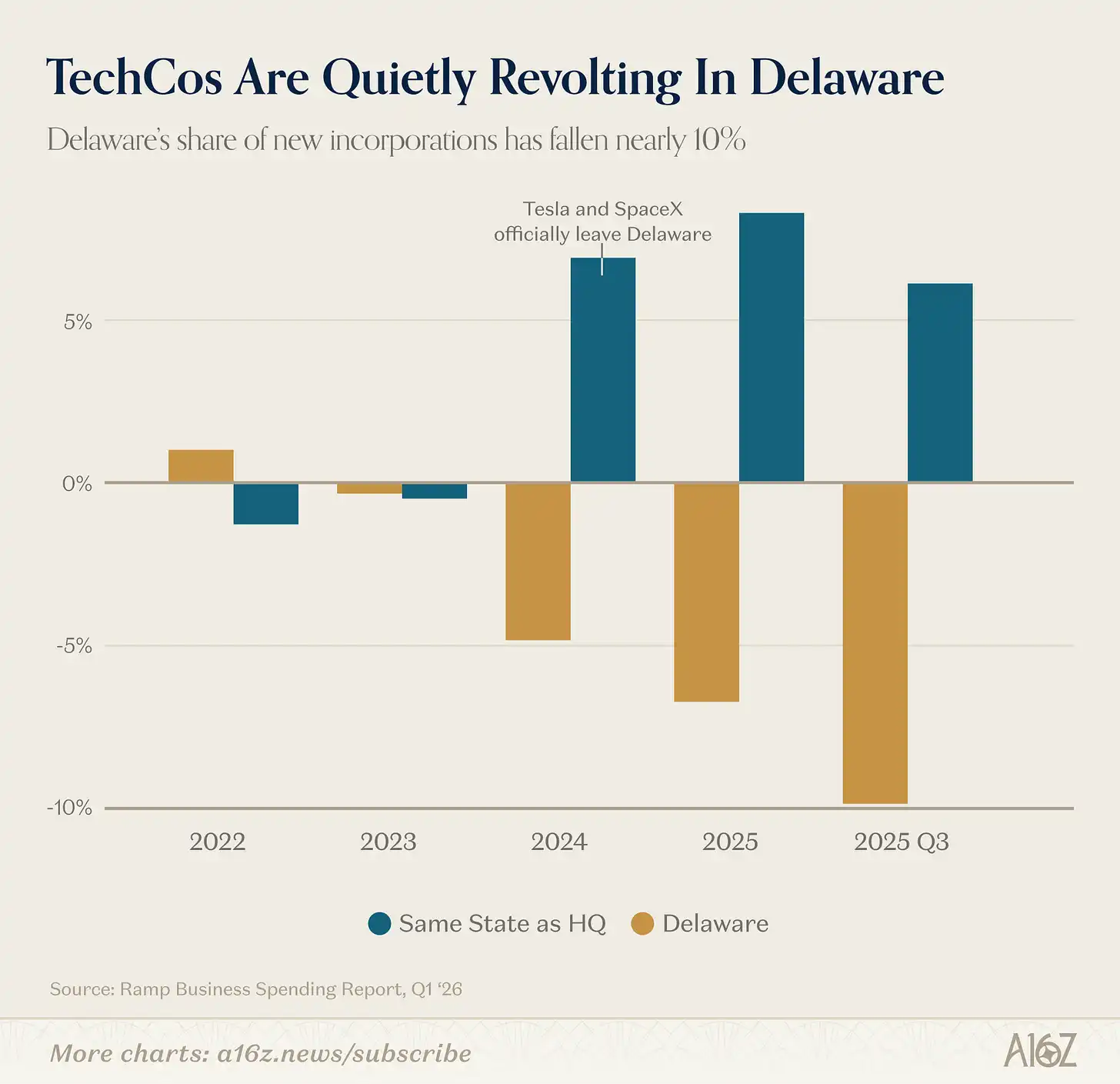
According to Ramp's data, Delaware's share of new company registrations has been declining since 2023, with a drop of about 10% in Q3 2025.

History doesn't repeat itself exactly, but it often rhymes......maybe.

Delaware hasn't always been the holy land for corporate registration.

About a century ago, Delaware replaced New Jersey—the original "Mother of Trusts"—as the preferred state for incorporation. New Jersey lost its advantage because then-Governor Woodrow Wilson tried to curb "corporate abuses," severely worsening the state's business environment. Delaware's corporate law was modeled on pre-Wilson era New Jersey law and was happy to welcome the departing companies. It then, along with the Delaware Court of Chancery, spent nearly 100 years building a reputation as a mature and fair venue for resolving disputes between companies and investors.

However, what took a century to build began to动摇 in just a few years. Rightly or wrongly, the Delaware Court of Chancery has recently taken a more lenient stance on shareholder litigation (especially in several high-profile cases, including but not limited to Tesla), and companies have really started moving their registrations elsewhere. Goodnight, and good luck, Delaware.

This is at least the mainstream narrative, but other data shows the situation is more complex.

First, even Delaware's founding myth itself isn't entirely accurate.

It wasn't until the 1980s (about 60 years after Governor Wilson's term) that Delaware truly surpassed New Jersey to become the number one state in the US for the number of corporate registrations:
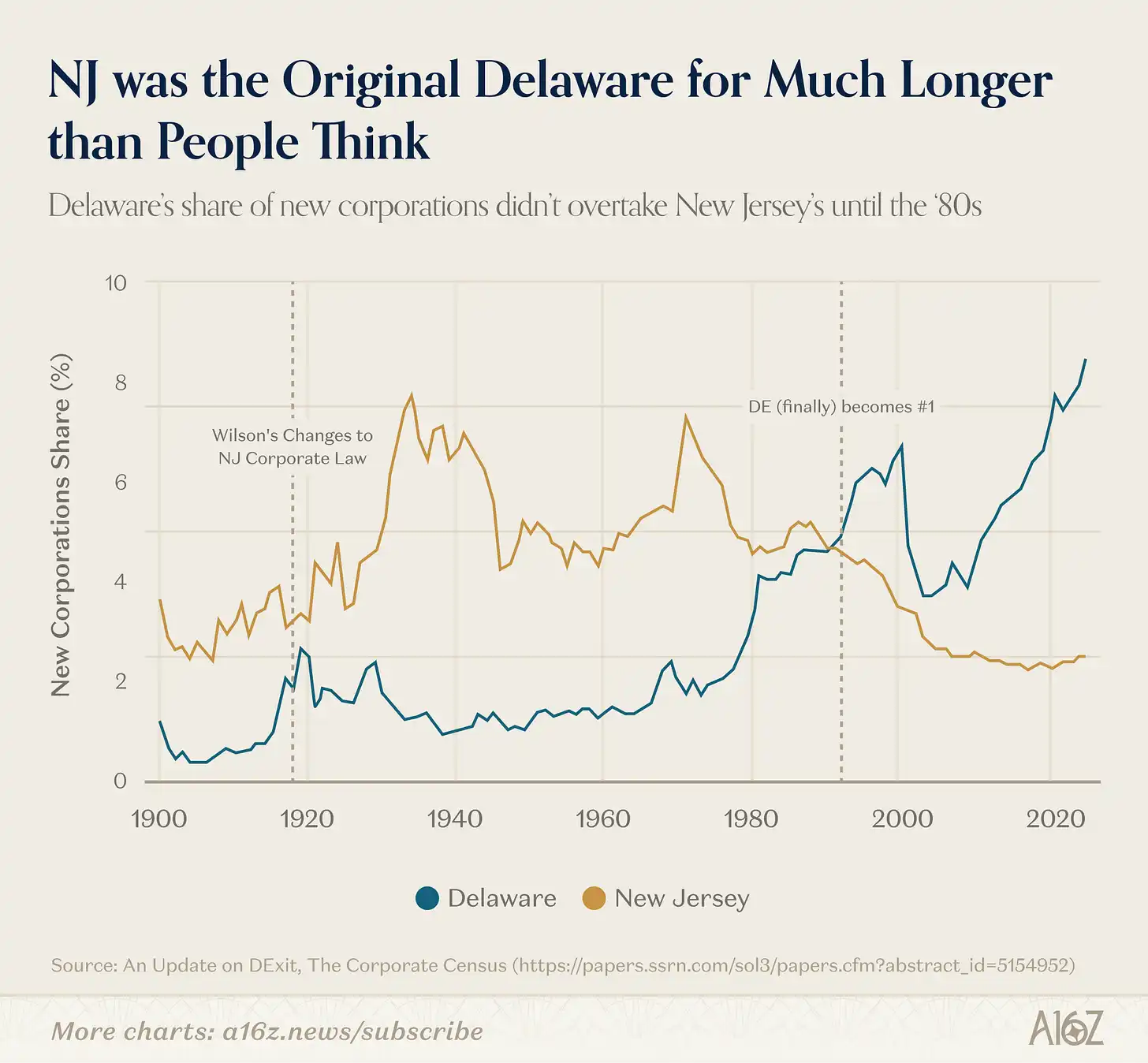
New Jersey dominated for much longer than the mainstream narrative suggests. The catalyst for Delaware's eventual overtaking was likely its passage of a series of laws related to director liability, which were particularly favored by public companies, coupled with network effects that continuously reinforced themselves, creating their own inertia.

Second, regardless of what's happening with high-profile public companies (and the companies in Ramp's data), Delaware as a whole still seems to be doing well, even more than well:
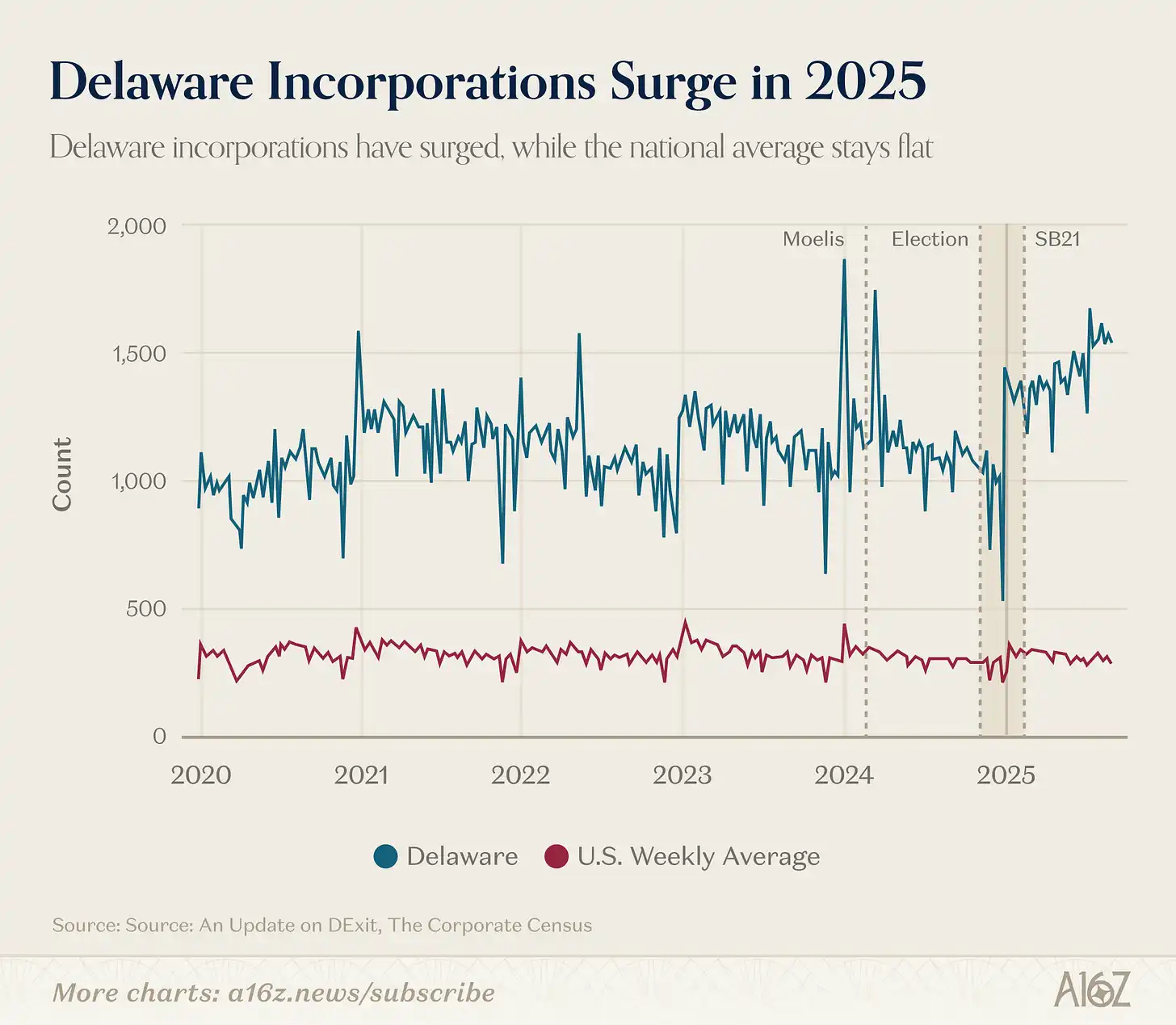
According to data published by the Harvard Law School Forum on Corporate Governance, Delaware's share of the total number of US companies actually increased significantly from late 2024 to 2025.

In fact, if you're looking for a clear case of "DExit," it's probably this one, and it has nothing to do with Tesla, but rather involves a specific type of company structure:
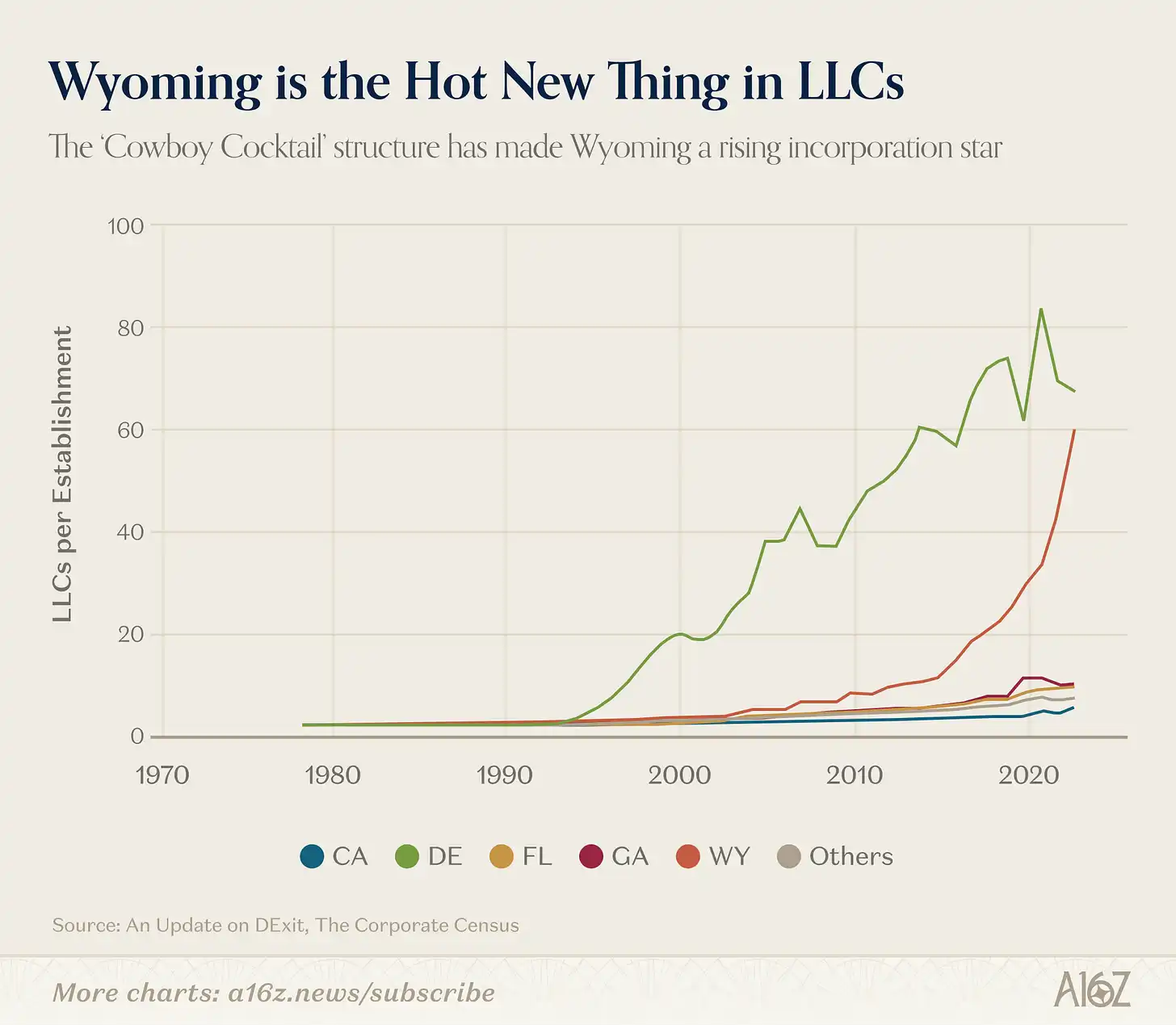
Wyoming LLCs began to surge around 2015.

Why? This is likely related to specific asset protection and privacy provisions in Wyoming's LLC law, which the state itself promotes as a "cowboy cocktail."

In short, the point here is not to say that DExit isn't happening (because at least some data suggests it is—even if it's just a few high-profile companies moving out, it's significant), but the reality is certainly more complex than the mainstream narrative presents.

The reality is that Delaware still enjoys the advantage of being the default option, not to mention all the network effects tied to it, and these are very difficult to shake.

We published an earlier version of this chart before, but as more data comes in, the effect becomes more stunning.

Token costs fall, Token consumption rises:
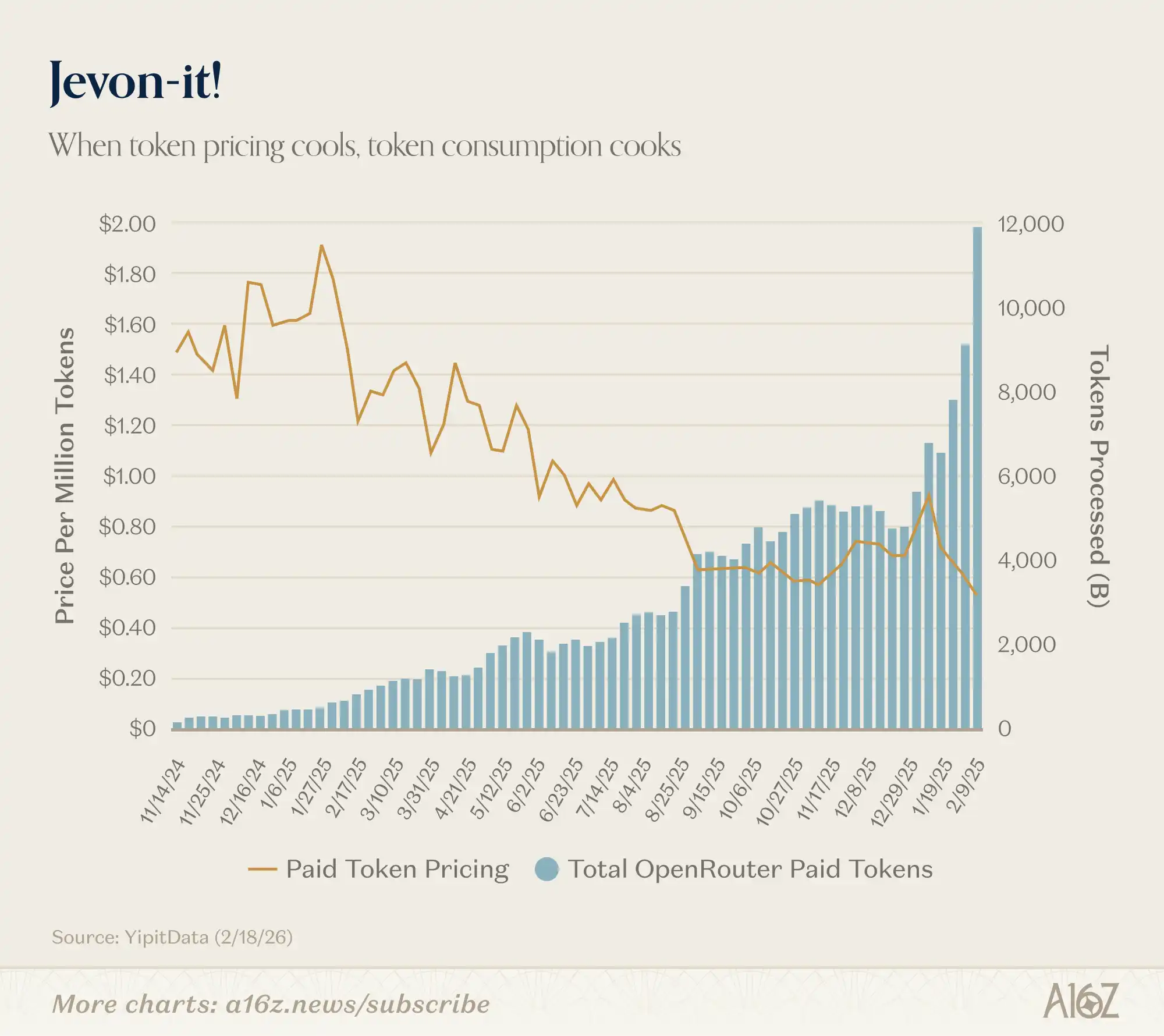
Since the beginning of this year, paid Token pricing has dropped from about 90 cents per million Tokens to 50 cents, while the number of Tokens processed has nearly doubled, from about 6,000 to 12,000.

This is a typical Jevons effect. The cheaper AI gets, the more AI we use. Delightful.

Remember when people said that when newer, better GPUs came out, the old ones would be unwanted?

That doesn't quite seem to be the case either:
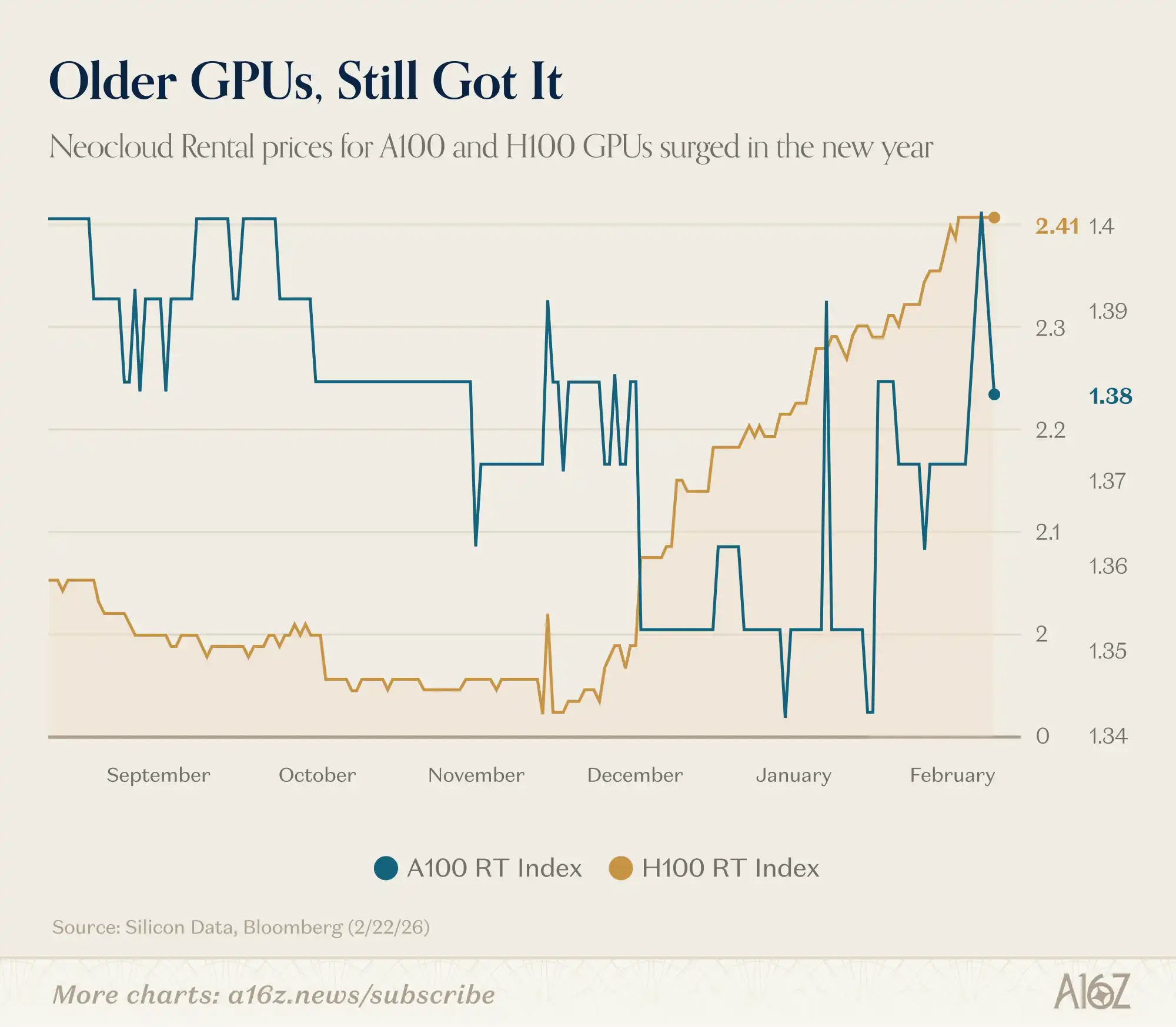
According to Silicon Data, rental prices for NVIDIA's H100 and A100 have both increased this year.

The market is far from showing signs of a compute oversupply; instead, it seems we haven't even scratched the surface of existing demand.

This comparison isn't a perfect analogy, but if history offers any reference, it might take us a while longer to truly see what an "AI-driven" economy really looks like:
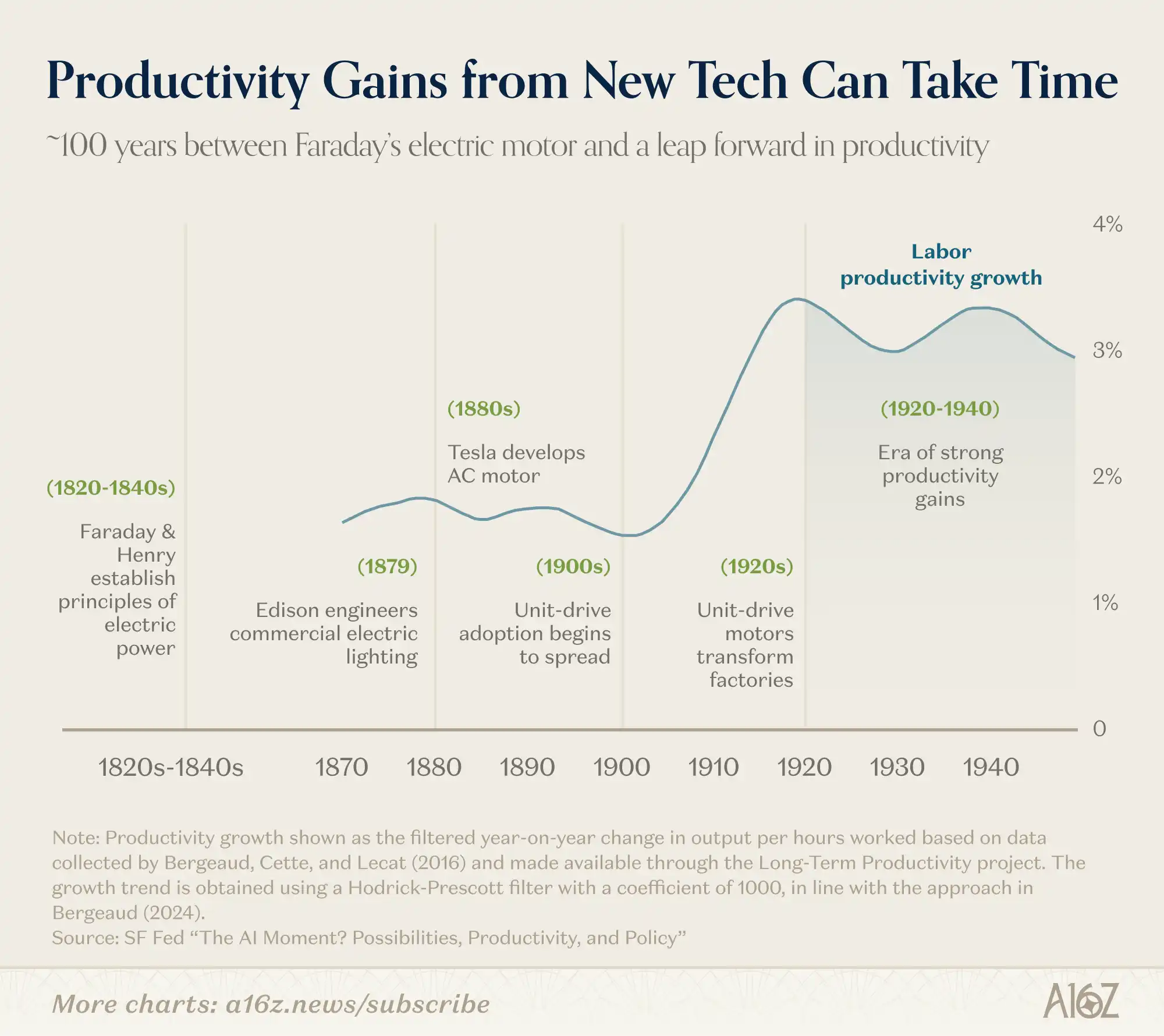
From the initial discussions of electric current by Faraday and Henry to the true explosion of industrial productivity waves in the first half of the 20th century, it took about 100 years.

Technology iteration cycles have indeed accelerated since the 1820s, but the variables involved in a platform-level shift are still extremely numerous.

Roy Amara famously said, "We tend to overestimate the effect of a technology in the short run and underestimate the effect in the long run." (Paraphrased common interpretation of the quote).

Capital Expenditure, Put in Perspective

Here's some data that never gets old: AI capital expenditure is huge.

Consider these comparisons:

2026 AI capex is projected to be close to the total net new lending by US banks in 2025:
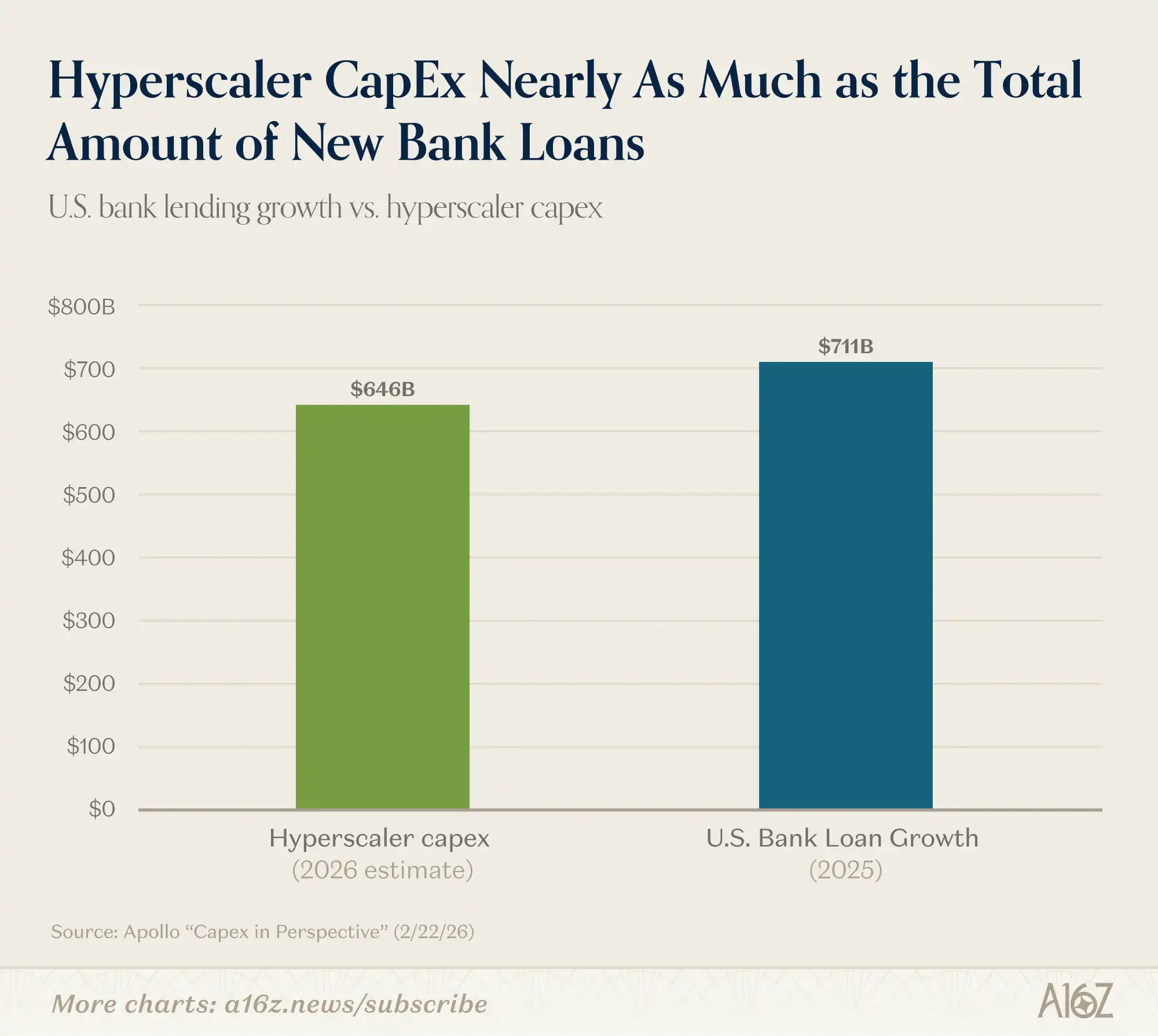
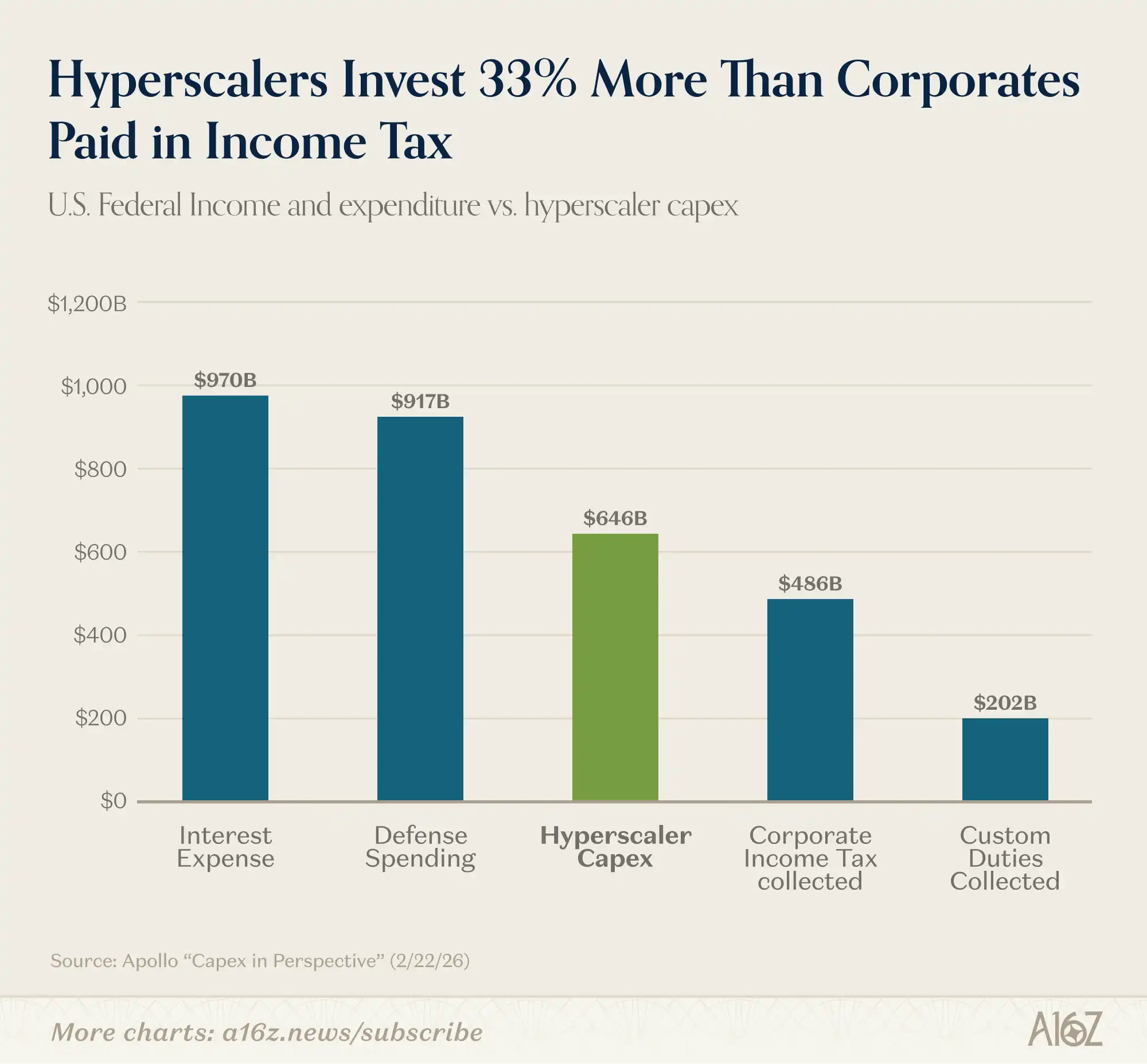
Capex is about 33% higher than total US corporate income tax revenue and about 3 times the total tariff revenue:
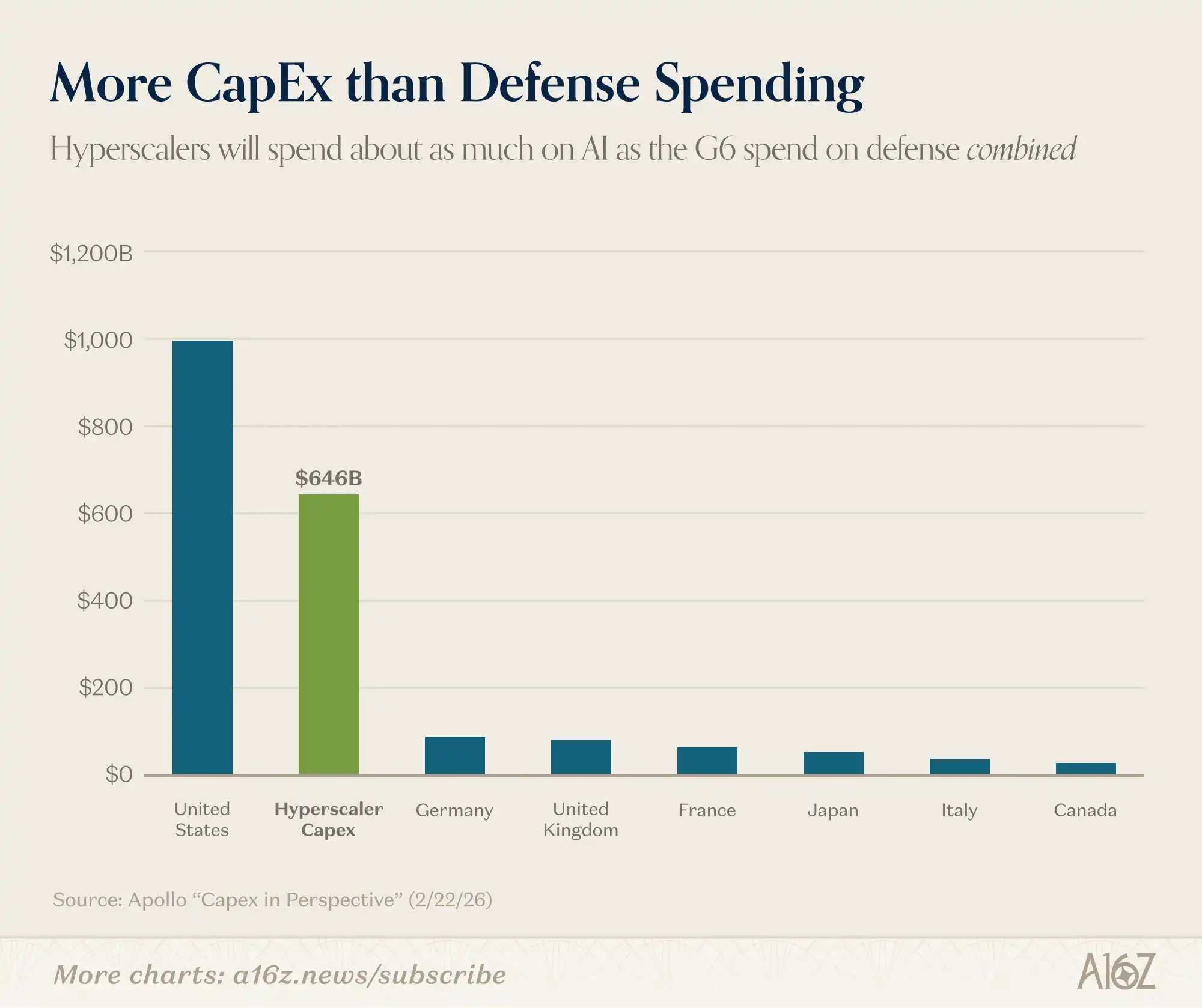
Capex is about 6 times the total military budget of any non-US G7 member country:
So, yes, capital expenditure is really huge.

Kalshi Moves into Macro Prediction

Federal Reserve researchers think prediction markets are pretty good.

At least on one metric, Kalshi's predictions for the federal funds rate have already outperformed professional forecasting agencies:
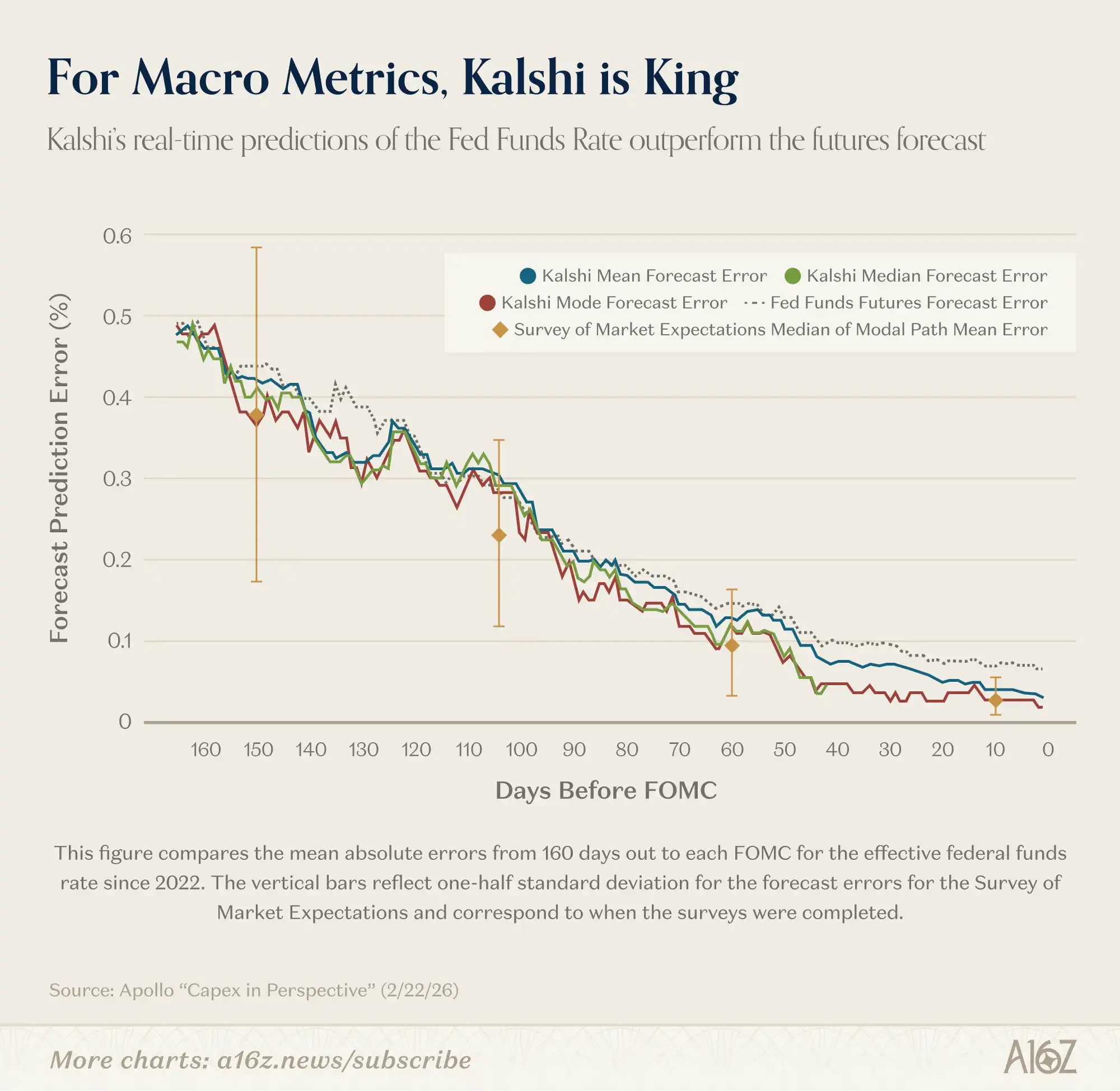
For predictions of the federal funds rate 150 days later (i.e., after 3 FOMC meetings), Kalshi's mean absolute error is very close to that of professional forecasters. But unlike surveys that provide only a modal path snapshot every six weeks, Kalshi provides a continuously updated full probability distribution...... We find that Kalshi's median and mode predictions have a perfect prediction record the day before FOMC meetings, which is a statistically significant improvement over federal funds futures predictions.

In other words, while all predictors start out similar, Kalshi's "continuously updated" predictions optimize over time, eventually achieving a "perfect prediction record" the day before the rate is officially announced. Furthermore, Kalshi's performance is also better than predictions from futures markets.

Kalshi's advantage extends beyond the federal funds rate. As the Fed researchers point out, since there are no other options markets for macroeconomic indicators like inflation, growth, and unemployment, Kalshi is the only place that provides a "high-frequency, continuously updated, probability distribution-rich benchmark" reflecting "crowd" judgment on the direction of these economic indicators.

Sounds pretty important.

The Delay of Adulthood

Here is a thought-provoking chart, with (a little) commentary:
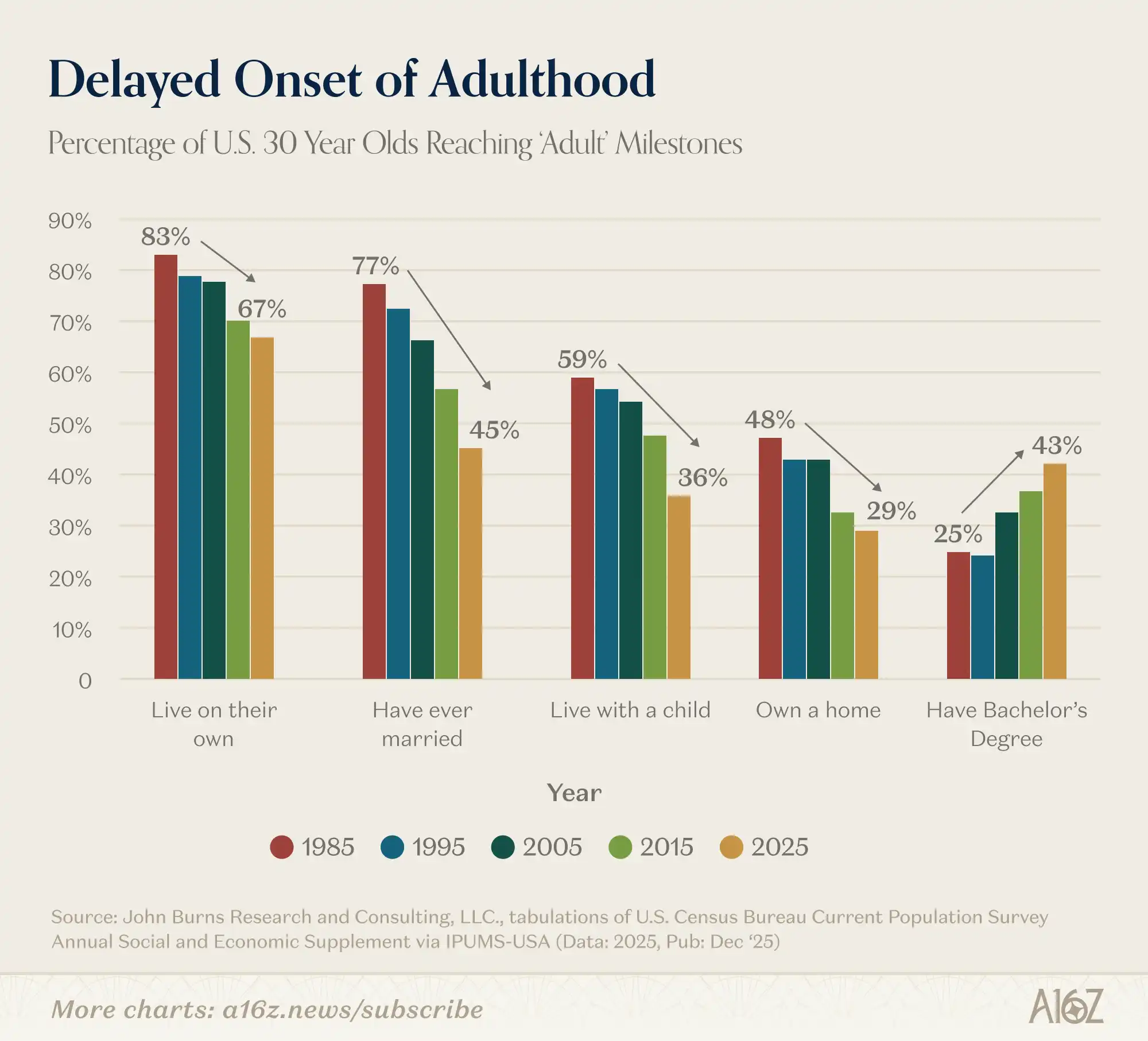
The proportion of 30-year-olds achieving major life milestones has been declining quite steeply since at least the 1980s.

Fewer and fewer 30-year-olds:

Live independently;

>Have ever been married;

>Live with children;

>Own their home.

The only exception is college enrollment rates—the proportion of 30-year-olds with a bachelor's degree has almost doubled since 1995.

So, is college worth it?
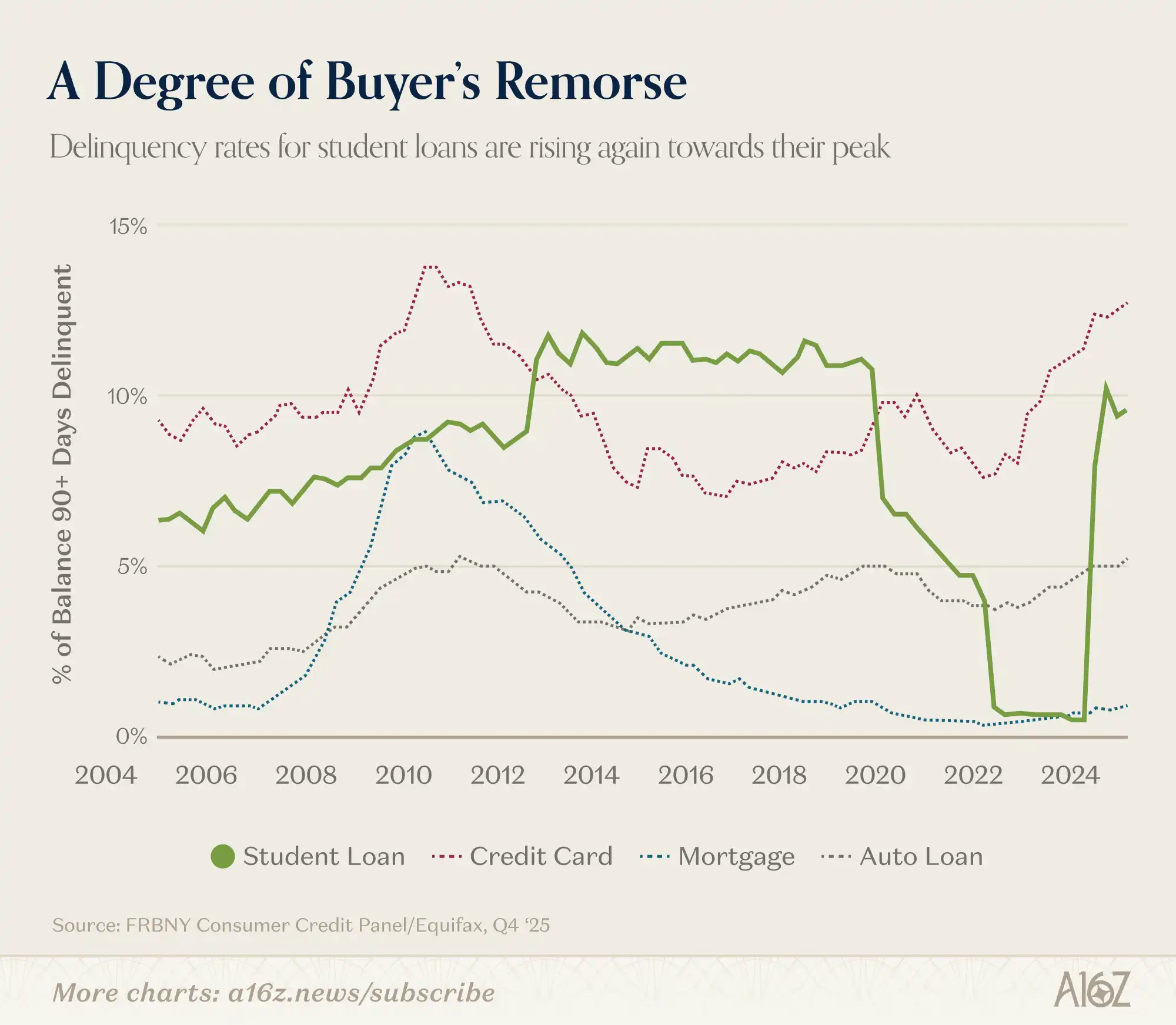
Milestones? More like milestones around the neck, right?!

Maybe, maybe not, but a sense of "buyer's remorse" seems to be in the air.

Trending Cryptos

Related Questions

QWhat is the Jevons Effect mentioned in the article, and how is it demonstrated in the AI industry?

AThe Jevons Effect refers to the phenomenon where increased efficiency in using a resource leads to an increase in its consumption. In the AI industry, this is demonstrated by the fact that as the cost of AI tokens halved (from about $0.90 to $0.50 per million tokens), the number of tokens processed nearly doubled (from about 6,000 to 12,000).

QAccording to the data, what is the trend regarding the share of new company registrations in Delaware since 2023?

AAccording to Ramp's data, Delaware's share of new company registrations has been declining since 2023, with a drop of about 10% in the third quarter of 2025.

QHow does the performance of the prediction market Kalshi compare to professional forecasters in predicting the Federal Funds Rate?

AKalshi's predictions for the Federal Funds Rate have outperformed those of professional forecasters. Its median and mode predictions had a 'perfect predictive record' the day before FOMC meetings, which is a statistically significant improvement over the predictions from federal funds futures.

QWhat are the major life milestones for 30-year-olds that have seen a significant decline since the 1980s?

AThe major life milestones for 30-year-olds that have seen a significant decline since the 1980s are: living independently, ever being married, living with children, and owning a home.

QHow does the projected AI capital expenditure for 2026 compare to other major US economic figures?

AThe projected AI capital expenditure for 2026 is nearly equivalent to the total net new lending by all US banks in 2025. It is also about 33% higher than total US corporate income tax revenue and about three times the total US tariff revenue.

Related Reads

In Conversation with Ray Dalio: We Are Currently in an AI Bubble, with 1% of My Portfolio in Bitcoin

Ray Dalio, founder of Bridgewater Associates, warns in an interview that the current AI boom shows classic bubble characteristics, which could lead to significant economic downturns as seen in past cycles like 1929 or 2000. He explains that speculative enthusiasm, fueled by debt and overvaluation, often precedes a crash when rising rates or taxation force asset sales, causing widespread losses and recession. Dalio also outlines his "Big Cycle" theory, describing an approximate 80-year pattern where widening wealth gaps, massive government deficits, and shifting geopolitical power (like China's rise) create internal conflict and global instability. He emphasizes that we are in a late-cycle, transitional phase where traditional powers like the US and UK face decline. For personal wealth protection, Dalio advises diversification beyond cash into assets like stocks, bonds, real estate, and particularly gold, which he prefers over Bitcoin. While he holds about 1% of his portfolio in Bitcoin as a non-printable hard asset, he views gold as more secure from technological or governmental threats. Regarding AI's impact, Dalio believes it will disproportionately benefit capital owners, worsening inequality by replacing both physical and cognitive labor. He suggests that human intuition and emotional intelligence, combined with AI, will be key for future workers. On taxation, Dalio argues that wealth taxes are impractical and risk triggering asset sell-offs, reducing productive investment. He points to the UK as a cautionary example of debt, low productivity, and political strife. Geopolitically, Dalio foresees a more regionalized world, with the US showing weakness in prolonged conflicts like with Iran, akin to past imperial declines. The ideal outcome, he suggests, is coexisting powerful blocs (e.g., Americas, China-Asia Pacific) without major war.

marsbit2h ago

In Conversation with Ray Dalio: We Are Currently in an AI Bubble, with 1% of My Portfolio in Bitcoin

marsbit2h ago

Daily 7.2 Trillion KRW: Foreign Capital's Record Net Buying on Friday! Wall Street Says Headwinds for Korean Stock Fund Flows Have Subsided

South Korean stock market sees a dramatic shift in fund flows. On July 31, foreign investors made a record net purchase of approximately KRW 7.2 trillion in KOSPI stocks, marking a fundamental reversal from the persistent large-scale net outflows seen in previous months. This contributed to a significant narrowing of foreign net selling in July to KRW 9.8 trillion, down sharply from KRW 48.4 trillion in June and KRW 44.5 trillion in May. Simultaneously, domestic institutional pressure eased. South Korean pension funds and asset managers turned to a net buying position in July, purchasing KRW 1.0 trillion worth of KOSPI shares, contrasting with net sales in May and June. Market volatility is expected to be dampened by new financial regulations. Effective July 31, the Financial Services Commission tightened access for retail investors to single-stock leveraged ETFs by raising the minimum cash deposit requirement. Trading volumes for these products subsequently dropped to about 50% of their monthly average. Citigroup Research maintains its year-end KOSPI target of 10,000 points. The firm cites several supportive factors: the substantial easing of headwinds from capital outflows, a robust fundamental outlook for the semiconductor sector, historically low market valuations, strong economic fundamentals, and the potential for policy support from financial authorities if needed.

marsbit2h ago

Daily 7.2 Trillion KRW: Foreign Capital's Record Net Buying on Friday! Wall Street Says Headwinds for Korean Stock Fund Flows Have Subsided

marsbit2h ago

Thanks to Dice Rolls, Bitcoin Keys Are Stored Offline, But Not Everyone Will Do It

The article discusses using dice rolls to generate secure Bitcoin wallet seeds, providing entropy independent of potentially flawed hardware random number generators. It explains that each fair dice roll offers about 2.585 bits of entropy, with around 50 rolls needed for a standard 12-word seed phrase and 99+ recommended for higher security. This method gained attention after a vulnerability was revealed in some Coldcard hardware wallets, where a faulty firmware RNG (dating back to 2021) compromised generated keys. The analysis notes that while a dice-generated main seed was safe from this specific flaw, other Coldcard functions (like creating paper wallets, backup keys, or passwords) could still be vulnerable if they used the defective RNG. The piece argues that while dice-based entropy is technically robust, the manual process is error-prone, tedious, and unrealistic for most new users, who might make mistakes in recording or inputting rolls. It concludes that while manual entropy generation should remain an option for advanced users, the long-term goal is to develop reliable, user-friendly hardware and software that securely generates randomness without requiring specialized knowledge. Coldcard users are advised to check their firmware version and replace any secondary secrets (like paper wallet keys) created with vulnerable devices, while also considering multi-signature setups with devices from different manufacturers for added security.

cryptonews.ru7h ago

Thanks to Dice Rolls, Bitcoin Keys Are Stored Offline, But Not Everyone Will Do It

cryptonews.ru7h ago

Trading

Spot

Hot Articles

Discussions

Welcome to the HTX Community. Here, you can stay informed about the latest platform developments and gain access to professional market insights. Users' opinions on the price of AI (AI) are presented below.

活动图片















